The Moment He Finally Remembered
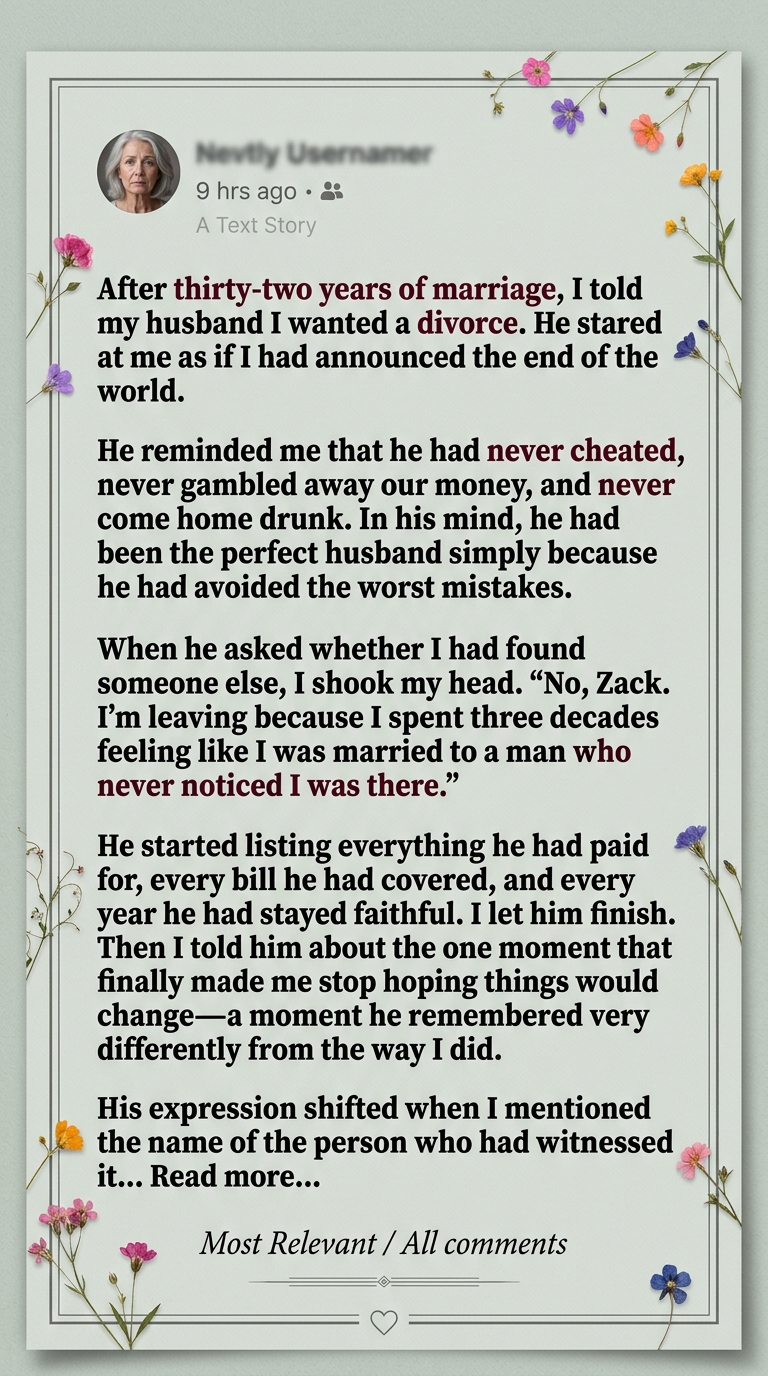
After thirty-two years of marriage, I told my husband I wanted a divorce.
Zack was sitting at the kitchen table, reading the newspaper and drinking his second cup of coffee. He lowered the paper slowly, as though he hadn’t understood what I’d said.
“What?”
“I want a divorce.”
He stared at me. Then he laughed once, nervously, waiting for me to smile and admit it was a joke.
When I didn’t, he pushed his chair back.
“Have you met someone?”
“No.”
“Are you having some kind of crisis? Is this about menopause? The kids moving out?”
“It’s about thirty-two years, Zack.”
He shook his head. “I don’t understand. I’ve never cheated on you. I’ve never gambled away our money. I’ve never come home drunk and frightened you. I’ve worked every day to keep this family comfortable. What exactly have I done that’s so terrible?”
I looked at him for a long moment.
“That’s the problem. You think being a good husband means avoiding the worst things a man could do. You’ve never considered that I might need something more than a man who doesn’t hurt me.”
His expression hardened.
“I paid the mortgage. I covered the bills. I made sure you had a car. I never stopped working, even when I was exhausted. I gave you a good life.”
“You gave this family a comfortable life,” I replied. “But you never learned how to share one with me.”
He looked genuinely offended.
For years, I had imagined having this conversation. In those imaginary versions, I shouted, cried, or finally listed every disappointment I had swallowed. Instead, I felt strangely calm.
Perhaps I had already done all my crying.
Zack and I had met when I was twenty-one. He was charming in a quiet, dependable way. He remembered birthdays, kept his promises, and never embarrassed me in public. When we married, my friends told me I had found a good man.
And in many ways, I had.
He was never cruel. He never raised a hand against me. He worked hard, supported our children, and made sure we never struggled to pay for necessities.
But somewhere along the way, our marriage became an arrangement in which I managed the emotional life of the family while he managed the practical one.
I remembered which child was frightened before an exam, which relative needed a phone call, and which anniversary had become painful for a friend. I noticed when Zack was worried about work before he admitted it. I learned how to approach him when he was tired and when to leave him alone.
He rarely noticed when I needed the same consideration.
When I was thirty-four, my father died. Zack attended the funeral, drove me home, and made sure there was food in the refrigerator.
The following morning, he asked whether I had remembered to pay the electricity bill.
I remember standing at the kitchen counter, still wearing the black dress from the funeral, wondering how a person could be so physically present and yet so far away.
When our son had surgery, I spent three nights sleeping in a hospital chair. Zack visited after work, brought clean clothes, and returned home to sleep because he had an important meeting.
He wasn’t doing anything wrong, I told myself. He had responsibilities.
When I was promoted at work after years of trying, he congratulated me and asked whether the salary increase would make it easier to replace the washing machine.
I laughed then, because I didn’t know what else to do.
The years passed like that. Small disappointments, each too ordinary to justify a serious argument. Every time I tried to explain that I felt lonely, Zack would ask what he could possibly have done wrong.
Eventually, I stopped explaining.
He mistook my silence for happiness.
Now, standing in our kitchen, he was demanding a reason that made sense to him.
I gave him one.
“Do you remember our thirty-second anniversary dinner?”
He frowned.
“Of course. We went to the restaurant near the river.”
“No. I mean what happened there.”
“We had a lovely evening. I even ordered that expensive wine you like.”
I almost smiled.
“That isn’t what I remember.”
It had been a Friday evening in early spring. Our daughter, Olivia, had arranged a small dinner for us at a restaurant where Zack and I used to go when we were first married. She had reserved a table for four because she wanted to join us with her husband, Marcus.
I had been excited. Not because of the restaurant, but because Olivia had told me she wanted to celebrate the fact that her parents had stayed together for so long.
I had bought a new dress and spent the afternoon getting ready.
Zack arrived home late, as usual, and changed his shirt while answering work messages. At the restaurant, he spent the first twenty minutes discussing a problem with one of his suppliers.
Then Olivia asked us a question.
“What do you think has kept your marriage strong all these years?”
Zack didn’t hesitate.
“Commitment,” he said. “You don’t walk away just because things aren’t exciting anymore. You provide for your family, stay faithful, and keep your promises. That’s what marriage is.”
Olivia smiled.
“And Mom?”
Zack turned toward me.
“She knows I would never let her go without anything. She’s never had to worry about the important things.”
He said it proudly.
I remember looking at him, waiting for him to mention something about me. Something he loved about me. Something he had learned from living beside me for thirty-two years.
Instead, he reached for his glass.
I tried to answer the question myself.
“I think a marriage stays strong when two people keep choosing to know each other,” I said. “Not just when they first fall in love, but when they change.”
Zack nodded without really listening.
Then his phone rang.
He answered it at the table.
I watched him turn away from us, discussing a delivery schedule. I watched Olivia glance at me, then at Marcus. I watched the candle burn down between our glasses.
When Zack finally ended the call, he looked irritated.
“Sorry. Business doesn’t stop just because we’re celebrating.”
Olivia gently suggested that we order dessert.
I said I wasn’t hungry.
Zack later told everyone it had been a wonderful evening.
But the part that made me stop hoping things would change happened after dinner.
As we were leaving, I went back to the restroom. When I returned, I saw Zack standing beside our table, talking to Olivia.
He was telling her that I had become difficult lately.
“She takes everything personally,” he said. “I give her a comfortable life, but somehow it’s never enough.”
Olivia looked uncomfortable.
“Dad, maybe she just wants you to listen sometimes.”
Zack shook his head.
“Your mother has never understood how much pressure I carry. I can’t spend every evening discussing feelings.”
I had heard enough to walk away quietly, but Olivia saw me.
Her expression changed.
“Mom?”
Zack turned.
“What are you doing standing there?”
“I came back for my scarf.”
He picked it up from the chair and handed it to me.
Then he said, in the same casual tone he might have used to discuss the weather, “See? This is what I mean. You always assume something negative.”
I didn’t argue.
I simply thanked him and walked out.
For the first time, I understood that Zack wasn’t unaware of my loneliness because I had failed to communicate it.
He had heard me.
He just didn’t believe it was important.
Back in our kitchen, Zack’s face had begun to change.
“You’re making too much of one conversation,” he said. “I was frustrated. Everyone says things they don’t mean.”
I shook my head.
“That conversation wasn’t the reason I left emotionally. It was the moment I realized you had been telling our daughter that my feelings were a burden while I was standing close enough to hear you.”
He rubbed his forehead.
“Why are you bringing Olivia into this?”
“Because she witnessed it.”
Zack looked at me sharply.
“She didn’t understand the context.”
“She understood enough to defend me.”
He went quiet.
Then he said, “Olivia told you what I said?”
“No. I heard it myself.”
He stared at the floor.
I continued.
“That night, Olivia called me after you went to bed. She asked whether I was all right. I told her I was tired. She said something I’ll never forget.”
“What?”
“She said, ‘Mom, you always make room for everyone else’s feelings. I wish Dad would make a little room for yours.’”
Zack’s expression shifted.
He sat down slowly.
“She said that?”
“Yes.”
For a moment, he looked as though he wanted to argue. Then he seemed to remember the evening more clearly.
“I didn’t know you were standing there,” he murmured.
“That doesn’t make it better.”
He looked up.
“I never meant to make you feel unimportant.”
“I believe you,” I said. “But after thirty-two years, intention isn’t enough. You cannot keep telling someone you love them while refusing to notice what life feels like beside you.”
He began listing his efforts again, but the words were weaker now.
“I worked overtime so you wouldn’t have to worry about money.”
“I know.”
“I fixed things around the house.”
“I know.”
“I stayed faithful.”
“I know, Zack. I have never denied any of that.”
“Then why isn’t it enough?”
I took a breath.
“Because I wanted a husband, not a provider who happened to share my address. I wanted someone who asked how my day went and waited for the answer. Someone who noticed when I was unhappy without making me prove that I had a right to be. Someone who wanted to know who I was becoming, not just whether the household was running properly.”
He looked at me with an expression I had rarely seen.
Fear.
“What if I change?” he asked. “What if I start doing all those things now?”
I sat across from him.
“I don’t know whether you can. But I know I cannot spend another decade waiting to find out.”
He reached across the table and took my hand.
I didn’t pull away immediately. Thirty-two years do not disappear in a single conversation. His hand was familiar, and there was still affection between us. But affection was no longer enough to keep me in the marriage.
“Can we try counseling?” he asked.
“We can attend counseling to help us understand what happened and work out the separation. I’m not promising it will bring us back together.”
His hand slowly loosened.
For the next several weeks, we met with a counselor and began discussing practical arrangements. Zack initially treated the sessions as another problem he could solve by making a list. He brought financial statements, schedules, and proposed agreements.
The counselor eventually asked him a question that stopped him.
“When was the last time you asked your wife what she wanted from her life, without immediately explaining why it was impractical?”
Zack opened his mouth.
Then he closed it.
He had no answer.
We separated gradually and handled the divorce without turning our children into messengers. Olivia and our son, Peter, were upset, but neither tried to force us to remain together.
Zack moved into a small apartment near his office. I stayed in the house until the sale was completed, then rented a modest place with a sunny balcony.
The first months were difficult. I missed familiar routines and sometimes caught myself preparing his favorite meal before remembering he wasn’t coming home.
But I also began noticing things about myself that had been buried beneath years of responsibility.
I joined a local photography group. I took a weekend course in gardening. I began having dinner with friends without checking whether everyone else had already eaten.
I discovered that I enjoyed quiet mornings when nobody expected me to organize the day.
Zack struggled more visibly.
At first, he called frequently to ask practical questions. Then the calls became less frequent. Eventually, he began asking about my life.
Not the house. Not the bills. Me.
One afternoon, he called and asked whether I was enjoying the photography course.
I told him about a picture I had taken of an old woman feeding pigeons outside the market.
He listened.
When I finished, he said, “I would have liked to see it.”
There was something sincere in his voice.
I sent him the photograph.
A few days later, he called again.
“I looked at it for a long time,” he said. “I think I understand something now. You weren’t asking me to buy you things or take you somewhere expensive. You wanted me to pay attention.”
I didn’t rush to reassure him.
“Yes,” I said. “That was what I wanted.”
He was quiet.
“I wish I’d understood earlier.”
“So do I.”
Our divorce was finalized eight months after that first conversation in the kitchen. We divided our property fairly, and neither of us tried to punish the other.
We remained polite. We attended family birthdays and graduations. Sometimes we even laughed together.
But we did not return to being husband and wife.
A year after the divorce, Olivia invited us both to dinner for her birthday. Zack arrived early and helped set the table. When I came in, he stood and greeted me warmly.
During dinner, Olivia asked him how work was going.
“Busy,” he said. Then he turned to me. “How is the photography?”
I smiled.
“I’m learning.”
“What are you photographing now?”
I began telling him about a series of pictures I was taking of people in the neighborhood who opened their shops before sunrise.
He asked questions. He remembered the details. He didn’t interrupt when Olivia’s husband mentioned something about work.
It was a small thing, but I noticed it.
Later, as we stood outside waiting for our rides, Zack looked at me.
“I used to think I was a good husband because I never did anything terrible,” he said. “I never understood that being present is different from simply being there.”
I looked at him.
“I’m glad you understand that now.”
“Do you ever regret leaving?”
I considered the question honestly.
“I regret that we spent so many years not knowing how to reach each other. I don’t regret choosing a life where I no longer have to beg to be noticed.”
He nodded, accepting the answer.
Then he said, “I hope someone notices you the way you deserve.”
I smiled gently.
“I’ve started noticing myself.”
We said goodbye without anger.
That night, I returned to my apartment and placed my camera on the table. Through the balcony doors, the city lights shimmered in the distance.
For thirty-two years, I had believed that staying was proof of love. I had mistaken endurance for happiness and silence for peace.
Zack had never been a monster. He had been a man who believed that fulfilling his responsibilities was the same as loving someone well. It took losing our marriage for him to understand the difference.
And I had learned something too.
A person doesn’t have to betray you dramatically for you to feel abandoned. Sometimes the deepest loneliness comes from sharing a home with someone who never thinks to ask what is happening inside your heart.
I had spent years waiting for Zack to notice me.
Now, at fifty-five, I was finally building a life in which I no longer disappeared.

