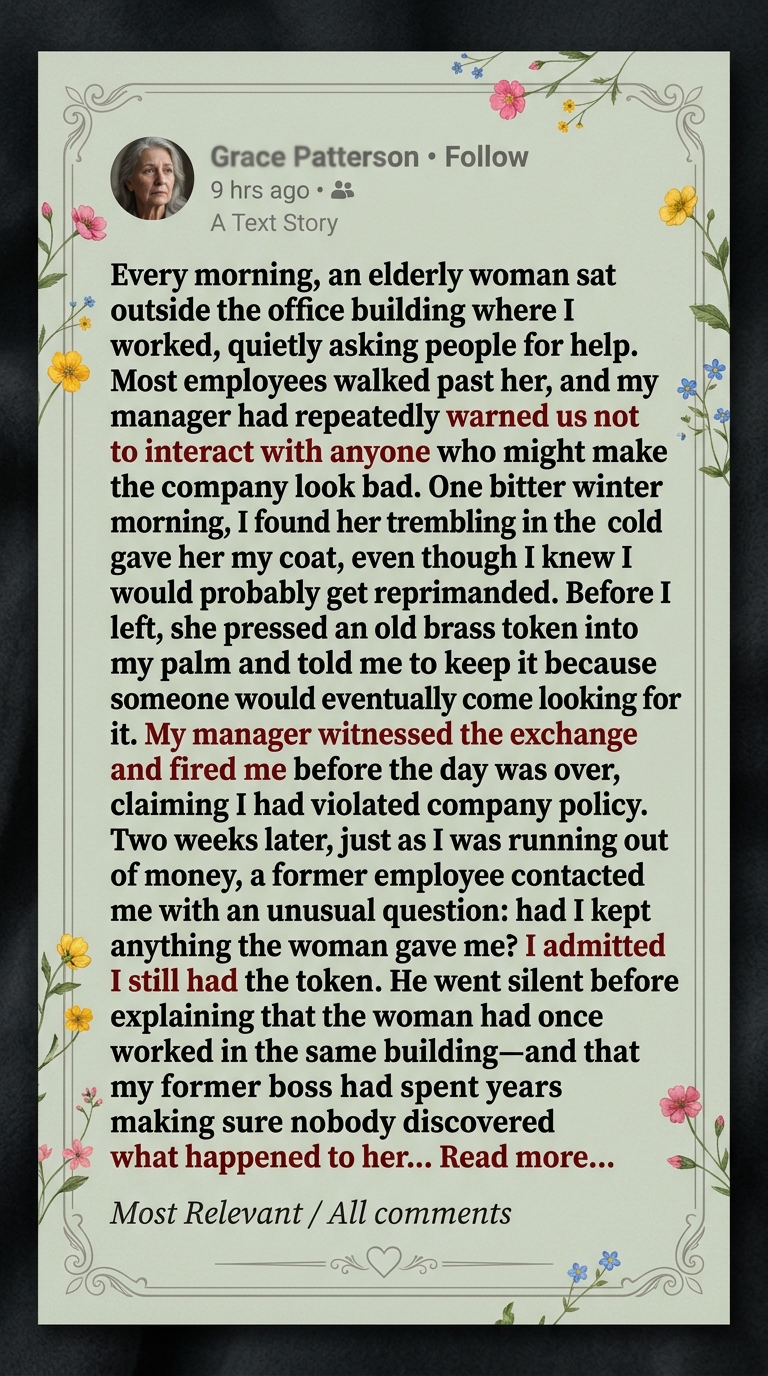
The Brass Token No One Was Supposed to Find
Every morning, an elderly woman sat outside the glass doors of the office building where I worked.
She always occupied the same spot beside the stone planter, wrapped in a faded brown shawl. Her shoes were worn through at the heels, and she kept a small paper cup in her lap. She rarely spoke unless someone approached her. Then she would quietly ask whether they could spare a little help.
Most people ignored her.
Some pretended to be busy with their phones. Others crossed the street to avoid passing her. Our manager, Richard Cole, had made his position clear.
“Don’t engage with her,” he told us during a Monday staff meeting. “This is a professional building, not a public shelter. We have clients arriving every day. I don’t want complaints about employees encouraging loitering.”
I had worked for the company for six years. I knew Richard’s rules were often unreasonable, but I had learned not to challenge him unless I was prepared for an argument.
The woman, whose name I eventually learned was Evelyn, never caused trouble. She didn’t shout, approach customers, or block the entrance. She simply sat there, hoping someone might help her get through another day.
I began leaving a few coins in her cup whenever I could.
One morning, I brought her a sandwich. Another day, I bought her a hot drink from the café across the road.
She always thanked me quietly.
“People are kinder than they think,” she once said.
I wasn’t sure whether she was talking about me or trying to convince herself.
Then came the coldest morning of that winter.
The temperature had dropped overnight, and a sharp wind swept through the street. When I arrived at work, Evelyn was sitting against the planter with her arms wrapped tightly around herself. Her lips looked pale, and her hands were shaking so badly that the paper cup rattled against her knees.
I stopped.
“Are you all right?”
She tried to smile.
“Just cold, dear.”
I looked at her thin shawl. Without thinking much about it, I took off my wool coat and placed it around her shoulders.
She immediately tried to give it back.
“No, you’ll need this.”
“I’ll be inside most of the day. Please keep it.”
She held the coat closed around herself.
“Thank you,” she whispered.
I was fastening the collar of my shirt when I heard Richard’s voice behind me.
“What exactly are you doing?”
I turned.
He stood near the entrance, holding his briefcase and staring at the coat.
“She’s freezing,” I said.
“That isn’t your responsibility.”
“I couldn’t just leave her sitting here like that.”
Richard glanced toward the building’s security camera.
“You’ve been warned about this. You’re representing the company whether you’re on the pavement or inside the office.”
“I’m not representing the company. I’m helping someone.”
His face tightened.
“Come to my office.”
I knew what was coming, but I followed him inside.
Before I could leave, Evelyn reached for my hand. She pressed something cold into my palm.
It was a small brass token, worn smooth around the edges. One side carried a raised number, 14. The other had a simple emblem: a tree surrounded by a circle.
“Keep this,” she said.
I looked at it.
“What is it?”
“Something that belongs to someone who hasn’t forgotten.”
She leaned closer.
“Someone will come looking for it eventually. When they do, don’t let them take it without asking why.”
I barely had time to respond before Richard called my name again.
I slipped the token into my pocket.
Inside his office, Richard didn’t bother pretending the meeting was about anything other than my behavior.
He told me I had violated company policy, damaged the building’s professional image, and ignored a direct instruction from management.
I tried explaining that I had only given an elderly woman my coat.
He said that was irrelevant.
By noon, Human Resources had called me into a meeting. By the end of the day, my employment had been terminated.
Six years of work ended because I had helped someone stay warm.
I left the building carrying a cardboard box containing my desk belongings. Through the glass doors, I saw Evelyn still sitting beside the planter.
She was wearing my coat.
I wanted to go over and tell her what had happened, but Richard was watching from the reception area. I kept walking.
For the next two weeks, I struggled to find another job. My rent was due, my savings were limited, and the company had delayed my final payment while reviewing the circumstances of my dismissal.
I tried not to regret helping Evelyn.
But when I looked at my bank balance, it became harder to feel noble about it.
Then, on a Thursday afternoon, I received a message from a man named Peter.
He had worked at the same company several years earlier as a facilities supervisor. I remembered him vaguely. He had left before Richard became our manager.
His message was short.
I heard you were dismissed recently. I need to ask you something. Did an elderly woman outside the building give you anything?
I stared at the screen.
Then I replied.
Yes. An old brass token with the number 14 and a tree emblem. Why?
Peter called immediately.
“Please tell me you still have it.”
“I do. It’s in my kitchen drawer.”
He was silent for several seconds.
“Don’t lose it,” he said. “And don’t give it to anyone from that company.”
My stomach tightened.
“What is going on?”
Peter asked whether we could meet somewhere away from the office. We arranged to meet at a small café the following morning.
He arrived carrying a thick folder.
After ordering coffee, he placed an old photograph on the table.
It showed the same building where I had worked, but the entrance looked different. A row of wooden doors stood beneath the windows, and a brass plaque was mounted beside the main entrance.
The plaque read:
EVELYN MARSH — FOUNDER AND DIRECTOR, MARSH COMMUNITY SERVICES.
I looked up.
“That’s her?”
Peter nodded.
“Evelyn wasn’t always sitting outside asking for help. She founded the organization that originally owned the building.”
I stared at the photograph.
Peter explained that nearly forty years earlier, Evelyn had started a small employment and training center for women who had lost their jobs, escaped difficult homes, or needed help returning to work after raising children.
The center provided office training, temporary accommodation referrals, childcare assistance, and a place where people could receive practical support without being judged.
It began in two rented rooms and eventually grew into a respected community organization.
Evelyn had purchased the building with money she had inherited from her parents and donations from local businesses.
“What happened to it?” I asked.
Peter opened his folder.
“Richard happened.”
He explained that Richard had joined the organization as its finance director. He was persuasive, organized, and very good at making himself appear indispensable.
When Evelyn became seriously ill, Richard convinced the board that the organization needed to restructure. He argued that the community programs were too expensive and that the building should be leased to commercial tenants.
Some board members disagreed, but Richard presented financial reports showing that the organization was almost bankrupt.
Evelyn challenged the figures.
A few weeks later, she was accused of misusing charitable funds.
The accusation was devastating. Her reputation was damaged, the board removed her from daily operations, and the organization eventually closed.
Richard became managing director of the commercial company that took over the building.
I looked again at the photograph.
“But why was Evelyn outside the building?”
“Because she lost her home after the organization collapsed. She had used most of her personal savings to keep the programs running. The legal dispute drained what remained.”
I felt sick.
“Why didn’t she tell someone?”
“She did. For years. But Richard had convinced people she was unstable and dishonest. He made sure that anyone who questioned the takeover was pushed away.”
Peter tapped the folder.
“I worked here when some of it happened. I saw documents disappear. I saw staff members pressured into signing statements they didn’t agree with. I left because I refused to take part.”
“Do you have proof?”
Peter hesitated.
“Not enough to undo everything. But I have something that may help.”
He showed me a copy of an old board policy.
The brass tokens had been issued to the original trustees and senior staff. Each one opened a numbered compartment in a secure cabinet located in the building’s former records room.
Token 14 belonged to Evelyn.
“What was in her compartment?”
Peter looked at me.
“That’s what Richard has spent years trying to find.”
I reached into my bag and placed the token on the table.
Peter didn’t touch it.
“Evelyn must have kept it because she knew the compartment was never opened.”
“Why would she give it to me?”
“Perhaps she recognized someone who wasn’t afraid to treat her like a human being.”
I thought about her words.
Someone will come looking for it eventually.
Peter leaned forward.
“There’s something else you need to know. The building is being renovated next month. Richard plans to remove the old records room and destroy whatever remains inside.”
We both understood what that meant.
If there was evidence in compartment fourteen, we might have only a short time to find it.
Peter contacted a lawyer who had represented several former employees during the organization’s closure. She advised us not to enter the building without permission or attempt to remove anything secretly.
Instead, she helped us prepare a formal request to inspect the organization’s archived property records. The building had changed owners, but some original assets had been placed under a preservation agreement when the commercial company acquired it.
That agreement required the company to retain certain historical records until an independent review was completed.
Richard had apparently forgotten—or hoped everyone else had forgotten—that clause.
The lawyer submitted the request and asked the court to preserve the old records room while the ownership and financial history of the building were reviewed.
Richard responded through his legal representative, insisting that the request was baseless.
Then something unexpected happened.
A former board member, a retired accountant named Margaret Shaw, contacted Peter.
She had heard that someone was finally investigating Evelyn’s case.
Margaret had been the organization’s treasurer before Richard took control. She had resigned after refusing to approve a set of accounts that she believed had been altered.
She agreed to provide her original audit notes.
They showed that the organization had been financially healthy when Richard recommended its restructuring. The supposed losses had been created by transferring expenses from a separate property company into the charity’s accounts.
There were also records of payments made to a company secretly controlled by Richard’s brother.
The transactions had been disguised as building maintenance expenses.
But the most important evidence was still missing: the original board authorization.
Without it, Richard could claim the restructuring had been approved properly.
Margaret believed Evelyn had kept the original authorization and the minutes of the final board meeting in the records room.
The lawyer arranged an inspection with an independent administrator.
Two weeks later, we entered the building together.
The reception area had been modernized, but the old records room remained behind a locked door in the basement. The administrator examined the token and allowed us to try the numbered cabinet.
The brass keyhole was hidden behind a small metal plate.
I inserted the token into a narrow slot beneath it.
There was a click.
A drawer slid open.
Inside were several folders, a small ledger, and a sealed envelope.
I felt my pulse quicken.
The administrator photographed everything before allowing us to examine the contents.
The first folder contained the original board minutes.
They showed that the board had never approved the transfer of the building. In fact, the minutes recorded a formal objection from Evelyn and Margaret.
The second folder contained a handwritten ledger tracking payments made to Richard’s brother’s company.
The figures matched Margaret’s audit notes.
The sealed envelope contained a letter from Evelyn addressed to the organization’s legal adviser.
In it, she explained that Richard had attempted to persuade her to sign a transfer document that would give him control of the building. She had refused and instructed the adviser to preserve the original records in case the board was ever misled.
At the bottom was a statement that made me stop reading.
If anyone finds this after I am gone, please remember that the center was built for people who had nowhere else to turn. It should never become a place where those people are made to feel unwelcome.
I looked at Peter.
He was staring at the letter with tears in his eyes.
The evidence was enough to reopen the investigation into the organization’s financial collapse and the transfer of its property.
The independent review found that Richard had concealed financial transactions, misrepresented the charity’s position, and obtained control of the building without proper authorization.
The commercial company was ordered to return part of the property proceeds and compensate the organization’s remaining charitable trust.
Richard was removed from his position. He later faced criminal proceedings over the fraudulent transactions.
But there was one more consequence I hadn’t expected.
The trust’s new board contacted Evelyn.
They had located her through a local outreach worker and asked whether she would attend a meeting.
She was reluctant.
“I don’t want another room full of people telling me what I did wrong,” she said when Peter and I visited her.
“They want to hear what you have to say,” I told her.
She studied my face.
“Do they?”
I nodded.
After a long silence, she agreed.
The meeting took place in the building’s former training hall. The room had been repainted, and the old desks were gone, but the large windows still overlooked the street where Evelyn had once welcomed people looking for work.
She entered wearing the wool coat I had given her.
When the new trustees stood to greet her, she looked overwhelmed.
The chairperson apologized for the way the organization had treated her and acknowledged that the previous board had failed to protect the center’s mission.
Evelyn listened without interrupting.
Then she asked one question.
“What will happen to the people who need this place?”
The chairperson explained that the trust intended to restore the original community programs, beginning with employment support and practical assistance for people facing financial hardship.
Evelyn nodded.
“Then don’t waste another year talking about it. Start helping them.”
The room fell quiet.
She wasn’t asking for her old title back. She wasn’t asking for a public celebration or a plaque with her name on it.
She wanted the doors opened again.
Over the following months, the building was gradually restored as a community employment center. The first programs were modest: job-search assistance, computer training, interview preparation, and a weekly drop-in service for people who needed help finding housing or accessing local support.
Evelyn visited regularly, though she never returned to managing the organization.
She preferred sitting near the entrance, greeting people as they arrived.
One afternoon, I went to see her after my new job interview.
She was arranging brochures on a table when she noticed me.
“How did it go?” she asked.
“I think well. They said they’ll call next week.”
She smiled.
“Good. And how are you managing?”
“Better.”
I had found temporary work through a friend and was beginning to rebuild my savings. The legal review of my dismissal had also concluded that Richard had used company policy selectively to retaliate against me. The company offered compensation and a formal correction to my employment record.
I accepted the correction but declined to return.
I didn’t want to spend another day working for people who believed kindness was a threat to their reputation.
Before I left, Evelyn handed me a small envelope.
Inside was a photograph of the original community center, taken on the day it opened.
She stood in the middle, surrounded by volunteers and the first group of women who had come there for help.
On the back, she had written:
Some people measure a person’s value by what they can offer. Others recognize it by what they are willing to give.
I looked at her.
“You don’t owe me anything.”
She smiled.
“I know. That’s why I wanted you to have it.”
I still have the photograph.
The brass token is displayed beside it on a shelf in my home. It no longer opens a cabinet, and nobody is waiting to claim it.
But I think about that winter morning whenever I see it.
I had believed I was giving an old woman a coat.
I hadn’t realized I was helping return a building, a reputation, and a purpose to someone who had spent years being erased from the place she created.
And the day I was fired, I thought I had lost my livelihood because I had broken a company rule.
Now I understand that I had simply refused to follow the wrong kind of rule.

