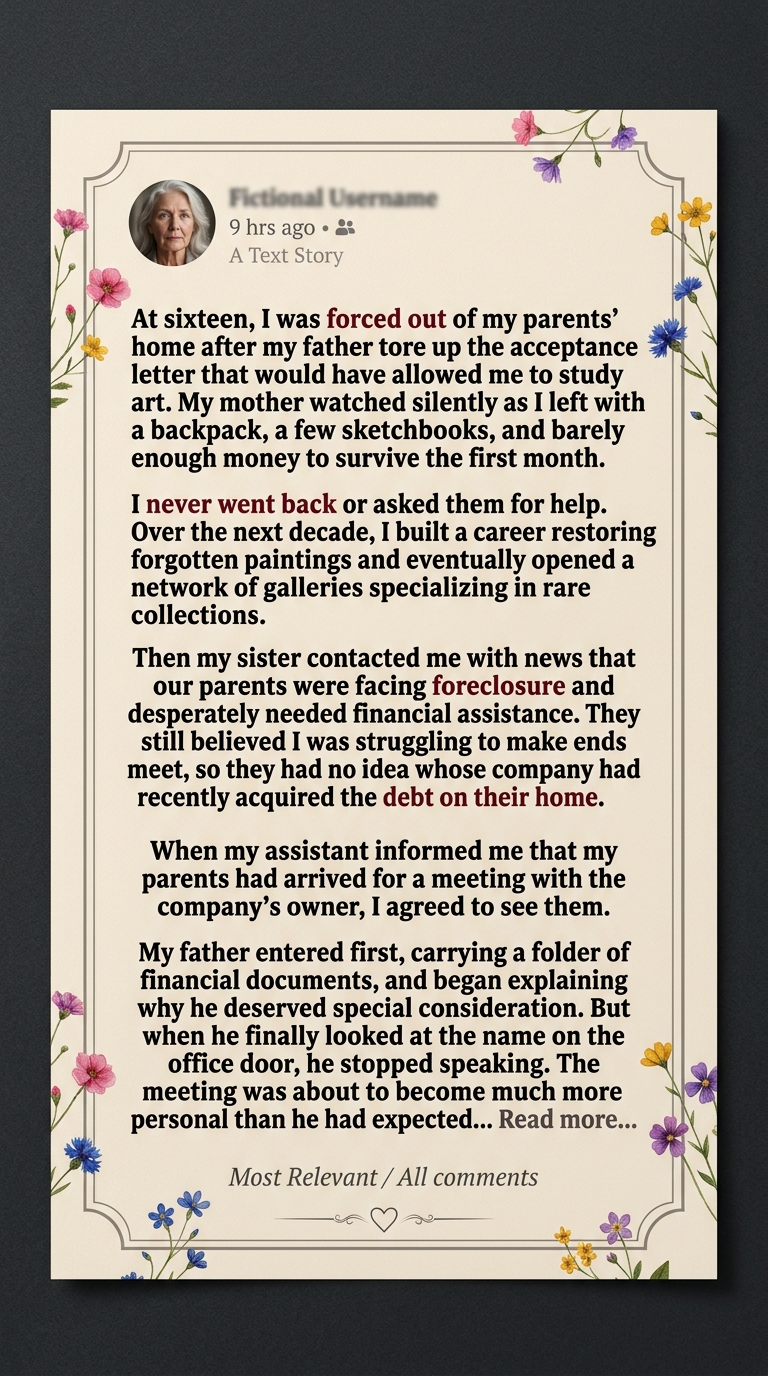
The Daughter Behind the Office Door
At sixteen, I left my parents’ house with a backpack, three sketchbooks, and forty-seven dollars.
My father had torn my art college acceptance letter into pieces in front of me. He said he would not waste another dollar supporting a daughter who wanted to spend her life painting pictures instead of building a respectable career.
“You have one chance to make something of yourself,” he told me. “And you intend to throw it away.”
I tried to explain that I had earned a scholarship. Tuition would be covered, and I had been offered a place in a student residence. I only needed his permission to sign the final documents.
He refused to listen.
My mother stood beside the kitchen counter, drying a plate. I kept looking at her, waiting for her to intervene.
She didn’t.
When I finally picked up my backpack, my father pointed toward the front door.
“If you walk out, don’t expect to come back when your little dream fails.”
I was sixteen. I had no idea where I would sleep that night.
But I walked out.
For the first few months, I survived through a combination of stubbornness and help from people who had no obligation to care about me. A retired art teacher named Mrs. Alvarez let me sleep in a spare room while I finished school. I worked evenings cleaning a small restaurant and weekends helping at a secondhand bookshop.
I never asked my parents for money.
I didn’t contact them when I was accepted into a different arts program through a community scholarship. I didn’t tell them when I received my first professional placement. And I didn’t call when I spent my twenty-first birthday working in a cold conservation studio, carefully removing decades of dirt from a damaged landscape painting.
That painting changed my life.
It had been stored in the basement of a provincial museum for years. The frame was broken, the varnish had yellowed, and several sections of the canvas had been poorly repaired.
Most people considered it beyond saving.
I saw something different.
Under the grime was a remarkable painting by an overlooked regional artist. I spent months researching its history, testing pigments, and restoring it layer by layer.
When the museum displayed it again, visitors stopped in front of it for hours.
A collector who attended the exhibition asked who had restored the work. That introduction led to another commission, then another.
Over the next decade, I built a career specializing in forgotten paintings and neglected private collections. I learned how to evaluate damaged works, negotiate acquisitions, and identify pieces whose historical value had been overlooked.
Eventually, I founded Meridian Art Group.
It began as a single restoration studio with two employees. By the time I was twenty-eight, it had expanded into a network of galleries and conservation workshops specializing in rare collections.
I was proud of what I had built, but I rarely spoke about my childhood.
My employees knew I preferred to work quietly. My investors knew I was demanding about standards. My clients knew I could spend an entire afternoon discussing the condition of a single painting.
Very few people knew that the company founder had once slept in a room belonging to a retired art teacher because her own father had thrown her out.
I had no interest in proving anything to my parents.
Then, eleven years after I left home, my younger sister called.
Her name was Hannah. She had been fourteen when I left, too young to challenge our father and too frightened to follow me. We had spoken occasionally over the years, though never about the real reason our family had broken apart.
“Clara,” she said, “I need to tell you something about Mom and Dad.”
I was reviewing an acquisition proposal when she called. Her voice sounded strained.
“What happened?”
“They’re in trouble. The bank has started foreclosure proceedings on the house.”
I put down my pen.
“How much do they owe?”
“It’s complicated. Dad borrowed against the property to expand his construction business. The business failed, and then he took out another loan to cover the first one. He’s missed several payments.”
I closed the proposal.
“Why are you telling me?”
“Because I don’t know what else to do. Mom is terrified. Dad keeps saying he’ll find a solution, but he hasn’t. They could lose everything.”
I was quiet.
Hannah continued, “I know what he did to you. I’m not asking you to forgive him. But they’re still our parents.”
That sentence stayed with me.
I didn’t blame Hannah. She had grown up in the same house, under the same rules, and had spent years trying to keep the peace.
“Send me the details,” I said.
She sounded relieved.
“Will you help them?”
“I said I’d look at the situation.”
After we hung up, I asked my financial director to review the information Hannah sent.
The debt had recently been acquired by a subsidiary of Meridian’s investment division. The original lender had sold a portfolio of distressed property loans, and our company had purchased several of them as part of a broader commercial property strategy.
My parents’ home was among those loans.
I hadn’t known when the acquisition was made. The property was listed under a holding company, and the borrowers’ names had not appeared in the summary documents I reviewed.
The balance was substantial, but the situation was not beyond repair. The property had considerable value, and a reasonable restructuring agreement could give them time to sell the business assets and reduce the debt.
I instructed our legal team to pause any immediate enforcement action while the account was reviewed.
I could have handled the matter anonymously.
Instead, I asked my assistant, Daniel, to arrange a meeting with the borrowers.
Two days later, he appeared at my office door.
“Your ten-thirty appointment has arrived,” he said.
I was signing a document.
“Who is it?”
“Mr. and Mrs. Bennett. They said the meeting concerns their mortgage restructuring.”
I looked at him.
“Are they here together?”
“Yes. Your father is speaking to reception.”
For a moment, I couldn’t move.
Then I put down my pen.
“Send them in.”
My father entered first.
He looked older than I remembered. His hair had turned almost entirely gray, and his shoulders seemed narrower. But he still carried himself with the confidence of a man accustomed to being listened to.
My mother followed him, holding a leather handbag against her chest.
Neither recognized me immediately.
My father placed a folder on the table.
“Thank you for seeing us,” he began. “We’ve been told your company has acquired the debt on our property. I understand these matters are handled by people who have some discretion.”
I remained seated.
He continued explaining the construction business, the economic downturn, and the circumstances that had forced him to borrow against the house.
He described himself as a hardworking man who had always met his obligations until circumstances beyond his control had intervened.
My mother sat silently.
My father opened the folder and pushed a collection of statements toward me.
“We aren’t asking for the debt to be forgiven,” he said. “We simply need more time. My wife has lived in that house for nearly thirty years. It would be cruel to force us out now.”
I looked at the documents.
Then I looked at him.
“Why did you choose this property?”
He frowned.
“What?”
“Why is the house so important to you?”
He seemed confused by the question.
“It’s our home.”
I nodded slowly.
“And what makes you believe the company should offer you special consideration?”
He leaned forward.
“Because I’m a man who has worked hard all his life. I’ve never expected handouts. I raised two daughters, paid for their education, and provided a good home.”
My mother lowered her eyes.
I felt the old anger rise, but I kept my voice steady.
“You paid for both daughters’ education?”
My father looked at me more carefully.
“I’m sorry?”
I stood and walked toward the office door.
My name was engraved on the brass plate outside.
CLARA BENNETT — FOUNDER AND CHIEF EXECUTIVE OFFICER, MERIDIAN ART GROUP.
When I returned to my desk, my father was staring at the plate.
His mouth opened slightly.
“Clara?”
“Hello, Dad.”
He looked from me to the company name on the documents.
Then he sat down.
My mother pressed a hand to her mouth.
For several seconds, the room was completely silent.
My father finally spoke.
“You own this company?”
“I do.”
“But Hannah said you worked in art.”
“I do work in art.”
He looked around the office, at the paintings on the walls and the framed conservation awards.
“I thought you were doing small restoration jobs.”
“I did, once.”
He seemed unable to connect the girl he had ordered out of his house with the woman sitting across from him.
Then he recovered enough to ask, “Why didn’t you tell us?”
I almost laughed.
“You never asked.”
His face reddened.
“You could have contacted us. You could have told us you were successful.”
“I could have. But I spent eleven years building a life without your approval. I didn’t feel the need to report my progress.”
My mother finally spoke.
“We didn’t know you had become all this.”
I looked at her.
“You knew I had left. You knew I had nowhere to go. Did you ever wonder what happened to me?”
Her eyes filled.
“I did.”
“When?”
She looked down at her hands.
“Many times.”
“But you never called.”
She had no answer.
My father interrupted.
“This isn’t the time to revisit old arguments. We have a serious financial problem, and you are in a position to help us.”
There it was.
Even now, he was trying to direct the conversation toward what he needed.
I closed the folder.
“You came here asking for special consideration. You didn’t know who owned the company, and you didn’t know I would be sitting in this chair. If I were someone else, would you still be asking for help?”
“Of course,” he replied quickly. “Anyone would expect a reasonable lender to consider the circumstances.”
“Then you don’t need me to be your daughter. You need the company to treat you fairly.”
He looked irritated.
“Don’t turn this into some kind of punishment.”
“I’m not.”
I explained that our legal team had already reviewed the loan. We were willing to offer a structured repayment arrangement, provided they supplied accurate financial information and agreed to a realistic schedule.
The house would not be taken immediately. But the debt would not simply disappear because I owned the company.
My father looked relieved.
“So you’ll help us?”
“I’ll make sure you receive the same fair process we offer other borrowers. Nothing more, nothing less.”
He frowned.
“After everything that’s happened, that’s all you’re prepared to do?”
I looked at him steadily.
“After everything that’s happened, it’s more than you gave me.”
My mother began to cry quietly.
My father turned toward her, irritated.
“Please don’t start.”
That small sentence told me that some things had not changed.
I ended the meeting and asked Daniel to arrange a follow-up with our restructuring team. My parents left with copies of the proposed terms and instructions for submitting their financial records.
Before my mother reached the door, she turned back.
“Clara, could we talk? Just the two of us?”
I hesitated.
Then I agreed to meet her the following week.
She came alone.
Without my father beside her, she seemed smaller. She wore a plain blue cardigan and carried no folder of documents.
We sat in the same office where she had watched my father discover my identity.
For a while, she said nothing.
Then she took a breath.
“I should have stopped him that day.”
I didn’t respond.
“I knew how much that acceptance meant to you. I knew you had worked for it. When he tore the letter, I wanted to tell him he was wrong.”
“But you didn’t.”
“No.”
She wiped her eyes.
“I was afraid of him. I had spent so many years avoiding arguments that I convinced myself silence was the safest choice. I told myself you would come home once you calmed down.”
“I was sixteen, Mom.”
“I know.”
“You let me leave with almost nothing.”
“I know.”
She didn’t offer excuses after that. For the first time, she seemed willing to sit with what she had done without asking me to make her feel better.
“I thought about calling you,” she said. “But every year that passed made it harder. Your father would say you had made your choice. Eventually, I started believing that perhaps you didn’t want to hear from us.”
I looked at her.
“You could have written one sentence. You could have asked whether I was safe.”
She nodded.
“I should have.”
We sat in silence.
Then she asked, “Do you hate us?”
I considered the question.
“I don’t spend my days hating you. I built a life. But I don’t have the same feelings I had when I was a child waiting for her mother to defend her.”
She nodded slowly.
“I understand.”
I wasn’t sure she did, but I appreciated that she didn’t argue.
The financial review continued over the next month.
My father had to sell some equipment and close the remaining operations of his construction business. He complained about the restructuring terms, but the numbers were fair, and he eventually signed the agreement.
The house was saved, though they had to reduce their expenses and accept that their financial position would never return to what it had been.
I didn’t pay their debt.
I didn’t buy the house.
I didn’t punish them by allowing the foreclosure to proceed.
I simply refused to let my personal history influence a business decision that needed to be handled properly.
Hannah later thanked me.
“I know it couldn’t have been easy,” she said.
“It wasn’t.”
“Dad keeps telling people you’re the reason they still have the house.”
I sighed.
“That’s not what happened.”
“I know. But he’s proud of you.”
I looked out the window.
“That’s something he can feel. It doesn’t mean I have to pretend we have a relationship we never built.”
Hannah was quiet.
Then she said, “I hope you and Mom can find a way to talk.”
“Maybe we can. But it will take time.”
Several months later, I attended an exhibition opening at one of our galleries. The collection featured paintings by artists who had been rejected by major institutions during their lifetimes.
One painting showed a young woman standing outside a stone house, holding a suitcase. The artist had painted her from behind, so her face was hidden. The doorway was open, but the woman wasn’t looking back.
I had chosen that painting for the exhibition because it reminded me of the night I left home.
As I stood beside it, I heard someone approach.
It was my mother.
She had received an invitation through Hannah and had asked whether she could attend. I hadn’t expected her to come.
She stood beside me, studying the painting.
“Is this one of yours?” she asked.
“No. I restored it.”
She looked at the woman’s suitcase.
“She looks very young.”
“She is.”
My mother was silent for a while.
Then she said, “I wish someone had helped you carry yours.”
I looked at her.
It was the first time she had spoken about that night without defending herself or blaming my father.
“So do I,” I said.
She didn’t ask for forgiveness.
She didn’t ask me to come home.
She simply stood beside me until the exhibition began.
That evening, I walked her to the entrance. We said goodbye, and she asked whether she could call me sometime.
I told her she could.
It wasn’t reconciliation. It wasn’t a promise that everything would become normal.
It was a beginning, and I was willing to let it remain small.
My father never apologized directly for tearing up my acceptance letter. He continued to believe he had been protecting me from an impractical future. I stopped expecting him to understand what he had taken from me.
But I no longer needed him to understand in order to value what I had built.
I had spent years restoring paintings other people had considered worthless. I knew that damage didn’t always destroy what remained underneath. Sometimes careful work could reveal something remarkable.
But I had also learned that restoration required honesty. You couldn’t repair a painting by pretending the cracks were never there.
The same was true of families.
I was no longer the sixteen-year-old girl standing outside her parents’ door, hoping someone would change their mind.
I was the woman who had built a life from the things she had carried away.
And when my father finally discovered whose name was on the office door, he learned something I had understood long before he arrived:
I had not failed without him.
I had succeeded without him.

