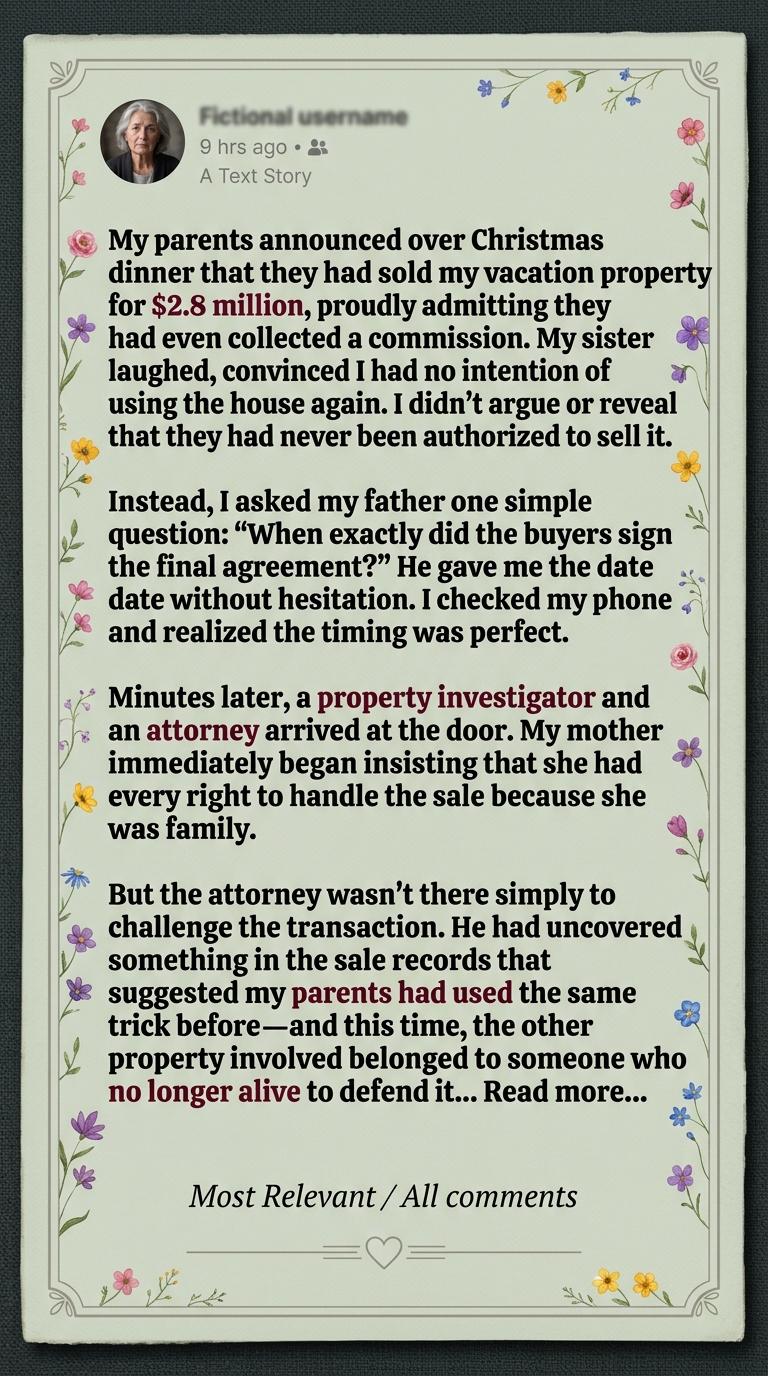
My father raised his glass halfway through Christmas dinner and announced that he had wonderful news.
“We finally sold the beach house,” he said proudly. “Two-point-eight million dollars. Not a bad return, considering what it cost you.”
I stopped cutting my turkey.
Across the table, my mother smiled as if she had just announced a family achievement. My younger sister, Vanessa, laughed and reached for her wine.
“Honestly, it’s about time,” she said. “You hardly ever go there anymore.”
I put down my fork.
“You sold my house?”
My father looked surprised by my reaction.
“Don’t make it sound so dramatic. We handled everything. The buyers were very reasonable, and we even negotiated a commission for ourselves.”
My mother nodded. “We thought it was foolish to leave such an expensive property sitting empty. You’re always busy with work. You weren’t using it.”
The property was a coastal house I had purchased seven years earlier. I had spent two years renovating it, replacing the old roof, restoring the garden, and turning the neglected guesthouse into a place where I could eventually spend more time away from the city.
I had not visited in several months, but that did not mean I had abandoned it.
More importantly, my parents had never been given permission to sell it.
I looked at my father.
“When exactly did the buyers sign the final agreement?”
He answered without hesitation.
“December eighteenth. Why?”
I checked my phone.
The date mattered.
Three days earlier, my attorney had filed a formal notice with the property registry after receiving a suspicious request to change the mailing address associated with my title. The registry had placed a temporary restriction on any transfer requiring my personal verification.
The buyers’ agreement had been signed before that restriction appeared, but the final transfer had not been completed.
My parents had managed to sign a contract. They had not managed to transfer ownership.
I kept my expression neutral.
“I’m just curious,” I said.
Vanessa leaned back in her chair.
“Why are you acting like this? Mom and Dad have done you a favor. You can buy another vacation house.”
I turned toward her.
“Did you know they were selling it?”
She shrugged.
“I knew they were discussing it.”
“And did you receive any money?”
Her smile disappeared.
“Why would I?”
My father placed his glass on the table.
“Enough. We are not going to spend Christmas arguing about a business decision.”
I nodded slowly.
“All right.”
My mother seemed relieved. She began talking about the new kitchen she wanted to install, and Vanessa returned to her phone.
I let them continue.
Then the doorbell rang.
My father frowned.
“Who’s that? We’re not expecting anyone.”
“I believe you are,” I said.
He gave me a puzzled look.
I stood and walked to the front door.
Two people were waiting outside. One was Daniel Price, a property investigator who had been handling the registry issue for my attorney. The other was Ms. Evelyn Shaw, the attorney who represented me in the matter.
I welcomed them inside.
My parents went quiet when they entered the dining room.
“What’s this about?” my father demanded.
Evelyn placed her briefcase on an empty chair.
“Mr. and Mrs. Bennett, I’m here regarding the attempted sale of my client’s property.”
My mother immediately straightened.
“We had every right to handle it. We’re her parents.”
“Being related to the owner does not give you authority to sell her property,” Evelyn replied.
My father scoffed.
“We had an agreement. The buyers signed it. The money is already being arranged.”
“That’s precisely why we’re here,” Daniel said.
He opened a folder and removed several printed pages.
“The property registry received a transfer request supported by a power of attorney bearing the owner’s name. The signature was submitted as authorization for the sale.”
My mother looked at me.
“You signed it.”
“No, I didn’t.”
“Don’t lie. Your father handled the paperwork.”
Evelyn placed a copy of the authorization on the table.
“Your daughter did not sign this document. The signature was copied from an older administrative form. The notarial certification attached to it is also under investigation.”
My father’s face changed.
For the first time that evening, he looked less angry than frightened.
Vanessa put down her phone.
“Wait. What does that mean?”
“It means the attempted transfer is not valid,” Evelyn said. “The buyer has been informed that ownership cannot be transferred without proper authorization.”
My mother shook her head.
“This is a family matter. We were trying to help her.”
Daniel turned another page.
“Then perhaps you can explain why the same notary’s office appears in another property transaction involving your family.”
My father stared at the papers.
Evelyn continued.
“Five years ago, a small commercial building belonging to Mrs. Bennett’s late aunt was transferred to a company called Westbridge Holdings. The transfer was supported by a power of attorney that supposedly had been signed by the aunt shortly before her death.”
My mother went pale.
Vanessa looked between them.
“What aunt?”
“Your great-aunt Helen,” Evelyn replied. “She owned the old building near the railway district.”
I remembered Helen.
She had been my mother’s older sister, a quiet woman who owned a row of small shops and spent much of her life managing the tenants herself. She had never married and had no children. When she died, my parents told everyone that the building had been sold to settle her debts.
I had been seventeen at the time.
I had never questioned the explanation.
My mother folded her arms.
“That property had nothing to do with us. Helen left everything to charity.”
“That’s not what the estate records show,” Evelyn said.
She placed another document on the table.
“Helen’s will named a local educational trust as the beneficiary of the building. The transfer to Westbridge Holdings occurred eleven months after her death. A deceased person cannot execute a power of attorney, and the document used in that transaction contains a signature dated four months after her death.”
The dining room fell silent.
My father pushed back his chair.
“This is ridiculous. That was handled years ago.”
“By whom?” Evelyn asked.
He didn’t answer.
Daniel explained that the investigator had discovered the connection while examining the paperwork used in the attempted sale of my house. The same notary, the same document preparer, and the same company had appeared in both transactions.
Westbridge Holdings had been registered to a business associate of my father. The company had acquired Helen’s building at a price far below its market value, then sold the shops individually.
The proceeds had never reached the educational trust.
I looked at my mother.
“You told us Helen’s building had been sold to pay her debts.”
My mother stared at the table.
“It was complicated.”
“Was it?”
My father finally spoke.
“Your aunt was difficult. She never trusted anyone. She had no idea how to manage her property properly. We made arrangements so it wouldn’t fall into disrepair.”
“You transferred it to your friend,” I said.
“He was a businessman. He knew how to handle these things.”
“Did you receive money?”
My father said nothing.
Evelyn answered for him.
“Financial records indicate that payments were made to an account controlled by your father and another account associated with your mother. We are still establishing the full amount and whether any additional parties benefited.”
My mother covered her mouth.
Vanessa looked horrified.
“Are you saying Mom and Dad stole Aunt Helen’s property?”
My father slammed his hand against the table.
“Watch your mouth!”
But Vanessa didn’t look away.
“You told me that building was worthless. You said there was nothing left after Helen died.”
My mother began crying.
“We were trying to keep the family together. Your father had debts, and the business was struggling. Helen wouldn’t have wanted the property to go to strangers.”
I felt a strange emptiness.
For years, I had believed my parents were simply controlling. They had always insisted that they knew what was best for everyone. They made decisions on behalf of relatives, interfered in private matters, and treated family relationships as if they were permanent permission slips.
I had mistaken their confidence for authority.
Now I understood that the behavior had gone much further.
Evelyn closed her folder.
“There are two separate matters here. The current attempted sale must be stopped, and the previous transfer involving Helen’s estate requires a formal investigation. We have already notified the relevant authorities and the trustees named in her will.”
My father looked at me.
“You’re going to let strangers destroy your own parents over a mistake?”
I met his eyes.
“You sold my property without permission. And you used a dead woman’s name to take something that belonged to a trust.”
“We did what we had to do.”
“No. You did what you thought you could get away with.”
He stood.
“If you cooperate with them, don’t expect us to treat you like our daughter.”
I looked around the dining room.
The Christmas decorations were still glowing. The candles were burning low. The food had gone cold, and nobody had touched the dessert.
I had spent years trying to keep this family peaceful by overlooking things I should have challenged. Every time my parents crossed a boundary, I convinced myself that confronting them would create unnecessary trouble.
But silence had not kept the family together.
It had only made their behavior easier.
“I didn’t ask you to stop being my parents,” I said quietly. “I asked you not to sell what belongs to me. You chose to do it anyway.”
Vanessa stood beside her chair.
“Mom, Dad, did you really take Aunt Helen’s building?”
My mother began sobbing.
My father refused to answer.
That was the moment Vanessa understood that the story she had been told all her life was not true.
She turned to me.
“Why didn’t you tell me something was wrong?”
“I didn’t know,” I replied. “Not until tonight.”
She looked toward our parents again.
“Then what else have you lied about?”
Neither of them answered.
The investigation took several months.
The attempted sale of my coastal property was formally challenged before the transfer could be completed. The buyer, who had acted in good faith, eventually withdrew after receiving confirmation that the authorization was invalid. The deposit was returned through the appropriate process, and my parents were required to repay the commission they had collected.
The separate investigation into Helen’s estate uncovered a more extensive scheme.
The notary’s certification had been falsified, and the company that purchased the building had been used to conceal the transfer. Investigators traced part of the sale proceeds through several accounts before identifying payments to my parents and their associate.
The educational trust’s trustees brought a civil claim to recover the property or its value. Because the building had already been divided and sold to several small business owners, the resolution was complicated. Some innocent buyers had to be protected, while the parties responsible for the fraudulent transfer were held financially accountable.
My parents were not simply asked to apologize and return the money. They faced formal proceedings, and their accounts and assets were examined as part of the recovery process.
My father eventually admitted that he had arranged the original transfer with the help of his business associate. He claimed he had intended to replace the money after his company recovered, but the records showed that much of it had been spent on personal debts.
My mother admitted that she had signed supporting paperwork after being told it was necessary to settle Helen’s estate.
Vanessa moved out of their house.
She called me several weeks later and asked whether we could meet.
We sat in a small café near the river. She looked tired.
“I used to think you were selfish,” she said. “You always kept your money and your property separate. Mom said you didn’t trust anyone.”
I stirred my coffee.
“I learned that having boundaries doesn’t mean you don’t love people.”
She nodded.
“I think I understand that now.”
She told me she had spent years believing our parents had sacrificed everything for the family. She had never questioned the stories about Helen or the money from the building. She was ashamed that she had laughed when our parents announced the sale of my house.
“I thought it was funny because I believed they were helping you,” she said.
“I know.”
“I’m sorry.”
I accepted her apology, but I didn’t pretend everything was immediately repaired. Trust takes longer to rebuild than it takes to lose.
As for my parents, I stopped allowing them access to my financial and property information. Any future communication about family matters would go through clear, written arrangements. I didn’t need revenge, and I didn’t need to spend the rest of my life arguing with them.
I needed distance and accountability.
Nearly a year later, I returned to my coastal property.
The garden had grown wild during the dispute. The path leading to the back terrace was covered in weeds, and the salt air had begun to wear down the wooden shutters. I spent the morning walking through the rooms, opening windows and letting the sea breeze move through the house.
I had once imagined selling the property when I became too busy to visit.
Now I understood that I wanted to keep it, not because it was worth millions, but because it represented something I had built through my own work.
That evening, I sat on the terrace and watched the sun disappear beyond the water.
My parents had believed that being family gave them the right to make decisions for me. They had even convinced themselves that the same excuse could justify taking from someone who was no longer alive to object.
But family is not ownership.
Love does not create authority, and silence does not turn wrongdoing into permission.
For the first time in years, I felt no obligation to make excuses for the people who had hurt me.
I locked the front door, kept the keys in my own pocket, and went inside.

