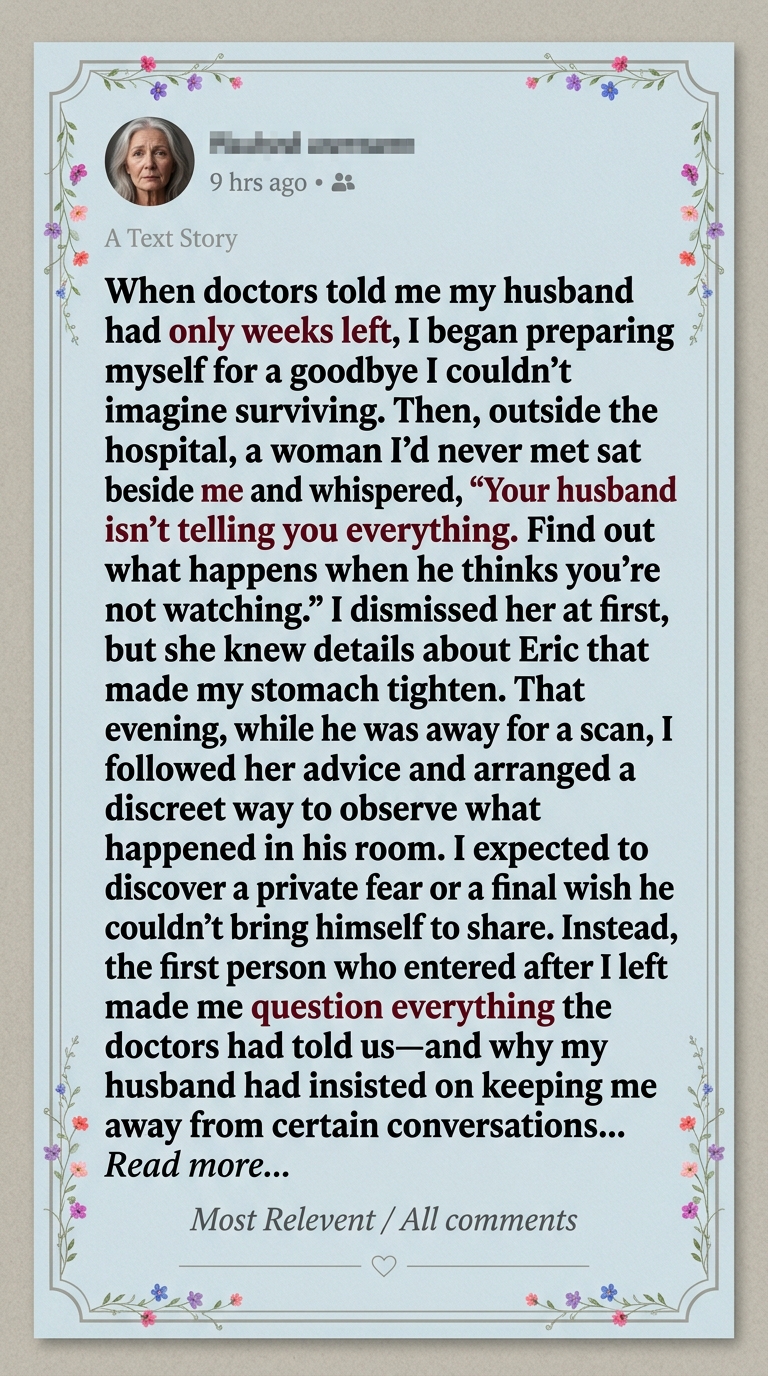
For three weeks, I had been preparing to lose my husband.
Eric had been diagnosed with an aggressive form of pancreatic cancer. The doctors had explained the situation carefully, using words like progression, limited options, and comfort care. They estimated he had between four and six weeks left.
I heard every word, but none of them seemed real.
Eric was fifty-eight. We had been married for thirty-one years. We had raised two children, survived a failed business, paid off our mortgage, and spent nearly every summer driving to the coast in an old car that never seemed to have enough air conditioning.
Now I was learning how to measure our remaining time in hospital visits.
I kept a notebook beside his bed. I recorded his medications, the names of his doctors, and the things he said he wanted to eat. I also wrote down little memories whenever they came to me, afraid that grief would eventually blur details I desperately wanted to keep.
Eric, meanwhile, had become strangely protective of certain conversations.
Whenever a doctor approached with an update, he sometimes asked me to wait outside. If a nurse mentioned a consultation, he insisted he could handle it himself. When I asked what they had discussed, he always gave the same answer.
“Nothing you need to worry about, sweetheart.”
At first, I thought he was trying to protect me.
Then, one Tuesday afternoon, I met the woman outside the hospital.
I had gone downstairs to buy coffee. I was sitting beneath the covered entrance, staring at the paper cup in my hands, when a woman in a gray coat approached.
“Are you Mrs. Lawson?”
I looked up.
“Yes.”
“My name is Helen. I know your husband.”
I didn’t recognize her.
“From where?”
She glanced toward the hospital doors.
“Your husband isn’t telling you everything. Find out what happens when he thinks you’re not watching.”
I stared at her.
“I’m sorry?”
She sat beside me without asking.
“Eric has been meeting someone here. He waits until you leave, then he asks the nurses to let him speak privately with that person.”
“Who?”
“I can’t tell you everything. But I can tell you that what he says about his condition isn’t the whole story.”
My coffee suddenly tasted bitter.
“Are you suggesting my husband is lying about having cancer?”
“No. He’s sick. Very sick. But there are things happening around his treatment that you haven’t been told.”
She stood before I could ask another question.
“Watch carefully. Don’t confront him until you understand.”
Then she walked toward the parking garage.
I sat there for several minutes, trying to decide whether I had just encountered a disturbed stranger or someone who genuinely knew something.
When I returned to Eric’s room, he was asleep.
His breathing was shallow, and his face looked thinner than it had a month earlier. I felt ashamed for even considering that he might be hiding something from me.
That evening, he was taken for another scan.
While he was away, I asked a nurse named Patricia whether anyone had visited him privately.
She hesitated.
“His specialist has spoken with him several times.”
“Anyone else?”
Patricia glanced toward the door.
“There’s a hospital counselor who has been meeting with him. I assumed you knew.”
“I don’t.”
She looked uncomfortable.
“I shouldn’t discuss another patient’s private conversations without his permission. But if you have concerns, you can ask your husband directly.”
I thanked her.
I didn’t want to spy on Eric. But Helen’s words had unsettled me, and the secrecy surrounding his conversations was becoming impossible to ignore.
I remembered that the hospital offered family members access to a patient communication portal, where authorized visitors could receive updates about appointments and care arrangements.
I had been listed as Eric’s primary contact, but I discovered that he had recently changed his preferences so that certain discussions were marked private.
I requested a meeting with the patient liaison and explained that I wanted to understand the limits of my access and make sure I wasn’t missing important information about his care.
The liaison, a calm woman named Denise, explained that Eric had the right to private medical conversations, even with his wife. She also explained that I could ask him to authorize me to receive information.
I didn’t ask her to break any rules.
I simply asked whether a private family meeting could be arranged with his doctor and counselor.
The next morning, Eric returned from a consultation looking exhausted.
“Everything all right?” I asked.
He nodded.
“Just another discussion about pain management.”
“Was the counselor there?”
His expression changed.
“Who told you about that?”
“Patricia mentioned someone had been meeting with you.”
Eric looked toward the window.
“It’s nothing important.”
“Then why haven’t you told me?”
He took my hand.
“Because I don’t want you carrying every burden I have.”
I squeezed his fingers.
“I’m already carrying the fear of losing you. You can’t protect me by making me feel like a stranger in my own marriage.”
He didn’t answer.
That afternoon, Helen called me.
I hadn’t given her my number, but she said she had found it through the hospital’s volunteer office, where she worked as a family support volunteer.
“I know you spoke to the nurse,” she said.
“Who are you, Helen?”
She sighed.
“My husband was treated at that hospital. Eric helped me when I was trying to understand the patient support system. He was kind to me, and I became concerned when I learned what he was planning.”
“What is he planning?”
“Please ask for a meeting with Dr. Shah. Ask about the second opinion and the treatment trial.”
I sat down.
“What second opinion?”
“Eric was referred to a specialist at another medical center. There is a clinical trial that may be suitable for some patients with his type of cancer. It isn’t a cure, and it isn’t guaranteed to help. But he has been discussing whether to pursue it.”
My heart began pounding.
“Why wouldn’t he tell me?”
“I don’t know. But I think he believes he’s protecting you from false hope.”
The call ended before I could ask more.
I immediately requested a meeting with Dr. Shah through the patient liaison.
When I entered his office the following morning, Eric was already there.
He looked at me with an expression I had never seen before.
Not anger.
Fear.
Dr. Shah invited us to sit.
“I understand you have questions about the additional consultation,” he said.
I looked at Eric.
“You told me there were no other options.”
“I said there were no options that could promise anything.”
“That’s not the same thing.”
Dr. Shah nodded.
“Your husband has been evaluated for a clinical trial at the regional cancer center. The trial involves an experimental combination therapy for patients who meet specific medical criteria. Eric’s current condition makes his eligibility uncertain, and the potential benefits are unknown.”
I turned toward my husband.
“How long have you known?”
“About two weeks.”
“Two weeks?”
He rubbed his face.
“I didn’t want you to spend every day waiting for a miracle that might never happen.”
I felt tears rise.
“So you decided I wasn’t allowed to know?”
Eric looked down.
“I thought it would be easier.”
Dr. Shah waited before speaking again.
“There is another matter we should clarify. The trial would require additional testing, travel, and frequent monitoring. Eric has also asked to speak with our palliative care counselor about managing symptoms if he chooses not to participate.”
That explained the private meetings, but not Helen’s concern.
I asked Dr. Shah whether there was anything else.
He looked at Eric.
“Would you like to tell her?”
My husband took a long breath.
“There’s a financial part.”
He explained that the trial itself would not charge participants for the experimental medication, but travel, accommodation, and some related expenses could become difficult. He had contacted a former colleague, Martin, who worked for a medical charity that helped families with treatment-related costs.
Martin had been visiting him privately to explain the application process.
“Why didn’t you tell me about that?” I asked.
“Because I had already started making arrangements.”
“What arrangements?”
Eric hesitated.
“I was going to use the money we saved for retirement.”
I stared at him.
“That money is ours.”
“I know.”
“And you were going to make that decision without me?”
He closed his eyes.
“I didn’t want you to feel you had to spend everything trying to keep me alive.”
I sat back.
For a moment, I was too hurt to speak.
I understood his fear. I understood that he was facing a diagnosis that had changed every expectation he had for the future. But I also understood that he had been making decisions about our shared life while leaving me outside the room.
“Eric,” I said quietly, “I don’t need you to promise me you’ll survive. I need you to let me be your wife.”
He reached for my hand.
“I thought I was sparing you.”
“You were sparing yourself the conversation.”
His eyes filled.
“Yes,” he whispered. “Maybe I was.”
The meeting continued for another hour. Dr. Shah explained the available options, including the uncertainty surrounding the trial and the importance of comfort-focused care regardless of which path Eric chose.
We agreed that no decision would be made until we had spoken with the specialist together.
That afternoon, I met Helen in the hospital cafeteria.
She looked relieved to see me.
“Did you find out?”
“I did. But I still don’t understand why you approached me like that.”
Helen lowered her eyes.
“Because Eric asked me not to tell you.”
I frowned.
“Why would he involve you?”
She explained that she had been volunteering with the hospital’s family support program for nearly five years. She had helped Eric understand the trial application because he had once helped her husband navigate a complicated treatment decision.
But she had become uncomfortable watching him make arrangements while telling me there were no further possibilities.
“He said he wanted you to remember him as he was before the illness,” she explained. “He was afraid that if you knew about the trial, every day would become another test result, another appointment, another disappointment.”
I understood the fear, but I wasn’t ready to excuse the secrecy.
“Did you know about the financial arrangements?”
“Only that he was considering using savings. I told him he needed to discuss that with you.”
I nodded.
“Thank you for telling me.”
Helen reached across the table.
“I hope you don’t blame yourself for not knowing.”
“I don’t. But I wish everyone had remembered that I was his wife, not just someone who needed protecting.”
Over the next several days, Eric and I met with the specialist at the regional cancer center.
The evaluation was difficult. His scans showed that the disease had progressed, and his physical condition was worse than either of us had hoped. The specialist explained that he might not qualify for the trial. Even if he did, there was no guarantee that the treatment would slow the cancer.
Eric listened carefully.
When the appointment ended, we sat in the car without speaking.
Finally, he turned toward me.
“I think I want to try.”
I took his hand.
“Then we’ll discuss it together.”
He looked surprised.
“You’re not angry?”
“I am angry that you shut me out. I’m not angry that you want more time.”
He nodded, and tears slipped down his cheeks.
Two days later, the medical team confirmed that Eric did not meet the trial’s eligibility requirements because of how quickly his condition had deteriorated. The specialist offered another treatment option, but warned us that the likely benefit was limited and the side effects could be severe.
We talked about it for hours.
In the end, Eric chose not to pursue the additional treatment.
Instead, he decided to focus on comfort, spending time with family, and being well enough to return home.
It was not the outcome I had hoped for, but it was his decision, and this time I had been part of it.
The hospital arranged home palliative care. Nurses visited regularly, and Eric’s pain was managed much more effectively. Our children came to stay for a few days. We talked about ordinary things, watched old movies, and listened to music from the years when we first met.
One evening, Eric asked me to sit beside him.
“I owe you an apology,” he said.
I put down my book.
“For what?”
“For thinking that protecting you meant keeping you uninformed. I was frightened, and I wanted to control at least one thing. I couldn’t control the cancer, so I tried to control what you knew.”
I held his hand.
“I wish you had trusted me with the truth.”
“I know.”
He looked toward the window.
“I’m sorry I made you feel alone while you were sitting right beside me.”
I leaned forward and kissed his forehead.
We didn’t pretend that apology could repair everything. But it gave us a way to spend the time that remained without another wall between us.
Eric died peacefully at home twenty-three days later, with me beside him and our children nearby.
The grief was unbearable, but there was comfort in knowing that his final days had been spent according to choices we had made together.
Several weeks after the funeral, I received a handwritten card from Helen.
She wrote that she was sorry for the distress her warning had caused, but she had feared that Eric’s silence would leave me believing I had been excluded because I didn’t matter.
At the bottom, she had written one sentence:
Sometimes people hide the truth because they are afraid of losing us, forgetting that the secrecy can make us feel lost long before they are gone.
I kept the card in the notebook I had used during Eric’s hospital stay.
I never learned every private thought he had carried during those final weeks. Some things belonged to him alone.
But I learned that love does not mean shielding someone from every painful truth. Sometimes it means trusting them enough to face that truth together.
And I would always be grateful that, before it was too late, Eric finally let me do that.

