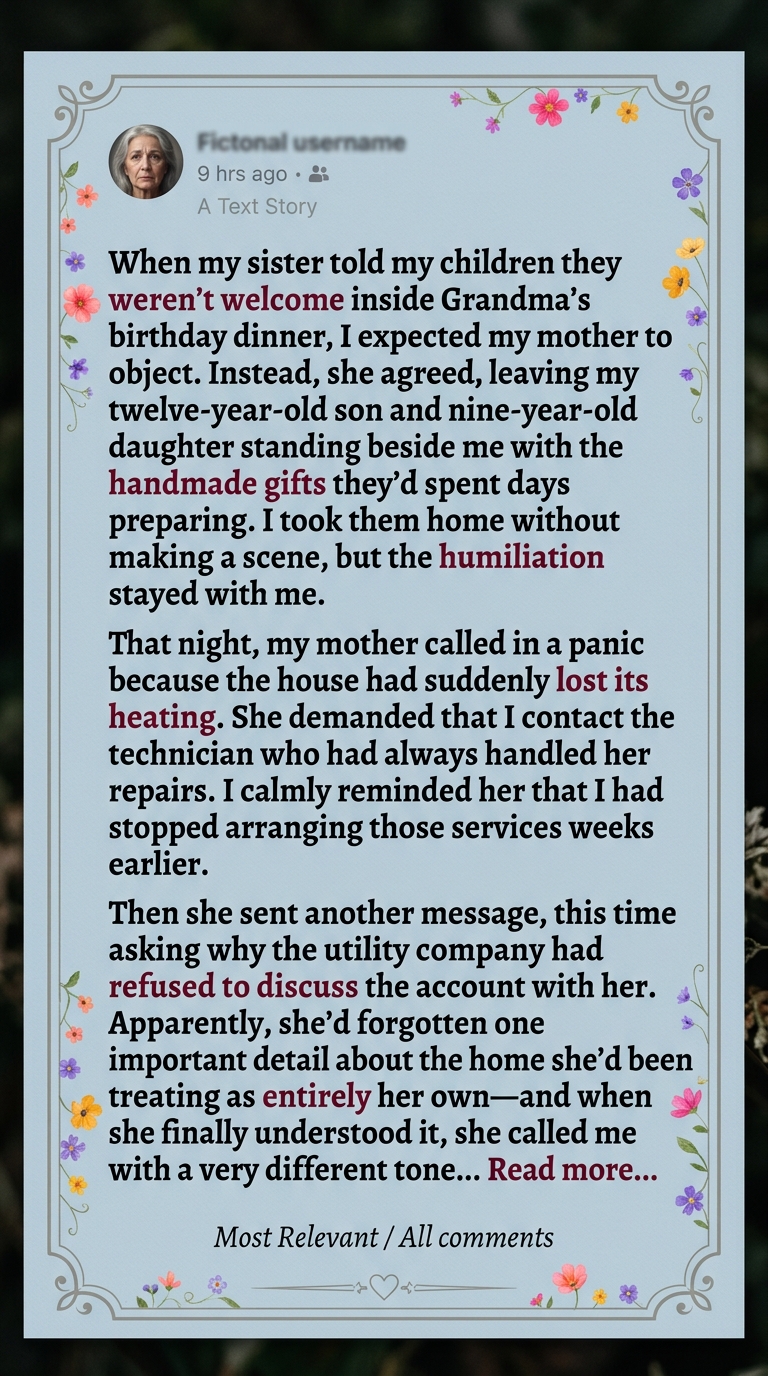
My sister told my children they weren’t welcome at Grandma’s birthday dinner while they were still holding the presents they had made for her.
My son, Oliver, was twelve. My daughter, Sophie, was nine. They had spent the previous weekend making gifts for their grandmother. Oliver had built a small wooden jewelry box in his school workshop, carefully sanding the edges and painting her initials on the lid. Sophie had made a photo frame decorated with tiny paper flowers and placed a picture of herself and Grandma inside.
They were proud of those gifts.
I had no reason to expect trouble when we arrived at my mother’s house that Saturday evening.
The dining room was already full. My sister, Vanessa, stood near the table arranging place cards. She glanced at my children, then looked directly at me.
“Why did you bring them?”
I thought she was joking.
“Because it’s Grandma’s birthday,” I replied. “They made her presents.”
Vanessa sighed.
“This is an adults-only dinner. I told everyone that.”
“No, you didn’t.”
“I told Mom.”
I turned toward my mother, who was standing beside the kitchen counter.
“Mom?”
She avoided my eyes.
“Vanessa thought it would be easier without the children tonight.”
I looked at the empty chairs around the table. There were at least three places available.
“Easier for whom?”
“Please don’t make this difficult,” my mother said. “Your sister has organized everything. We should respect her arrangements.”
Oliver lowered his wooden box. Sophie held her photo frame against her chest.
I felt my face grow hot, but I refused to let them see me argue.
“Come on, sweetheart,” I said quietly.
My mother finally looked at the children.
“It’s nothing personal. We can celebrate another day.”
Sophie nodded, although her eyes had begun to fill with tears.
Oliver didn’t say anything. He simply followed me toward the door.
As we reached the driveway, he asked, “Did Grandma not want our presents?”
I stopped beside the car.
“She knows you worked hard on them,” I said. “And you did nothing wrong.”
“Then why couldn’t we stay?”
I didn’t have an answer that wouldn’t hurt him further.
We drove home in silence.
That evening, I placed the gifts on the dining-room shelf. Sophie went upstairs early. Oliver spent an unusually long time doing his homework, even though he had already finished most of it in the car.
I was angry, but more than that, I was disappointed.
For the past four years, I had been the person keeping my mother’s household running.
When her husband died, I helped her manage the property, arranged repairs, dealt with contractors, and made sure the utilities were paid on time. I had also taken responsibility for maintaining the house she lived in, a large property my late father had purchased before I was born.
My mother had always called it her home.
And in every ordinary sense, it was. She had lived there for decades, filled it with furniture, hosted family gatherings, and made decisions about the garden and rooms.
But there was one important distinction she had gradually stopped acknowledging.
The house was legally mine.
My father had transferred ownership to me several years before his death. He had wanted to ensure that the property remained within the family and that my mother could live there for the rest of her life without worrying about losing her home.
The arrangement had been carefully prepared with an attorney. My mother had a registered lifetime right to occupy the property. She could live there, enjoy it, and use it as her home. I could not simply remove her because we disagreed.
I had never used that arrangement to control her.
In fact, I had rarely mentioned it.
I paid the property insurance and arranged major repairs. My mother paid the ordinary household expenses from her own account, and I covered the costs that exceeded her budget. I had also organized the heating service, annual inspections, and several maintenance contracts.
I considered it part of looking after my mother.
But over time, she and Vanessa began treating my help as an obligation rather than a kindness.
Vanessa often referred to the property as “Mom’s house” whenever she wanted to make decisions. She had even begun discussing renovations without consulting me, although the contractors were sending their estimates to my email because I was the registered owner.
I had let those comments pass.
Then, three weeks before the birthday dinner, I received a call from a heating technician named Peter.
He explained that Vanessa had contacted him directly and instructed him to replace the existing heating system with a more expensive model. She had also told him to send the bill to me.
When I asked whether my mother had approved the work, Peter said he had spoken only to Vanessa.
I told him not to proceed without proper authorization.
The following week, I discovered that Vanessa had also contacted the utility provider, claiming she was authorized to change the account arrangements. The provider refused because she wasn’t named on the account and couldn’t provide the required permission.
I had already informed the relevant companies that I would no longer arrange optional services or manage household requests unless my mother contacted me directly.
I wasn’t withdrawing my mother’s right to live in the house. I was simply stepping away from being the unpaid manager of every inconvenience.
I hadn’t expected that decision to become important so quickly.
At 9:42 that night, my phone rang.
It was my mother.
“Something’s wrong with the heating,” she said, sounding irritated. “The radiators are cold.”
“Have you checked the thermostat?”
“Of course I have. It’s not working. Call Peter.”
“I don’t arrange his visits anymore.”
There was a pause.
“What do you mean?”
“I stopped managing the maintenance requests a few weeks ago. You can contact him directly and arrange an appointment.”
“Don’t be ridiculous. You know he always deals with this house.”
“He does. But he doesn’t work for me anymore.”
My mother raised her voice.
“Then why is the heating not working?”
“Have you contacted the service company?”
“They said they needed the account holder to confirm the visit.”
“Then you’ll need to speak with them about the appointment.”
“Claire, I don’t have time for this. Just call them.”
I took a breath.
“Mom, I was willing to help you with everything. But you and Vanessa decided my children weren’t welcome at your birthday dinner. You didn’t even question it. I won’t continue managing every part of your household while being treated as though my family doesn’t belong there.”
“That’s not fair. This has nothing to do with the heating.”
“It has everything to do with how you treat people who help you.”
She ended the call.
I assumed that would be the end of it for the night.
It wasn’t.
A little after ten, another message arrived.
The utility company won’t discuss the account with me. They say I’m not the registered owner. Why have you made this so complicated?
I stared at the screen.
Then I replied:
The utility account is in my name because I arranged it when Dad died. You have always had permission to use the services. If you want to change the account, you can contact the company and ask what documentation they require.
My phone rang almost immediately.
“What do you mean the account is in your name?” my mother demanded.
“Exactly what I said.”
“But this is my home.”
“You have the legal right to live there for the rest of your life. Dad arranged that. But he transferred ownership to me.”
Silence.
Then she said, “I thought that was just paperwork.”
“It was paperwork that established who owns the property.”
“Your father would never have wanted me to feel like a guest in my own home.”
“He didn’t. That’s why he made sure you had the right to remain there for life. He wanted you secure. He also wanted the property protected.”
My mother sounded shaken.
“Why didn’t you tell me this before?”
“I did. The attorney explained it when the documents were signed. You were there.”
“I don’t remember it that way.”
“I know you don’t.”
She hung up again.
The next morning, Vanessa called.
“You’ve upset Mom,” she began. “She’s sitting in the kitchen freezing because you refuse to call a technician.”
“I haven’t refused to help her. I’ve told her how to arrange the repair.”
“You’re punishing her because of one dinner.”
“No. I’m changing the arrangement because I’ve been doing everything for years, and apparently none of you think my children deserve basic courtesy.”
Vanessa scoffed.
“Don’t bring the children into this. It was an adults-only dinner.”
“Then you should have told us before we arrived. And Mom could have said she wanted to see her grandchildren another day instead of agreeing while they stood there holding their presents.”
“She was trying to avoid an argument.”
“She avoided an argument by letting two children feel unwanted.”
Vanessa went quiet for a moment.
Then she said, “You need to remember that Mom lives there. You can’t just take the house away from her.”
“I have no intention of taking her home away. Her lifetime right to occupy it is protected. I’m not changing that.”
“Then why are you acting like the owner?”
“Because I am the owner. That doesn’t mean I get to treat her badly, and it doesn’t mean she gets to treat my children badly.”
Vanessa ended the call.
For several days, my mother didn’t contact me.
I arranged for the heating company to send her the instructions for booking a repair directly. I also made sure she had a temporary electric heater delivered, because I wasn’t interested in making her uncomfortable to prove a point.
The technician eventually visited and discovered that the boiler had shut down because of a pressure problem. It was a routine repair, not the expensive replacement Vanessa had requested.
My mother called me afterward.
Her voice was quieter.
“Peter said the repair wasn’t as serious as I thought.”
“I’m glad it’s fixed.”
“I suppose I should have asked you before letting Vanessa arrange things.”
I waited.
“She thought she was helping,” my mother added.
“Maybe she did. But she doesn’t own the property, and neither of you can authorize major work in my name.”
“I understand.”
There was another silence.
Then my mother asked, “Are you still angry about the birthday?”
I looked toward the shelf where the children’s gifts were sitting.
“Yes.”
“I didn’t realize they would be so upset.”
“Mom, Oliver is twelve. He understood exactly what happened. Sophie cried all the way home. They weren’t asking for special treatment. They wanted to give you presents.”
My mother began to cry softly.
“I never wanted them to feel unwanted.”
“Then you need to tell them that yourself.”
She agreed, but I didn’t arrange a visit immediately.
A week later, she came to my house.
She brought a small box of chocolates for the children and stood awkwardly in the doorway.
“May I come in?”
I stepped aside.
Oliver was in the living room. Sophie was drawing at the dining table.
My mother approached them.
“I owe you both an apology,” she said. “I should never have let you leave my birthday dinner. I was wrong to agree with your aunt.”
Sophie looked up.
“Did you not want our presents?”
My mother’s face crumpled.
“I wanted them very much, sweetheart. I was foolish, and I allowed someone else to make a decision that hurt you.”
Oliver crossed his arms.
“Why didn’t you say something?”
“Because I was afraid of arguing with your aunt. That wasn’t a good enough reason.”
He looked at his grandmother for a long moment.
Then he said, “I made the box for you.”
“I know, darling. May I see it?”
He brought it down from the shelf and placed it in her hands.
My mother opened the lid carefully. She ran her fingers over the painted initials and the smooth wooden edges.
“This is beautiful,” she whispered.
Sophie brought her frame over next.
My mother held it against her chest.
“I’ll put this beside my bed.”
The apology didn’t erase what had happened, but it gave the children something they needed: an adult who admitted that she had hurt them instead of pretending it was harmless.
Before leaving, my mother asked whether I would continue arranging her repairs.
“I’ll help when you genuinely need me,” I said. “But I won’t automatically manage everything anymore. You can contact the companies directly, and if something is beyond your ability, we can discuss it together.”
She nodded.
“And the house?”
“Your right to live there hasn’t changed. You don’t have to worry about that.”
She looked relieved.
“I suppose I always thought it belonged to me.”
“I understand why. You’ve lived there for so long. But Dad made a specific arrangement so you could stay there safely while keeping the ownership in the family. I intend to honor that.”
My mother looked down at her hands.
“I should have remembered.”
“Yes,” I said. “You should have.”
Over the following months, our relationship slowly improved. Vanessa remained distant for a while, but she eventually stopped making decisions about the property without permission. My mother began handling her own routine appointments, and I helped only when she asked.
More importantly, my children no longer had to wonder whether their grandmother wanted them around.
The following year, my mother invited us to her birthday lunch. This time, the invitation came directly from her, and the children were included from the beginning.
Oliver brought another small wooden gift. Sophie brought flowers from our garden.
My mother greeted them at the door and hugged them both.
When we sat down to eat, she placed the children’s gifts beside her plate.
I looked around the table and realized that the house had never been the real issue.
It was about whether people understood that having a place in someone’s life was not something they could demand while refusing to show basic respect in return.
My father had given my mother a secure home. I had spent years helping her maintain it. But neither the property nor my help gave anyone the right to make my children feel that they were less welcome than the adults who had excluded them.
That evening, when we were leaving, my mother hugged me.
“Thank you for not giving up on us,” she whispered.
I hugged her back, but I also made something clear.
“I won’t give up on family, Mom. But I won’t teach my children that being family means accepting humiliation.”
She nodded.
For the first time, I believed she understood.

