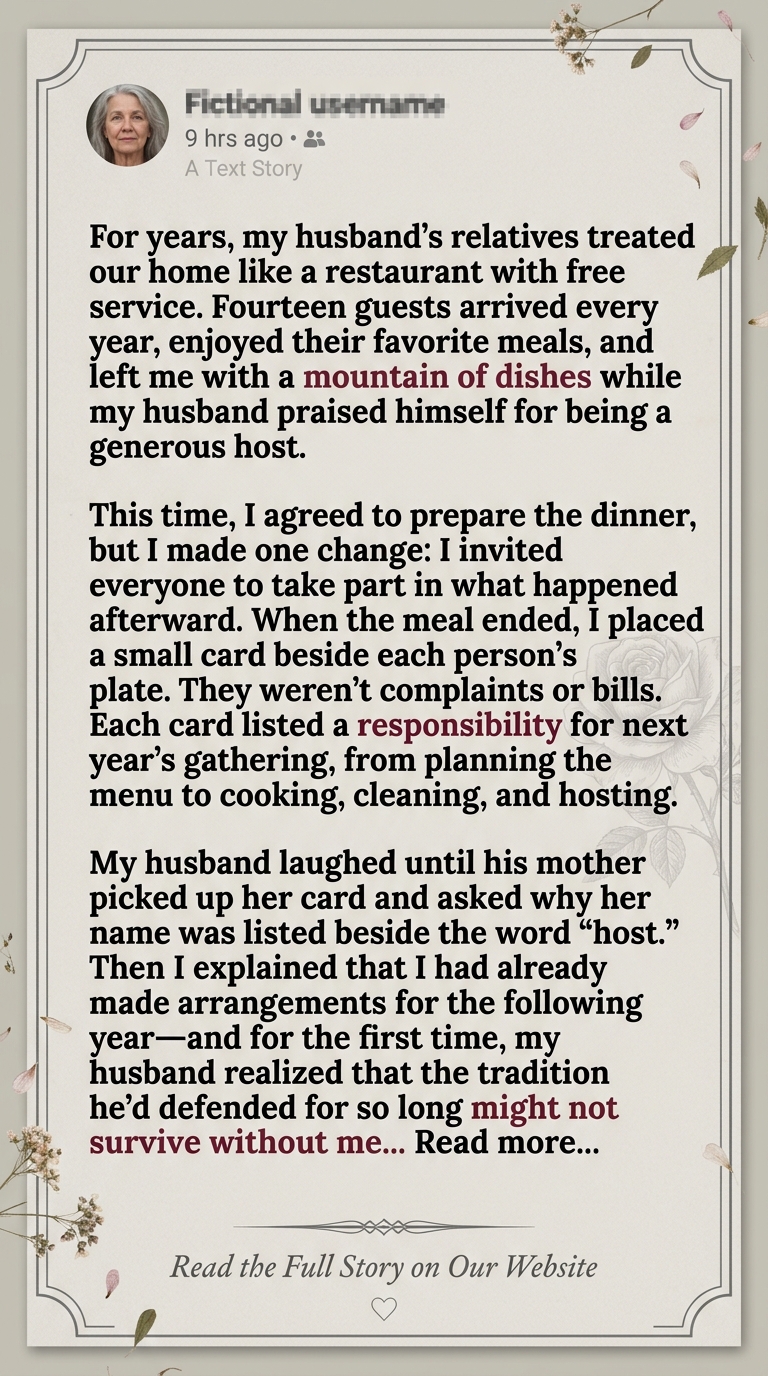
For eleven years, my husband’s family had treated our home like a restaurant that never closed.
Every December, fourteen relatives arrived expecting the same things: a spotless dining room, a table covered in food, drinks waiting in the refrigerator, and me moving between the kitchen and dining room while everyone else enjoyed themselves.
My husband, Richard, loved the tradition.
“There’s nothing better than bringing the family together,” he always said.
He particularly enjoyed telling people how much he loved hosting.
What he never mentioned was that I did nearly everything.
I planned the menu, bought the groceries, prepared the food, decorated the house, washed the serving dishes, and cleaned the kitchen afterward. Richard occasionally carried a chair or opened a bottle of wine, then spent the evening accepting compliments for being such a wonderful host.
His mother, Margaret, was the most demanding guest.
She wanted her roast cooked a particular way, complained if the vegetables were too soft, and always asked whether I had remembered her favorite dessert.
His sister, Diane, brought her husband and two children but never offered to help. His brother, Paul, arrived early enough to sample the food but somehow disappeared whenever it was time to set the table.
I had tried asking for help.
The first year, Margaret said she was too old to stand for long periods. Diane explained that her children needed supervision. Paul joked that he would probably make things worse in the kitchen.
Richard laughed along.
“Don’t worry, sweetheart. Everyone appreciates what you do.”
Appreciation, I discovered, was apparently something people could express without lifting a finger.
Last December, after everyone had left, I stood in the kitchen at nearly one in the morning, scraping dried sauce from a roasting pan.
Richard walked in, loosened his tie, and poured himself a drink.
“Another successful family dinner,” he announced.
I looked at the sink.
“Successful for whom?”
He frowned.
“What’s that supposed to mean?”
“It means I’m exhausted. Every year, I spend days preparing this dinner while you enjoy being praised for hosting it.”
He sighed.
“It’s one evening. They’re my family.”
“And I’m your wife, not your unpaid catering staff.”
He put down his glass.
“You always make everything sound like a competition. Nobody is forcing you to do it.”
That sentence stayed with me.
Nobody was forcing me.
He was right.
I didn’t have to keep doing it.
So when Richard asked in October whether I would host the family dinner again, I smiled.
“Of course.”
He looked relieved.
“Wonderful. My mother has already asked about the menu.”
“I have one small change this year.”
“What change?”
“Everyone will have a responsibility.”
He laughed.
“That’s fine. You can ask Diane to bring a salad or something.”
“I’ll let everyone know after dinner.”
He didn’t ask another question.
For the next several weeks, I prepared as usual, but I also made a few arrangements of my own.
I contacted a local community hall that rented its dining room for private events. I reserved it for the following December and paid a small deposit. I also spoke with the manager about the possibility of booking the kitchen and catering space.
Then I contacted the relatives individually.
I didn’t complain about Richard. I didn’t tell anyone they had taken advantage of me. I simply asked whether they would be willing to take responsibility for part of the next family gathering.
Some agreed immediately.
Others laughed.
Paul said he could handle drinks. Diane offered to organize activities for the children. One cousin volunteered to manage the invitations.
Margaret was harder to reach, so I sent her a message explaining that I wanted to make the annual gathering more manageable and enjoyable for everyone.
She replied with a single sentence.
I hope you aren’t planning to change the menu.
I didn’t respond.
On the evening of this year’s dinner, fourteen relatives arrived as usual.
The house smelled of roasted vegetables, fresh bread, and cinnamon. The dining table was decorated with candles, and the food was arranged exactly as Margaret liked it.
Richard greeted everyone at the door.
“Welcome! Come in. We’ve been preparing all day.”
I looked at him but said nothing.
Dinner went smoothly.
Margaret complimented the roast. Paul asked for a second helping. Diane praised the dessert. Richard raised his glass and thanked everyone for coming.
Then he looked at me.
“Of course, none of this would happen without my wonderful wife.”
Everyone applauded.
I smiled politely.
When the meal ended, I didn’t stand up to clear the table.
Instead, I placed a small cream-colored card beside each person’s plate.
“Before anyone leaves, I’d like everyone to read this.”
Richard chuckled.
“What is this? A Christmas quiz?”
“Something like that.”
Margaret picked up her card first.
Her expression changed.
“Why does this say I’m hosting next year?”
The room became quiet.
I explained that the cards contained responsibilities for the following year’s gathering. Each person had been assigned a specific role, based on what they had told me they were willing to do.
Margaret’s card read:
HOST AND VENUE COORDINATOR
Diane’s card read:
MENU PLANNER AND FAMILY INVITATIONS
Paul’s card read:
GROCERY SHOPPING AND DRINKS
Richard’s card read:
MAIN COURSE AND KITCHEN SUPERVISION
Other relatives had been assigned desserts, side dishes, table arrangements, transportation, and cleanup.
At the bottom of every card was the same sentence:
The person responsible for each task will arrange it personally or organize someone to help.
Margaret looked up.
“I don’t understand. Why am I hosting?”
“Because you have always had the strongest opinions about how the gathering should be organized. I thought you might enjoy making the decisions yourself.”
Her mouth tightened.
“I can’t host fourteen people.”
“Then perhaps someone else can take the role.”
Diane shifted in her chair.
“Wait. I thought I was only organizing invitations.”
“You are. That’s what you agreed to when I called you.”
“I didn’t agree to plan the entire dinner.”
“You said you were happy to help organize things. I gave you one responsibility.”
She glanced at her card again.
Richard was no longer smiling.
“Hold on. What exactly is going on?”
I sat down.
“For eleven years, I’ve done nearly everything involved in this dinner. I don’t mind bringing the family together, but I won’t continue doing it alone. Next year, everyone will share the work.”
He leaned toward me.
“You could have discussed this with me first.”
“I did. Last year. You told me nobody was forcing me to do it.”
His face reddened.
“That doesn’t mean you get to embarrass my family.”
“I’m not embarrassing anyone. I’m giving everyone a chance to participate.”
Margaret pushed her card away.
“This is ridiculous. Family traditions shouldn’t come with job assignments.”
I nodded.
“Then perhaps we should stop calling it a family tradition when one person does all the work.”
Nobody spoke.
Then Richard asked the question I had been waiting for.
“So what happens if nobody wants to do it?”
I reached into my handbag and placed a printed reservation confirmation on the table.
“Then we won’t use this house.”
I explained that I had reserved the community hall for the following December. It had a proper kitchen, enough seating, and a cleaning service included in the rental. The booking could be transferred to another family member if they wanted to organize the gathering there.
“I’ve paid the deposit,” I said. “If someone wants to take over the arrangements, they can use the reservation. Otherwise, I’ll cancel it before the deadline.”
Richard stared at the paper.
“You’ve already booked somewhere else?”
“Yes.”
“Without asking me?”
I looked at him.
“It’s a reservation for next year. I haven’t signed away our house.”
“That’s not the point.”
“What is the point, Richard?”
He looked around the table, apparently expecting someone to support him.
Instead, Paul cleared his throat.
“Actually, I don’t mind handling the drinks and shopping.”
Diane glanced at him.
“I can organize the invitations, but I don’t want to plan the whole menu.”
“You don’t have to,” I replied. “Your card lists exactly what you agreed to.”
Margaret remained unconvinced.
“I’ve been coming here for years. I don’t see why everything has to change now.”
I answered quietly.
“Because I’ve been doing it for years, too.”
That ended the discussion.
The relatives began leaving earlier than usual. Some thanked me for dinner. A few apologized for never offering to help. Margaret left without saying goodbye.
When the door closed, Richard turned toward me.
“You made me look foolish.”
I gathered a few glasses from the table.
“You told everyone you were the host. I simply gave you a chance to do some hosting.”
He followed me into the kitchen.
“You know my mother won’t organize a dinner. She’s not capable of doing all that.”
“Then someone else can take over.”
“And what if nobody does?”
“Then there won’t be a dinner.”
He stared at me as though I had suggested something unthinkable.
“You’d really let the tradition end?”
I put the glasses in the dishwasher.
“Richard, the tradition was never supposed to be my exhaustion.”
He didn’t answer.
Over the next few days, the family group chat became unusually active.
Paul volunteered to coordinate the shopping. Diane offered to organize a smaller gathering at her house if Margaret didn’t want to host. One of the cousins suggested rotating the event between households every year.
Margaret complained that everything had become unnecessarily complicated.
But something else happened that surprised me.
Richard began asking questions.
He wanted to know how much I usually spent on groceries, how long preparation took, and why the kitchen always seemed to need another hour of cleaning after everyone left.
I showed him the list I had kept from previous years.
He looked at the total and frowned.
“I didn’t realize it cost this much.”
“You never asked.”
He studied the pages for a long time.
“I thought you enjoyed doing it.”
“I enjoyed having everyone here. I didn’t enjoy being the only person responsible for making it happen.”
He nodded slowly.
For the first time, he didn’t argue.
A few weeks later, Margaret called me.
Her tone was stiff.
“I suppose I should apologize for what I said at dinner.”
I waited.
She continued.
“I’ve always assumed you were happy to organize everything. I didn’t realize how much work it involved.”
“I’m glad you understand.”
She hesitated.
“Diane says she can host next year. She wants to do a simpler dinner. Nothing elaborate.”
“That sounds lovely.”
“And she says everyone will have to bring something.”
I smiled.
“That sounds even better.”
The following December, we gathered at Diane’s house.
There were fewer dishes, less food, and no elaborate decorations. Paul brought drinks. Margaret prepared her own favorite dessert. Richard cooked the main course with Diane’s husband, and the children helped set the table.
I arrived with a side dish and a small present for the host.
Nobody expected me to spend the entire evening in the kitchen.
After dinner, Richard stood beside me while everyone cleared their plates.
He leaned closer.
“I think I owe you an apology.”
I looked at him.
“For what?”
“For acting like hosting was something I did when you were the one doing all the work.”
I didn’t rush to reassure him.
“Thank you for saying that.”
He picked up two plates and carried them to the kitchen.
It wasn’t a grand transformation. Margaret still had opinions, Paul still arrived late, and Richard occasionally needed reminding that a gathering required more than welcoming people at the door.
But the following year, the family rotated the dinner between three homes. Everyone contributed, and nobody was expected to carry the entire tradition alone.
I eventually understood that I hadn’t needed to punish anyone or abandon the family.
I had only needed to stop making their comfort my responsibility.
The best part wasn’t the smaller workload or the cleaner kitchen.
It was sitting at the table, eating a meal while everyone else enjoyed it, and realizing that I was finally a guest in my own family tradition—not the person working behind it.

