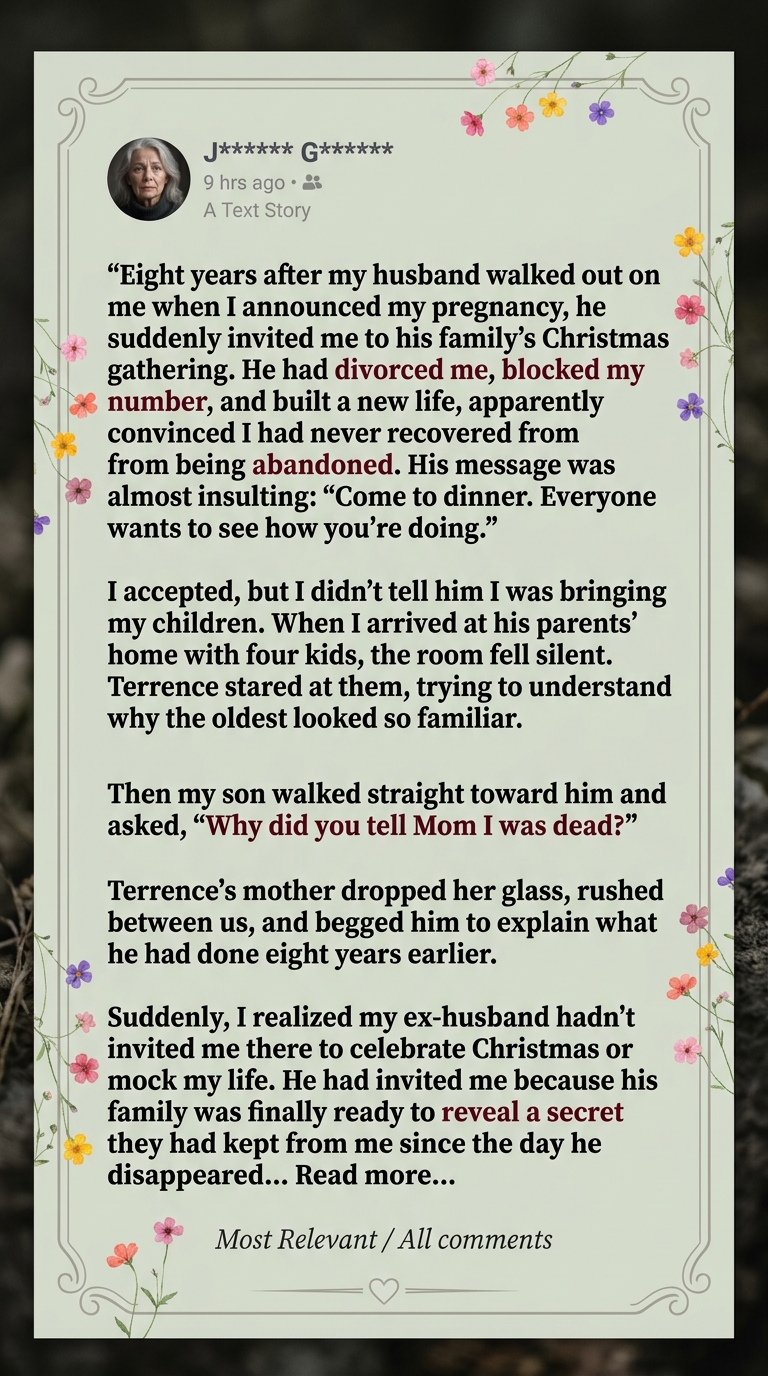
The last time I saw Terrence, I was standing in our kitchen with a positive pregnancy test in my hand.
We had been married for barely two years. I was twenty-six, he was twenty-nine, and I genuinely believed we were building a future together.
When I told him I was pregnant, he didn’t smile.
He didn’t ask how I felt or put his arms around me.
He simply stared at the test and said, “I can’t do this.”
I thought he was frightened. I tried to reassure him that we would manage together, but he stepped away as though I had handed him a problem he wanted no part of.
Three days later, he packed a suitcase.
“I want a divorce,” he announced.
“Because I’m pregnant?”
“Because I don’t want this life.”
I cried, begged, and asked him to reconsider. He refused to discuss it. Within weeks, he had filed for divorce, changed his phone number, and blocked every way I could contact him.
His parents stopped answering my calls.
His younger sister, Natalie, sent one message saying she was sorry but didn’t want to get involved.
Then Terrence disappeared.
I gave birth to a little boy and named him Noah. I raised him alone, working at a dental clinic during the day and taking bookkeeping jobs at night. When Noah was three, I married again, this time to a kind man named Michael.
Michael never tried to replace Terrence. He simply loved Noah as his own.
Over the following years, we welcomed three more children: Lily, Grace, and Ethan.
Our life wasn’t perfect, but it was steady. We had a modest home, noisy breakfasts, school runs, and family traditions that belonged to us.
Terrence became a name I rarely mentioned.
Then, eight years after he left, a message appeared on my phone.
It came from an unfamiliar number.
Come to Christmas dinner at my parents’ house. Everyone wants to see how you’re doing.
I read it several times.
There was no apology. No explanation. Not even a question about whether I wanted to see him.
It sounded as though he expected me to arrive alone, perhaps looking miserable, while he showed everyone how well his life had turned out.
I almost deleted it.
Instead, I replied:
I’ll be there.
I didn’t tell him I was bringing the children.
On Christmas Eve, I dressed them in matching winter clothes and drove to his parents’ house. Noah sat beside me in the front passenger seat, now a tall eight-year-old with dark hair and serious brown eyes.
“Are we meeting your old family?” he asked.
“Some of them,” I replied.
“Is my biological father going to be there?”
I glanced at him.
“Yes.”
Noah had known the truth for several years. I had never lied about Terrence, but I had also never spoken cruelly about him.
When Noah was six, he had asked why his biological father never visited. I told him that Terrence had left before he was born and that it wasn’t his fault.
That was all he needed to know at the time.
But a few months earlier, Noah had discovered an old photograph of Terrence in a box of family documents. He had stared at it for a long time.
“He looks like me,” he had said.
I hadn’t known what to answer.
Now, as we approached the house, Noah looked at the photograph on my phone one more time.
“That’s him, isn’t it?”
“Yes.”
He nodded and turned toward the window.
When I rang the doorbell, Terrence’s mother, Margaret, opened it.
Her smile vanished as soon as she saw the children.
“Claire?”
“Hello, Margaret.”
She looked at Noah, then at the three younger children behind him.
“Who are they?”
“My children.”
Terrence appeared in the hallway.
He was older, heavier around the face, but I recognized him immediately.
His eyes moved from me to the children.
He stopped when he reached Noah.
For several seconds, he said nothing.
“Claire,” he finally whispered. “What is this?”
I removed my coat.
“These are my children. Noah, Lily, Grace, and Ethan.”
His gaze remained fixed on Noah.
The boy stepped forward.
“Why did you tell Mom I was dead?”
The room fell silent.
Terrence looked as though someone had struck him.
“What?”
Noah’s voice trembled, but he didn’t look away.
“Why did you tell Mom I was dead?”
Margaret dropped the glass she was holding.
It shattered against the floor.
“Terrence!” she cried.
She rushed between us, her face pale.
“Tell her what you did. Tell her the truth before this gets any worse.”
I turned toward her.
“What truth?”
Terrence looked at his mother, then at me.
“Mom, please.”
“No,” Margaret said. “You have had eight years to explain yourself. You invited her here. You don’t get to hide behind silence again.”
She led us into the sitting room.
Terrence’s father, George, was sitting near the fireplace. His expression was grim. Natalie stood beside the dining table, holding a folded piece of paper.
I hadn’t seen her since the divorce.
She looked at Noah and began to cry.
“I’m sorry,” she whispered.
I felt my stomach tighten.
“What is happening?”
Margaret sat down and took a shaky breath.
“Eight years ago, Terrence told us you had lost the baby.”
I stared at her.
“What?”
“He said you had suffered complications during pregnancy and that the child hadn’t survived.”
I looked at Terrence.
“That is a lie.”
He lowered his head.
Margaret continued.
“He told us you didn’t want anyone contacting you. He said you blamed the family for what happened and had asked him to keep everyone away.”
I felt cold.
“I gave birth to Noah. I sent photographs. I called this house. I left messages.”
George nodded slowly.
“We know that now.”
“What do you mean?”
Natalie stepped forward.
“Terrence told us you were struggling emotionally after the loss. He said you had moved away and didn’t want reminders of the pregnancy.”
I stared at her.
“I never lost my baby.”
“I know,” she said, crying. “I found out the truth three years ago.”
She handed me the folded paper.
It was a copy of an email sent by Terrence to his mother shortly after Noah’s birth.
The message claimed that I had suffered a miscarriage and that there was no child.
But the email contained a detail that made my hands shake.
Terrence had written that he had personally confirmed the loss with a hospital employee.
I looked up.
“You told them you saw my medical records?”
He nodded faintly.
“I did.”
“You never came to the hospital.”
“I know.”
“Then how could you say that?”
He covered his face.
Margaret began crying.
“Because he wanted us to stop looking for you. He told us you were dangerous to contact and that you had become unstable.”
I couldn’t breathe properly.
For eight years, I had believed Terrence had simply abandoned me.
But he had done more than leave.
He had erased his own child from his family’s lives and convinced them that the baby had never survived.
Noah stood beside me, listening.
“Why would you do that?” he asked.
Terrence looked at him.
“I was scared.”
“Of me?”
Terrence shook his head.
“Of becoming a father.”
Noah’s expression hardened.
“Then why did you tell everyone I was dead?”
Terrence had no answer.
George finally spoke.
“Tell her about the money.”
I turned toward him.
“What money?”
Terrence’s father looked furious.
“When you announced the pregnancy, Terrence was already in serious financial trouble. He had borrowed money from several people to keep his business running. He owed more than he could repay.”
I remembered Terrence’s business. He had started a small construction supply company, and I had often worried about how much money he was putting into it.
George explained that Terrence had asked his parents for help shortly before leaving me. They refused to cover his debts without seeing the accounts.
Terrence became angry and told them that I had been hiding money from him.
He claimed I had planned to take half his business and demand child support.
Margaret had not believed him completely, but she had been frightened by his accusations.
Then he told them the baby had died.
He used the supposed tragedy to explain why he had ended the marriage and why he wanted no contact with me.
He also asked his parents not to send me money or respond to my calls.
They had agreed, believing they were respecting my wishes.
I felt a wave of anger so strong that I had to sit down.
“You knew I was pregnant,” I said to Margaret. “You knew I was alone, and you believed I didn’t want anyone to contact me?”
Margaret began sobbing.
“He said you were refusing help. He said you had moved on.”
“I called you from the hospital.”
“I know.”
“I sent you photographs.”
“I know.”
“Then why didn’t you answer?”
She covered her face.
“Because I believed my son.”
That answer hurt almost as much as Terrence’s lies.
Natalie explained that she had discovered the truth three years earlier when she found an old email exchange on a family computer.
Terrence had accidentally left his account signed in. She searched his messages because she was trying to locate an old business receipt and found a conversation with a former colleague.
In it, Terrence admitted that he had invented the miscarriage story because he didn’t want his parents pressuring him to support a child.
Natalie confronted him.
He begged her not to tell their parents, claiming he intended to contact me eventually.
She had given him time.
Months became years.
Then she discovered that he had never attempted to find me or Noah.
“I was ashamed,” she said. “I thought if I told the family, I would destroy everything. But I was protecting him, not you.”
I looked at her.
“You let me believe your family wanted nothing to do with my child.”
She nodded.
“I know. I was wrong.”
Terrence finally spoke.
“I didn’t invite you here to hurt you.”
I turned toward him.
“Then why did you invite me?”
He looked at Noah again.
“Because my father is ill. His health has deteriorated, and he wanted to meet his grandson.”
George’s expression tightened.
“That isn’t entirely true.”
Terrence looked at him.
George continued.
“I wanted to meet Noah, but I also wanted you to tell Claire the truth. I told you I wouldn’t spend another Christmas pretending this family had done nothing wrong.”
I understood then why the invitation had arrived so suddenly.
Terrence had not invited me because he was proud of his new life or curious about mine.
His family had finally refused to carry his lie any longer.
But he had still chosen to bring us there without warning us what we were walking into.
I stood.
“Noah and his siblings are not here to make you feel better.”
Terrence rose too.
“Claire, please. I want to know my son.”
“You had eight years to want that.”
“I was young and stupid.”
“You were thirty years old.”
He flinched.
“You didn’t just abandon me. You told your family our child was dead. You made me spend years explaining to Noah why his father never wanted to meet him. You took away the chance for your parents to know their grandson.”
“I know.”
“No, you know now because he is standing in front of you.”
Noah moved closer to me.
“Are we leaving?”
I looked down at him.
“Yes.”
Margaret reached for my hand.
“Please, Claire. Let us get to know the children. I know we don’t deserve it, but they’re our family.”
I looked at her for a long moment.
“You can ask for a relationship with them. But you cannot demand one. And you cannot expect me to pretend that what happened doesn’t matter.”
She nodded through her tears.
I turned to George.
“I’m sorry we didn’t meet under better circumstances.”
He stood slowly.
“I am too.”
Then I took the children and left.
The drive home was quiet.
Noah stared out the window until we reached the highway.
“Did Dad really tell them I was dead?”
I tightened my hands around the steering wheel.
“Yes.”
“Why?”
“Because he was afraid of responsibility, and he made a terrible choice.”
Noah was silent.
“Does he want me now?”
I took a breath.
“I think he wants the chance to know you. But wanting something now doesn’t erase the years he wasn’t there.”
Noah nodded.
“I’m not ready to call him Dad.”
“You don’t have to.”
That night, after the younger children were asleep, Noah came into my room.
“Mom?”
“Yes?”
“I’m glad you didn’t let him take me away.”
I pulled him into a hug.
“Nothing he said or did ever changed who you were. You were my son from the moment I knew you existed.”
He rested his head against my shoulder.
For the first time in years, I cried about the little boy I had raised without help—not because I regretted my life, but because he had deserved the truth from the beginning.
The weeks that followed were difficult.
Terrence sent several messages asking to see Noah. I did not answer immediately. Instead, I spoke with a family counselor and arranged for any future contact to begin slowly, with Noah’s wishes and emotional safety at the center.
Terrence agreed to attend counseling.
He also admitted the truth to his parents and sister in a written statement, acknowledging that I had never claimed the baby had died and that I had repeatedly tried to contact them.
His parents sent a letter apologizing for their silence. They did not ask me to forget what happened. George simply wrote that he hoped one day he might be allowed to know the children.
After several months, Noah agreed to meet Terrence in a counselor’s office.
I waited outside.
The meeting lasted forty minutes.
When Noah came out, his expression was difficult to read.
“How was it?” I asked.
“He said he was sorry.”
“What did you say?”
“I told him I don’t know him.”
I nodded.
“That’s honest.”
Noah looked at me.
“He wants to meet again.”
“Do you?”
He thought for a moment.
“Maybe. But I don’t want to pretend we’re a family just because he says he wants one.”
“Then we won’t.”
Over the following year, Noah and Terrence met occasionally. Their relationship developed slowly, with no promises and no pressure. Terrence learned that being a father was not something he could claim simply because he had finally decided he wanted to be one.
He had to show up.
As for me, I never returned to the life I had shared with him. I didn’t want to.
But I eventually allowed Margaret and George to meet the children under clear boundaries. They had made a terrible mistake by believing their son without questioning his story, yet they were willing to acknowledge it and take responsibility.
At our first family lunch together, Margaret brought Noah a small wooden train.
He thanked her politely and placed it beside his chair.
She watched him for a long time.
“You have his eyes,” she whispered.
I corrected her gently.
“He has his own eyes.”
She looked at me, then nodded.
“Yes,” she said. “He does.”
I realized that Christmas had not given us a perfect reunion. It had given us something more difficult: the truth, followed by the chance to decide what to do with it.
Terrence had once told his family that his son was dead because he couldn’t face the responsibilities of fatherhood.
But Noah had never needed Terrence to make him a whole person.
He already had a home, three siblings, and a man who had chosen to love him without being asked.
And I had learned that forgiveness did not mean handing someone the years they had stolen. It meant deciding whether they could be trusted with the days still ahead.

