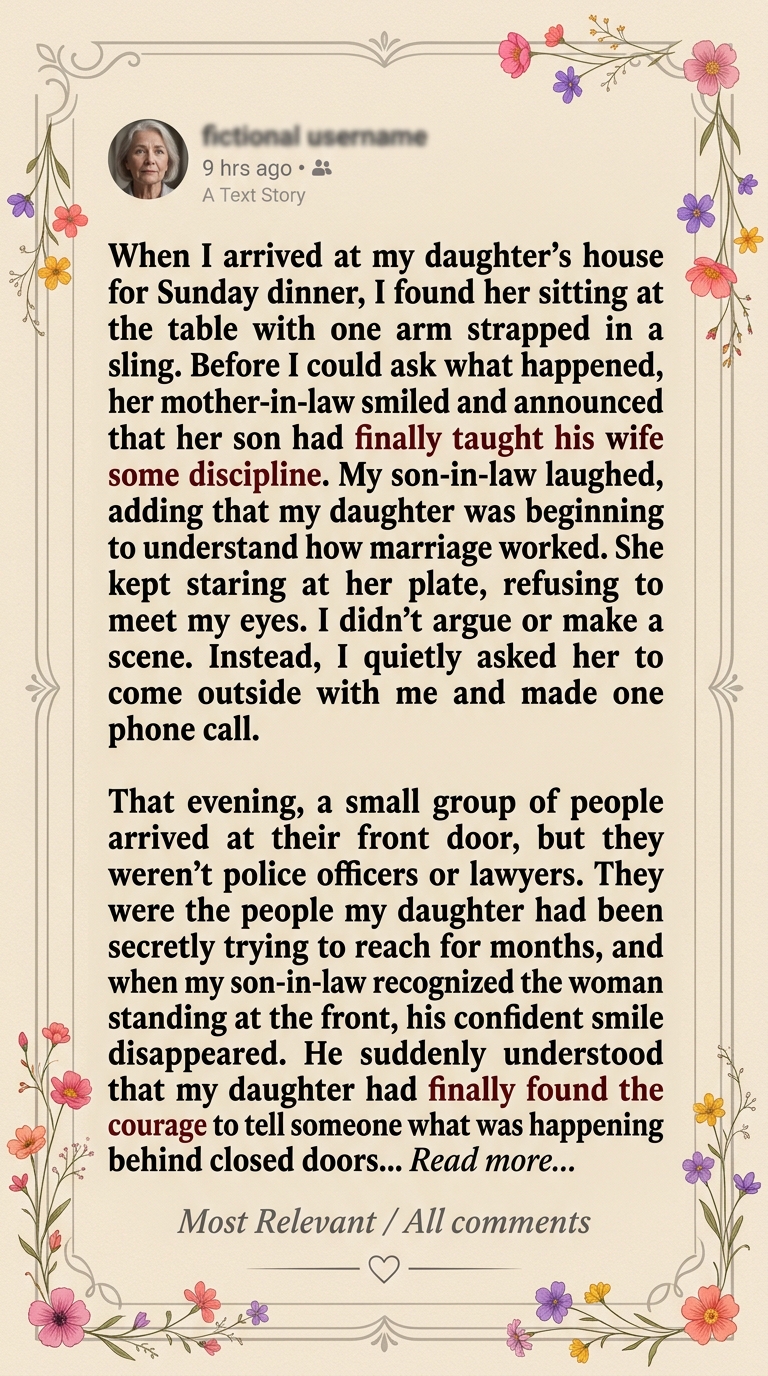
When I arrived at my daughter’s house for Sunday dinner, I knew something was wrong before I even stepped through the front door.
Emily usually greeted me with a hug. She would take my coat, ask about my week, and complain that I had brought too much food again.
That afternoon, she remained seated at the dining table.
Her left arm was secured in a black sling, and a faint bruise showed beneath the sleeve of her sweater.
Before I could ask what had happened, her mother-in-law, Patricia, placed a bowl of vegetables on the table.
“Don’t worry about that arm,” she said cheerfully. “My son has finally taught his wife a little discipline.”
I stopped moving.
My son-in-law, Mark, laughed from the other side of the table.
“She’ll learn eventually. Marriage isn’t about doing whatever you want.”
Emily stared at her plate.
I looked at Mark.
“What happened to her arm?”
“She fell,” he answered.
Patricia gave a little laugh.
“She has a habit of making everything difficult. Mark only lost his patience because she wouldn’t listen.”
I pulled out a chair but didn’t sit down.
Emily’s eyes met mine for half a second. There was fear in them, but something else too.
A silent request.
I had known my daughter for thirty-four years. I knew when she was hiding a surprise birthday present, when she was pretending not to be upset, and when she was frightened but trying to protect someone else.
This was not an ordinary family disagreement.
I placed my handbag on the table.
“Emily, would you come outside with me for a moment?”
Mark immediately frowned.
“Why?”
“I need her help with something in the car.”
“She can’t carry anything with that arm.”
“I didn’t ask her to carry anything.”
Patricia looked between us.
“There’s no need to be dramatic. We’re having dinner.”
I kept my voice calm.
“Then we’ll be back shortly.”
Emily stood carefully and followed me outside.
As soon as the door closed, she began crying.
I put my arms around her, avoiding the injured one.
“Tell me what happened.”
She shook her head.
“Mom, I can’t go back in there.”
“Then you won’t.”
She looked toward the house.
“He checks my phone. He reads my messages. Patricia tells him everything I say. I’ve tried calling people, but he always finds out.”
I felt anger rising inside me, but I kept my voice gentle.
“How long has this been happening?”
“Almost a year.”
I closed my eyes briefly.
A year.
My daughter had been living with this for almost a year, and I had mistaken her silence for the ordinary distance that sometimes develops when adult children build their own households.
“Your arm,” I said. “Did Mark hurt you?”
She nodded.
“Last Tuesday. I told him I wanted to visit you. He said I was always choosing my family over his. When I tried to leave, he grabbed me. I fell against the stairs.”
“Did you see a doctor?”
“He took me to a clinic the next morning. He told them I had fallen while cleaning.”
I held her hand.
“Did you tell the doctor the truth?”
She shook her head.
“Mark was standing beside me. I couldn’t.”
I wanted to march back inside and confront him. I wanted to demand an explanation from Patricia and tell them both exactly what I thought of their behavior.
But Emily was frightened, and I knew a confrontation could put her in greater danger.
So I asked one question.
“Do you remember the woman you met at the community center last year?”
Emily looked at me.
“Mrs. Reynolds?”
“Yes. Do you still have her number?”
Emily nodded.
“She told me I could call her if I ever needed help. But Mark said she was interfering in our marriage.”
“Have you tried contacting her?”
“Several times. He found the messages and deleted them.”
I took out my phone.
“Then I’ll call her.”
The woman Emily had mentioned was Helen Reynolds, the coordinator of a local family support network. I had met her during a neighborhood fundraiser and later learned that she helped women facing domestic abuse find practical, confidential assistance.
I had no idea how much my daughter had relied on her.
Helen answered after two rings.
“Hello?”
“It’s Margaret. I’m Emily’s mother.”
Her voice changed immediately.
“Is Emily with you?”
“Yes. She’s injured, and she says she isn’t safe at home.”
There was a brief silence.
“Is she able to speak privately?”
I handed the phone to Emily.
For several minutes, my daughter spoke quietly while I stood beside her.
When she finished, Helen asked us to remain outside and away from the house if possible. She arranged for a support worker and a trained domestic violence advocate to meet us at a nearby location.
Then she told us something I hadn’t expected.
“Emily contacted us five months ago,” Helen explained. “She came to one of our support sessions, but she never felt safe enough to make a plan. We’ve been trying to reach her through the contact method she approved.”
Emily lowered her head.
“I kept thinking I could fix it.”
Helen’s voice softened.
“You don’t have to fix someone else’s violence. You only have to decide what keeps you safe.”
We drove to a nearby café, where Helen and another advocate met us.
They helped Emily explain what had been happening, documented her injuries with her consent, and arranged a medical assessment.
The doctor confirmed that her upper arm had a fracture consistent with a significant fall or impact. He also noticed older bruising on her shoulder and back.
Emily finally told him that Mark had caused the injuries.
The support worker explained the available options, including emergency accommodation, legal protections, and help retrieving personal belongings safely.
Emily chose to stay with me that night.
But before we left, she asked if she could return to the house briefly to collect her medication, identification, and a few clothes.
The advocate advised against going back alone.
Helen made a phone call.
That evening, a small group arrived at Mark’s front door.
They weren’t police officers or lawyers.
They were Helen Reynolds, two trained family-support workers, and a representative from a local domestic abuse service who had been helping Emily prepare to leave.
I accompanied them.
Mark opened the door with an irritated expression.
“What is this?”
Then he recognized Helen.
His confident smile disappeared.
“You?”
Helen remained calm.
“Good evening, Mark. We’re here because Emily has asked for assistance.”
He glanced behind her and saw my daughter standing beside me.
“This is a private family matter.”
Helen nodded.
“Emily is an adult. She has the right to decide where she lives and who supports her. We’re here at her request.”
Patricia appeared behind him.
“What’s all this nonsense? My son has never done anything wrong.”
Emily’s hands began trembling.
I stepped beside her.
“You don’t have to explain anything to them tonight.”
Mark looked at me.
“You’ve been filling her head with lies.”
“No,” I replied. “I finally listened when she told me the truth.”
He turned toward Emily.
“Come inside. We can discuss this without strangers.”
She took a breath.
“No.”
The single word seemed to surprise everyone.
Mark’s face hardened.
“Emily, don’t embarrass yourself.”
“I’ve been afraid of embarrassing you for months,” she answered. “I’ve been afraid of making you angry. I’ve been afraid of what your mother would say. I’m not going back.”
Patricia scoffed.
“You’re destroying your marriage over a broken arm?”
Emily looked at her.
“You watched him hurt me and called it discipline.”
For the first time, Patricia had nothing to say.
Helen explained that Emily was there to collect essential belongings. The support workers would remain present, and any further communication about the separation should go through appropriate professional channels.
Mark tried to argue that he had a right to stop her.
He didn’t.
Emily collected her medication, identification, work documents, and a small suitcase. She also took her grandmother’s photograph from the bedroom dresser.
When she returned to the hallway, Patricia stood near the stairs.
“You’ll regret leaving,” she said.
Emily looked at her for a long moment.
“I already regret staying.”
Then she walked out.
The first weeks were difficult.
Emily moved into a small supported apartment while her arm healed. She attended medical appointments and began meeting regularly with a counselor. The support network helped her understand the pattern of control she had experienced.
The more she spoke, the more she remembered.
Mark had gradually isolated her from friends, criticized her clothes, monitored her spending, and insisted that she ask permission before visiting family. Patricia had reinforced his behavior, telling Emily that a good wife should know when to remain quiet.
The physical violence had begun much later.
Emily had hidden it because she was ashamed and because Mark repeatedly told her that nobody would believe her.
But people did believe her.
Her medical records, photographs, messages, and account of the incidents helped establish what had happened. With support from an advocate and legal counsel, she obtained appropriate protective measures and began divorce proceedings.
Mark sent messages apologizing, then accusing her of exaggerating, then promising to change.
Emily did not respond directly.
She was learning that an apology did not automatically make a person safe.
Several months later, I visited her new apartment.
Her arm was out of the sling, though she still attended physical therapy. She had placed fresh flowers on the kitchen table and bought a bright yellow kettle because, as she told me, she had always wanted one.
We made tea and sat near the window.
“Do you think I should have told you sooner?” she asked.
I reached across the table.
“I wish you had. But I’m not angry with you.”
“I was embarrassed. I thought you’d ask why I stayed.”
I shook my head.
“I might ask what you need now. That’s more important.”
She smiled faintly.
For the first time in a long while, she looked like herself.
A few weeks later, she began volunteering at the same family support network that had helped her leave. She wasn’t ready to share her entire experience publicly, but she wanted to help with practical tasks, organize donated clothing, and welcome women who arrived feeling frightened and uncertain.
Helen eventually introduced her to a woman who had recently left a controlling relationship.
Emily sat beside her and listened.
She didn’t tell the woman what to do. She simply said, “You don’t have to figure out your whole future today. Just take the next safe step.”
I watched from across the room.
I remembered the daughter who had sat silently at that Sunday dinner, staring at her plate while two people mocked her injuries.
Now she was speaking without looking at the floor.
One afternoon, she asked me whether I regretted not recognizing the warning signs earlier.
I thought carefully before answering.
“I regret that you were hurt. I regret that I didn’t understand how much you were hiding. But I won’t make your recovery about my guilt.”
She reached for my hand.
“Thank you for not making me explain everything before helping me.”
I squeezed her fingers.
“You never had to earn my help.”
Her divorce was finalized the following year. Mark and Patricia remained part of the past she was learning to leave behind. She established clear boundaries, rebuilt friendships, and gradually returned to work.
The last time I heard from Patricia, she sent a message saying that I had broken up a family.
I didn’t answer.
A family is not held together by forcing one person to endure fear and humiliation.
That Sunday, I had gone to my daughter’s house expecting an ordinary meal. Instead, I found a woman who had been trying to ask for help while the people hurting her sat comfortably at the same table.
I still think about how easily I could have missed it.
If I had argued with Mark in front of everyone, Emily might have been left alone with him again. If I had demanded that she explain herself before helping, she might have retreated into silence.
Sometimes the most important thing a parent can do is recognize the quiet request hidden behind a familiar face.
And sometimes, saving someone begins with a simple promise:
“You don’t have to go back.”

