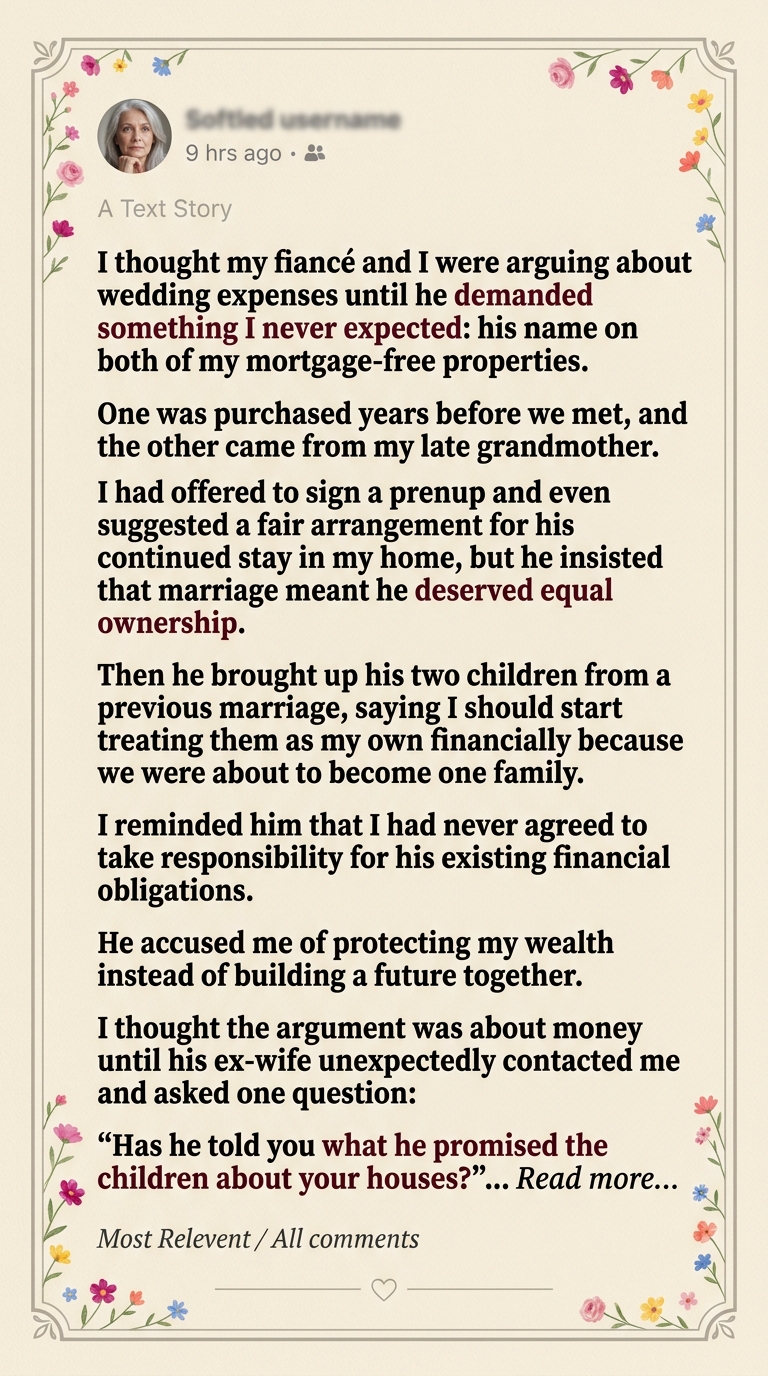
I had always believed that the hardest part of planning a second marriage would be blending two different lives. I never imagined the greatest difficulty would be discovering that my fiancé had already made promises about things he did not own.
My name is Rebecca, and I was forty-six when I became engaged to Daniel, a man I had been dating for nearly three years. He was charming without being overbearing, thoughtful in small ways, and devoted to his two children, Sophie, who was thirteen, and Ethan, who was ten.
I had never been married, although I had come close once. After that relationship ended, I decided to build a life that didn’t depend on anyone else. I worked hard, bought a modest house in the suburbs, and later purchased a small lakeside property that I rented out during the summer.
The first house was completely paid off before I met Daniel. The second had been left to me by my grandmother, who had spent her final years there. Both properties were mortgage-free, and I had no intention of giving either away.
Daniel knew all of this from the beginning.
He also knew that I had no children of my own and that I had always been careful with money. He never seemed bothered by it. In fact, he often praised my independence.
When we became engaged, I offered to arrange a prenuptial agreement. I wanted both of us to feel protected, especially because Daniel had children and financial responsibilities from his previous marriage.
He agreed at first.
Then, as our wedding plans became more serious, his attitude changed.
It began with a conversation about where we would live after the wedding. Daniel had been staying at my house for several months, and I suggested that we continue living there while keeping the properties legally separate.
I was happy to share the home with him. I was even willing to discuss a written agreement giving him certain protections if we ever separated after years of living together.
He didn’t like that suggestion.
“If we’re getting married, why should I be treated like a tenant?” he asked.
“You wouldn’t be a tenant,” I replied. “You’d be my husband. But the house was mine before we met.”
He leaned back in his chair.
“That sounds like you’re already planning for the marriage to fail.”
“Planning responsibly isn’t the same as expecting failure.”
He dropped the subject, but only for a few days.
The next argument happened when we were reviewing wedding expenses. Daniel wanted a more expensive reception, and I suggested a smaller celebration so we could avoid unnecessary spending.
He suddenly brought up the properties again.
“I think my name should be added to both deeds before the wedding,” he said.
I stared at him.
“Both properties?”
“Yes. They’re going to be our family assets. I don’t see why everything should remain in your name.”
“One was purchased years before I knew you. The other belonged to my grandmother.”
“And now we’re getting married.”
“Marriage doesn’t mean I automatically give away everything I owned before meeting you.”
His expression tightened.
“That’s exactly the problem. You keep saying my money, your property, your house. When do we become one family?”
I reminded him that I had offered a prenup and was willing to discuss fair arrangements for our shared expenses and living situation.
He shook his head.
“A prenup is just a way to make sure I leave with nothing.”
I was beginning to realize that we were no longer discussing how to build a future together. We were arguing over what he believed he was entitled to receive.
Then he mentioned Sophie and Ethan.
“They’re going to be your children too,” he said. “You should start thinking about their future. Those houses could give them security.”
“I care about them, Daniel. But I never agreed to become financially responsible for obligations from your previous marriage.”
He looked offended.
“They’re children, Rebecca. You’re talking about them like they’re strangers.”
“They aren’t strangers. But caring about them doesn’t mean transferring ownership of my grandmother’s home.”
He stood up.
“You’re protecting your wealth instead of building a future with me.”
That evening, we barely spoke.
I went to bed wondering whether I had been unreasonable. I had never expected Daniel to contribute equally to the value of my properties. I had simply wanted to preserve what I had built and inherited.
The next morning, I received a message from a number I didn’t recognize.
The woman introduced herself as Laura.
She was Daniel’s former wife and the mother of Sophie and Ethan.
I had met her briefly at one of the children’s school events, but we had never spoken privately.
Her message was short.
Rebecca, I know this is uncomfortable, but I need to ask you something. Has Daniel told you what he promised the children about your houses?
I read it twice.
Then I called her.
Laura answered almost immediately.
“I’m sorry to contact you like this,” she said. “I don’t want to interfere in your relationship. But I heard something from Sophie that worried me.”
“What did she say?”
Laura hesitated.
“Daniel told the children that after the wedding, they would have two houses available to them. He said one would eventually be theirs to use when they were older, and the other could be sold to help pay for their university education.”
I felt my stomach tighten.
“He told them that?”
“Yes. Sophie thought it was wonderful. She told me she was excited because she wouldn’t have to worry about university fees anymore.”
I gripped the phone.
“Did he tell you that he planned to give them my properties?”
“He didn’t say he was giving them the properties directly. He said you were going to put his name on the deeds, and that once you were married, he would make sure the children benefited from them.”
I was silent.
Laura continued.
“I asked him where the money would come from. He told me that you were financially comfortable and that it was only fair for your assets to support the family.”
“Did he tell you this himself?”
“He told me last week when we were discussing the children’s future expenses. He said I wouldn’t need to worry so much about their university costs because you would be helping.”
I felt something inside me settle.
The argument about the deeds suddenly made sense.
Daniel wasn’t simply asking to feel included in my financial life. He had already presented my properties to his children as part of their future.
“Why are you telling me?” I asked.
“Because Sophie asked me whether she should start choosing which house she wanted to live in when she was older. I didn’t know what to say. I thought perhaps you had agreed to something without telling me.”
I thanked Laura for contacting me.
Before ending the call, she added something else.
“Please don’t blame the children. They believe what their father tells them. They’re excited because they think someone has made their future secure.”
I promised her I wouldn’t.
That afternoon, I asked Daniel to sit down with me.
I didn’t tell him Laura had contacted me immediately. I wanted to hear what he would say when given the opportunity to be honest.
“Have you discussed my properties with Sophie and Ethan?”
He looked up from his phone.
“What about them?”
“Have you told them they would eventually benefit from my houses?”
He frowned.
“I’ve told them we’re going to be a family. That’s all.”
“Have you told them one property could be sold to pay for their university education?”
His expression changed.
For several seconds, he didn’t answer.
Then he sighed.
“They’re children. I was reassuring them.”
“Reassuring them about something you don’t own?”
“Rebecca, don’t twist my words.”
“I’m asking a simple question. Did you promise them that my properties would provide for them?”
He rubbed his forehead.
“I told them that once we’re married, we’ll have more resources. I thought you’d want to help them.”
“I want to support them in reasonable ways. I have never promised to pay for their education or give them access to my inheritance.”
He leaned forward.
“You have two houses and no children. What exactly do you need all that property for?”
The question hurt more than I expected.
Not because I didn’t know the answer, but because he had reduced my entire working life to something he believed I should distribute.
“The houses are not sitting there because I don’t know what to do with them,” I said. “One is where I live. The other is part of my family’s history. I may sell it someday, keep it, or leave it to someone. That’s my decision.”
Daniel shook his head.
“You’re making this about ownership instead of love.”
“No. I’m making it about honesty.”
I told him that I wanted to speak with an independent attorney before making any decisions about the marriage.
He immediately became defensive.
“Why do we need lawyers involved? We’re supposed to trust each other.”
“Trust is exactly why I need to understand why you promised my property to your children without asking me.”
He stood and walked toward the kitchen.
“I can’t believe you’re doing this.”
I didn’t follow him.
For the next two days, he barely spoke to me. When he did, he returned to the same argument. He said I was humiliating him, that Laura was interfering, and that I was creating conflict between him and his children.
But I refused to discuss the matter with Sophie or Ethan.
They had done nothing wrong.
Instead, I contacted an attorney named Miriam Cole, who specialized in estate planning and family property matters. She reviewed my deeds, financial records, and the draft prenuptial agreement Daniel had initially agreed to.
Her advice was straightforward.
Keep the properties separate. Do not add Daniel to the deeds under pressure. Make sure any future shared expenses and living arrangements are clearly defined. If I wanted to provide financial support for the children, I could do so voluntarily and directly without giving anyone ownership of my assets.
She also suggested that I ask Daniel to attend a meeting with an independent mediator before the wedding.
I agreed.
Daniel refused.
He said a mediator would only encourage me to protect myself.
That was when I finally understood that no agreement would satisfy him unless it gave him the ownership he wanted.
A week later, he returned from work and placed a printed document on the kitchen counter.
“I’ve had someone prepare a proposal,” he announced.
I picked it up.
It was a draft agreement outlining how the properties would be transferred into joint ownership after our marriage. It also included a section describing how future rental income from the lakeside property could be used toward the children’s education.
At the bottom was a space for my signature.
I looked at him.
“Who prepared this?”
“A friend who understands property matters.”
“Did you tell him these properties belonged to me before our relationship?”
“Of course.”
“And did you tell him I had never agreed to transfer ownership?”
Daniel looked away.
“I thought once you saw it in writing, you’d understand that it was fair.”
I placed the document back on the counter.
“I won’t sign this.”
His face reddened.
“Then maybe we shouldn’t get married.”
I felt a strange calm settle over me.
“Maybe we shouldn’t.”
He stared at me, apparently expecting another argument.
Instead, I went upstairs and began packing his belongings.
He followed me.
“Are you serious?”
“Yes.”
“You’re ending everything over two houses?”
“No, Daniel. I’m ending it because you made promises about my property to your children, pressured me to sign away ownership, and treated my refusal as proof that I didn’t love you.”
He began speaking rapidly, insisting that he had only been trying to provide stability for Sophie and Ethan.
I believed that he wanted to provide for his children. But that did not excuse using my future marriage as a way to secure assets for them without my consent.
I told him he could collect the rest of his belongings the following day.
He left that evening.
For several weeks, he sent messages apologizing for how he had handled the situation. Some were sincere. Others accused me of allowing Laura to destroy our relationship.
I didn’t answer the accusations.
I did, however, contact Laura and thank her again.
She told me Sophie had been disappointed when her father explained that the houses were not going to become part of their future.
“I told her the truth,” Laura said. “I explained that adults sometimes make promises they don’t have the right to make. I also told her that her education is her father’s responsibility and that we’ll work together to plan for it.”
I appreciated that she hadn’t allowed the children to feel responsible for what had happened.
A month later, Daniel collected the last of his belongings. Before leaving, he stood in the doorway and looked at the living room.
“I really did think we could have had a good life together,” he said.
“So did I.”
“Don’t you think there’s a way to compromise?”
I considered his question.
“We already had a compromise. I offered to protect both of our existing assets while building a shared life. You wanted my name removed from the future of my own property and yours added to it.”
He lowered his eyes.
For once, he didn’t argue.
After he left, I canceled the wedding arrangements. Some deposits were lost, and several people asked what had happened. I simply told them that we had discovered we wanted different things from marriage.
I didn’t explain every detail.
Over the following months, I returned to the life I had built before meeting Daniel. I continued working, visited the lakeside property, and began restoring the small garden my grandmother had planted.
I also started a modest education savings fund for Sophie and Ethan.
Not because Daniel had demanded it, and not because I believed I owed them anything.
I did it because I had come to care about them, and because children should never be made to feel responsible for the choices of adults.
The fund was arranged through an independent account with clear conditions. Laura knew about it, and Daniel was informed that the money was a voluntary gift from me, not a commitment to future expenses.
He never thanked me.
That was fine.
One afternoon, while I was planting new flowers beside my grandmother’s old house, I received a message from Sophie.
She wrote that she was sorry things hadn’t worked out between her father and me. She said she hoped I was happy and thanked me for remembering her birthday.
I smiled and wrote back that I wished her well and hoped she would continue working hard toward the future she wanted.
Then I put my phone away.
For a long time, I had thought that protecting my properties meant protecting my money.
I finally understood that it meant protecting the choices those properties represented: where I lived, what I preserved, what I gave away, and what I left behind.
Marriage should create a shared future, not give one person permission to promise another person’s past to someone else.
I had wanted a husband.
I had nearly married someone who saw my life as an opportunity to secure his own family’s future.
And I was grateful that I discovered the difference before signing my name.

