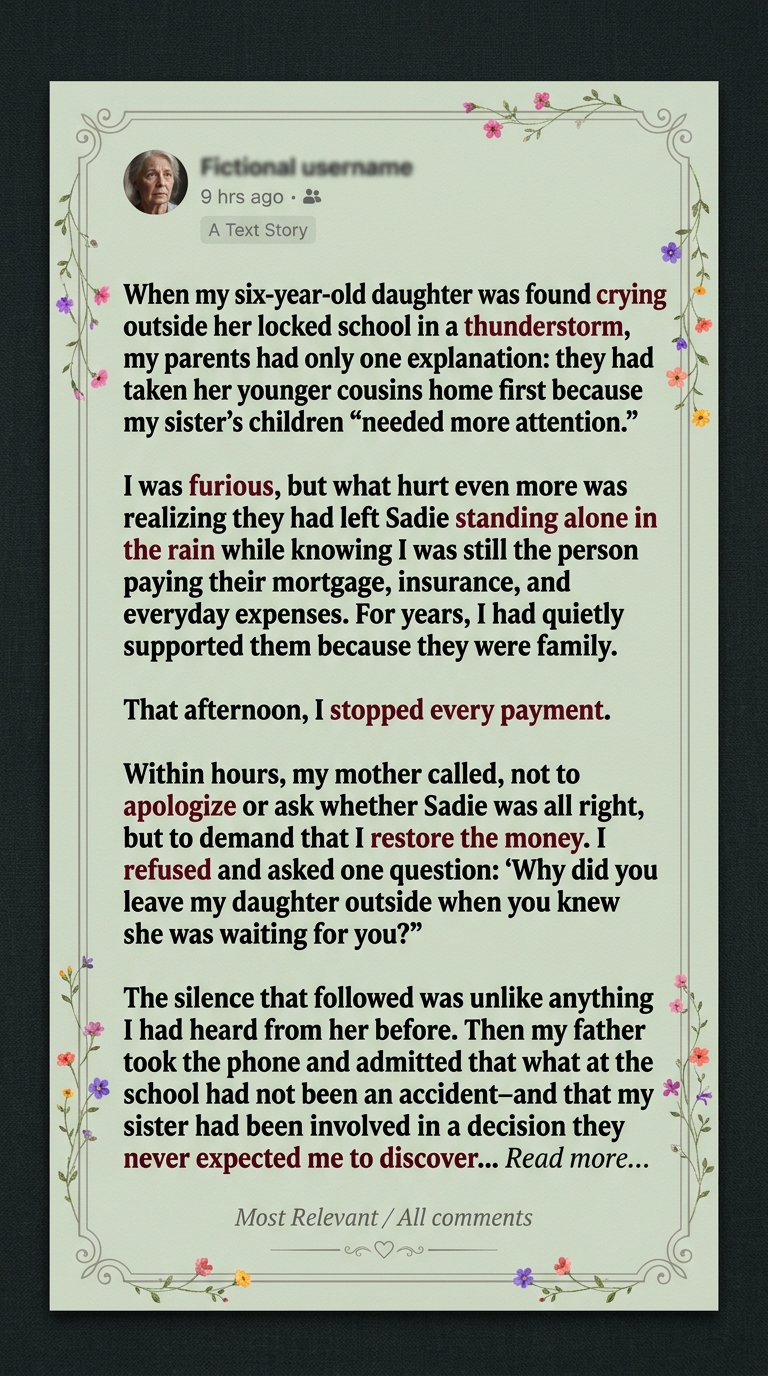
The first time I realized my parents valued my sister’s children more than mine, my six-year-old daughter was standing outside a locked school in the middle of a thunderstorm.
I was working late that afternoon when the school called.
The receptionist sounded concerned.
“Mrs. Carter, Sadie is still here. Everyone has gone home, and we can’t reach the people listed to collect her.”
I looked at the clock.
It was nearly five.
“My parents were supposed to pick her up,” I said. “I’ll be there as quickly as I can.”
When I arrived, the rain was coming down so heavily that I could barely see the school entrance.
Sadie was sitting beneath the narrow overhang beside the locked gate. Her backpack was soaked, her hair was plastered to her cheeks, and her little hands were trembling.
The school receptionist had stayed with her until I arrived.
The moment Sadie saw me, she ran into my arms.
“Mommy, I thought you forgot me.”
Those words hurt more than anything else.
I wrapped my coat around her and held her close.
“I would never forget you, sweetheart.”
She began crying again.
“Grandma said they were coming back, but they didn’t.”
I took her home, changed her clothes, made her something warm to drink, and waited until she had stopped shivering before asking what happened.
Sadie explained that my parents had collected her cousins first. Her aunt, my younger sister Vanessa, had asked them to take her two children to an after-school activity.
Apparently, my parents decided that was more important than collecting Sadie at the agreed time.
But that wasn’t the worst part.
When I finally reached my mother, she didn’t sound worried.
“Oh, she’s with you now, isn’t she?” she said.
“Yes. She’s home. Why did you leave her at school?”
“We didn’t leave her. We had a little problem with the children.”
“What problem?”
“Vanessa’s youngest was upset. He needed us, and we couldn’t just leave him crying.”
“So you left my daughter outside in a storm?”
My mother sighed.
“Don’t make this bigger than it is. Sadie is fine.”
I looked at my daughter, who was sitting on the sofa with a blanket around her shoulders.
“She was frightened and alone. She thought nobody was coming for her.”
“Well, you picked her up, didn’t you?”
I couldn’t believe what I was hearing.
For years, I had helped my parents financially. My father had retired early after a workplace injury, and my mother had never returned to full-time employment. When their mortgage payments became difficult, I began helping.
At first, it was temporary.
Then I started covering their home insurance, utilities, groceries, and several recurring expenses.
I never complained. I believed helping family was something you did when you were able.
But that afternoon, something changed.
I opened my banking application and reviewed every payment connected to their household.
The mortgage contribution.
The insurance.
The monthly grocery allowance.
The utility payments.
I stopped them one by one.
Within an hour, my mother called again.
“What have you done?”
I kept my voice calm.
“What do you mean?”
“The mortgage payment hasn’t gone through. Your father says the insurance payment has been canceled too. Why are you doing this?”
“Because I need to reconsider the financial arrangements.”
“You can’t suddenly stop helping us!”
“I can.”
“We’re your parents!”
“And Sadie is your granddaughter.”
There was a pause.
Then my mother said something that made my hands tighten around the phone.
“You’re punishing us because we had to take care of Vanessa’s children.”
“No. I’m stopping because you left mine alone outside in dangerous weather.”
She became defensive.
“Vanessa’s children needed us more at that moment.”
I looked toward the living room.
Sadie was drawing a picture of our house. She had drawn herself standing beside the front door, holding my hand.
I lowered my voice.
“Why did you leave my daughter outside when you knew she was waiting for you?”
My mother didn’t answer.
For several seconds, all I could hear was breathing.
Then my father took the phone.
“Claire, there’s something you need to know.”
His voice sounded different. Not angry. Not defensive.
Afraid.
“What is it?”
“What happened at the school wasn’t exactly what your mother told you.”
I stood up.
“Explain.”
He hesitated.
“Vanessa called us before pickup. She asked us to collect her children first because she had somewhere important to be.”
“That doesn’t explain why Sadie was left behind.”
“No. It doesn’t.”
He took a breath.
“Vanessa asked us not to collect Sadie until after we had taken her children home. She said she wanted to teach you something.”
I felt a chill.
“Teach me what?”
My father was silent for a moment.
“She said you needed to learn that you couldn’t keep treating your parents like paid employees.”
I couldn’t speak.
He continued.
“Your mother didn’t agree at first. But Vanessa told her that if we kept helping with Sadie, you’d never stop expecting us to be available whenever you needed something.”
I gripped the edge of the kitchen counter.
“My daughter was left outside in a storm because Vanessa was angry that I expected you to collect her?”
“Yes.”
“Did you know the school was closing?”
“Yes.”
“Did you know Sadie was waiting?”
My father lowered his voice.
“Yes.”
I closed my eyes.
For a moment, I couldn’t hear anything except the rain hitting the windows.
Then I asked, “Why didn’t you tell me?”
“Because we knew you would be angry.”
I almost laughed.
They had known exactly what they were doing.
My father said Vanessa had promised to return for Sadie after taking her children home. But when the rain started, she called again and told them not to go back.
“She said you could collect your own daughter,” he admitted.
I felt sick.
“Did Mom agree?”
He didn’t answer.
That was answer enough.
I ended the call.
I didn’t shout. I didn’t send Vanessa a furious message. I didn’t threaten anyone.
I simply made one decision.
My daughter would never again be placed in their care unless she could be certain she was safe.
The next morning, I contacted the school and asked them to remove my parents as approved pickup contacts. I also arranged for a trusted neighbor and a licensed after-school service to help with collection when work ran late.
Then I called my attorney to review the financial support I had been providing my parents.
The mortgage was in their names, and I had never signed an agreement promising to pay it. The insurance and utility accounts were also theirs.
My attorney advised me to make sure the cancellation of each payment was handled correctly and to keep records of the arrangements I had previously made.
I wasn’t trying to take their home.
I was simply no longer willing to finance a household that treated my daughter as an inconvenience.
Two days later, Vanessa came to my house.
She arrived without calling and stood on my porch with her arms crossed.
“Are you really doing this?” she demanded.
I opened the door but didn’t invite her inside.
“Doing what?”
“Cutting off Mom and Dad’s money.”
“They’re responsible for their own expenses.”
“You know they can’t manage everything without you.”
“Then they need to make different arrangements.”
She rolled her eyes.
“This is ridiculous. You act like Sadie was abandoned in the wilderness.”
“She was left outside a locked school in a thunderstorm.”
“Mom and Dad had my children to look after.”
“They could have collected all three children. They chose not to.”
Vanessa’s expression hardened.
“You’ve always thought your daughter should come first.”
I stared at her.
“She does come first. She’s my child.”
“Exactly. You expect everyone else to organize their lives around her.”
I couldn’t believe she was saying this.
For years, I had helped Vanessa too. I had paid for emergency childcare when she was between jobs, covered school supplies, and helped with unexpected expenses.
I had never kept a list.
But suddenly, I understood that she had mistaken my generosity for an obligation.
“Why did you ask them to leave Sadie at school?” I asked.
Vanessa looked away.
“I didn’t tell them to leave her in the rain.”
“You told them not to collect her until after your children were home.”
“I needed help.”
“And when the weather got worse?”
She shrugged.
“They should have handled it.”
I took a breath.
“Did you tell them you wanted to teach me a lesson?”
She didn’t answer.
I continued.
“Did you think my six-year-old daughter was an appropriate way to punish me?”
Vanessa finally looked at me.
“You make everything about yourself.”
“No. You made a decision about my child without caring what it would do to her.”
She stepped closer.
“Mom and Dad are suffering because of you.”
I shook my head.
“They’re suffering because they relied on money they didn’t earn and made choices they knew could cost them my support.”
Vanessa left without another word.
That evening, my mother sent a long message explaining that she had been under pressure and hadn’t intended to hurt Sadie.
I read it carefully.
She wrote about how difficult it was to manage three children, how Vanessa had been upset, and how my father was struggling with his health.
Not once did she ask how Sadie was feeling.
Not once did she apologize for leaving her outside.
I didn’t respond.
Over the next few weeks, my parents began making changes. They contacted their mortgage provider, reduced their expenses, and arranged for my father to return to part-time work within the limits of his injury.
They also sold a second vehicle they rarely used.
I heard about these changes through relatives, but I didn’t offer to resume the payments.
Then something unexpected happened.
Sadie’s school counselor called me.
She explained that Sadie had begun asking whether someone would always come for her after school. She had also become anxious whenever the weather turned bad.
The counselor recommended a few sessions with a child therapist to help her process the experience.
I agreed.
During one session, Sadie told the therapist that she had been afraid her grandparents didn’t love her anymore.
When I heard that, I cried in my car.
I had spent so many years trying to make sure my parents were comfortable that I had never considered whether their behavior might one day make my daughter feel unwanted.
I decided that any future relationship between Sadie and her grandparents would depend on their willingness to acknowledge what they had done and respect clear boundaries.
About six weeks after the incident, my father came to visit.
He called first and asked whether I would allow him to speak with Sadie.
I told him he could come, but I would be present.
He arrived carrying a small wooden puzzle.
Sadie stayed close to me when he entered.
My father knelt in front of her.
“Hello, sweetheart.”
She looked at the puzzle but didn’t reach for it.
He swallowed.
“I owe you an apology.”
She said nothing.
“I knew you were waiting at school. I knew the weather was getting worse, and I should have come back for you. I didn’t. That was wrong, and I’m sorry.”
Sadie looked up.
“Why didn’t you come?”
My father lowered his head.
“I made a selfish decision. I thought about what your aunt wanted instead of what you needed.”
“Did Grandma know?”
He nodded.
“Grandma knew too.”
Sadie looked at me.
I didn’t tell her what to say or how to feel.
After a moment, she asked him whether he would leave her at school again.
My father looked directly at her.
“No. And if I ever say I’ll collect you, I will make sure you’re safe. But your mother will decide when you’re ready to trust me again.”
It was the first time I had heard him accept responsibility without blaming my sister.
I allowed him to visit occasionally, but I did not restore the old childcare arrangement. He had to earn back trust through consistent behavior, not promises.
My mother took longer.
She eventually sent an apology, but it focused mostly on how badly the family had been divided. I told her that I was willing to talk when she could acknowledge what had happened without defending it.
She didn’t reply for several weeks.
Vanessa never apologized.
She told relatives that I had abandoned our parents financially and turned one bad afternoon into a family crisis.
I stopped trying to correct every version of the story.
The people who mattered knew what had happened.
Several months later, Sadie and I were walking home from school when dark clouds gathered overhead.
She looked up at the sky.
“Mommy, it’s going to rain.”
“Yes, sweetheart.”
She reached for my hand.
“Are you picking me up tomorrow?”
I squeezed her fingers.
“Every day, I’ll make sure someone safe is there for you.”
She smiled and continued walking.
I thought about the money I had spent supporting my parents over the years. I didn’t regret every dollar. Helping family had once been a choice I made freely.
But I finally understood that generosity without boundaries can become an expectation, and an expectation can become something people feel entitled to take—even when the cost is someone else’s child.
My parents had believed I would keep paying because they were my parents.
My sister had believed she could use their dependence on me to force me into doing what she wanted.
They had all forgotten one important thing.
I was not asking them to love my daughter more than their other grandchildren.
I was asking them to treat her as a child who deserved the same basic care and safety.
That should never have been too much to ask.
And no amount of family loyalty could make me accept otherwise.

