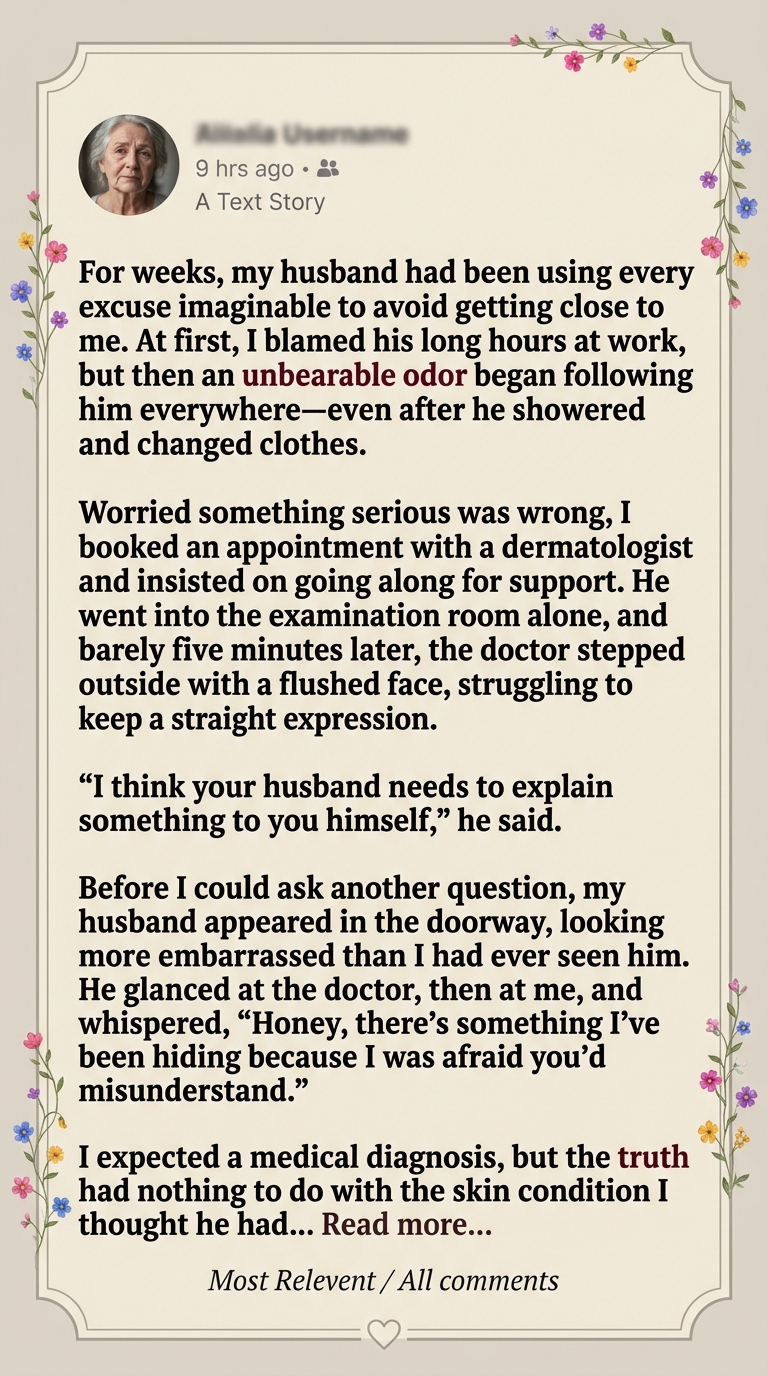
For nearly two months, my husband had been finding reasons to avoid touching me.
At first, I thought it was exhaustion. Daniel had recently taken on extra responsibilities at work, and he often came home looking drained. When I tried to hug him, he would turn sideways to put down his briefcase. When I reached for his hand in bed, he would pretend he needed to check his phone.
I didn’t want to make him feel guilty for being tired, so I gave him space.
Then the smell started.
It was difficult to describe. It wasn’t ordinary sweat or the smell of someone who had skipped a shower. It was a sharp, unpleasant odor that seemed to cling to his clothes and skin. Even after he showered, changed into fresh clothes, and used deodorant, it returned.
One evening, I opened the bedroom window while Daniel was changing.
He noticed and frowned.
“Is it really that bad?”
“I didn’t say anything.”
“You don’t have to. I can see your face.”
I softened my voice. “I’m worried about you. Maybe there’s something medical going on.”
He shook his head. “It’s nothing.”
But it wasn’t nothing. I could smell it when he sat beside me on the sofa, and sometimes even when he walked through the hallway.
I suggested seeing a doctor. He refused.
A week later, I booked an appointment with a dermatologist and told him I was going with him.
“You don’t need to come,” he protested.
“I know. I want to.”
He looked as though he wanted to argue, but eventually agreed.
The clinic was quiet when we arrived. After taking his history, the dermatologist, Dr. Harris, asked Daniel several questions about his skin, medications, and recent changes in his routine.
Daniel answered reluctantly.
When the doctor asked whether he had noticed any unusual discharge, irritation, or changes in the areas where the odor seemed strongest, Daniel stared at the floor.
“I don’t think that’s relevant,” he muttered.
Dr. Harris remained professional.
“It may be. I’d like to examine you privately for a few minutes.”
Daniel glanced at me.
“Wait here,” he said.
I watched him disappear behind the examination-room door.
Five minutes passed.
Then another.
Finally, Dr. Harris stepped into the hallway. His face was slightly flushed, and he seemed to be choosing his words carefully.
“Mrs. Carter, I think your husband needs to explain something to you himself.”
My stomach tightened.
“Is it serious?”
“Not in the way you’re imagining,” he replied. “But it is something he should have discussed with you.”
Before I could ask another question, Daniel appeared behind him.
His face was red.
“Honey,” he whispered, “there’s something I’ve been hiding because I was afraid you’d misunderstand.”
I looked from him to the doctor.
“What’s going on?”
Daniel rubbed his forehead.
“I’ve been trying to fix it myself.”
“Fix what?”
He took a breath.
“About six weeks ago, I started using a product I bought online. It was supposed to help with a problem I was having.”
“What problem?”
He looked toward the doctor.
Then he finally said it.
“I’ve been using a homemade odor treatment on my skin. It’s made everything worse.”
I blinked.
“What kind of treatment?”
Daniel swallowed.
“An antibacterial solution. Someone at work recommended it.”
Dr. Harris stepped in.
“Your husband has been applying a concentrated chemical preparation to his skin, including areas where the skin is particularly sensitive. It has caused irritation and a secondary infection. The odor is coming from the affected skin and the product itself.”
I stared at Daniel.
“You’ve been putting chemicals on yourself for six weeks?”
He looked miserable.
“I didn’t know it could do this.”
The explanation was strange, but it still didn’t answer why he had hidden it from me or why he had been avoiding physical contact.
Dr. Harris explained that Daniel had developed a painful rash in a private area. He had become embarrassed by the symptoms and had tried to treat them without seeking medical advice.
The first application had caused burning. Instead of stopping, Daniel had assumed the discomfort meant the product was working.
He applied it again.
And again.
Eventually, the irritated skin became inflamed and infected.
The doctor told him to stop using the product immediately. He prescribed an appropriate treatment, explained how to care for the affected skin, and arranged a follow-up appointment to check that the infection was clearing.
I listened carefully, then asked the question that had been bothering me.
“Is this contagious?”
“Based on what I’ve found today, the infection appears to be associated with the damaged skin and the product he applied,” Dr. Harris explained. “However, we shouldn’t assume anything without the necessary tests. Until we have the results and the inflammation has healed, avoid intimate contact and follow the treatment instructions.”
Daniel nodded.
I didn’t feel angry about the medical problem. I felt hurt that he had allowed embarrassment to create so much distance between us.
On the drive home, neither of us spoke for several minutes.
Finally, I asked, “Why didn’t you tell me?”
Daniel stared through the windshield.
“Because I thought you’d be disgusted.”
“By a rash?”
“By the smell. By the whole thing.”
I shook my head.
“Daniel, I thought you were seriously ill. I was worried about you.”
He rubbed his hands together.
“I know. But every time you came close, I imagined you noticing it. Then I started making excuses. I thought if I could get rid of it before you found out, everything would go back to normal.”
“And instead, you made me think you didn’t want me near you.”
He looked at me.
“I didn’t realize how much it was hurting you.”
That evening, he showed me the product.
It came in an unmarked plastic bottle with a printed label that promised to eliminate stubborn body odor. There was no reliable ingredient list, no manufacturer’s address, and no clear safety information.
I asked where he had bought it.
“From a man at work. He said his brother used it.”
I turned the bottle over.
“Did you even check what was in it?”
Daniel shook his head.
I placed it in a sealed bag and told him not to use it again. We followed the dermatologist’s instructions and disposed of it safely.
The next few days were uncomfortable, but something important changed.
Daniel stopped pretending everything was fine.
He told me that the problem had begun after a minor irritation from a new laundry detergent. He had been embarrassed to mention it because he thought it was an intimate hygiene issue. When the smell appeared, he panicked and searched for a quick solution.
His shame had made him secretive. His secrecy had made me feel rejected.
Neither of us had understood how far the misunderstanding had grown.
At his follow-up appointment, the doctor confirmed that the inflammation was improving. The tests did not show evidence of a sexually transmitted infection, and Daniel was advised to continue the prescribed care until his skin had completely healed.
A few weeks later, the odor was gone.
More importantly, the distance between us began to disappear.
One night, Daniel came into the kitchen while I was making tea. He stood behind me and gently rested his chin on my shoulder.
I turned around.
“Feeling better?”
He smiled.
“Much better.”
Then his expression became serious.
“I owe you an apology. I thought I was protecting you from something embarrassing, but I was actually shutting you out.”
I put my arms around him.
“You don’t have to hide every uncomfortable thing from me. I can’t help you with a problem I don’t know exists.”
He nodded.
“I understand that now.”
We never bought another mysterious treatment from someone at work. Daniel learned to seek medical advice instead of trusting unverified remedies, and I learned that his silence had not necessarily meant he had stopped loving me.
For a while, I had been preparing myself for the possibility that something terrible was happening to our marriage.
The truth was much less dramatic, but it taught us something neither of us would forget.
Sometimes, the thing that damages a relationship isn’t the problem itself.
It’s the shame that convinces someone they must face it alone.

