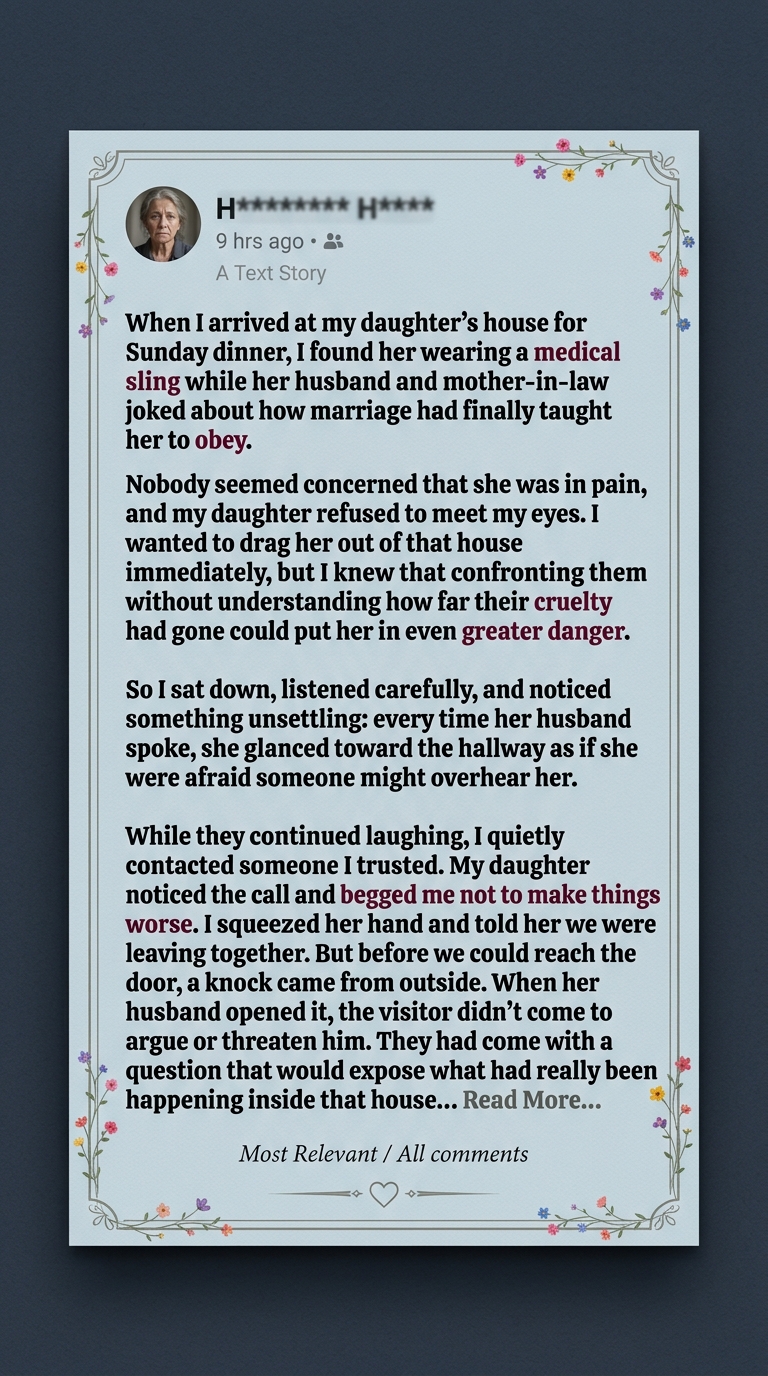
The Question at the Door
The first thing I noticed when I walked into my daughter’s house was the sling around her left arm.
The second was the laughter.
My daughter, Emily, sat at the dining table with her arm secured against her chest. Her face looked pale, and a faint bruise disappeared beneath the collar of her sweater. Across from her, her husband, Mark, was telling his mother how Emily had finally learned that marriage required obedience.
His mother, Patricia, laughed into her wineglass.
“Some women need a little reminding,” she said. “You can’t expect a husband to tolerate every little disagreement.”
Emily stared at her plate.
I had raised that girl to speak her mind. Even as a child, she would question rules that didn’t make sense and defend anyone she thought was being treated unfairly. Seeing her sit silently while two people made jokes about her pain felt like watching someone slowly erase her.
“What happened to your arm?” I asked.
Emily flinched before answering.
“I slipped.”
Mark answered for her. “She had a disagreement with the kitchen cabinet. The cabinet won.”
Patricia laughed again.
I forced myself to smile, though my stomach was tightening. If I confronted them immediately, Emily might pay for it after I left. I had seen enough to understand that whatever was happening in this house was more serious than a family argument.
So I pulled out a chair.
“Then let’s hope the cabinet has learned its lesson,” I said calmly.
Mark relaxed. He seemed pleased that I wasn’t challenging him. He began talking about work, the weather, and his plans to renovate the downstairs bathroom. Patricia complained that Emily hadn’t been keeping the house properly.
All the while, Emily barely touched her food.
And every time Mark raised his voice, her eyes moved toward the hallway.
It was a small movement, almost invisible. But I noticed it three times.
When Patricia left the table to answer a telephone call, I leaned closer to my daughter.
“Does your arm hurt?”
She nodded.
“Did you see a doctor?”
Her eyes filled with tears.
“Please don’t ask me here.”
I placed my hand over hers. Her fingers were cold.
“I’m not angry with you,” I whispered. “Whatever happened, you can tell me.”
She shook her head.
“Mom, please. Don’t make things worse.”
That sentence frightened me more than the sling.
I excused myself and walked toward the bathroom. Once inside, I called Helen, a family support worker I had known for years. She had helped a friend of mine leave an unsafe marriage and understood how dangerous it could be to act without a plan.
I explained what I had seen and asked whether she could come to the house.
“Don’t confront him,” Helen told me. “Keep your daughter near you if you can. I’ll come with someone who can speak to her privately. We need to understand what she wants and whether she’s in immediate danger.”
When I returned to the dining room, Emily was watching me.
“Who did you call?” she whispered.
“Someone who can help us.”
Her expression changed.
“You shouldn’t have done that.”
“Emily, look at me. I am not leaving you here if you don’t feel safe.”
She lowered her head.
Before I could say anything else, a knock sounded at the front door.
Mark pushed his chair back.
“Who on earth is that?”
He opened the door and found Helen standing outside with a woman named Rachel, an independent domestic abuse advocate. They weren’t carrying legal papers or making threats. Helen simply introduced herself and asked whether she could speak with Emily privately.
Mark’s smile disappeared.
“She’s my wife. Whatever she needs to say, she can say in front of me.”
Rachel remained calm.
“Emily is an adult. She has the right to speak with a support worker without anyone else present.”
Patricia appeared behind him.
“This is ridiculous. You’re making a private family matter into something it isn’t.”
Helen looked past them toward my daughter.
“Emily, may I ask you one question?”
Emily stood slowly, holding her injured arm.
Helen’s voice was gentle.
“Did you hurt yourself in an accident, or did someone in this house hurt you?”
The room went silent.
Mark immediately interrupted.
“She fell. I’ve already explained that.”
Helen didn’t look at him.
“I asked Emily.”
For several seconds, my daughter couldn’t speak. Then she looked at me, and I saw something I hadn’t seen in her face for months.
Fear mixed with the smallest trace of hope.
“Mark pushed me,” she whispered.
His expression hardened.
“Don’t start inventing stories.”
Emily swallowed.
“He grabbed my arm when I tried to leave the kitchen. I fell against the counter. My wrist broke.”
Patricia folded her arms.
“She was provoking him. You don’t know what she’s like when she gets upset.”
Emily began to cry.
I wanted to cross the room and put myself between them, but Rachel gently guided the conversation away from the argument.
“Emily, would you feel safer speaking somewhere else?”
My daughter nodded.
Mark stepped forward.
“She isn’t going anywhere.”
That was when Emily finally found her voice.
“You don’t get to decide that anymore.”
His face turned red.
“You wouldn’t last a week without me.”
“I’ve been surviving you for months,” she replied.
The words came out quietly, but they changed the room.
Helen and Rachel accompanied Emily into the sitting room, where they could speak without Mark or Patricia listening. I remained nearby, ready to help if she needed me.
The truth emerged slowly.
The injury hadn’t been the first time Mark had hurt her. He had begun by criticizing her clothes, her friends, and the way she spent money. Then he started checking her telephone and demanding to know where she had been. Patricia supported him, insisting that Emily needed to become a better wife.
When Emily resisted, Mark would block doorways, take her car keys, or threaten to tell everyone she was unstable.
The broken wrist had happened three weeks earlier.
He had driven her to a clinic himself and told the doctor she had fallen. Emily had been too frightened to contradict him. Afterward, he warned her that if she told anyone, he would make sure she never saw her family again.
“What about the bruises?” I asked when she finally showed us the ones on her upper arm.
Emily looked down.
“Sometimes he holds me so tightly that I can’t pull away. His mother says I should be grateful he doesn’t leave me.”
Rachel explained that Emily didn’t have to prove everything that day to deserve help. She needed medical care, a safe place, and support making decisions without pressure.
Helen arranged transportation and helped Emily contact a local support service. We also made sure her injury was properly documented by a medical professional.
Mark tried to stop us when we returned to the hallway.
“You’re taking my wife out of my house?”
Emily looked at him.
“I’m going to my mother’s. I don’t know what happens after that, but I know I’m not staying here tonight.”
Patricia stepped forward.
“You’ll destroy this marriage over one argument?”
Emily shook her head.
“No. You both helped destroy it long before today. I just stopped pretending it was normal.”
Mark’s expression changed when he realized she wasn’t going to argue with him.
He lowered his voice.
“Emily, think carefully. You’ll regret embarrassing me like this.”
For the first time that afternoon, she looked directly into his eyes.
“I regret being afraid of you.”
We left without another word.
At the hospital, doctors confirmed that Emily’s wrist had not healed properly because she had avoided follow-up appointments. They treated the injury and arranged further care. A social worker also helped her understand her options and connect with legal assistance.
The following weeks were difficult.
Emily woke from nightmares. She apologized whenever she asked for help, even when she needed something as simple as a glass of water. Sometimes she would stop speaking halfway through a sentence, as though she expected someone to punish her for saying the wrong thing.
I never told her to be strong.
Instead, I reminded her that she didn’t have to earn safety by being brave every minute.
Mark sent dozens of messages. At first, he apologized. Then he blamed Patricia. Then he blamed Emily. When she refused to return, he began threatening to come to my house.
With Rachel’s guidance, Emily documented the messages and sought appropriate legal protection. Mark eventually faced a formal investigation into the assault. Patricia was interviewed as well, but continued insisting that she had done nothing wrong.
Emily filed for divorce.
Months later, her wrist had healed enough for her to return to work. She moved into a small apartment of her own, close enough that I could visit but far enough that she could begin building a life without someone monitoring every decision.
One Sunday evening, I found her cooking dinner.
She was laughing at something on the radio, stirring a pot with her good hand while music played from her telephone.
For a moment, I simply stood in the doorway.
She noticed me and smiled.
“What?”
“Nothing,” I said. “I just missed hearing you laugh.”
Her smile softened.
“I missed it too.”
She placed two plates on the table. Before we ate, she reached across and held my hand.
“Mom, I’m sorry I didn’t tell you sooner.”
I squeezed her fingers.
“You don’t owe me an apology for being frightened.”
She looked toward the kitchen window, where the evening light rested against the glass.
“I thought leaving would be the hardest part,” she said. “But it wasn’t. The hardest part was admitting that the person I married was someone I needed to escape.”
I understood then that leaving the house had been only the beginning. The real work was helping her believe she could make decisions, disagree with people, and live without fear.
That evening, we ate dinner together without anyone making jokes about obedience.
And when Emily disagreed with me about which film we should watch, she laughed instead of looking down.
It was a small thing.
But after everything she had endured, it felt like the beginning of her life returning to her.

