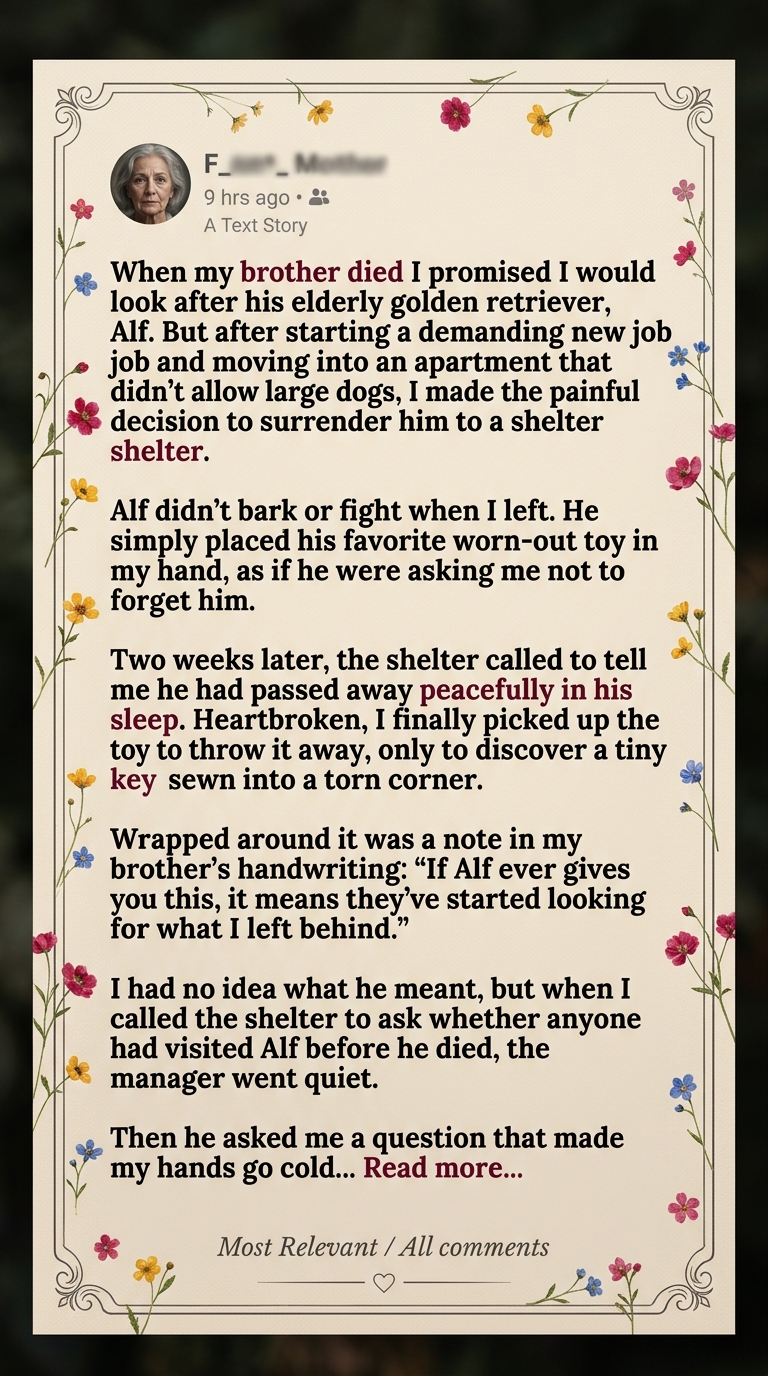
The Secret Alf Was Trusted to Keep
When my brother died, I made him a promise I never imagined would become so difficult to keep.
“I’ll look after Alf,” I whispered beside his hospital bed.
My brother, Michael, had owned the golden retriever for nearly twelve years. Alf had been with him through a divorce, two job changes, and the quiet years when Michael lived alone in a small house outside town. They were rarely apart. Even when Michael became too weak to walk far, Alf stayed beside his chair, resting his enormous head on his knee.
After the funeral, I brought Alf home.
For the first few months, everything seemed manageable. I worked from home, and Alf spent his days sleeping beside my desk or watching the neighborhood through the front window. Every evening, we walked around the park. He always carried the same worn-out blue duck in his mouth, a toy Michael had bought him years earlier.
But my circumstances changed.
I accepted a demanding management position that required long hours and frequent travel. Then my landlord sold the house, forcing me to move into a smaller apartment with strict rules against large dogs.
I tried everything. I contacted landlords, asked friends, and even considered moving farther away. But the available places were either too expensive or unsuitable for an elderly dog with stiff joints.
Eventually, I made the decision I had spent weeks trying to avoid.
I took Alf to a reputable animal shelter that had a senior-dog care program. The manager, a kind woman named Denise, assured me that older dogs received quiet accommodations and special attention.
I signed the surrender papers with trembling hands.
Alf didn’t bark when I stood up to leave. He didn’t pull toward the door or scratch at the kennel gate.
He simply picked up his blue duck, walked toward me, and placed it in my hand.
I knelt and held his face.
“I’m sorry, old boy. I really am.”
He licked my wrist.
Then I left.
For two weeks, I barely slept. I called the shelter several times, asking how he was eating and whether he was settling in. Denise always reassured me that he was comfortable, although he spent much of the day sleeping.
Then, on a Wednesday morning, the shelter called.
Denise’s voice was unusually gentle.
“I’m sorry to tell you this, but Alf passed away last night. He went peacefully in his sleep. The veterinarian believes it was natural causes.”
I sat down on the kitchen floor.
He had been old, and I knew his time was limited. Still, the thought that he had died without me beside him felt unbearable.
I collected his belongings that afternoon. The blue duck was inside a small plastic bag, its fabric worn thin and one corner torn open.
At home, I placed it on the table.
I couldn’t bring myself to throw it away. I ran my fingers over the faded fabric, remembering Michael laughing when Alf destroyed the first three toys he had bought him.
Then I noticed something hard inside the torn corner.
I carefully opened the seam.
A tiny brass key slipped into my palm.
Wrapped around it was a narrow strip of paper, folded several times. The handwriting was unmistakably Michael’s.
If Alf ever gives you this, it means they’ve started looking for what I left behind.
I read it again.
Then again.
Michael had written those words before he died, and somehow he had arranged for the key to remain with Alf.
I called the shelter.
“Denise, did anyone visit Alf before he passed away?”
There was a long silence.
“Why are you asking?”
“Because I found something inside his toy. I need to know whether anyone approached him or asked about his belongings.”
Denise lowered her voice.
“Someone came here last Friday. A man in his forties. He said he was an old friend of your brother’s. He asked whether Alf had brought any personal belongings from home, especially a blue toy.”
My fingers tightened around the telephone.
“What did you tell him?”
“I said we couldn’t release an animal’s belongings to someone who wasn’t listed on the surrender paperwork. He became irritated and asked whether the dog had been given to anyone else.”
“Did you give him my name?”
“No. But he already seemed to know it.”
I stared at the key.
“Did he come back?”
Denise hesitated.
“Yes. On Monday morning. He said he had an urgent family matter to discuss. When I told him Alf was still being monitored by our veterinarian, he asked whether the dog had died yet.”
The room seemed to grow colder.
“Did you tell him?”
“I didn’t. I thought his questions were strange, so I asked him to leave. But before he went, he said something I haven’t been able to forget.”
“What?”
“He said, ‘If the dog is still carrying it, the girl will come looking eventually.’”
I thanked Denise and ended the call.
I knew Michael had been hiding something, but I had no idea what.
I turned the key over in my hand. It was small, old-fashioned, and stamped with the number 28.
I searched Michael’s house that evening, which I had kept almost untouched since his death. I checked his desk, filing cabinet, bedside drawers, and garage. Nothing matched the key.
Then I remembered something from childhood.
Michael had always kept a metal tool chest in our father’s old workshop. It was a heavy green box with numbered compartments. After our father died, Michael had taken it home because he couldn’t bear to see it sold.
I drove there the next morning.
The workshop had been closed for months. Dust covered the workbench, and the old radio still sat beside a jar of screws. The tool chest was exactly where Michael had left it.
I opened the first drawer.
Inside were ordinary tools, spare bolts, and old measuring tapes. The second drawer contained several small metal compartments, each numbered.
Number 28 was locked.
The brass key fit perfectly.
Inside was a folded sheet of paper, a small memory card, and a photograph of Michael standing beside a woman I didn’t recognize.
The note was dated four months before his death.
Claire, if you’re reading this, I wasn’t able to finish what I started. I need you to understand that the people searching for this aren’t looking for money. They’re looking for evidence that could put someone in serious trouble. I kept it away from the house because I knew they might search there.
I looked at the photograph again.
On the back, Michael had written a name.
Peter Lawson.
I didn’t recognize it.
The memory card was labeled with a date and the words Harbor Project.
I took everything to a computer repair shop and asked the technician to make a copy without opening the original files. Once I had a duplicate, I examined the contents.
There were photographs of shipping containers, warehouse loading records, and screenshots of internal messages from a company called Westbridge Logistics.
I recognized the company.
Michael had worked there as a safety coordinator before becoming ill.
The records suggested that senior managers had been falsifying inspection reports for several years. Containers marked as damaged or unsafe were being recorded as cleared for transport. Several employees had raised concerns, but their complaints had disappeared from the official system.
One message was particularly disturbing.
It came from a regional director named Peter Lawson.
Michael has copies. Find out where he put them before the audit begins.
Another message, sent a few days later, read:
Don’t approach him directly. He’s already suspicious.
I understood then why someone had been asking about Alf.
Michael had trusted very few people during his final months. Alf had been with him constantly, and the blue duck was the one thing Michael knew I would never throw away without thinking about it.
But the evidence on the memory card was incomplete. It showed possible misconduct, but it didn’t explain what had happened to the employees who had reported the unsafe shipments.
I needed help.
I contacted a former colleague of Michael’s named Rachel, whose name appeared in one of the messages. She agreed to meet me at a café.
When I showed her the files, she looked frightened.
“Michael told me he had made copies,” she said. “I thought he meant the documents we submitted to compliance. I didn’t know he had kept more.”
“What happened to the complaints?”
Rachel explained that several workers had been pressured to withdraw their reports. One employee had suffered a serious injury when a container’s damaged locking mechanism failed during unloading. The company blamed him for ignoring procedure, even though the inspection records had been altered.
Michael had discovered that the original reports were being replaced after inspections. He began collecting evidence, but his illness made it difficult for him to continue.
“Did he ever mention Peter Lawson?” I asked.
Rachel nodded.
“Peter was the regional director. He was responsible for approving the reports. Michael believed he was trying to destroy the evidence before an external audit.”
I asked why Michael hadn’t gone directly to the authorities.
“He did. But he was worried that the company would claim the files were stolen or altered. He wanted an independent copy of the original records.”
Rachel told me that Michael had also been working with a retired auditor named Samuel Reed. Samuel had helped him verify the documents and identify which records could be authenticated.
I found Samuel through an old email address.
When I called, he was silent for a moment after hearing Michael’s name.
“I wondered what happened to those copies,” he said.
I arranged to meet him.
Samuel examined the files and confirmed that several documents matched records he had already reviewed. He explained that the memory card contained enough information to reopen the investigation, but the original inspection logs and a witness statement were still missing.
“Michael told me he had secured the witness statement somewhere safe,” Samuel said. “He said it was in the only place he trusted completely.”
I looked down at my hands.
“Alf.”
Samuel nodded slowly.
“Your brother told me that the dog would never be searched by anyone who didn’t understand why he mattered.”
I felt tears rise.
Michael had known that Alf was more than a pet. He was the one companion who had never betrayed him, never asked him to explain himself, and never left his side.
Samuel helped me contact the independent investigator assigned to the case. I provided the memory card, the photographs, and the notes. Rachel agreed to give a formal statement about the complaints she and other employees had made.
The investigation took several months.
Peter Lawson initially denied knowing anything about altered inspection records. But the digital evidence, combined with original copies recovered from an external archive, contradicted his account. Investigators found that he had approved the removal of several safety warnings and had instructed staff to replace failed inspection reports.
The company eventually dismissed him and referred the matter to the relevant authorities. The injured worker’s case was reopened, and other employees who had been blamed for the falsified reports were given the opportunity to have their records corrected.
I never learned exactly how much Michael had managed to uncover before he died.
But I learned why he had hidden the evidence.
He hadn’t been trying to protect a fortune or expose a family inheritance dispute. He had been trying to make sure that people who had been hurt weren’t blamed for someone else’s dishonesty.
A few weeks after the investigation began, Denise called me again.
She told me that Alf’s veterinarian had confirmed his death was consistent with natural causes. There had been no signs of mistreatment. The man who had visited the shelter had not been connected to the staff, and the shelter had reported his behavior to the authorities once the investigation began.
I asked whether Alf had seemed distressed during his final days.
“No,” Denise said. “He was quiet, but he ate, slept, and enjoyed being brushed. He carried that blue toy everywhere.”
I thanked her.
After the call, I sat at my kitchen table with the toy in front of me.
For weeks, I had blamed myself for surrendering him. I kept imagining him waiting for me at the shelter door, wondering why I hadn’t returned.
I couldn’t change the decision I had made. I couldn’t give him the final years I wished I had been able to provide.
But I could stop treating his last gift as a reminder of my failure.
I arranged for Alf’s ashes to be placed beside a small memorial for Michael in the garden of my home. I kept the blue duck in a glass case nearby, with the brass key beside it.
Sometimes, when I pass that little display, I remember the way Alf placed the toy in my hand.
At the time, I thought he was asking me not to forget him.
Now I understand that he was carrying something my brother had trusted him to protect.
Michael had left me a difficult responsibility, and I had nearly missed it because I was overwhelmed by guilt and grief.
I still wish I had found a way to keep Alf with me.
But I no longer think of him as a dog I abandoned.
He was the last loyal companion my brother trusted, and even after both of them were gone, the two of them had managed to leave me one final act of courage.

