The Recipe That Changed Everything
By the time the rehearsal dinner began, I had already spent six hours in the kitchen.
I wasn’t officially part of the catering team, but my stepson, Ethan, had asked me to help prepare a few dishes for the evening. He was getting married the following morning, and he wanted the dinner to feel personal rather than like another expensive event arranged by his mother’s social circle.
His mother, Vanessa, had other ideas.
She had spent weeks discussing the guest list, the decorations, and the seating arrangements. She had also made it clear that she considered me an unfortunate addition to her son’s life.
Vanessa and I had been civil for years, but never friendly. She had married Ethan’s father when Ethan was very young, and after their divorce, she had remained determined to control every important decision in her son’s life.
I entered Ethan’s life when he was twelve. I never tried to replace his mother. I simply tried to be someone he could rely on.
Sometimes that meant helping with school projects. Sometimes it meant sitting with him after a difficult day. And sometimes it meant teaching him how to make a decent meal when his father was working late.
Cooking had been my profession long before I met his father.
I had worked in restaurant kitchens for nearly twenty-five years, beginning as a dishwasher and eventually becoming a head chef. I had worked through holidays, endured burns, and spent countless nights perfecting dishes that most customers finished without knowing how much effort had gone into them.
Vanessa had never respected that work.
To her, cooking was something people did because they lacked ambition.
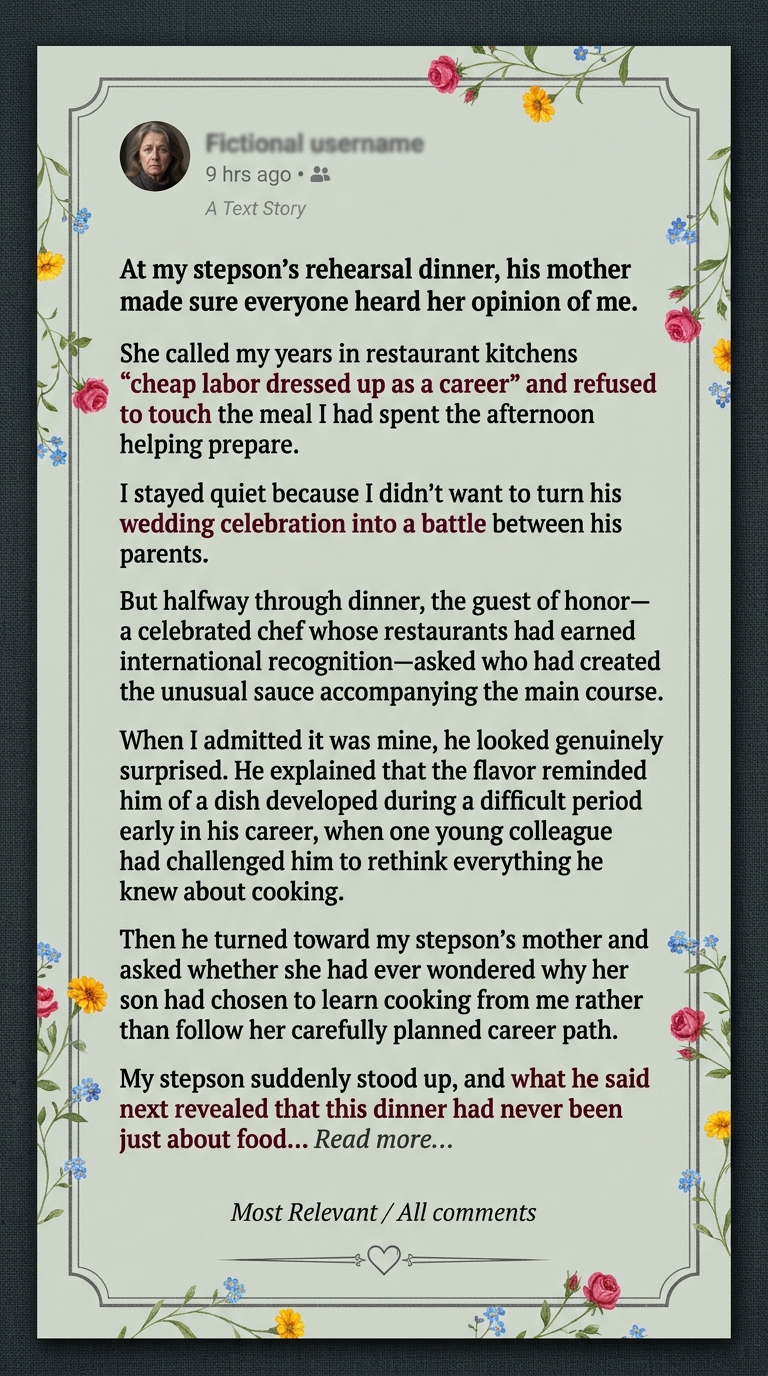
At the rehearsal dinner, she made sure everyone heard her opinion.
When a guest asked how I knew the caterers, Vanessa smiled.
“Oh, she’s spent most of her life in restaurant kitchens. You could say she’s made a career out of cheap labor.”
Several people laughed awkwardly.
I kept arranging the serving plates.
Later, when the main course arrived, Vanessa examined her plate and pushed it away.
“I don’t think I’ll try this,” she announced. “I prefer food prepared by people with proper culinary training.”
I looked at Ethan.
He was already tense, and I knew he didn’t want his wedding celebration turned into another argument between his parents.
So I said nothing.
The main course was roasted duck with a sauce made from charred plums, toasted coriander, and a reduction of dark stock. It was a recipe I had developed years earlier after experimenting with ingredients that most chefs considered too difficult to combine.
I had made it especially for Ethan because it was one of his favorite dishes.
At the far end of the table sat Chef Adrian Moreau, a celebrated culinary figure whose restaurants had earned international recognition. He had been invited because Ethan had trained at one of his kitchens during culinary school.
Adrian had been eating quietly until he tasted the sauce.
He stopped, lifted another spoonful, and examined it.
“Who prepared this?”
The catering manager pointed toward me.
“She helped develop the menu.”
Adrian looked directly at me.
“You made this sauce?”
“Yes.”
He took another taste.
“Where did you learn to combine charred plum with coriander this way?”
I explained that I had developed the recipe many years earlier, when I was working in a small restaurant in the northern part of the country.
Adrian slowly put down his fork.
“That is remarkable.”
Vanessa gave a small laugh.
“She’s always been very enthusiastic about cooking.”
But Adrian wasn’t looking at her.
He was looking at me with an expression I couldn’t quite understand.
“Did you ever work at the old Bellamy Kitchen?”
I nodded.
“For almost seven years.”
He leaned back.
“I thought I recognized the technique.”
Then he told the table a story.
Early in his career, before his restaurants became famous, Adrian had worked at a struggling restaurant where the kitchen was divided between two groups. The senior chefs believed traditional recipes should never be changed. The younger cooks wanted to experiment.
One young woman had challenged him repeatedly.
She argued that a sauce didn’t become sophisticated simply because it contained expensive ingredients. She believed the best cooking came from understanding how ordinary ingredients could create unexpected depth.
“She was the reason I stopped treating recipes like instructions that couldn’t be questioned,” Adrian said. “She made me rethink how I approached flavor.”
He turned toward me.
“Her name was Claire Bennett.”
I felt my face warm.
“Yes. That was me.”
Adrian smiled.
“I’ve been trying to find you for years. You left before I had the chance to thank you properly.”
The table had gone quiet.
He continued.
“The sauce you served tonight is remarkably close to the one we developed during those early years. I remember the first time Claire convinced me to use charred fruit instead of sugar to balance a rich stock. I thought she was making a mistake. She proved me wrong.”
Vanessa shifted in her chair.
“That’s an interesting story,” she said. “But I’m not sure what it has to do with Ethan.”
Adrian turned toward her.
“Perhaps you should ask yourself why your son chose to learn cooking from Claire rather than follow the career path you planned for him.”
Ethan suddenly stood.
His chair scraped against the floor.
“Because she was the first person who let me choose what I wanted to become.”
Everyone turned toward him.
Vanessa’s expression hardened.
“Ethan, sit down. This isn’t the time.”
“No, Mom. I think it is.”
He looked around the table, then toward his fiancée, Olivia.
“When I was sixteen, I told you I wanted to become a chef. You said it was an embarrassing choice for someone from our family. You wanted me to study finance, join your father’s investment company, and eventually take over one of the divisions.”
Vanessa folded her arms.
“I wanted you to have opportunities.”
“You wanted me to have your opportunities.”
He took a breath.
“When Dad married Claire, I barely spoke to her. I thought she was trying to take your place. But she never asked me to call her Mom. She never criticized you. She just let me spend time in her kitchen.”
He smiled faintly.
“She taught me how to sharpen a knife, how to control heat, and how to admit when a dish wasn’t working. More importantly, she taught me that being good at something required patience, not permission.”
Vanessa looked toward his father.
“Are you going to let him speak to me like this?”
His father, Richard, remained seated.
“Let him finish.”
Ethan continued.
“When I applied to culinary school, you refused to help pay for it. You told me I was throwing away my future. Claire didn’t give me money or make promises. She helped me find a scholarship, introduced me to people in the industry, and made me earn my place.”
He paused.
“Do you know who recommended me for my first professional placement?”
Vanessa didn’t answer.
“Chef Adrian.”
Adrian nodded.
“I remember his application. It included a recommendation from Claire.”
Ethan looked at me.
“She didn’t ask him to accept me because I was her stepson. She told him to judge my work and nothing else.”
I felt tears gathering, but I kept my eyes on Ethan.
He reached into his jacket and took out a folded piece of paper.
“There’s something else I wanted everyone to know tonight.”
Vanessa’s expression changed.
“What is that?”
Ethan unfolded the paper.
“Tomorrow, after the wedding, Olivia and I are announcing our first business project. We’re opening a restaurant together.”
A few guests smiled.
Vanessa looked confused.
“A restaurant?”
“Yes. A small place near the old market district. We’ve been developing the concept for almost a year.”
“You haven’t discussed this with me.”
“I didn’t need permission.”
His words were calm, but firm.
He explained that Olivia had worked in hospitality management for several years and wanted to run a restaurant with him. They had found a modest property, secured financing through a small business lender, and spent months developing a menu.
The restaurant would focus on seasonal food, local suppliers, and dishes that combined traditional techniques with modern ideas.
Then he looked at me.
“We’ve asked Claire to be our culinary director and help train the kitchen team.”
I blinked.
“Ethan, you never told me that was happening.”
He smiled.
“I wanted to ask you properly after the wedding. I didn’t want you to feel obligated because of me.”
Vanessa gave a sharp laugh.
“So this entire dinner was arranged to embarrass me?”
“No,” Ethan replied. “The dinner was arranged to celebrate my wedding. The restaurant is something Olivia and I have worked for. What happened tonight simply reminded me why I need to stop pretending your opinion determines whether my choices are worthwhile.”
Olivia stood beside him and took his hand.
“I didn’t fall in love with Ethan because he came from a particular family,” she said. “I fell in love with the person he became. His passion, his discipline, and the way he treats people who work beside him.”
She looked at Vanessa.
“I hope you can be happy for us, but we won’t postpone our plans to make them more acceptable to you.”
Vanessa stared at her son.
“You’re choosing her over your own family?”
Ethan shook his head.
“I’m choosing my future. You’re welcome to be part of it, but you can’t control it.”
For several seconds, nobody spoke.
Then Adrian raised his glass.
“To good food, honest work, and the people who teach us to think for ourselves.”
The guests slowly joined him.
Vanessa didn’t raise her glass.
She left the table shortly afterward, telling Richard that she needed fresh air. He didn’t follow her immediately. Instead, he remained beside Ethan and congratulated him on the restaurant.
I returned to the kitchen to help clear the remaining dishes.
A few minutes later, Ethan appeared in the doorway.
“You all right?” he asked.
I laughed softly.
“I’m the one who should be asking you that.”
He stepped closer.
“I wanted to say all of that for a long time. I just didn’t want to ruin the wedding.”
“You didn’t ruin anything.”
“I know you never wanted to replace my mother.”
I nodded.
“I never did.”
He looked down at his hands.
“When I was younger, I thought accepting you meant betraying her. But you never made me choose. You just showed up whenever I needed someone.”
I reached for his shoulder.
“That’s what family is supposed to do.”
He hugged me.
“Thank you for teaching me how to cook.”
“You taught yourself,” I replied. “I just made sure you didn’t burn everything.”
He laughed, and the tension finally left his face.
The wedding the next morning was beautiful.
Vanessa attended, though she kept her distance from me. During the reception, she congratulated Ethan and Olivia, but she didn’t mention the restaurant.
I didn’t expect her to change overnight.
Several months later, Ethan and Olivia opened their restaurant.
They named it Second Table, inspired by the small kitchen where Ethan had first learned to cook. The opening menu included the roasted duck with charred plum sauce, which Adrian had encouraged them to keep.
On opening night, I stood near the kitchen entrance and watched Ethan serve the first table.
He was nervous, but his hands were steady.
Adrian had traveled to attend the opening and was among the first guests. After tasting the sauce, he smiled at Ethan.
“Your stepmother taught you well.”
Ethan looked toward me.
“She taught me more than recipes.”
I smiled.
That evening, Vanessa arrived unexpectedly.
She stood near the entrance for several minutes before approaching the kitchen. I was preparing a final batch of sauce when she stopped beside me.
“I owe you an apology,” she said.
I turned off the heat.
She struggled to continue.
“I spent years believing that if Ethan respected you, it meant he respected me less. I made everything into a competition that you never asked to enter.”
I listened without interrupting.
“I still don’t understand why he chose this career,” she admitted. “But I can see that he’s happy.”
“That’s what matters,” I said.
She looked toward the dining room, where Ethan was laughing with Olivia.
“I suppose I should have listened to him sooner.”
It wasn’t a perfect reconciliation, and I didn’t pretend that one apology erased years of insults. But it was an honest beginning.
Before leaving, Vanessa asked whether she could try the duck.
I served her a small plate.
She tasted the sauce, paused, and looked at me.
“I can see why Adrian remembered it.”
For the first time, I smiled at her without feeling the need to defend myself.
The restaurant grew steadily, not through celebrity attention or family connections, but because Ethan and Olivia built it carefully. They hired people who cared about their work and created a kitchen where young cooks could experiment without being humiliated for making mistakes.
And every time I walked past the main dining room, I remembered the rehearsal dinner.
Vanessa had thought my years in restaurant kitchens made me insignificant.
But the work she dismissed had helped shape a young man who knew how to build a life on his own terms.
I had never needed a famous chef to prove my worth.
I had never needed my stepson’s mother to approve of me.
The most meaningful recognition came from the person who had watched me work quietly for years—and had finally found the courage to stand up and tell everyone what that work had meant to him.