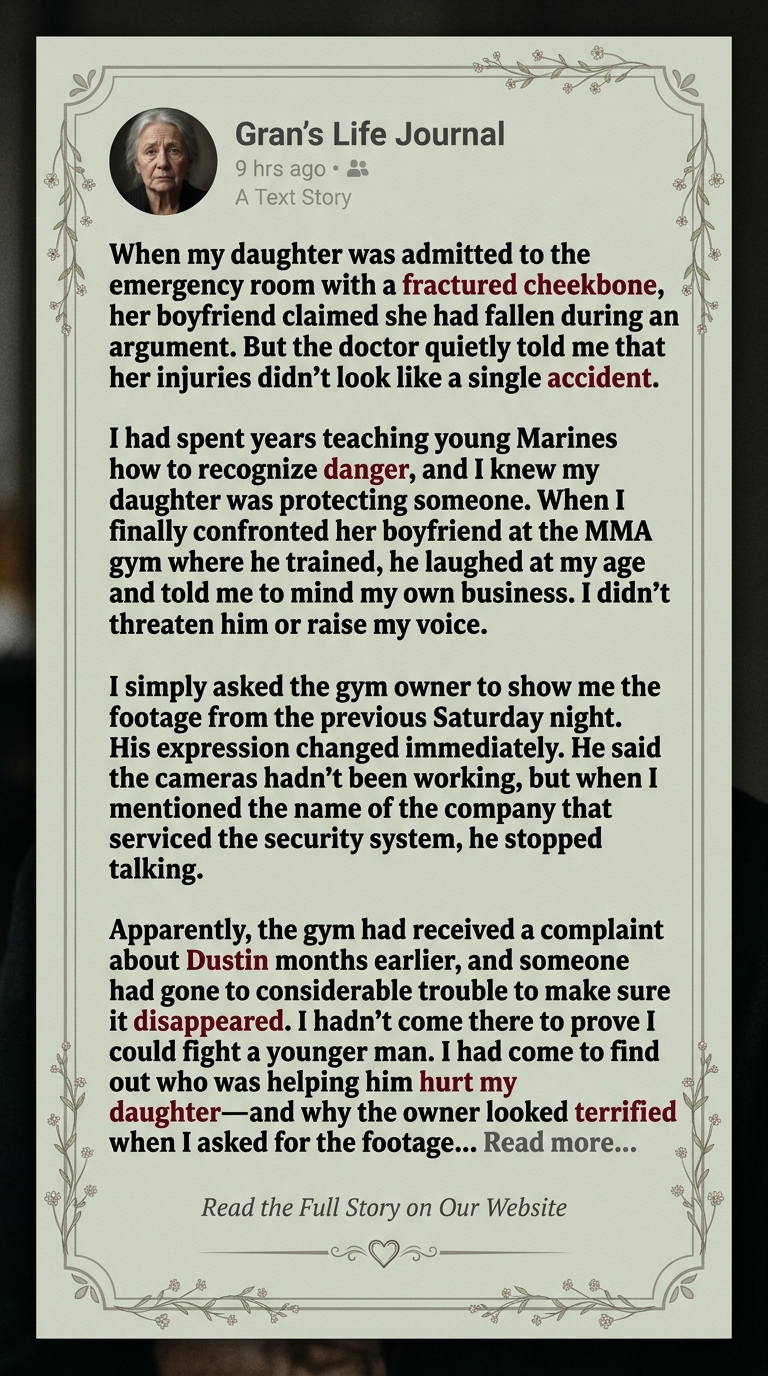
The first time I saw my daughter’s fractured cheekbone, I had to remind myself that I was standing in a hospital and not somewhere I could simply order everyone to step back.
Her name was Emily. She was thirty-two, old enough to make her own decisions, but when I walked into the emergency room and saw her lying beneath the harsh fluorescent lights, I felt the same fear I had experienced when she was a little girl and came home crying after falling off her bicycle.
Her boyfriend, Dustin, stood beside the bed with his arms folded.
“She slipped during an argument,” he explained. “It wasn’t anything serious.”
I looked at Emily.
She wouldn’t meet my eyes.
The doctor asked Dustin to wait outside while she examined my daughter. Once the door closed, she pulled a chair beside the bed.
“Your daughter has a fractured cheekbone, bruising along her jaw, and injuries to her upper arms,” she said quietly. “The pattern concerns me. These don’t look like injuries from one simple fall.”
I nodded.
For nearly twenty-five years, I had served in the Marine Corps, eventually becoming an instructor responsible for teaching young Marines how to recognize threats, assess dangerous situations, and respond without letting emotion cloud their judgment.
I wasn’t a police officer, and I wasn’t going to pretend that my military experience made me an expert in domestic violence. But I knew when someone’s explanation didn’t match the evidence.
“Has she told you what happened?” I asked.
“Not yet. She seems frightened.”
I looked through the small window in the door.
Dustin was staring at his phone.
“Please don’t let him take her home until she’s had a chance to speak privately with someone,” I said.
The doctor nodded and explained that the hospital’s safeguarding team would speak with Emily.
When I returned to the room, Emily immediately began apologizing.
“Dad, please don’t make this worse.”
I pulled a chair beside her.
“I’m not angry with you.”
“You don’t understand.”
“Then help me understand.”
She started crying.
Dustin had been her boyfriend for nearly two years. At first, he had been charming and attentive. He brought her flowers, remembered small details, and made her feel as though she had finally found someone who understood her.
But gradually, his behavior changed.
He criticized her friends, questioned her spending, and became angry whenever she wanted to visit me. He would apologize afterward, sometimes buying expensive gifts or promising that it would never happen again.
The first time he grabbed her hard enough to leave a bruise, he blamed stress.
The second time, he said she had provoked him.
By the time she was admitted to the hospital, she had learned to explain away injuries before anyone could ask questions.
“Why didn’t you call me?” I asked.
“Because he said you’d come after him.”
I held her hand.
“I don’t need to hurt him to protect you.”
She looked at me for the first time.
“Promise?”
“I promise.”
I stayed until the hospital’s social worker arranged a safe place for her to recover. The staff documented her injuries, discussed her options, and helped her contact a domestic violence support service.
Dustin was furious when he learned she wouldn’t be leaving with him.
He stood in the corridor and demanded to know who had authorized the decision.
A security officer asked him to lower his voice.
“This is between me and my girlfriend,” Dustin snapped.
Emily didn’t answer him.
For the first time, she allowed someone else to speak on her behalf.
Over the following days, I helped her recover at my house. She had difficulty chewing, so I prepared soft meals. I drove her to follow-up appointments and made sure she had time to rest.
I didn’t question her constantly. I knew she needed space to understand what had happened without feeling that every conversation was another interrogation.
But I did ask one question.
“Has Dustin ever hurt anyone else?”
She hesitated.
“Not that I know of.”
I remembered his name.
Dustin trained at a local mixed martial arts gym called Iron Harbor. He often posted photographs of himself sparring and wearing competition medals. He liked telling people that discipline and respect were the foundations of his training.
I decided to visit the gym.
I wasn’t going there to challenge him. I wanted to understand whether the people around him knew what he was doing.
The owner, a broad-shouldered man named Glenn, recognized me from a photograph Emily had once shown him.
“You’re Emily’s father,” he said.
“That’s right.”
His expression changed slightly.
“Is she okay?”
“She’s recovering.”
Glenn looked toward the training area.
Dustin was hitting a heavy bag near the far wall. When he noticed me, he stopped and walked over.
“Well, look who it is,” he said. “Emily’s father.”
I kept my voice calm.
“I want to talk about what happened last Saturday.”
Dustin laughed.
“Your daughter fell. I’ve already explained that.”
“The doctor doesn’t agree.”
He stepped closer.
“Maybe you should mind your own business.”
I didn’t move.
“My daughter is my business when she’s being hurt.”
Dustin smiled.
“You’re an old man. You think your military stories mean something in here?”
“I didn’t come here to fight you.”
“Good. Because you wouldn’t last thirty seconds.”
I turned toward Glenn.
“Can I see the security footage from last Saturday?”
Glenn’s smile disappeared.
“The cameras weren’t working.”
“All of them?”
“That’s right.”
I looked at the small camera mounted above the reception desk.
“Then perhaps you can explain why the company that services your system was paid to replace the recording unit three months ago.”
Glenn froze.
I had noticed the company name on a maintenance sticker near the entrance. It was the same company listed on the invoice Emily had once shown me when she helped Dustin organize his gym competition paperwork.
I hadn’t come prepared with a legal argument. I had simply remembered the name.
Glenn glanced at Dustin.
Dustin’s expression had changed too.
“What company?” he asked.
I looked at him.
“Northstar Security Systems.”
Glenn swallowed.
“Those records aren’t available.”
“Then why did the gym receive a complaint about Dustin last spring?”
The room went quiet.
Dustin turned sharply toward Glenn.
“What complaint?”
Glenn didn’t answer.
I understood then that the camera footage was only part of the story.
I had come expecting to find someone who had witnessed Dustin hurting my daughter. Instead, I had found a gym owner who seemed more frightened of what the records might reveal than of the man standing beside him.
I asked Glenn to speak with me privately.
He refused at first.
Then I mentioned the name of the person who had signed the maintenance authorization.
His expression collapsed.
“Come into the office,” he said.
Dustin immediately objected.
“Why are you talking to him?”
Glenn looked at him.
“Go back to training.”
For once, Dustin didn’t argue.
Inside the office, Glenn shut the door.
He sat behind his desk and rubbed his face.
“I don’t want trouble,” he said.
“Neither do I. I want the truth.”
Glenn stared at the floor.
The previous spring, a woman named Natalie had filed a formal complaint against Dustin. She had been attending the gym for several months and had briefly dated him before ending the relationship.
According to her complaint, Dustin had followed her after training, grabbed her outside the building, and threatened her when she refused to get back into his car.
Another member had intervened.
The incident had been reported to Glenn, who initially promised to review the security footage.
But when he checked the system, the relevant recordings were missing.
Natalie later submitted a written complaint to the gym’s management.
Glenn said he had forwarded it to the company’s regional operations manager, a man named Victor Hale.
Victor had been a financial supporter of the gym since its opening. He had paid for new equipment, sponsored local competitions, and helped Glenn secure a commercial lease.
A week after the complaint was submitted, Victor called Glenn into his office.
He told him Natalie was exaggerating and that Dustin was an important athlete who brought attention to the gym.
Glenn was instructed to close the complaint.
When he refused, Victor reminded him that the gym’s insurance and equipment financing depended on agreements connected to his company.
Glenn eventually signed a statement claiming the complaint could not be substantiated.
The camera system was then serviced, and the recording archive was supposedly cleared during a routine reset.
“Did you know Dustin was hurting Emily?” I asked.
Glenn shook his head.
“Not until last week. I heard about the hospital visit yesterday.”
“Why didn’t you report what happened to Natalie?”
He looked ashamed.
“Because I was afraid of losing the gym.”
I studied him for a moment.
“Then you protected the wrong person.”
He didn’t disagree.
Glenn explained that the security company had retained maintenance reports and service logs. The technician who worked on the system had also complained that someone at the gym repeatedly requested that recordings be deleted before the normal retention period.
The technician had refused to sign the final service report.
His name was Aaron.
I asked Glenn whether he would be willing to provide that information to the police.
He hesitated.
Then he opened a drawer, removed a folder, and placed it on the desk.
“I kept copies,” he admitted. “I knew something wasn’t right.”
Inside were maintenance invoices, correspondence with Victor, and a copy of Natalie’s original complaint.
There was also a note from Aaron stating that the recording system had been functioning normally on the night of Natalie’s incident.
That meant the missing footage had not disappeared because of a technical failure.
Someone had deliberately removed it.
I photographed the documents and asked Glenn to preserve the originals.
Then I left.
Dustin was waiting near the entrance.
“You think you’ve accomplished something?” he asked.
I stopped several feet away.
“I think the truth is finally getting attention.”
He laughed, but it sounded forced.
“Emily will come back. She always does.”
I looked at him.
“Not this time.”
I walked out without another word.
That evening, I contacted the police and gave them the information Glenn had provided. I also told them about the hospital findings and the recordings I had requested.
An investigator named Detective Harris arranged separate interviews with Glenn, Natalie, and the security technician.
I did not try to conduct my own investigation.
I had spent years teaching people to recognize danger, but I knew that collecting evidence and building a criminal case required professionals, not a father with a personal grudge.
The following week, Detective Harris contacted me.
Aaron, the security technician, had preserved an independent copy of the maintenance logs and a short segment of footage from the night of Natalie’s complaint. He had saved it because the system’s deletion request had seemed suspicious.
The recording showed Dustin waiting near the side entrance after training. Natalie walked outside and headed toward her car.
Dustin followed her.
When she refused to speak with him, he grabbed her arm and shoved her against the vehicle. Another gym member intervened, and Dustin walked away.
The footage did not show everything Natalie had described, but it supported important parts of her complaint.
The maintenance records also showed that the gym’s cameras had been working that night.
Detectives then discovered that Victor Hale had instructed a staff member to remove the relevant footage from the main system. He had also asked Glenn to classify Natalie’s complaint as a personal dispute unrelated to gym activities.
Victor had not physically assaulted anyone, but he had used his influence to suppress a complaint and interfere with the handling of evidence.
When police questioned him, he claimed he had only been protecting the gym from a false accusation.
The investigators weren’t convinced.
They obtained the relevant business records and interviewed additional employees. Two former members confirmed that Dustin had previously threatened people who complained about his behavior.
The investigation widened.
Meanwhile, Emily was slowly beginning to speak about what had happened to her.
She told Detective Harris that Dustin had grabbed her during an argument outside his apartment. When she tried to leave, he struck her across the face and knocked her against a concrete pillar.
He then drove her to the hospital and told her to say she had fallen.
She had agreed because he threatened to ruin her life if she told anyone.
The doctor had noticed the pattern of injuries because the bruising on her arms suggested she had been restrained before the impact that fractured her cheekbone.
Emily’s statement, medical records, and other evidence formed the basis of the case against Dustin.
He was arrested several weeks later.
When he learned that Glenn had cooperated, he sent him threatening messages. Those messages were preserved and provided to investigators.
Victor was also charged with offenses relating to interference with evidence and the handling of Natalie’s complaint. The precise charges were determined after the investigation and legal review.
The gym’s board removed him from its management role while the case proceeded.
Glenn made a public statement acknowledging that he had failed Natalie and that his decision to protect the gym’s reputation had allowed Dustin to remain in a position where he could intimidate others.
It didn’t undo what had happened, but he finally accepted responsibility.
Dustin eventually pleaded guilty to assaulting Emily and Natalie and to related offenses. The court imposed a prison sentence and a restraining order protecting both women.
Victor also faced legal consequences for his role in suppressing the complaint and interfering with the evidence.
I attended the sentencing hearing with Emily.
She held my arm as we walked into the courtroom.
I expected to feel satisfaction when Dustin was sentenced.
Instead, I felt tired.
There was no victory in seeing my daughter describe the worst moments of her life in front of strangers. There was only relief that she no longer had to face him alone.
Afterward, Emily asked me whether I had been disappointed that I hadn’t confronted Dustin physically.
I looked at her.
“Why would I be?”
“You could have beaten him.”
“Maybe. Maybe not. But that wouldn’t have given you your life back.”
She looked down.
“I thought you would want to hurt him.”
“I wanted to make sure he couldn’t hurt you again. Those are different things.”
She leaned against my shoulder.
For months, her recovery continued. Her cheekbone healed, although she still experienced discomfort when the weather changed. She began counseling and gradually reconnected with friends she had stopped seeing during her relationship.
She also returned to work.
One afternoon, she told me she wanted to volunteer with a local organization that helped women leave abusive relationships.
I supported her decision but reminded her that she didn’t have to turn her pain into a public mission.
“You can simply live your life,” I told her.
She smiled.
“I know. But I think I’d like to help someone else recognize the warning signs before things get as bad as they did for me.”
I understood.
As for Iron Harbor, the gym remained closed for several weeks while its management changed. Eventually, a new owner took over, hired an independent security company, and established a formal complaint process.
Glenn was allowed to remain as a trainer, but he no longer controlled the gym’s administration. He later apologized to Natalie in person, without asking her to forgive him.
She accepted the apology but made it clear that she would never train there again.
I respected her decision.
One evening, Emily and I sat on my porch watching the sun disappear behind the trees.
She was laughing about something that had happened at work, and for a moment I heard the carefree voice I remembered from before Dustin entered her life.
I didn’t ask whether she was completely healed.
I knew recovery wasn’t a finish line.
I simply sat beside her and listened.
I had once believed that protecting someone meant standing between them and the person who wanted to hurt them.
Now I understood that sometimes protection meant helping them find their own voice, preserving the truth when others tried to bury it, and refusing to let fear decide what happened next.
I had gone to that gym expecting to discover who had helped Dustin hurt my daughter.
I found something worse: people who had known enough to intervene and had chosen silence because speaking up might cost them something.
But their silence had finally ended.
And my daughter was free.

