The Name the Head Chef Remembered
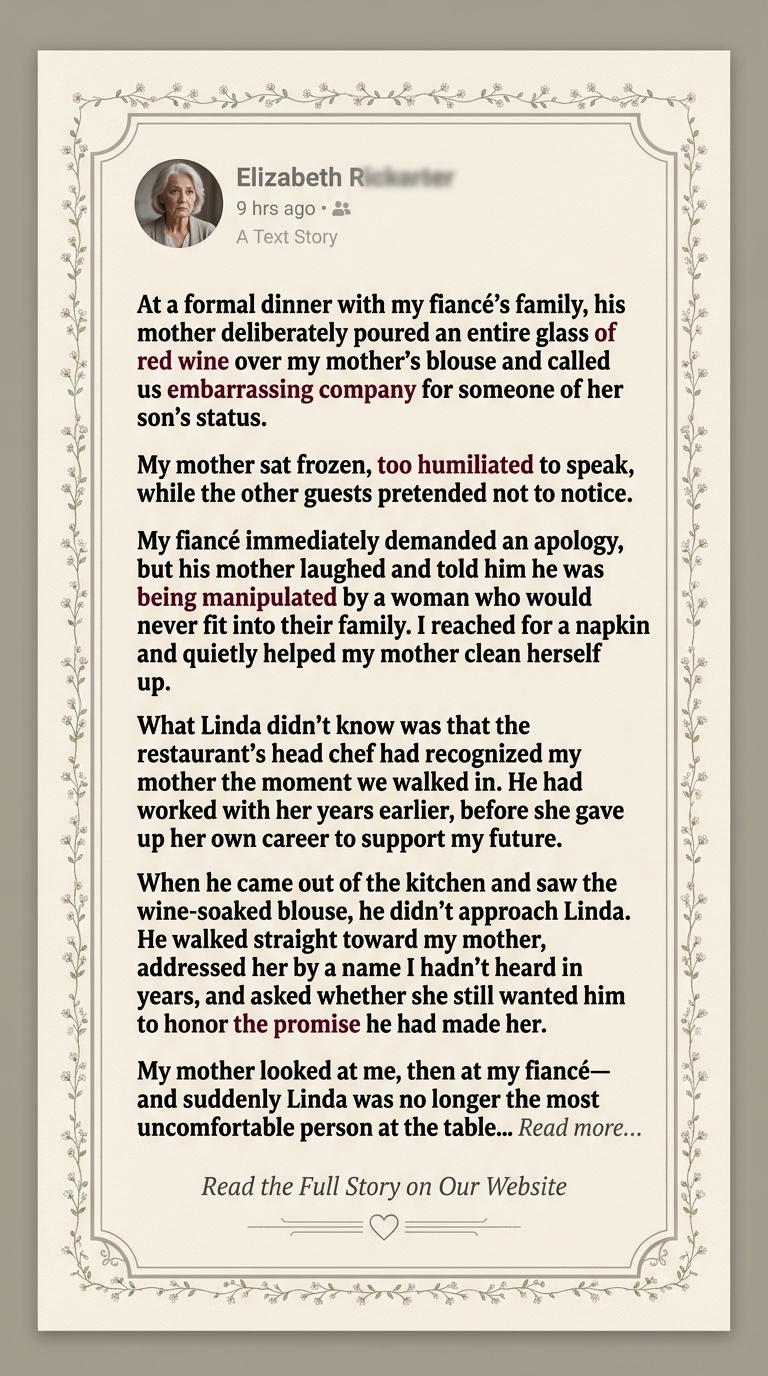
The first splash of red wine struck my mother’s chest before anyone at the table understood what had happened.
My mother, Evelyn, sat perfectly still as the dark liquid spread across the pale blue blouse she’d spent an entire afternoon choosing. A few drops ran down her sleeve and landed on the white tablecloth.
Across from her, Linda Whitmore placed her empty glass beside her plate.
“Honestly,” she said, dabbing her lips with a linen napkin, “I don’t know why I expected anything different.”
The table fell silent.
Linda was the mother of my fiancé, Andrew. She had invited us to dinner at the Grand Meridian, one of the city’s most exclusive restaurants, supposedly to celebrate our upcoming wedding. From the beginning, she’d made it clear that my mother and I were not the sort of people she usually entertained.
My mother had raised me alone after my father died when I was twelve. She worked long hours, repaired old clothes instead of buying new ones, and rarely spent money on herself. She had never been ashamed of her modest life, but she also never pretended to be someone she wasn’t.
Linda considered that a personal failure.
She had already criticized my mother’s dress, questioned why she hadn’t hired a professional driver, and made a pointed remark about the neighborhood where we lived.
But pouring wine over her was something else entirely.
“Mother!” Andrew pushed his chair back. “What is wrong with you?”
Linda looked at him with theatrical surprise.
“It slipped.”
“You tilted the glass toward her.”
“Don’t start making a scene. Your future wife is already sensitive enough.”
I reached for my napkin and gently pressed it against my mother’s blouse.
“Mom, are you okay?”
She nodded, although her eyes were fixed on the table.
“I’m fine, sweetheart.”
She wasn’t fine. I could see the humiliation in the way her fingers trembled.
Andrew turned toward his mother.
“You owe her an apology. Right now.”
Linda laughed.
“An apology? For an accident? Andrew, please. You’re allowing that woman to manipulate you. She knows exactly how to make you choose sides.”
“She didn’t do anything,” he replied. “You poured wine on her.”
Linda leaned back.
“This is precisely why I’ve never supported your engagement. You were raised to expect a certain standard, and now you’re preparing to marry into a family that will embarrass you at every opportunity.”
I felt my face grow warm, but my mother gently touched my wrist.
“Please,” she whispered. “Let’s not ruin his evening.”
That sentence nearly broke my heart.
My mother had spent her life making herself smaller so I could have room to grow. Even now, when someone had deliberately humiliated her, she was worried about inconveniencing me.
Then the restaurant’s head chef appeared from the kitchen.
His name was Gabriel Moreau. He was a distinguished man in his late fifties, known for overseeing the restaurant’s menu and personally greeting important guests. He had been watching our table from the kitchen entrance, but I assumed he was coming to check on the service.
Instead, he walked straight past Linda.
He stopped beside my mother.
For several seconds, he simply stared at her face.
Then he said a name I hadn’t heard since childhood.
“Elena?”
My mother slowly raised her eyes.
Gabriel smiled, but there was something emotional in his expression.
“I knew it was you. I recognized your hands when you picked up the menu.”
My mother looked startled.
“Gabriel? Goodness. It’s been a long time.”
Andrew glanced between them.
“You two know each other?”
Gabriel pulled out a chair.
“Know each other? Your mother-in-law-to-be taught me more about cooking than any culinary school ever could.”
Linda’s expression changed.
My mother looked uncomfortable.
“Gabriel, please. That was a long time ago.”
He ignored her embarrassment and examined the wine stains.
“What happened?”
“Nothing important,” my mother answered.
Gabriel looked at the empty glass in front of Linda, then at the soaked blouse.
“That doesn’t look like nothing.”
Linda gave a dismissive wave.
“It was an unfortunate accident. We were having a private family dinner.”
Gabriel didn’t respond to her. He kept his attention on my mother.
“Do you still have the old recipe book?”
My mother blinked.
“The blue one?”
“Yes. The one with your handwritten notes.”
She smiled faintly.
“I still have it. It’s in a box at home.”
Gabriel nodded, then asked the question that changed the entire evening.
“Do you still want me to honor the promise I made you?”
My mother went completely still.
I turned toward her.
“What promise?”
She looked at Gabriel, then at me.
“I don’t think this is the right time.”
But Gabriel had already made his decision.
“Then I’ll explain it,” he said gently. “Because I believe your daughter deserves to know what you gave up.”
He turned toward the table.
“Twenty-six years ago, I was a young cook working in a small restaurant on the edge of the city. I was talented enough to make mistakes with confidence, but not experienced enough to understand why my food never tasted the way I imagined.”
He smiled at my mother.
“Elena was the head chef. She had spent years developing her own approach to regional cooking. She took me under her wing when nobody else wanted to work with me.”
My mother shook her head.
“We were all learning.”
“No,” Gabriel replied. “You were teaching. There’s a difference.”
He explained that my mother had once been considered one of the most promising chefs in the region. She had won a national cooking competition, received an offer to work at a prestigious hotel, and been invited to participate in a culinary exchange program overseas.
I stared at her.
I knew she’d worked in restaurants when she was younger, but I’d never heard any of this.
“Mom, why didn’t you tell me?”
She lowered her eyes.
“Because it was a long time ago.”
Gabriel continued.
“When my first restaurant was struggling, Elena helped me redesign the menu. She taught me how to build flavor without hiding poor ingredients behind expensive ones. She even introduced me to a supplier who became one of my most important partners.”
He paused.
“She never asked for money.”
My mother gave a small shrug.
“I was happy to help.”
“Then she received her opportunity abroad. But shortly afterward, her husband died, and she had a little girl to raise. She decided not to leave.”
I remembered the stories about my father. I remembered the months when my mother worked two jobs and came home smelling of onions, garlic, and cooking oil. I remembered her hands being rough from washing dishes and handling hot pans.
I had always thought those were simply the circumstances of our life.
I hadn’t understood what she had sacrificed.
Gabriel continued.
“Before she left the restaurant, she told me that she had one regret. She wanted to open a cooking school for young people who couldn’t afford professional training. She believed talent shouldn’t depend on someone’s bank account.”
My mother gave him a warning look.
“Gabriel.”
He smiled.
“I know. You never liked talking about yourself.”
Then he turned to me.
“When I eventually opened my first successful restaurant, I promised Elena that if I ever had the means, I would help her build that school. Not a business with her name on the door. A place where young people could learn a trade, earn a living, and discover that their circumstances didn’t have to determine their future.”
My throat tightened.
“Did you ever build it?”
Gabriel shook his head.
“Not without her. I asked several times, but she always said she wasn’t ready.”
My mother looked at him.
“I had a child to raise. I couldn’t take a risk on another dream.”
“That’s why I waited.”
Linda let out an impatient sigh.
“Well, this is touching, but I fail to see what it has to do with our dinner.”
Gabriel finally turned toward her.
“It has everything to do with it.”
He pointed toward the dining room.
“This restaurant is part of a group I founded. We operate five locations and a training kitchen. Three years ago, we established a charitable culinary program for young adults who cannot afford formal education. We have the facilities, the instructors, and the funding. What we’ve lacked is someone with the experience and vision to lead the program.”
He looked at my mother again.
“Elena, I want you to run it. I want you to design the curriculum, choose the instructors, and build the school you imagined all those years ago. I’ve kept the position open because I believed you might say yes one day.”
My mother looked almost frightened.
“Gabriel, I don’t know if I can do that anymore.”
“You don’t have to decide tonight.”
He reached into his jacket and handed her a card.
“The offer is real. The resources are ready. And this time, you won’t have to sacrifice your future to take care of everyone else.”
I looked at my mother.
For the first time that evening, she wasn’t trying to hide her feelings. Her eyes were shining.
Linda, however, had become very quiet.
She looked from Gabriel to my mother and then toward the restaurant’s manager, who had approached after hearing part of the conversation.
“Is this some kind of arrangement?” Linda asked. “Are you offering her a position because she’s connected to your family?”
Gabriel’s expression became cold.
“Mrs. Whitmore, I have known Elena for more than two decades. Her work helped shape my career. I would offer her this opportunity regardless of whom her daughter planned to marry.”
Linda scoffed.
“Well, I hope you understand that Andrew comes from a family with certain expectations. We don’t need unnecessary complications.”
Andrew stood up.
“Stop.”
His voice was different now. Not angry in the way it had been earlier, but firm.
“You’re still doing it. You’re treating people as if their worth depends on how useful they are to you.”
Linda looked offended.
“I’m your mother.”
“And Evelyn is the woman who raised the person I’m marrying. You poured wine on her because you think she isn’t good enough to sit at your table.”
Linda glanced around. Several diners were watching now.
“Andrew, sit down.”
“No.”
He removed his jacket from the back of his chair.
“I invited you to meet the family I hope to join. Instead, you used the evening to humiliate them. I won’t pretend that was acceptable.”
Linda’s face flushed.
“You’re choosing them over your own mother?”
“I’m choosing to behave like an adult. And if you can’t respect my future wife and her mother, you won’t be involved in planning our wedding.”
She stared at him, seemingly unable to believe he had spoken to her that way.
Then she turned toward me.
“Are you satisfied? Is this what you wanted?”
I looked at her calmly.
“No. I wanted to have dinner with the people my fiancé loves. I wanted my mother to be treated with basic respect. I didn’t want anyone to have to choose sides.”
I glanced at the stain on my mother’s blouse.
“But I won’t ask her to pretend this didn’t happen just to make you comfortable.”
Linda pushed her chair back.
“You’re both being ridiculous.”
She picked up her handbag and walked out.
No one followed her.
Andrew looked at my mother.
“Evelyn, I’m deeply sorry. I should have stopped this kind of behavior long before tonight.”
My mother studied him.
“You did stand up for me.”
“I should have done more than stand up for you tonight. I should have made it clear to my mother years ago that insulting people is not something I’ll tolerate.”
She nodded slowly.
“Then make sure you mean it.”
“I do.”
The evening ended differently from how any of us had imagined. Gabriel arranged for my mother to have her blouse professionally cleaned and insisted that the restaurant cover the cost. He also invited us to visit the training kitchen the following week.
But the most important conversation happened after we got home.
My mother sat at our kitchen table, still holding Gabriel’s business card.
“Do you think I’m too old to start again?” she asked.
I sat opposite her.
“Mom, you spent twenty years helping me build a future. Why shouldn’t you have one of your own?”
She looked down at the card.
“I used to dream about that school. I imagined teaching children who had nowhere else to go. But after your father died, I thought those dreams belonged to another life.”
“They don’t have to.”
She smiled, though tears slipped down her cheeks.
“I was afraid you would think I was selfish if I chose something for myself.”
I reached across the table and took her hand.
“You gave up enough for me. Let me be proud of you now.”
Three weeks later, my mother met with Gabriel and his team.
She didn’t accept the position immediately. Instead, she visited the training kitchen, reviewed the program’s finances, interviewed potential instructors, and asked to speak with former students. She wanted to know whether the school would genuinely help people or simply give wealthy donors something attractive to put on their annual reports.
Gabriel welcomed every question.
Eventually, she accepted.
The program was renamed the Elena Morris Culinary Workshop, but my mother insisted that her name appear only on a small sign near the entrance. She wanted the students to remember the purpose of the school, not the person who ran it.
The first class began with twelve students. Some had left school early. One was a single father who needed a reliable profession. Another was a young woman who had been working night shifts at a convenience store to support her younger brothers.
My mother treated them all the same.
She taught them how to sharpen knives safely, prepare vegetables efficiently, control heat, and understand why a dish worked instead of simply memorizing a recipe.
She also taught them something she had learned long before I was born.
“Never confuse the price of an ingredient with the value of the person preparing it,” she told them. “A good meal doesn’t need to announce how expensive it is.”
By the end of the first year, several students had secured paid positions in restaurants. Two returned as assistant instructors. The program received additional funding because of its results, not because of publicity.
Andrew and I postponed our wedding for several months. We used that time to discuss the kind of marriage we wanted and the boundaries we would maintain with both families.
He eventually spoke to his mother again, but he made one condition clear: she would need to acknowledge what she had done and apologize directly to Evelyn before being invited to participate in our wedding.
Linda resisted for a long time.
Then, almost a year after the dinner, she arrived at the culinary workshop.
She found my mother supervising a group of students preparing lunch.
“I’d like to speak with you,” Linda said.
My mother wiped her hands and stepped away from the counter.
Linda looked uncomfortable. Without the formal dining room, the expensive wine, and the audience she had once commanded, she seemed much smaller.
“I owe you an apology,” she said.
My mother waited.
“I was cruel to you. I judged you because of your clothes and your background, and I embarrassed you in front of everyone. There was no excuse for what I did.”
My mother nodded.
“Thank you for saying that.”
Linda glanced at the students working behind her.
“I didn’t know you had done all this.”
My mother looked toward the kitchen.
“You didn’t need to know. You only needed to treat me with respect.”
Linda lowered her eyes.
“I understand.”
My mother accepted the apology, but she didn’t offer an instant friendship or pretend the incident had disappeared. She simply returned to her students.
That was enough.
When Andrew and I finally married, the celebration was held in a modest garden beside the restaurant’s training kitchen. My mother prepared the main course with her students, who were delighted to cook for the woman who had taught them.
Gabriel gave a short speech about the importance of recognizing talent before the world does.
Then he raised his glass toward my mother.
“To Elena,” he said, “who taught me that a kitchen can change a person’s life long before anyone knows their name.”
Everyone applauded.
I watched my mother standing among her students, laughing as they brought out the final dishes. Her blouse was a simple cream color, and her hands still bore the small marks of years spent working in kitchens.
But she no longer looked like someone who had given up her dreams.
She looked like someone who had finally returned to them.
And I realized that the most important thing Gabriel had recognized that night wasn’t my mother’s old reputation or the career she might have had.
It was the person she had remained, even after life demanded that she put herself last.