The Promise Beneath the Branding Iron
The first thing I noticed when my husband’s daughter stepped out of the black SUV was that she wasn’t wearing the boots she used to ride in as a teenager.
She wore polished leather shoes, a tailored coat, and the expression of someone arriving to collect something she already considered hers.
Behind her came her husband, Martin, carrying a thick document folder. A sheriff’s deputy followed them up the gravel drive.
I stood on the porch of our ranch house, watching them approach.
“Morning, Rebecca,” I said.
She barely returned the greeting.
“We need to settle something, Margaret.”
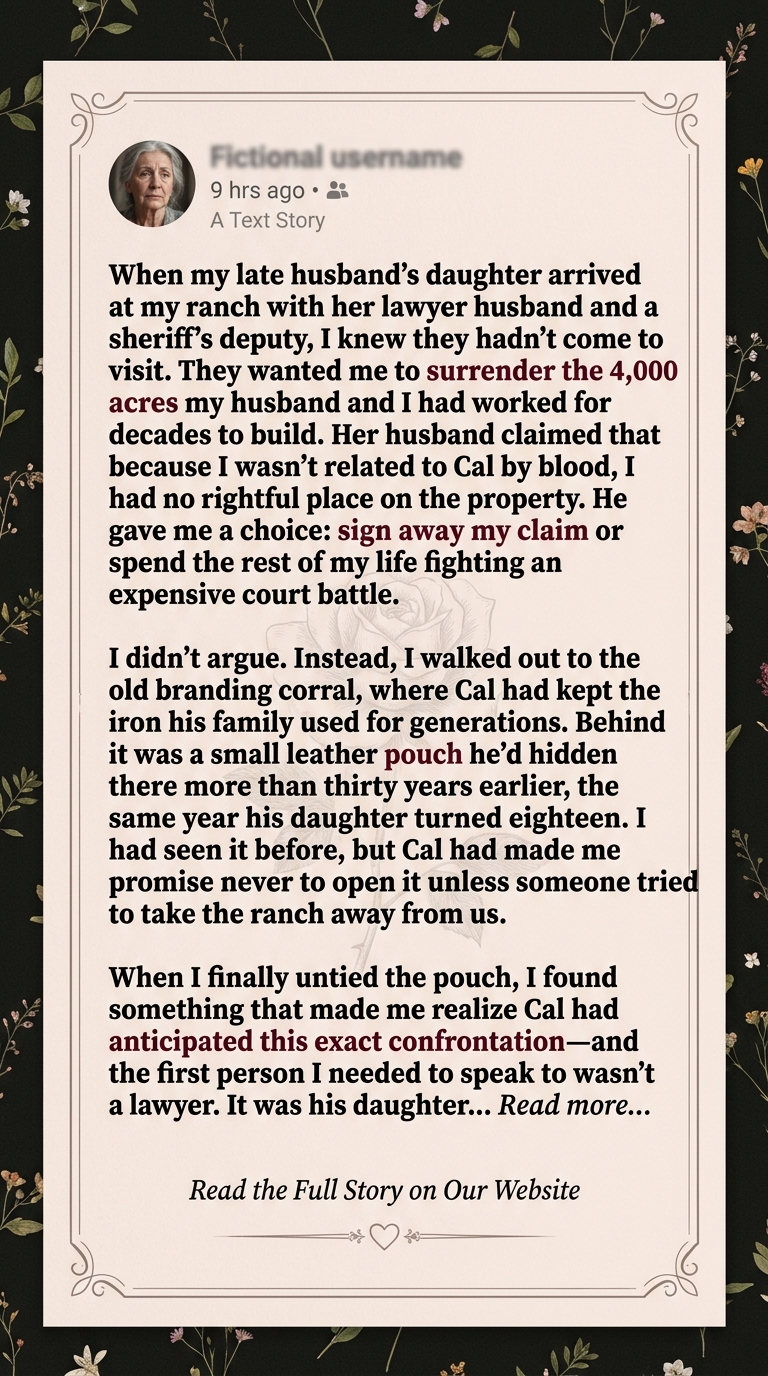
My late husband, Cal, and I had spent thirty-eight years building our ranch in eastern Montana. Four thousand acres of grazing land, two barns, a modest farmhouse, several outbuildings, and a herd of cattle that had grown from a few dozen animals into a profitable operation.
Cal had inherited a small portion of the original land from his father. We bought the surrounding parcels over the years, sometimes paying cash and sometimes borrowing against everything we owned. I kept the accounts, managed the livestock records, negotiated with suppliers, and worked alongside him through winters when the water lines froze and summers when the grass turned brown.
The ranch wasn’t simply something Cal had owned.
It was something we had built together.
Rebecca was his daughter from his first marriage. She had been eighteen when I married Cal, and although we had never become particularly close, I had never tried to replace her mother. I respected her place in his life, and Cal had always made sure she knew she was loved.
But she had moved away years earlier, rarely visited, and shown little interest in the ranch until after Cal died.
Now she stood in front of me with a lawyer for a husband and a deputy behind them.
Martin opened his folder.
“My wife has inherited her father’s estate,” he said. “However, there are complications concerning the ranch’s ownership.”
I looked at the papers.
“What complications?”
“Your claim to the property.”
I almost laughed.
“My claim?”
Martin gave me a thin smile.
“You’re not related to Cal by blood. Rebecca is his only biological child. She believes the land should pass to her.”
“Cal left a will.”
“We have reviewed it.”
“Then you know what it says.”
Martin adjusted his folder.
“We believe the will was improperly influenced. Your husband was elderly and dependent on you when it was prepared. We intend to challenge its validity.”
Rebecca finally spoke.
“Dad wanted me to have the ranch. He told me that for years.”
“Your father told me many things, Rebecca. He never told me he wanted me removed from the home we built together.”
Her expression hardened.
“You’re making this difficult.”
Martin stepped forward.
“We’re offering you a practical solution. Sign a voluntary transfer of your interest in the property, and we’ll arrange a settlement. Otherwise, you’ll be dragged into years of litigation. The legal fees alone could consume whatever money you have left.”
The deputy shifted his weight.
I looked at him.
“Are you here because there’s a court order?”
He shook his head.
“No, ma’am. I’m here because Mr. Hale requested a civil standby. I’m not here to enforce any transfer of property.”
“Thank you.”
Martin looked annoyed.
“Let’s not waste time on technicalities.”
I returned my attention to Rebecca.
“Did you come here because you believe your father wanted this, or because your husband told you the ranch was worth fighting over?”
She didn’t answer.
I had my answer.
“Give me until tomorrow,” I said.
Martin smiled.
“Of course. But I wouldn’t recommend delaying.”
They returned to the SUV, leaving me on the porch.
I watched the vehicle disappear down the ranch road.
Then I went inside, poured myself a cup of coffee, and sat at Cal’s old kitchen table.
For three years, I had lived with the quiet that followed his death. Every morning, I still expected to hear his boots crossing the porch. Every evening, I caught myself turning toward his chair to tell him something about the cattle.
I missed him terribly.
But I wasn’t frightened of losing the ranch.
Not yet.
Because thirty-four years earlier, Cal had made me promise something.
We had been repairing the old branding corral when he showed me a small leather pouch tucked behind a loose timber near the iron storage rack.
He told me it belonged to his father before him, although he had never used it for anything important.
“One day,” he said, “someone may come asking for this place in a way that has nothing to do with what we’ve built. If that happens, I want you to open it.”
“What could be in there?”
“Something I should have dealt with a long time ago.”
He made me promise not to open it unless someone tried to take the ranch away from us.
At the time, I thought he was being overly cautious.
Now I understood.
I put on my coat, walked out to the branding corral, and found the loose timber exactly where he had left it.
The pouch was still there.
Its leather had darkened with age, and the cord around its opening was stiff. I carried it back to the house and placed it on the table.
For several minutes, I simply stared at it.
Then I untied the cord.
Inside was a small brass key, an old photograph, and a folded letter addressed in Cal’s handwriting.
The photograph showed Cal standing beside a young woman I recognized immediately.
It was Rebecca.
She couldn’t have been more than eighteen.
They were standing in front of the ranch’s original barn, both smiling. Cal had one arm around her shoulders.
On the back, he had written:
The day Rebecca told me what she wanted to do with her life.
I unfolded the letter.
“Margaret,
If you’re reading this, someone has decided that the ranch is worth more to them than the people who made it what it is.
I hope it never happens.
But if it does, I need you to understand something about Rebecca.
When she turned eighteen, she came to me with a decision. She wanted to leave the ranch and build a life of her own. I was proud of her, but I was also afraid of losing her. I made a promise that I have regretted ever since.
I promised her that if she ever returned and wanted the ranch, I would make room for her.
I did not promise her ownership.
There is a difference.
The key in this pouch opens the small safe in the old tack room. Inside are the original partnership records and a document Rebecca signed herself. I kept them because I wanted her to have the freedom to build her own future without carrying the burden of this place.
Before you speak to any lawyer, speak to my daughter. Let her remember what she wanted before someone else tells her what she is entitled to.
I should have had this conversation with her years ago.
Don’t let my silence become your punishment.
Cal.”
I read the letter twice.
Then I picked up the photograph again.
Rebecca had been eighteen when she made her decision. I remembered that year. She had been accepted into a veterinary program in Colorado and was desperate to leave Montana. Cal had worried she would eventually regret it, but he had supported her.
I hadn’t known about any promise concerning the ranch.
I also hadn’t known about the document in the safe.
I found the brass key and drove to the old tack room.
The building smelled of leather, dust, and the saddle soap Cal had used for decades. Behind a row of old tack hooks was a small metal safe built into the wall.
The key turned with difficulty.
Inside were several folders, a small notebook, and a sealed envelope.
The first folder contained the original purchase records for the ranch. They showed that Cal and I had purchased most of the acreage together through a partnership registered under both our names.
The second contained the partnership agreement, signed and witnessed more than thirty years earlier. It established that the ranch was not simply Cal’s personal property. It was a business owned jointly by us, with clearly defined interests and succession provisions.
There were also records of later purchases, all made through the same partnership.
The sealed envelope contained a document signed by Rebecca.
It was dated shortly after her eighteenth birthday.
I read it slowly.
Rebecca had formally declined any future ownership interest in the ranch in exchange for a financial contribution from Cal toward her university education. The agreement did not erase her inheritance rights under his personal estate, but it clearly established that she had chosen not to become a partner in the ranch business.
There was a handwritten statement beneath her signature.
I want Dad to help me get started, but I don’t want to spend my life running cattle. The ranch is his and Margaret’s future. Mine is somewhere else.
I sat on an old feed crate.
Cal had not hidden a secret inheritance.
He had hidden a decision Rebecca herself had made.
But something bothered me.
Why had Cal never shown her the document? Why had he never explained the difference between inheriting his personal assets and claiming ownership of the ranch?
The answer was in the small notebook.
It contained notes from conversations over the years. Several entries mentioned Rebecca’s visits, her financial difficulties, and Cal’s attempts to help her.
One entry, written eleven years earlier, caught my attention.
Rebecca asked whether she could borrow against the ranch to fund Martin’s first legal office. I said no. She was upset. Told me Martin believed the ranch should eventually belong to her because she was my only child. I need to speak to her again.
The next entry was dated three years later.
Martin called about transferring land into a trust. Rebecca says it would protect the family from future taxes. I don’t understand why he keeps asking about ownership arrangements. Margaret and I built this together. I won’t put her security at risk.
The final entry was written only six months before Cal died.
Rebecca came alone today. She asked me to sign a document Martin prepared. It would have given him authority over the ranch’s business accounts. I refused. She cried and said she was only trying to protect her future. I told her I would help her if she needed help, but I would not hand over control of the ranch.
I closed the notebook.
For the first time, I wondered whether Rebecca had even read the documents her husband was now asking me to sign.
I called her.
She answered after several rings.
“What?”
“I found something your father left behind.”
A pause.
“What kind of something?”
“A letter. And the agreement you signed when you were eighteen.”
Her voice sharpened.
“You opened that pouch?”
“Yes.”
“That was private.”
“Your father left it for me to open if someone tried to take the ranch.”
She was silent.
“Rebecca, I think we need to talk. Just you and me. No Martin. No lawyers. No deputy.”
“I don’t have anything to discuss.”
“Then answer one question. Did you know your father had kept the agreement you signed?”
Another pause.
“I knew I signed something when I went to college.”
“Did you know it said you didn’t want an ownership interest in the ranch?”
“I was eighteen. I didn’t understand all the legal language.”
“You wrote the statement yourself.”
She said nothing.
“Your father didn’t leave you without anything,” I continued. “He left you his personal estate according to his will. But the ranch belongs to the partnership we built. You knew that when you left.”
“Martin says the agreement can be challenged.”
“Perhaps. But I don’t think you should challenge something you signed without first understanding why your father kept it.”
She hung up.
I didn’t call again.
The next morning, I contacted an attorney named Daniel Price, who had handled the ranch’s business filings for years. He had retired from active practice but agreed to review the documents and refer me to a specialist.
He examined the partnership agreement, purchase records, and Rebecca’s signed declaration.
“This is important,” he said. “But we need to establish the current ownership structure, confirm the validity of every transfer, and examine Cal’s estate documents. Don’t assume the letter alone settles anything.”
“I understand.”
He recommended an independent property and probate attorney, and I hired one.
Within days, we had confirmed that the ranch partnership remained legally active. My interest was protected under the agreement, and Cal’s share was governed by its succession provisions. Rebecca had inherited what his will assigned to her, but the ranch itself could not simply be transferred to her by challenging my personal inheritance.
Martin’s demand had been built around a false premise.
He had treated the entire ranch as though it had belonged solely to Cal.
It hadn’t.
My attorney sent a formal response explaining the ownership structure and demanding that Martin stop representing the ranch as Rebecca’s individual inheritance.
That should have ended the matter.
It didn’t.
Two days later, Rebecca arrived alone.
She stood on the porch with the old photograph in her hand.
“Can I come in?”
I stepped aside.
She sat at the kitchen table and placed the photograph between us.
“Why did Dad keep this?”
“Because he remembered the day you chose your future.”
She looked at the picture for a long time.
“I didn’t want the ranch when I was eighteen.”
“I know.”
“I wanted to become a veterinarian. I wanted to travel. I didn’t want to spend every summer fixing fences.”
“Your father was proud of you.”
“Then why did he never tell me about the agreement?”
I considered the question.
“Because he thought he was protecting your freedom. And because he was afraid that telling you would reopen an argument he’d never properly finished.”
Rebecca’s eyes filled.
“He always said the ranch would be there if I needed it.”
“He did.”
“So why wouldn’t he let me have it?”
I leaned forward.
“Because being there for you didn’t mean giving you everything you asked for. It meant helping you build your own life.”
She looked down at the photograph.
“Martin told me the ranch was legally mine. He said you were taking advantage of Dad’s age and his attachment to you.”
“Did you believe him?”
“I wanted to.”
That answer hurt more than I expected.
She explained that Martin’s law practice had been struggling. He had taken on expensive office space, hired staff, and borrowed money to expand. Several clients had delayed payments, and the firm had fallen behind on its obligations.
Martin had told her the ranch could secure a loan large enough to stabilize the business. He had also convinced her that Cal had intended her to inherit everything.
“Did he know about the agreement?” I asked.
Rebecca nodded slowly.
“He said it was old and could be overturned because I was young when I signed it.”
“Did he tell you what was in it?”
“No.”
I stood and brought the notebook from the tack room.
I opened it to the entry about Martin’s request for authority over the ranch accounts.
Rebecca read it silently.
Then she turned the page and found the final entry.
Her face changed.
“He wrote this six months before he died?”
“Yes.”
She covered her mouth.
“I remember that day. Dad and I argued. Martin was angry when I came home without the signed document. He said Dad was being selfish.”
I let her read the entry again.
“Your father wasn’t trying to punish you, Rebecca. He was trying to protect what we had built. And he was trying to keep you from making a decision that would put your future in someone else’s hands.”
She wiped her eyes.
“I thought he was choosing you over me.”
“He chose to honor the partnership we created. That isn’t the same thing.”
For a long time, neither of us spoke.
Finally, she asked, “Can I see the original agreement?”
I brought it from the folder.
She read every page this time.
When she reached her handwritten statement, she stopped.
“I wrote that?”
“Yes.”
“I remember being excited. Dad had helped me get into the program. I was so sure I was going to have a different life.”
“You did.”
She nodded, slowly.
Then she looked at me.
“Martin said I should sign the transfer papers before you found out what was in the pouch.”
My stomach tightened.
“Did he know about the pouch?”
“He knew Dad had kept something in the corral. He thought it might be an old deed.”
I looked at the leather pouch lying beside the documents.
“Why didn’t you tell him what you remembered?”
“Because I didn’t remember what I’d signed until I saw it.”
She took a breath.
“I need to talk to him.”
I didn’t tell her what to do.
She left with a copy of the agreement and the photograph.
That evening, Martin called.
His tone was no longer polite.
“You’ve interfered in a private family matter.”
“I’ve protected my legal interest in the ranch.”
“Rebecca has a right to challenge the agreement.”
“She can seek independent legal advice. But you have no authority to demand that I sign away my ownership.”
He lowered his voice.
“You should understand that this could become very unpleasant.”
“I understand that perfectly.”
“You’re making an enemy of me.”
“No, Martin. You arrived at my home with a deputy and threatened me with years of litigation. You made that decision yourself.”
He hung up.
The following week, Rebecca moved out of their house and began staying with a friend.
She retained her own attorney, who reviewed the documents independently. She also learned that Martin had been using the ranch’s supposed value in financial discussions with lenders, even though he had no authority to pledge the property.
His firm was already under financial pressure, and he had hoped to use the ranch as collateral without first establishing a valid ownership interest.
Rebecca withdrew her support for the claim.
Her attorney sent written notice that she would not pursue ownership of the partnership property and that she disputed any attempt by Martin to use her father’s estate as security for his business debts.
Martin’s firm eventually entered insolvency proceedings. The lenders investigated the representations made about the ranch, and Martin faced professional scrutiny over his handling of the proposed transaction.
Rebecca filed for divorce several months later.
She didn’t ask me for money, and I didn’t offer it. She had inherited her father’s personal assets, and she was entitled to whatever the will provided. But the ranch remained where it belonged.
For a while, I thought that would be the end of our relationship.
Then one spring morning, Rebecca arrived in an old pair of riding boots.
She stood by the corral, watching a new calf struggle to find its feet.
“I forgot how much I missed this,” she said.
I handed her a pair of gloves.
“Your father would’ve liked seeing you out here.”
She smiled sadly.
“He used to tell me that the ranch was a place I could always come back to. I think I misunderstood what he meant.”
“What do you think he meant?”
“That I would always be welcome. Not that everything would automatically belong to me.”
I nodded.
She looked toward the farmhouse.
“I don’t expect you to forgive me for coming here with Martin.”
“I don’t expect you to forget what happened, either.”
“Fair enough.”
We stood together for a while, listening to the cattle moving across the pasture.
Before she left, she asked whether she could visit again.
I told her the gate was open, provided she came because she wanted to see us, not because she wanted something from the land.
She agreed.
That summer, we began having lunch together once a month. Sometimes she helped with the cattle. Sometimes we argued about ordinary things. Our relationship wasn’t suddenly close, but it became honest.
I kept Cal’s letter in the kitchen drawer beside the old photograph.
The leather pouch went back behind the loose timber in the branding corral.
I no longer needed it to defend the ranch. The records were secured, the ownership was confirmed, and the threat had passed.
But I kept the pouch because it reminded me of something Cal had understood long before I did.
The greatest danger to a family legacy isn’t always someone who wants to inherit it.
Sometimes it’s someone who mistakes love for entitlement, and silence for permission.
Cal had left me the truth.
His daughter had needed to hear it.
And the ranch, after all those years, remained what we had always intended it to be: a home built through partnership, hard work, and choices made freely—not a prize waiting for whoever arrived with the loudest lawyer.