The courtroom was so quiet that I could hear the clock above the judge’s bench ticking.
My husband, Daniel, stood beside his attorney with the confidence of a man who believed the outcome had already been decided. He had spent ten years married to me, yet somehow convinced himself that he understood every part of my life.
That morning, he intended to prove otherwise.
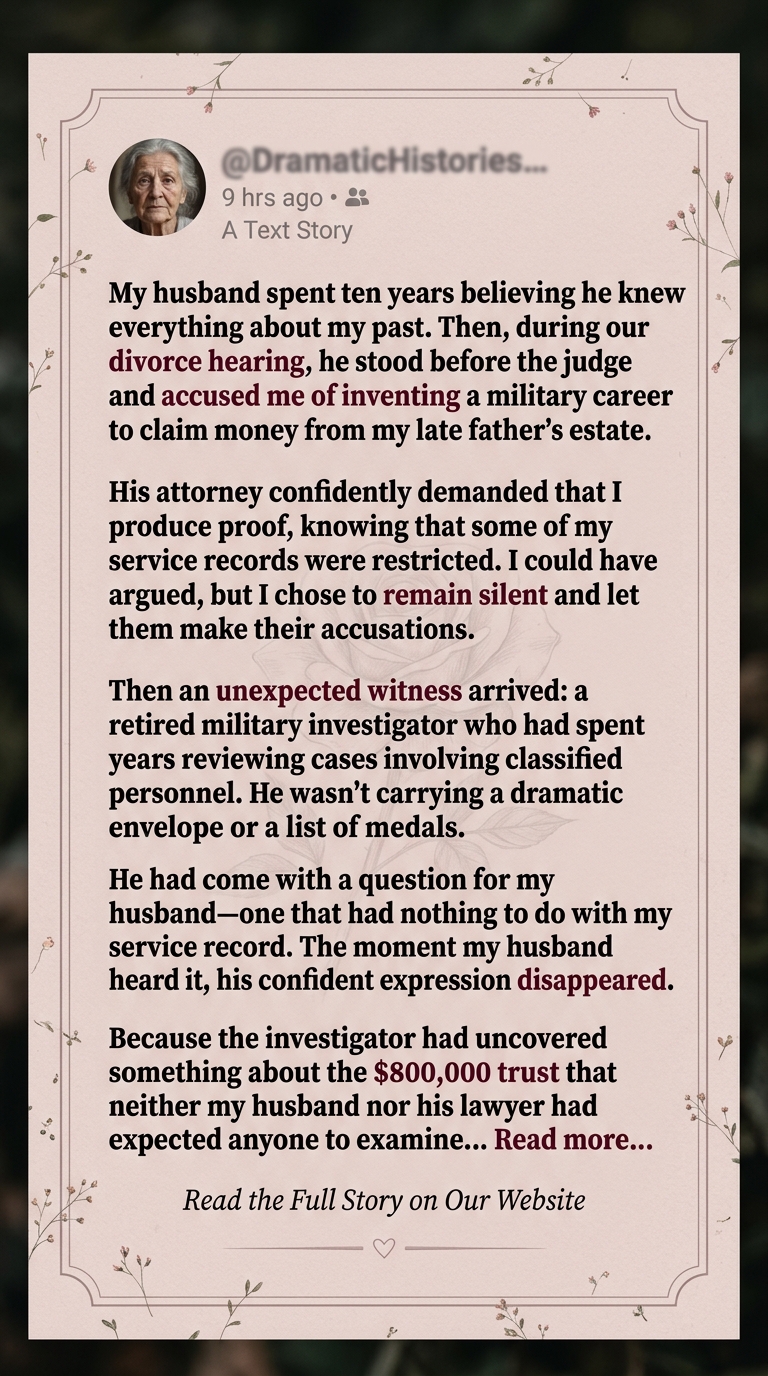
“She has fabricated an entire military career,” he told the judge. “She claims she served in the armed forces, but she cannot produce the records. Now she wants access to an $800,000 trust left by her father. This is an attempt to obtain money through deception.”
His attorney, Mr. Collins, rose from his chair.
“We are requesting that the court require the petitioner to provide complete documentation of her alleged service. If she cannot, her claims regarding the estate should be treated with serious skepticism.”
I sat beside my lawyer, Rebecca Shaw, with my hands folded in my lap.
Daniel glanced at me.
“Go ahead,” he said quietly. “Tell them where you served. Tell them what unit you belonged to. Give them something real.”
I said nothing.
It wasn’t because I had no answer. It was because the records he demanded included assignments that had never been intended for public disclosure. I had already explained that to Rebecca. She had advised me not to discuss operational details in open court.
Daniel mistook my restraint for fear.
He had always done that.
When we first met, I told him I had served in the military for several years. I never pretended to be a decorated war hero, and I never claimed to have done anything extraordinary. I simply said that my work had required discipline, travel, and periods of silence.
He accepted that explanation at the time.
After we married, however, his curiosity became suspicion. He wanted stories from deployments, names of commanding officers, photographs, and details I was not permitted to share. Whenever I declined, he accused me of exaggerating my past.
Eventually, he began telling people that I had probably worked in an office and invented the rest.
I had stopped correcting him.
The dispute over my father’s trust had made everything worse.
My father, Arthur Bennett, had died eighteen months earlier. He had established an $800,000 trust for me years before his death, with clear instructions that the funds were to remain separate from marital property. The trust was administered independently, and Daniel had never been named as a beneficiary.
He knew about the money, though.
And during the final months of our marriage, he had become increasingly interested in it.
When I refused to use the trust to rescue his failing investment company, he filed for divorce. A few weeks later, his attorney challenged my military background and argued that the trust should be considered part of our marital assets.
Now he was using my silence as evidence against me.
“Your Honor,” Collins continued, “my client has reason to believe the trust was established using money obtained through false claims connected to military service. We believe the source of those funds deserves examination.”
That was the first moment I looked directly at Daniel.
My father had spent thirty years building his engineering business. He had never received military compensation, and the trust had been funded through the sale of his company shares.
Daniel knew that.
But he was hoping the judge did not.
Rebecca stood.
“We object to the suggestion that the trust was funded through military benefits. The opposing party has presented no evidence whatsoever to support that allegation.”
Collins smiled.
“Then perhaps the petitioner can provide the evidence.”
Before Rebecca could answer, the courtroom doors opened.
A man in a charcoal suit entered, accompanied by a court officer. He was in his late sixties, with silver hair and a careful, measured way of walking. He carried no briefcase and wore no uniform.
Daniel leaned toward his attorney.
“Who is that?”
Collins looked equally confused.
The man approached the clerk and handed over his identification and a document authorizing his appearance as a witness.
The judge examined the paperwork.
“Mr. Mercer,” she said, “you are expected today?”
“Yes, Your Honor. I was asked to provide testimony concerning a matter raised in the proceedings.”
Rebecca turned toward me.
I recognized him immediately.
His name was Thomas Mercer. He had retired from military investigative service several years earlier. My father had known him professionally, and after my father’s death, Mercer had contacted me about an administrative matter connected to an old investigation.
I had not expected to see him in court.
The judge invited him to take the witness stand.
Collins rose immediately.
“Your Honor, before this goes any further, I would like to know what this witness has to do with the alleged trust.”
Mercer adjusted the microphone.
“That is precisely why I’m here.”
He looked toward Daniel.
“Mr. Bennett, do you recognize the name Northstar Logistics?”
Daniel’s expression changed.
Only slightly, but I saw it.
“No,” he answered.
Mercer nodded.
“That’s interesting. You signed a consulting agreement with them two years ago, didn’t you?”
Daniel’s attorney stood.
“Objection. Relevance.”
“I’ll establish relevance,” Mercer replied calmly.
The judge allowed him to continue.
Mercer explained that Northstar Logistics had been investigated for irregular financial transfers connected to several government contractors. The investigation had not concerned my military service. It had concerned a private network of companies that appeared to be moving money through consulting agreements that described services never actually performed.
One of those companies belonged to Daniel.
His firm, Bennett Strategic Solutions, had received three payments from Northstar over fourteen months. The payments totaled $286,000.
Daniel shifted in his seat.
“I provided legitimate consulting services,” he said.
Mercer looked at him.
“Then you should have no difficulty explaining why the invoices were approved by a person who never worked for Northstar.”
Collins objected again.
The judge instructed Mercer to explain the connection to the case.
He turned to a folder the clerk had placed before him.
“During our review, we discovered that a portion of the money received by Mr. Bennett’s company was transferred into a joint investment account held by Mr. Bennett and his wife. That account was later used to pay personal expenses and cover losses from his business.”
My stomach tightened.
I remembered that account. Daniel had persuaded me to open it after we married, claiming it would make household finances easier. I had deposited a small amount into it before eventually moving my salary elsewhere. I had never known he was using it to process payments from his company.
Mercer continued.
“When the marriage began deteriorating, Mr. Bennett contacted the administrator of his wife’s father’s trust. He requested information about its structure, distribution schedule, and withdrawal requirements.”
Daniel’s face had gone pale.
“That was a routine financial inquiry,” he said.
Mercer didn’t respond to the interruption.
“Two weeks later, he attempted to obtain a loan using a projected distribution from the trust as collateral. The application included a statement claiming that his wife had agreed to use the trust funds to support his company.”
I turned toward Daniel.
He had never asked me to sign such an agreement.
Rebecca slowly stood.
“Your Honor, we would like to see that application.”
The judge nodded.
The clerk handed Rebecca a copy.
She studied it, then passed it to me.
My signature appeared at the bottom.
But it wasn’t mine.
The shape was close enough to fool someone who had never seen my handwriting. The final letter of my surname was unusually sharp, and the signature leaned farther to the right than I ever wrote.
I looked at Daniel.
He wouldn’t meet my eyes.
Mercer continued.
“The loan was not approved. However, the application raised concerns because it appeared to involve an unauthorized representation of ownership and consent. During the investigation, we discovered that the trust itself had not been established through any military-related payments. It was funded through the sale of Mr. Bennett’s wife’s father’s business interests.”
Collins tried to interrupt.
“Are you suggesting my client forged his wife’s signature?”
Mercer answered carefully.
“I’m saying the signature was submitted as hers, and the independent handwriting review found substantial inconsistencies. The matter has been referred to the appropriate financial authorities.”
The courtroom had become completely still.
Then Mercer asked Daniel the question that had brought him there.
“Mr. Bennett, when you filed your divorce petition, why did you claim your wife had invented her military service to obtain money from her father’s trust, when you already knew that the trust was funded by the sale of a private business—and when you had previously attempted to borrow against it using a signature she denies writing?”
Daniel stared at him.
For the first time that morning, he had no prepared response.
“I never forged anything,” he finally said. “She gave me permission to handle the paperwork.”
I stood.
“No, Daniel. I didn’t.”
My voice sounded steadier than I expected.
“You told me the trust was protected. You told me I never needed to worry about it. And when I refused to give you money for your company, you decided to make my entire past sound like a lie.”
Daniel shook his head.
“You’re twisting everything.”
Rebecca placed the loan application on the evidence table.
“Then explain the signature.”
He looked toward Collins, who was now reading the document with a very different expression.
The judge called for a recess.
Outside the courtroom, Rebecca pulled me aside.
“Are you all right?”
I nodded, though my hands were trembling.
“I knew he was trying to get the trust money,” I said. “I didn’t know he had gone this far.”
“That’s why we let the evidence speak,” she replied. “You didn’t need to reveal anything classified to defend yourself.”
When the hearing resumed, the judge addressed the accusations against me first.
She ruled that Daniel had provided no credible evidence that my military service was fabricated or that the trust had been funded by military benefits. She declined to compel disclosure of restricted operational records and ordered that any further questions about my service be handled through appropriate confidential procedures.
She also ruled that the trust remained separate property under the documents presented to the court.
The financial allegations against Daniel were referred for further investigation. The judge made it clear that the divorce court would not determine criminal liability, but she ordered Daniel to preserve all financial records and prohibited him from attempting to borrow against or interfere with the trust.
Collins requested another hearing.
The judge denied the request to delay the financial restrictions.
Daniel sat motionless.
The man who had spent weeks telling everyone I was a liar had just been ordered to explain his own financial conduct.
The divorce was finalized several months later.
The financial investigation continued independently. It established that Daniel had submitted the unauthorized loan application and diverted money from his company through several personal accounts. He eventually entered a settlement requiring him to repay the disputed funds and accept restrictions on his business activities. The forged application became part of a separate civil proceeding, and he was no longer permitted to represent that I had authorized the loan.
He never admitted what he had done to me.
Instead, he told people that the investigator had misunderstood the situation and that our marriage had simply become too complicated.
I stopped trying to correct his version of events.
My military records remained protected. I provided the necessary verification through the proper confidential channel, and the court accepted it without requiring me to expose details that were never meant for public discussion.
One evening, after the final paperwork was completed, I visited my father’s grave.
I told him the trust was safe.
I also told him something I wished I had understood earlier: keeping parts of my life private had never made me dishonest. I had simply married someone who believed that love gave him the right to know everything—and that anything he couldn’t control must be a lie.
On the drive home, I thought about the question Mercer had asked Daniel.
It hadn’t been about medals, missions, or secret assignments.
It had been about why a man who claimed to be defending the truth had tried to take money that never belonged to him.
For ten years, Daniel had believed my silence meant he knew more than I did.
That day, he finally discovered the difference between someone who has nothing to say and someone who refuses to say what doesn’t belong in the room.