For fifteen years, I believed the hardest part of building a company would be convincing people to take a chance on me.
I was wrong.
The hardest part was discovering that the people who had watched me build it were quietly preparing to take it apart.
My name is Eleanor Hayes, and I founded a commercial interior design company called Hayes & Co. when I was twenty-nine. I started with a secondhand desk, two employees, and a small office above a printing shop. By the time I turned forty-four, we had seventy-three employees, contracts in six states, and an annual revenue that had grown beyond anything I imagined when I first opened our doors.
My husband, Richard, had been beside me for most of that journey.
At least, that was what I used to believe.
Richard was a successful attorney who specialized in business litigation. He had helped review my first major contracts, advised me when we expanded, and represented the company during several negotiations. Over the years, he became involved in more decisions than I initially intended.
I trusted him because he was my husband.
My mother, Margaret, and my younger sister, Vanessa, also benefited from the company. Mother received a monthly consulting payment for helping with administrative work, while Vanessa had been hired to manage vendor relationships. Neither position had ever been particularly demanding, but I wanted my family to share in the success I had worked so hard to achieve.
Richard often praised me for being generous.
He also had an affair with Vanessa.
I discovered it six months before the divorce hearing.
The affair had been going on for almost two years. I found out because a hotel reservation confirmation was accidentally sent to the shared email account we had once used for travel arrangements. The reservation included both their names.
When I confronted Richard, he didn’t deny it.
He simply said our marriage had been over for a long time and that Vanessa understood him better than I did.
My sister offered a different explanation. She said she had fallen in love and couldn’t control her feelings.
My mother asked me to consider the family’s reputation before making any decisions.
Not one of them asked how I was feeling.
I moved into a small apartment near the company headquarters and instructed my attorney, Helen Brooks, to begin divorce proceedings. I also ordered an independent review of the company’s financial records.
That review revealed something far more disturbing than the affair.
For nearly three years, several company payments had been directed toward a consulting business called Meridian Development Group. The invoices described market research, supplier evaluations, and strategic planning. The amounts were always just below the level that required my personal approval.
At first, the payments appeared ordinary.
Then Helen discovered that Meridian had been registered by Vanessa and Richard.
My mother was listed as its financial administrator.
They had used my company’s vendor contacts, employee research, and confidential pricing information to establish a competing business. They were also preparing to pursue contracts with two clients Hayes & Co. had spent years developing.
The consulting payments had funded their startup costs.
Even worse, some of the work billed to Hayes & Co. had been completed by my own employees during company hours. Those employees believed they were assisting with an internal expansion project. They had no idea their work was being used to build a separate business.
I felt sick when I understood the scale of it.
Richard had not merely betrayed our marriage. He had used his position as my legal adviser to help conceal a business that was taking money and opportunities from the company he had once promised to protect.
I wanted to confront all three of them immediately.
Helen stopped me.
“If you accuse them now, they’ll have time to coordinate their explanations,” she said. “We need to understand every transaction, who approved it, and what they intended to do with the information.”
So I stayed quiet.
I continued going to work. I attended meetings. I answered questions about upcoming projects. When Richard visited the office to collect personal belongings, I treated him with the same distant politeness I would have shown an unfamiliar visitor.
He mistook my silence for defeat.
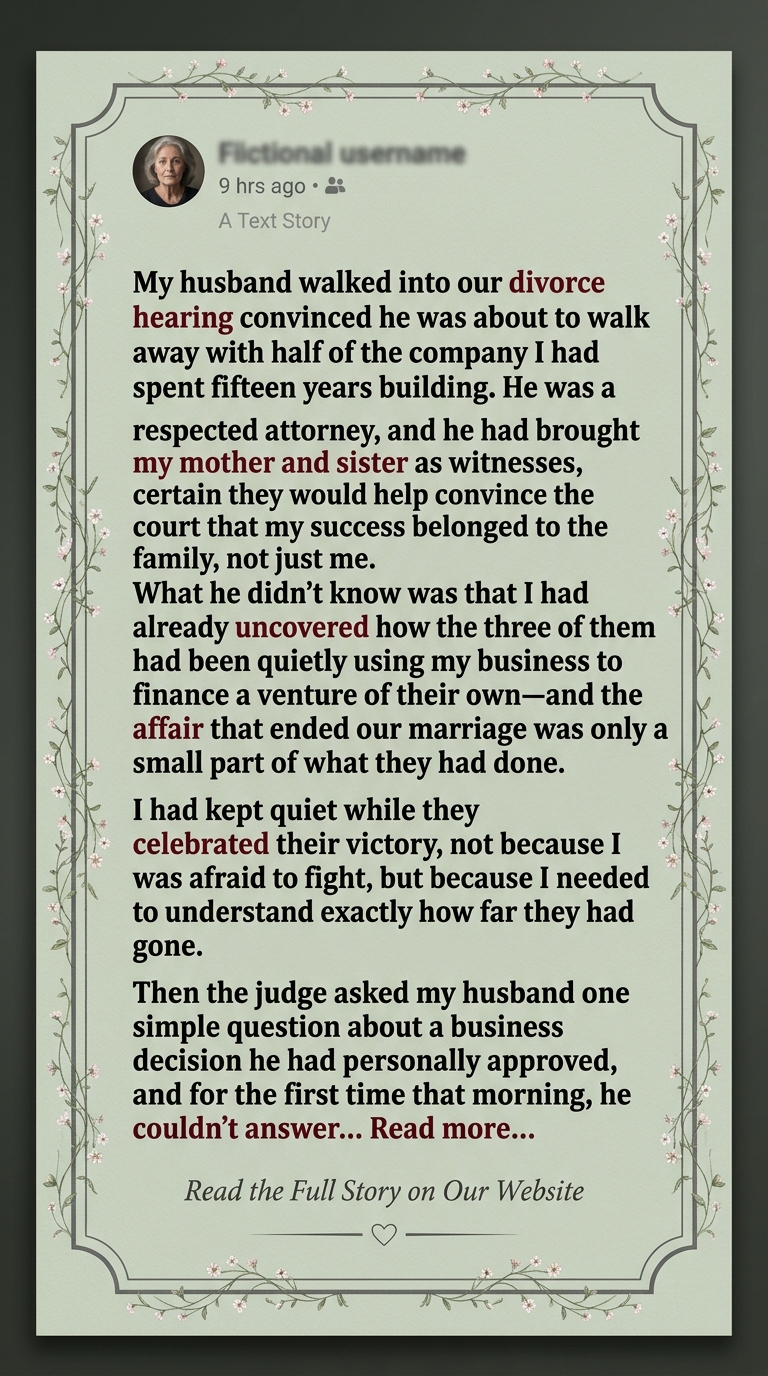
That mistake became especially obvious when his attorney filed a claim demanding half the value of Hayes & Co.
Richard argued that the company had grown during our marriage and that his legal and strategic contributions had been essential to its success. He also claimed that my mother and sister had helped build the business, making it a family enterprise rather than something I could claim as exclusively mine.
His attorney presented emails, meeting notes, and company photographs showing Richard at important business events.
They even brought my mother and Vanessa to the hearing.
I had not spoken to either of them in several weeks.
When I entered the courtroom, Mother was already seated behind Richard. She wore a navy dress and held her handbag tightly against her knees. Vanessa sat beside her, looking directly ahead.
Neither acknowledged me.
Richard turned around once and gave me a small smile.
He looked relaxed.
He had no reason to believe the hearing would go badly.
His attorney began by describing how Richard had supported the company throughout our marriage.
“He reviewed contracts, introduced business contacts, advised on expansion, and helped the petitioner navigate complex commercial negotiations,” he said. “My client is not seeking to take something he had no part in creating. He is asking for a fair share of an asset developed through years of joint effort.”
He called my mother first.
She testified that Richard had always been involved in the business and that I frequently relied on his advice.
“Eleanor was very talented,” Mother said. “But no successful person builds something entirely alone. Richard was there from the beginning, and our family supported her.”
Then Vanessa took the stand.
She described herself as one of the company’s earliest contributors and claimed that her vendor relationships had helped secure several important contracts.
When asked about Meridian Development Group, she said it was an independent venture she had started with Richard after discussing a possible business opportunity with me.
“That was never approved,” I whispered to Helen.
“I know,” she replied. “Wait.”
Richard’s attorney returned to his seat, looking satisfied.
Then he called Richard.
My husband spoke confidently about the hours he had spent reviewing contracts and the sacrifices he had made to support my career. He described the company as something we had built together.
He also suggested that I had recently become hostile because of his relationship with Vanessa.
The judge listened without interruption.
When Richard finished, the attorney asked for a division of the company’s value that would give him a substantial ownership interest.
Helen stood.
“Your Honor, we have no objection to examining legitimate contributions made during the marriage. But we believe the court should also examine the financial arrangements between Hayes & Co. and Meridian Development Group.”
Richard’s expression barely changed.
His attorney stood.
“Meridian is a separate company. There is no evidence that it has any relevance to the division of marital assets.”
Helen placed several documents on the evidence table.
“These records show that Hayes & Co. paid Meridian more than $1.4 million over thirty months. The invoices were approved through the company’s internal authorization system. We also have records showing that Meridian used confidential company materials and employee labor to prepare competing proposals for existing Hayes & Co. clients.”
My mother’s handbag slipped slightly from her knees.
Vanessa turned toward Richard.
He did not look at her.
His attorney requested time to review the documents.
The judge declined.
“I have reviewed the preliminary financial disclosures,” she said. “I would like to ask Mr. Hayes a question before we proceed.”
Richard stood.
“Yes, Your Honor.”
The judge turned to a document in front of her.
“On March 18 of last year, you approved a payment of $186,000 from Hayes & Co. to Meridian Development Group. The payment was described as an advance for a regional expansion study. Is that correct?”
Richard paused.
“Yes. I approved several consulting expenses.”
“What specific service did Meridian provide in exchange for that payment?”
“It was part of a broader development project.”
“Which project?”
Richard glanced toward his attorney.
The judge continued.
“Who at Hayes & Co. reviewed the completed work?”
“I believe the operations department handled that.”
“Who was responsible for the project?”
Richard cleared his throat.
“Vanessa managed the vendor relationship.”
The judge looked down again.
“Then perhaps you can explain why the payment approval system records you as both the requesting officer and the final approver, while the company’s policy required an independent project manager to certify delivery before payment.”
Richard said nothing.
The judge turned another page.
“More importantly, the records show that the $186,000 was transferred from Meridian into an account used to purchase a commercial property. That property was registered in your name and Ms. Vanessa Hayes’s name. Was the property part of the expansion study?”
Richard’s face lost its color.
“No, Your Honor. That was a separate investment.”
“Then why was company money used to finance it?”
“It wasn’t intended to be—”
He stopped.
The judge waited.
Richard looked at his attorney again, but this time his attorney did not stand to rescue him.
The question had exposed the problem.
Richard had approved the payment personally. He had also signed the internal certification stating that the consulting work had been completed and delivered to Hayes & Co. Yet the money had gone toward purchasing a property for himself and Vanessa.
There was no convincing explanation for that.
Helen rose.
“We would also like to submit the property purchase records, the bank transfer history, and the original consulting agreement.”
The judge accepted the documents for review.
Richard’s attorney asked for a recess.
During the break, I sat in the hallway with Helen.
“Did he know you had the property records?” I asked.
“He knew we had the payments,” she replied. “He didn’t know we had traced the money all the way through the purchase.”
I looked across the hallway.
Richard was speaking urgently to his attorney. Vanessa stood a few feet away, her arms folded. My mother sat alone on a bench.
For the first time, they looked less like a united family and more like three people realizing they had made promises to one another that could no longer protect them.
When the hearing resumed, Richard’s attorney no longer argued that Meridian was irrelevant. Instead, he claimed Richard had acted in good faith and that any financial irregularities were administrative mistakes.
Helen presented evidence that the payments had been divided among several invoices, all approved by Richard. She showed that the work supposedly delivered by Meridian was copied from internal company reports created by Hayes & Co. employees. She also produced messages in which Vanessa discussed using the company’s client list to approach customers once Meridian was ready to operate independently.
One message from Richard read: Once the property is secured, we’ll have enough room to move the team over.
That sentence changed the atmosphere in the courtroom.
The judge ordered an independent accounting of the transactions and prohibited Richard, Vanessa, and Margaret from accessing Hayes & Co.’s financial systems or confidential records. She also declined Richard’s request for an immediate ownership award, stating that his alleged misconduct and the disputed transfers had to be examined before any fair valuation could be determined.
The divorce itself was not decided that day.
But Richard had lost the advantage he had walked into court expecting to enjoy.
Over the following months, the independent accounting established that Meridian had received approximately $1.4 million from Hayes & Co. without providing the contracted services. The company also recovered records showing that Meridian had used internal staff time and confidential pricing information to pursue competing work.
The commercial property was eventually sold, and the proceeds were applied toward repayment of the diverted funds. Richard was removed from all company advisory roles. Vanessa’s employment ended after an internal investigation confirmed that she had used company resources for her private venture. My mother resigned before the company could complete its review of her administrative responsibilities.
The affair had broken my marriage.
The business scheme had destroyed what remained of my family’s trust.
Richard eventually accepted a divorce settlement that did not give him the ownership share he had demanded. The court considered the financial evidence when resolving the property dispute, and he received only the assets properly attributable to him under the applicable marital-property rules. The company remained under my control, subject to the final financial accounting and settlement.
I did not celebrate.
I had spent fifteen years building Hayes & Co. because I loved creating something that could stand on its own. I had imagined celebrating its success with the people I loved. Instead, I had to rebuild the business while learning how to live without them.
Some employees were frightened when they learned what had happened. I called a company meeting and told them the truth without turning it into a public attack on my family.
I explained that the company would repay any legitimate obligations, strengthen its approval procedures, and protect the people whose work had been misused.
Then I did something I should have done years earlier.
I appointed an independent finance director, separated personal relationships from business authority, and required two unrelated executives to approve significant payments.
For the first time, no family member could access company money simply because I trusted them.
Months later, Mother sent me a message asking whether we could meet.
She wrote that she missed me and that she hoped I would eventually understand how complicated the situation had become.
I read it twice.
Then I replied that I was willing to speak with her one day, but I would not pretend that what happened had been a misunderstanding. If we were ever going to have a relationship again, it would have to begin with honesty.
Vanessa never contacted me.
Richard sent one final message through his attorney, asking me to stop discussing the case with former colleagues.
I didn’t respond.
A year after the hearing, Hayes & Co. secured its largest independent contract. I stood in our new conference room, watching the team celebrate, and realized that the company had survived something far more dangerous than a difficult market or a failed project.
It had survived the people who believed they were entitled to own it simply because they were close to me.
I still missed the family I thought I had.
But I no longer confused loyalty with permission, or love with unlimited access.
Richard had entered that courtroom believing he was entitled to half of everything I had built.
The judge’s question had forced him to confront something much simpler.
He had been so busy trying to prove that my success belonged to him that he had forgotten to explain why he had been using it to finance a business of his own.