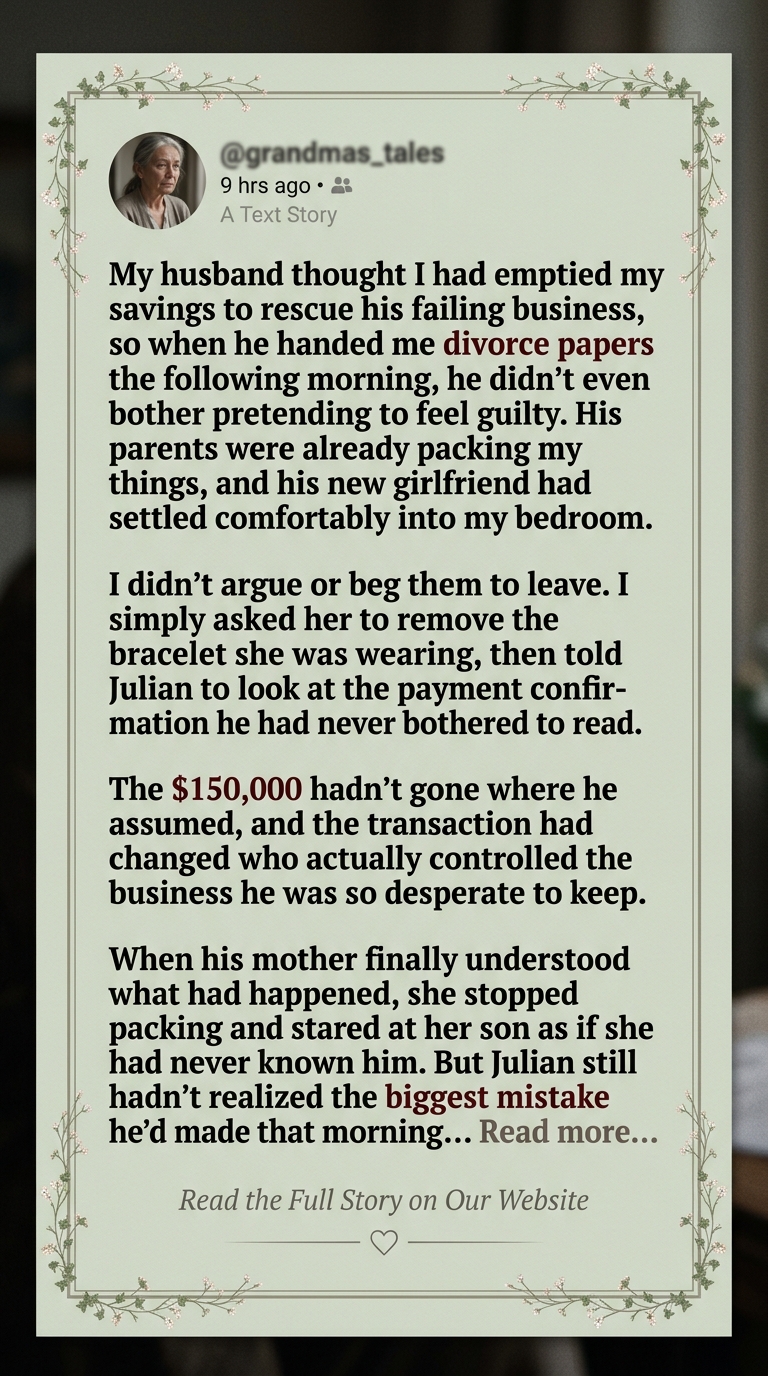
The morning Julian handed me divorce papers, his mother was packing my clothes into cardboard boxes.
His father stood in the hallway, supervising as though he had been waiting years for the opportunity. And Julian’s new girlfriend, Chloe, was sitting on the edge of my bed, wearing my silk robe and a diamond bracelet I had never seen before.
Nobody looked particularly uncomfortable.
Julian placed the papers on the kitchen counter.
“I think it’s best if we end this without making things ugly,” he said.
I looked at the signature line, then at him.
“You’ve already decided everything?”
“There’s nothing left to discuss, Emma.”
His mother, Patricia, gave a small, impatient sigh.
“We’ve been more than patient. Julian needs a fresh start, and you need to accept that the marriage is over.”
I glanced toward the bedroom.
Chloe lifted her coffee cup and offered me a polite smile.
It was almost impressive how quickly she had made herself at home.
Three days earlier, Julian had been sitting across from me at that same kitchen counter, telling me his company was on the verge of collapse. His commercial equipment business, Mercer Industrial Supply, had lost two major contracts, and the bank was threatening to withdraw its credit facility.
He said he needed $150,000 to keep the company operating long enough to secure a new distribution agreement.
I had spent years building my savings. I had worked as a financial controller before leaving my job to care for my mother, and I knew exactly what it meant to risk that much money.
But Julian was my husband.
I agreed to help.
He had hugged me, promised he would never forget what I had done, and told me we would rebuild together.
Apparently, his definition of rebuilding included replacing me.
“I thought you needed the money to pay your suppliers,” I said.
“I did.”
“And the business is safe now?”
He gave me a dismissive look.
“That’s none of your concern anymore.”
I nodded slowly.
Then I noticed Chloe’s bracelet.
It was a narrow platinum band with a small blue sapphire set in the center. I recognized it immediately because I had bought it several months earlier as a gift for myself. It had been in the jewelry box beside my bed.
“Chloe,” I said calmly, “would you mind taking off that bracelet?”
She glanced at her wrist.
“Julian gave it to me.”
“I know. But it’s mine.”
She looked at him.
Julian stepped forward.
“Emma, don’t start.”
“I haven’t started anything. I’m simply asking for my property back.”
Chloe unclasped it and placed it on the counter.
I picked it up and slipped it into my handbag.
Then I turned to Julian.
“Have you looked at the payment confirmation?”
His eyebrows drew together.
“What payment confirmation?”
“The one I sent you yesterday.”
“I was busy.”
“I assumed you were.”
He reached for his phone, irritated.
“What are you talking about?”
I took out my own phone and opened the message I had sent him the previous afternoon. It contained the confirmation for the $150,000 transfer, along with the legal agreement he had electronically acknowledged before the money was released.
He stared at the screen.
At first, he looked confused.
Then his face tightened.
“What’s this?”
“Your payment confirmation.”
“This says Mercer Industrial Holdings.”
“That’s the company’s holding entity.”
“I asked you to transfer money to the business account.”
“You asked me to rescue the business. I agreed to provide the money, but I didn’t agree to hand it over without protection.”
His father stopped packing.
Patricia slowly lowered the shirt she was holding.
Julian scrolled through the confirmation.
“You transferred the money to the holding company?”
“Yes.”
“Why?”
“Because the operating company was insolvent, and putting $150,000 directly into an account that creditors could seize would have been reckless.”
He looked up sharply.
“You had no right to make that decision.”
“I had every right to decide the terms under which I would lend my money.”
That was when he finally opened the attached agreement.
A few weeks before Julian asked for my savings, I had reviewed his company’s financial statements. I discovered that the operating business had accumulated unpaid supplier invoices, overdue taxes, and several expensive loans. The new distribution agreement he kept talking about was not guaranteed. In fact, the prospective distributor had made its offer conditional on the company restructuring its debt and securing additional working capital.
I told Julian that simply transferring money into the operating account would not solve the problem.
He insisted he understood the risks.
So I contacted an independent restructuring adviser and proposed a secured investment through the holding company.
The agreement gave me a convertible loan backed by a security interest in the company’s operating assets. If Julian failed to repay it by the agreed deadline, I could convert the outstanding balance into a controlling ownership position, subject to the agreed restructuring conditions.
Julian had signed the agreement electronically.
He had also signed the board resolution authorizing the holding company to accept the funds and the security arrangement.
He had been so desperate for the money that he approved everything without reading the documents carefully.
“You tricked me,” he said.
“No. You signed an agreement.”
“You said you were helping your husband.”
“I was. I was trying to save the company, not give you $150,000 with no protection.”
He looked toward his father.
“Dad, tell her she can’t do this.”
His father walked over and read the first page.
His expression changed as he reached the section describing the security interest.
“Julian,” he said quietly, “you signed this?”
“It’s just paperwork.”
“It’s not just paperwork.”
Patricia stepped closer.
“What does it mean?”
His father looked at her.
“It means Emma has a legal claim against the business. If Julian doesn’t meet the repayment terms, she can convert the loan into shares. Depending on the company’s valuation, she could end up controlling it.”
Patricia stared at me.
“But Julian owns that company.”
“Not entirely,” I replied. “And he won’t own it entirely if the agreement is triggered.”
Julian snatched the papers from his father.
“This is ridiculous. I never agreed to give you control.”
I pointed to the electronic signature.
“You agreed to the terms. You had your own attorney review the documents before signing.”
He stopped.
His attorney had, in fact, reviewed them. Julian had insisted on making a few changes to the repayment schedule before accepting the final version. The agreement was not something I had hidden inside a pile of paperwork. He had simply assumed the security provisions would never matter because he believed I would never enforce them against him.
That assumption had cost him.
Chloe stood up from the bed.
“Julian, what is she talking about? You told me the company was yours.”
“It is,” he snapped.
His father shook his head.
“Not if the agreement says what I think it says.”
I took a breath.
“There’s something else you should know.”
Julian looked at me with open hostility.
“What now?”
“The $150,000 wasn’t the only money I reviewed before making that transfer.”
I opened another file on my phone.
During my financial review, I had noticed that Mercer Industrial Supply had been paying unusually large consulting fees to a company called Northbridge Advisory. The payments were described as operational support, but the company had no employees, no meaningful office, and no record of providing the services listed on its invoices.
I had initially assumed it was a questionable supplier arrangement.
Then I discovered that Northbridge was owned by Julian’s business partner, Daniel Price, and that several payments had been redirected into an account connected to a property development project.
The project was being financed with money that should have been used to pay Mercer Industrial Supply’s suppliers.
Julian had approved the payments.
I showed him the transaction list.
“Do you recognize these?”
He glanced at the screen.
“They’re business expenses.”
“Then why did you tell the bank that the company had no related-party transactions?”
His expression changed.
Patricia looked from him to the phone.
“What does that mean?”
“It means the business was in worse shape than Julian told me. It also means the financial statements used to obtain the company’s latest credit facility may have been incomplete.”
Julian lowered the phone.
“You don’t understand how business works.”
“I understand enough to know that money doesn’t disappear simply because someone labels a transfer as consulting.”
His father sat down.
For years, he had helped Julian with the company. He had introduced him to suppliers, attended industry events, and occasionally provided money when the business struggled. He had always believed his son was a capable businessman who had made a few unfortunate decisions.
Now he was looking at evidence that Julian had concealed financial transactions while asking his wife to sacrifice her savings.
“Did you know about Northbridge?” he asked.
Julian didn’t answer.
“Julian, I’m asking you.”
“It was temporary. Daniel said the money would come back.”
“Did you disclose it to the bank?”
“Dad, this isn’t the time.”
His father stood.
“It is exactly the time.”
Patricia was no longer holding my clothes. She had placed them carefully on top of the bed.
“What have you done?” she whispered.
Julian turned toward her.
“Don’t make this worse.”
But the damage had already been done.
The biggest mistake Julian had made that morning wasn’t signing the investment agreement. It wasn’t bringing his girlfriend into our bedroom or allowing his parents to pack my belongings.
It was assuming that because I had transferred the money, I had stopped paying attention.
He had forgotten that I spent years working with financial records. I knew how to follow transactions, identify irregularities, and distinguish a struggling business from one being deliberately mismanaged.
And I had not transferred my savings until I understood what I was protecting.
I had also discovered something else.
The bank had not yet received the final documents required to complete the new credit facility. The lender had requested updated financial disclosures, including details of transactions involving related parties. Julian had been planning to submit those disclosures after receiving my money.
The independent review had identified the Northbridge payments before the final submission.
I had not hidden that information from him to sabotage his business. I had insisted that the irregularities be investigated before additional financing was approved.
Now the lender had received the same findings through the company’s independent restructuring adviser.
Julian’s phone began ringing.
He looked at the screen and walked toward the window.
It was Daniel.
He answered quietly.
“What?”
I couldn’t hear the other side, but I watched Julian’s face.
“No. That can’t be right.”
A pause.
“You said the transfer wouldn’t be reviewed.”
Another pause.
“Then call them back.”
He ended the call.
His father stared at him.
“What did Daniel say?”
Julian didn’t answer.
“Did the bank suspend the facility?”
Still nothing.
His father looked at me.
I didn’t need to explain.
The bank had suspended the proposed credit facility pending an independent review. The company would have to disclose the Northbridge transactions, provide supporting records, and demonstrate that its financial position had not been misrepresented.
The $150,000 I had provided remained protected under the investment agreement. It could not simply be withdrawn or spent without regard to the agreed restrictions.
Julian had wanted my money to keep control of his company.
Instead, he had accepted financing that gave me enforceable rights over the business while exposing the transactions he had hoped would remain unnoticed.
Chloe picked up her handbag.
“I think I should go.”
Julian turned toward her.
“Don’t leave.”
She looked at him for a long moment.
“You told me your wife was the problem. You said the company was going to be fine once she gave you the money.”
“I can explain.”
“You told me we would have our own place by the end of the month.”
She glanced at the boxes.
“I don’t want to be part of this.”
She left without taking anything else from the bedroom.
Patricia watched her go.
Then she turned toward her son.
“Did you bring her here while you were still married?”
Julian rubbed his forehead.
“Mother, please.”
“Did you?”
He didn’t answer.
His father walked toward the hallway and picked up the cardboard box containing my clothes.
“Put these back,” he told Patricia.
She looked at him.
“Why?”
“Because we shouldn’t be packing anything that doesn’t belong to us.”
For the first time that morning, Julian looked genuinely frightened.
“Dad, you’re taking her side?”
His father shook his head.
“No. I’m finally looking at what you’ve done.”
The divorce did not end that day.
Over the following months, the financial review continued, and the company’s ownership dispute became part of the wider settlement negotiations. Daniel eventually resigned from his position after investigators confirmed that Northbridge had received payments without providing the contracted services. The company pursued recovery of the improperly transferred funds, and the bank required a revised restructuring plan before considering further credit.
Julian tried to challenge my investment agreement, arguing that he had signed it under financial pressure.
But his own attorney had reviewed the terms, the company board had authorized the transaction, and the records showed that he had negotiated several provisions before signing. His claim that he hadn’t understood the agreement did not erase his obligations.
When the repayment deadline arrived, Mercer Industrial Supply still could not repay the full amount.
I exercised my conversion rights under the agreement.
An independent valuation and the agreed conversion formula gave me a controlling ownership interest in the restructured company. Julian retained a minority share, but he no longer had the authority to make major financial decisions without the approval required by the new governance structure.
I didn’t take control to punish him.
I took control because I had invested my savings in a business that employed forty-one people, and I refused to let their livelihoods depend on decisions made behind closed doors.
The divorce was finalized several months later.
Julian received the personal property and financial assets allocated to him under the settlement. I kept my investment and my interest in the company. The affair was addressed as part of the breakdown of the marriage, but it was the financial misconduct—not Chloe’s presence in my bedroom—that ultimately changed the direction of the business dispute.
I moved into a smaller house and started over.
The first year was difficult. We had to renegotiate supplier contracts, replace several unreliable vendors, and rebuild the trust of customers who had heard rumors about the company’s financial problems.
But we survived.
Eighteen months after the divorce, Mercer Industrial Supply secured a new distribution agreement. The company was smaller than before, but it was stable, profitable, and managed with transparent financial controls.
My father-in-law called once during that period.
He apologized for helping pack my belongings that morning.
“I thought I was protecting my son,” he said. “I didn’t realize I was helping him push away the one person who had actually tried to save him.”
I accepted his apology, though I didn’t pretend everything could return to how it had been.
Patricia never apologized. She sent a short message saying she hoped I would eventually forgive the family.
I didn’t respond.
As for Julian, he once asked whether I regretted putting my savings into the company.
I thought about the sleepless nights, the risk, and the years of work that followed.
“No,” I told him. “I regret believing that saving your business meant saving our marriage.”
He had no answer.
I kept the sapphire bracelet.
Not because it was expensive, but because the morning Chloe wore it, I finally understood how easily people can mistake kindness for weakness.
Julian had handed me divorce papers believing he was taking back his freedom and keeping everything he had built.
He had overlooked the one thing that mattered most.
The company he was so desperate to own had survived because I had protected my money before I ever transferred it.
And the woman he thought he was throwing out of his house had become the person with the authority to decide what happened to his business.