The first sign that something was wrong came at 6:17 on Christmas morning.
I was standing in my bedroom wearing a new red sweater, holding a suitcase I had spent weeks packing, when my phone rang.
It was my son, Daniel.
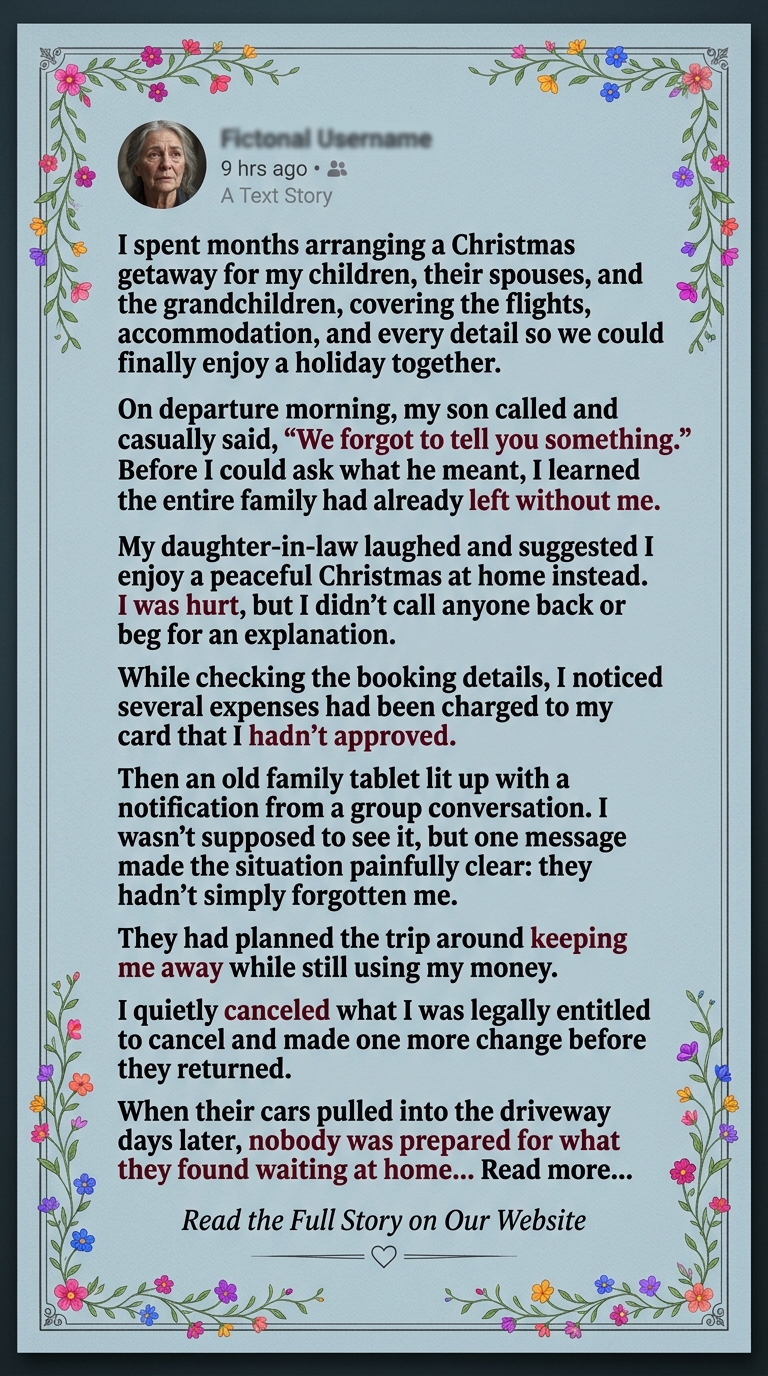
“Morning, Mom,” he said cheerfully. “We forgot to tell you something.”
I smiled, assuming he was calling to remind me about the airport transfer.
“What did you forget?”
There was a pause.
“Well, we’re already on the road. We left about an hour ago.”
I looked toward the hallway.
“What do you mean, you left?”
“The airport shuttle came early. We thought you’d be okay getting there separately.”
I glanced at the clock.
Our flight was scheduled to depart in less than three hours. I had arranged for everyone to travel together because I knew how difficult it could be coordinating six adults and three children during the holidays.
“Daniel, where are you?”
“In the car. We’re almost at the airport.”
“Where is everyone else?”
“With me. Sarah’s driving behind us.”
I gripped the phone.
“Why didn’t anyone wake me?”
Another pause.
Then I heard my daughter-in-law, Sarah, laughing in the background.
“Tell her to enjoy a quiet Christmas for once!”
Daniel chuckled awkwardly.
“Mom, don’t make this a big thing. The kids are excited, and everything is already arranged.”
I stared at the suitcase beside my bed.
“What about my ticket?”
“Well, we figured you could stay home. Traveling with the kids might be tiring anyway.”
I couldn’t believe what I was hearing.
I had spent five months arranging that trip. I had paid for six plane tickets, three hotel rooms, airport transfers, a rental vehicle, and several holiday activities. I had even booked a private Christmas dinner because my grandchildren had wanted to celebrate somewhere with snow.
The entire trip had been my idea.
My husband, Robert, had died four years earlier, and Christmas had never felt quite the same since. I wanted the family together again. I wanted photographs, noisy dinners, grandchildren opening presents, and the simple pleasure of waking up knowing everyone was under one roof.
I had told them repeatedly that I wanted us to make memories while we still could.
Now my own son was telling me they had left without me.
“Daniel, I paid for this trip.”
“I know, Mom. We’ll talk when we get back.”
Then the call ended.
I remained standing in my bedroom, listening to the silence.
For several minutes, I didn’t move.
I didn’t cry, either.
I simply looked at the suitcase and wondered when my family had decided that my presence was less important than my money.
Then I opened my laptop.
I wanted to understand exactly what had happened before making any decisions.
The airline booking showed six passengers, not seven.
My name had been removed from the itinerary three days earlier.
The change had been processed through the travel account I had created for the family. The cancellation fee had been charged to my card, but the refund had been issued as travel credit under Daniel’s account.
I checked the hotel reservation.
My name was missing there, too.
The original booking had been for three rooms, with one room assigned to me. The reservation had been modified two weeks earlier, and the hotel had charged an additional amount for a larger family suite.
That charge had also gone to my card.
I opened the remaining receipts.
There were payments for ski lessons, a private dining package, and children’s activities that I had never approved.
The total was nearly $4,800 beyond the original budget.
I called the hotel first.
The receptionist confirmed the changes but couldn’t discuss the other guests’ arrangements without authorization. Since I was the original cardholder and the person who had made the booking, she transferred me to the reservations manager.
I explained that several charges had been made without my approval and asked for copies of the amended reservation details.
She agreed to investigate.
Then I called the airline.
The representative confirmed that my ticket had been canceled through the family travel account. I asked for the cancellation record and the destination of the refund.
The information made my stomach tighten.
The refund had not returned to my original payment method.
It had been issued as credit to an account controlled by my son.
I ended the call and sat at the kitchen table.
That was when the old tablet on the sideboard lit up.
It was a family device we had used during video calls with the grandchildren. Robert had purchased it years earlier, and I had kept it connected to our family account so the children could call whenever they wanted.
A notification appeared from a group conversation.
I wasn’t part of the discussion, but the tablet displayed a message preview.
Sarah had written:
“Everything is sorted. Mom thinks we’re all traveling together. Once we’re gone, she’ll have no choice but to stay home. Just make sure Daniel doesn’t accidentally mention the original plan before we leave.”
Another message followed.
My daughter, Melissa, replied:
“She’ll be upset, but she’ll get over it. The important thing is that she doesn’t come. We can finally have a Christmas without her checking what everyone is eating and asking the kids to call her every morning.”
Then Daniel wrote:
“Don’t forget the extra charges. Mom won’t notice until we’re already there.”
I read the messages twice.
Then I sat back.
It wasn’t a misunderstanding.
They had deliberately excluded me, used my payment details to fund their holiday, and planned to tell me only after they were safely on their way.
I felt something inside me go quiet.
For years, I had been the person who made everything easier.
I paid for family celebrations. I bought the children’s school supplies, helped with emergency expenses, and covered holidays because I wanted my children to enjoy opportunities I hadn’t always been able to afford.
When Daniel and Sarah bought their first house, I contributed toward the closing costs. When Melissa’s husband lost his job, I helped cover their mortgage for several months.
I had never kept a record of those gifts because I believed family should help one another.
But I had also allowed them to mistake generosity for an obligation.
I picked up my phone and called my bank.
I reported the additional charges as unauthorized and asked them to secure my card. I explained that I had approved the original travel expenses but not the later modifications.
The bank opened a dispute and advised me to keep all correspondence and booking records.
Next, I contacted the hotel.
The manager reviewed the original reservation and confirmed that I was the person who had made and paid for it. Because the booking had been modified and the other guests were already checked in, the hotel could not simply remove them without following its cancellation and payment procedures.
I asked for the charges connected to my card to be separated from any services the other guests had independently agreed to pay for.
The manager agreed to place the disputed charges under review.
I then contacted the rental company and canceled the remaining portion of the vehicle reservation that was still under my name. The family would need to arrange its own transportation for the rest of the trip.
I didn’t cancel anything that belonged to someone else.
I didn’t interfere with the children’s flights or try to ruin their holiday.
I simply stopped paying for arrangements I had never agreed to fund.
Then I made one more call.
It was to a locksmith.
The house was mine. Robert and I had bought it thirty-two years earlier, and after his death I had updated the ownership records. Daniel and Melissa had never lived there permanently, but they both had keys because they often visited with their families.
I asked the locksmith to replace the locks on the exterior doors and deactivate the old garage access codes.
I also asked him to install a new keypad system that would allow me to provide temporary access when I chose.
It wasn’t a punishment.
It was a security decision.
By noon, the old keys no longer worked.
I spent the afternoon collecting the records from the tablet, the booking confirmations, and the bank statements. I saved copies in a folder and wrote down the dates of the unauthorized changes.
Then I made myself lunch.
For the first time in years, I ate Christmas dinner without rushing to prepare food for anyone else.
I heated a small portion of the roast I had bought for the trip, made a fresh salad, and sat beside the window.
The house was quiet.
It hurt more than I expected.
At six, I received a message from Daniel.
“Mom, the hotel says there are problems with the payment. Did you cancel something?”
I didn’t answer immediately.
Another message arrived.
“Sarah says the rental company canceled the car. Please call me.”
Then Melissa joined the conversation.
“Mom, why are you doing this? The kids are having a wonderful time.”
I looked at the messages.
Nobody asked whether I was all right.
Nobody apologized for leaving me behind.
They were concerned because the arrangements had stopped working.
I replied once.
“I discovered that you changed bookings and charged expenses to my card without my permission. I have reported the charges and canceled the remaining services paid for under my name. Please arrange your own expenses from now on.”
Daniel called immediately.
I let it ring.
He called again.
Then Sarah sent a message.
“You can’t punish the children because you’re upset with us.”
I typed a response, deleted it, and wrote something shorter.
“The children are not responsible for the decisions you made. I hope they enjoy their holiday. The financial arrangements are between the adults.”
I put my phone away.
For the next few days, I received occasional messages about hotel payments and transportation. I didn’t respond to every complaint. I forwarded relevant financial questions to the hotel and bank and kept my communication limited to practical matters.
On the fourth day, the family returned.
I knew they were coming because Daniel had messaged me that morning.
“We’ll be home around five. We need to talk.”
I was sitting in the living room when I heard the first car pull into the driveway.
Then another.
The doors slammed, children began talking excitedly, and Daniel walked toward the front entrance carrying two suitcases.
He inserted his old key.
It didn’t turn.
He tried again.
Then he pressed the garage code.
Nothing happened.
Sarah stepped out of the car.
“What’s going on?”
Daniel knocked.
I opened the door.
He looked at me, then at the new lock.
“Why did you change everything?”
“Because I wanted to.”
“Mom, this is ridiculous. We live here too.”
“No, Daniel. You visit here. You don’t live here.”
He stepped forward, but I remained in the doorway.
“We need to get inside. The children are exhausted.”
“I know. I’ve prepared something for them.”
I opened the door wider.
The children entered first, delighted to see me. My youngest granddaughter ran into my arms.
“Grandma! We brought you something!”
She handed me a small snow globe from the trip.
I thanked her and kissed her forehead.
Then I let the adults come inside.
The house looked different.
The large Christmas tree was still standing, but the gifts that had been intended for the family trip were no longer beneath it. I had packed them into separate boxes and placed them in the guest room.
On the dining table sat three folders.
Daniel noticed them immediately.
“What are those?”
“Records.”
Sarah looked irritated.
“Can we not do this in front of the children?”
“Agreed. Melissa, would you take them into the kitchen for some hot chocolate? There’s a puzzle waiting for them, too.”
Melissa hesitated, then took the children into the other room.
Once we were alone, I placed the first folder in front of Daniel.
It contained the airline cancellation record, the hotel amendments, and the additional charges.
The second folder contained the bank’s dispute reference and the correspondence confirming that my card had been used for expenses I hadn’t approved.
The third folder contained printed copies of the group conversation.
Daniel’s face changed when he saw them.
Sarah went pale.
“You went through a private conversation?”
“The messages appeared on a family tablet connected to my account. I saved them because they explained what had happened.”
Daniel pushed the folder away.
“You’re taking this too far.”
I looked at him.
“Why did you remove me from the flight?”
He opened his mouth, then closed it.
“Mom, we just wanted a holiday where everyone could relax.”
“Why did you use my money to pay for it?”
“We thought you wouldn’t mind covering the extra costs.”
“Why did you tell me we were traveling together?”
Sarah interrupted.
“Because you would have made it difficult if we told you beforehand.”
I turned toward her.
“So you decided to lie.”
“We didn’t want an argument.”
“You planned an entire holiday around keeping me away, but you still expected me to pay for it.”
Sarah folded her arms.
“You’re making it sound cruel.”
I looked at Daniel.
“Was it cruel when you told your sister I wouldn’t notice the charges? Was it cruel when you transferred my airline refund into your own travel account?”
He stared at the table.
“I was going to pay you back.”
“When?”
“After Christmas.”
“With what money?”
He had no answer.
I stood and walked toward the sideboard. I returned with one final document.
It was a written agreement I had prepared with my lawyer.
It explained that family members could no longer use my payment accounts, booking profiles, or financial details without my explicit permission. It also stated that any future financial assistance would be considered separately and agreed upon in writing.
I placed it in front of them.
“From today, there will be no shared travel account, no automatic payments, and no borrowing my card for family expenses. If I choose to help you, I’ll decide how and when.”
Daniel looked at me.
“You’re cutting us off?”
“No. I’m ending an arrangement you treated as an entitlement.”
Sarah shook her head.
“You’ve changed.”
I nodded.
“Yes. I have.”
Daniel glanced toward the kitchen, where the children were laughing.
“Can we at least get our things from the guest room?”
“Of course. I’ve packed everything you left here. You can take it with you.”
He stared at me.
“You packed our things?”
“The items you stored here. I didn’t touch anything that belongs to the children.”
I handed him the boxes.
He looked around the living room as though expecting me to change my mind.
“Where are we supposed to go?”
“That’s something you should have considered before deciding I wasn’t welcome in the holiday you expected me to finance.”
He lowered his voice.
“Mom, I’m still your son.”
I felt tears rise, but I kept my voice steady.
“I know. That’s why this hurts.”
For a moment, neither of us spoke.
Then I said the words I had rehearsed all week.
“I love you, Daniel. But being your mother doesn’t mean I have to accept being used.”
He looked away.
Sarah picked up her bag.
They left with the boxes and loaded them into their cars.
Before driving away, Daniel came back to the door.
“Will you still see the children?”
I looked at him.
“Of course. I love them. But visits will be arranged respectfully, and they will never be used to pressure me into paying for something.”
He nodded, though he didn’t apologize.
After they left, I sat in the living room and listened to the quiet.
I didn’t feel victorious.
I felt tired.
But beneath the sadness was something I hadn’t experienced in years: relief.
The bank eventually completed its investigation. The unauthorized charges were reversed where the evidence supported the dispute, while the original expenses I had approved remained my responsibility.
The airline refund was recovered through the appropriate process after Daniel was required to return the credit value.
I also closed the shared family travel account and removed the saved payment information from the devices I controlled.
A few weeks later, Daniel called.
This time, he didn’t begin by asking for money.
He apologized for excluding me from the trip and admitted that he and Sarah had discussed it for weeks. They had convinced themselves that because I often asked about the children’s schedules and liked planning family activities, I would make the holiday difficult if I were there.
He also admitted that they had assumed I would continue paying because I always had.
“I don’t know when we started treating it like it was automatic,” he said.
“Neither do I,” I replied. “But it has to stop.”
He asked whether he could bring the children to visit the following Sunday.
I agreed.
When they arrived, the children ran straight toward me. We baked cookies, played a board game, and watched a movie. Nobody mentioned money.
Daniel stayed for coffee.
He didn’t ask for help with bills or make excuses about the trip. He simply sat at the kitchen table and talked to me.
It wasn’t enough to repair everything, but it was a beginning.
The following Christmas, I didn’t arrange a holiday for the entire family.
I booked a small cottage near the coast for myself and invited the children to spend two days with me if they wanted to come. I paid for my own accommodation and made it clear that everyone would arrange their own travel.
Daniel and Sarah came with the children.
This time, nobody assumed I would cover everything.
We cooked together, exchanged modest presents, and took photographs on the beach.
It wasn’t the grand Christmas I had once imagined.
But when my granddaughter slipped her hand into mine as we walked along the water, I realized I had finally learned something important.
A family holiday is supposed to be about sharing time, not purchasing affection.
I had spent years paying for togetherness because I feared that without my help, everyone would drift apart.
That Christmas, I discovered that the people who truly wanted me in their lives didn’t need me to buy my place at the table.