The Secret Behind the Empty Place Card
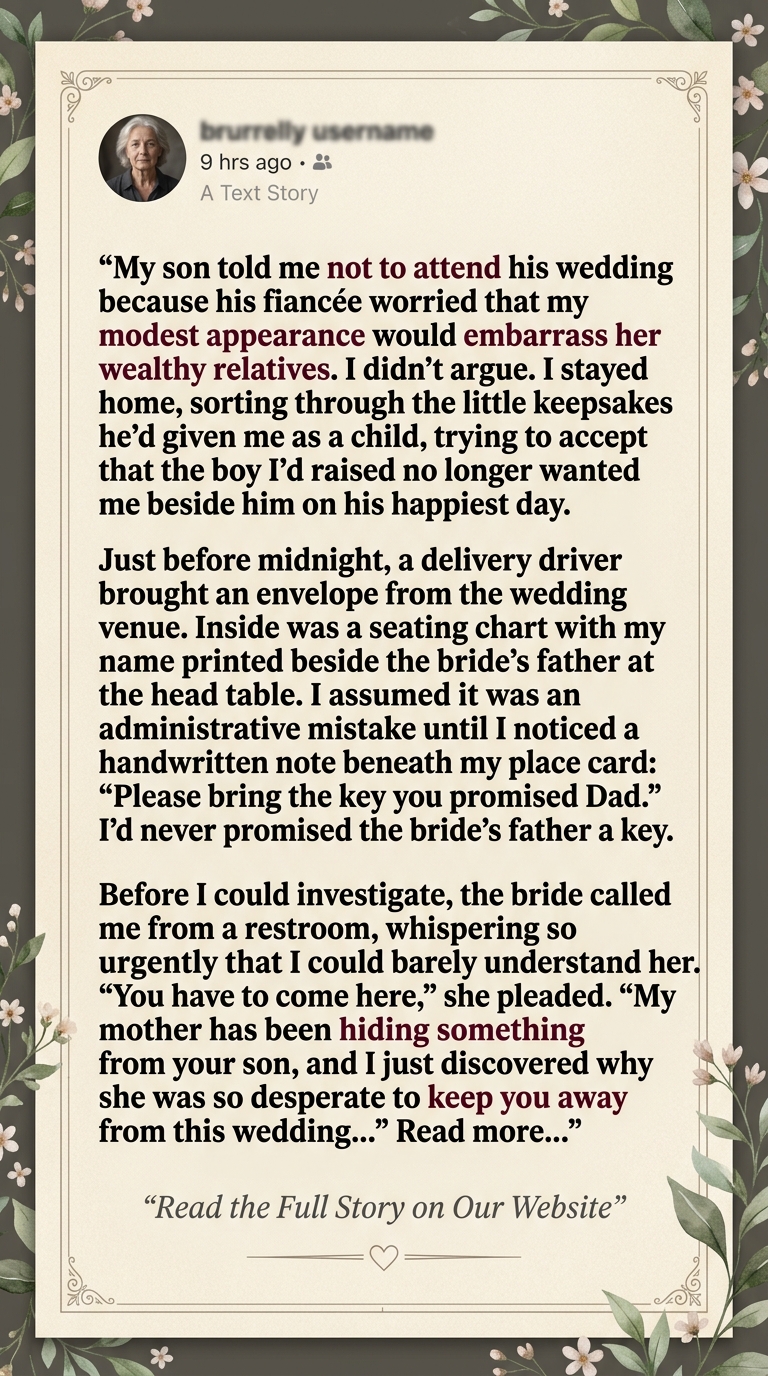
When my son told me not to attend his wedding, he delivered the news as though he were canceling a dinner reservation.
“Mom, I think it would be better if you stayed home.”
I was standing in my kitchen, holding a dish towel. For several seconds, I couldn’t find the words to answer him.
“Better for whom, Daniel?”
He sighed.
“Victoria’s family has invited some important people. Her parents are very particular about appearances, and she doesn’t want anyone making the wrong impression.”
I looked down at my clothes. I was wearing an ordinary cardigan and a pair of comfortable trousers. Nothing expensive, but everything was clean and presentable.
“Are you saying I would embarrass her?”
“That’s not what I said.”
“Then explain it to me.”
He rubbed the back of his neck.
“Her mother thinks you might not fit in with their guests. Please don’t turn this into an argument. Victoria and I have enough stress already.”
I had raised Daniel alone after his father died when he was nine. I worked as a seamstress, taking alterations from neighbors and repairing clothes late into the night. I couldn’t afford expensive holidays or designer shoes, but I made sure Daniel had school supplies, warm meals, and the opportunity to attend college.
When he received his first job offer, I cried harder than he did.
Now he was asking me to stay away from his wedding because my appearance might inconvenience his future in-laws.
“All right,” I said.
He looked relieved.
“I knew you’d understand.”
After he left, I sat at the kitchen table and stared at the empty chair opposite me.
That evening, instead of watching television, I brought down a box of Daniel’s childhood belongings. I found his first school photograph, a handmade birthday card, a wooden airplane, and a little paper crown he had worn at a school play.
I remembered him running through the front door after his first day of kindergarten, shouting that he had made a friend.
I remembered sitting beside him when he had chickenpox, reading the same story until he fell asleep.
I remembered the night his father died, when Daniel climbed into my bed and asked whether I would ever leave him too.
I had promised I wouldn’t.
I never imagined that one day he would be the person asking me to disappear.
Just before midnight, someone knocked on my door.
A delivery driver stood outside with a cream envelope.
“Mrs. Mercer?”
“Yes.”
“Someone at the Hawthorne Estate asked me to deliver this personally.”
The Hawthorne Estate was the venue where Daniel and Victoria had held their wedding reception.
I signed for the envelope and opened it at the kitchen table.
Inside was a seating chart.
My name was printed at the head table, directly beside the bride’s father, Richard Langford.
I assumed it was an outdated version. Perhaps the wedding planner had forgotten to remove my name.
Then I noticed a handwritten message beneath my place card.
Please bring the key you promised Dad.
I read it several times.
I had never promised Richard Langford a key.
Before I could examine the envelope again, my phone rang.
Victoria’s name appeared on the screen.
I answered.
“Hello?”
“Mrs. Mercer?”
Her voice was trembling.
“Victoria? What’s wrong?”
“Please don’t hang up. I need you to come to the venue.”
“Why? The wedding is over.”
“I know. But something has happened. I’m in the restroom, and my mother is looking for me.”
I stood up.
“Are you safe?”
“For the moment. Listen carefully. My mother has been hiding something from Daniel. I found out tonight why she was so determined to keep you away.”
“What did you find?”
Victoria lowered her voice.
“Your late husband helped my father years ago. My mother knows about it, and she has been using that history to control him. She believes you still have something that could expose what she did.”
I looked at the handwritten message.
“The key?”
“Yes. Please come. I can’t explain everything over the phone.”
The call ended.
I went upstairs and opened the small wooden jewelry box I had kept since my husband’s death.
Inside, beneath a collection of old brooches, was a brass key with a narrow black tag.
The number 38 was stamped into the metal.
My husband, Thomas, had given it to me shortly before he died.
“Keep this somewhere safe,” he had said. “If Richard Langford ever asks you for it, don’t hand it over until you know why.”
At the time, I had assumed it was connected to some old business matter. Thomas had worked as a bookkeeper for a manufacturing company before retiring, and he occasionally helped friends with their accounts.
I placed the key in my handbag and drove to the estate.
When I arrived, the reception room was nearly empty. Staff members were collecting glasses, and a few relatives were waiting for taxis.
A young wedding coordinator recognized me from the guest list.
“Mrs. Mercer? Please come with me.”
She led me to a private sitting room.
Victoria was there, still wearing her wedding dress. Her makeup had run, and her hands were clasped tightly together.
Daniel stood beside the window.
When he saw me, he looked shocked.
“Mom? Why are you here?”
“Your wife asked me to come.”
He turned toward Victoria.
“What’s going on?”
Victoria took a breath.
“I found something in my mother’s office.”
She placed a folded document on the table.
It was a copy of a financial agreement dated twenty-two years earlier.
The names at the top were Thomas Mercer and Richard Langford.
I recognized my husband’s signature immediately.
“What is this?” I asked.
Victoria looked at me.
“Your husband saved my father’s company.”
I stared at her.
She explained that Richard’s first business, Langford Precision Works, had nearly collapsed after a major customer failed to pay a substantial invoice. The company was facing bankruptcy, and several employees were at risk of losing their jobs.
Thomas had been working as an independent financial consultant at the time. He helped Richard negotiate with creditors, reorganize the company’s accounts, and secure a repayment arrangement with the bank.
But there had been one condition.
Richard had promised to repay Thomas through a private agreement if the business recovered.
The agreement included a small storage unit containing the company’s original financial ledgers and correspondence. Thomas had been appointed as an independent custodian of those records until the repayment arrangement was completed.
The brass key opened the storage unit.
“Why would your mother want those records?” I asked.
Victoria looked toward the door.
“Because she was working for my father at the time. She handled the company’s payroll and supplier payments. She told me she discovered that someone had been moving money out of the business before it nearly collapsed.”
Daniel frowned.
“Who?”
Victoria hesitated.
“My mother.”
The room went silent.
Richard had never known the full extent of the missing money. Patricia, his wife, had been secretly redirecting supplier payments into a separate account controlled by a company she had established with her brother.
When the business began failing, Thomas reviewed the accounts and discovered irregularities. He helped Richard save the company, but he kept the original records separate because he suspected the missing funds had been deliberately concealed.
Patricia had told her husband that the losses came from unpaid customers and poor management.
She had never admitted that she was responsible for the missing payments.
“How do you know this?” Daniel asked.
Victoria opened another document.
It was a letter written by Patricia to her brother.
The letter referred to payments made through a company called Westmere Trading. It also mentioned the storage unit and Thomas’s refusal to release the original records.
I read the letter twice.
The handwriting was unfamiliar, but the words were unmistakable.
Patricia had been afraid that Thomas’s records would reveal the truth.
Victoria explained that she had found the letter while looking for a copy of her marriage certificate in her mother’s office. Behind it were several printed messages between Patricia and her brother.
They had been discussing the storage unit for weeks.
Patricia believed the records were still there and that the key was in my possession.
She had learned that Daniel and I had not been speaking much before the wedding. She assumed I would be easy to pressure if she could make me feel unwelcome and then offer a reason for me to attend.
The seating chart had been deliberately changed.
The message beneath my name was meant to make me bring the key.
“Your mother arranged all this?” I asked.
Victoria nodded.
“She told the wedding planner to add your name to the head table. She said you had agreed to bring something for my father. I only discovered the note when I checked the final seating chart.”
Daniel looked furious.
“Why didn’t you tell me?”
“I tried. Your mother intercepted me twice. She kept saying it was an old family matter and that I shouldn’t interfere.”
“She’s your mother,” he said.
“That doesn’t make what she did right.”
A knock sounded at the sitting-room door.
Richard entered, followed by Patricia.
Patricia’s expression changed when she saw me.
“I wondered when you’d arrive.”
I looked at her.
“Did you send the seating chart?”
She smiled politely.
“I thought it would be a nice gesture to include you after all.”
“Then why did you ask for a key?”
Richard looked confused.
“What key?”
Patricia turned toward Victoria.
“Enough. This is not the place for family drama.”
Victoria stepped forward.
“Then explain why you have been asking about the storage unit.”
Patricia’s face tightened.
“Those records belong to the company.”
“They were never yours to control,” I replied.
Richard looked between us.
“What records?”
I took the brass key from my handbag but kept it in my hand.
“Your wife seems to believe this opens something she needs very badly.”
Patricia reached toward me.
“Give it to Richard. He can settle this.”
I stepped back.
“No. Not until we know what is inside.”
Richard’s expression hardened.
“Patricia, what is she talking about?”
She didn’t answer.
Victoria placed the letter on the table.
“Read it.”
Richard picked it up.
As he read, his face gradually changed. He looked at his wife, then at the letter, then at the old financial agreement.
“This is your handwriting,” he said.
Patricia shook her head.
“You’re misunderstanding it.”
“Did you transfer money from the company?”
“It was temporary. I was going to put it back.”
“How much?”
She looked away.
Richard read the letter again.
The amount was written clearly: nearly eighty thousand dollars.
He lowered the paper.
“That money was the reason we nearly lost the company.”
Patricia began crying.
“I was trying to help my brother. He was in trouble, and I thought I could replace it before anyone noticed.”
“You told me our customers had failed to pay us.”
“They had.”
“But you also took the supplier payments.”
She said nothing.
Daniel stepped between his wife and Patricia.
“You used my wedding to get this key?”
Patricia looked at him.
“I was trying to protect your future.”
“By telling me my mother was too embarrassing to attend?”
“That was different.”
“No,” Daniel replied. “It was exactly the same. You believed you could decide who mattered and who didn’t.”
Richard sat down.
For several moments, nobody spoke.
Then he turned toward me.
“Mrs. Mercer, I owe your husband an apology. He saved my business, and I allowed my wife to tell me a version of that history that made him look unreasonable.”
I didn’t respond immediately.
“Thomas never wanted praise,” I said. “He wanted the agreement honored and the records left alone.”
Richard nodded.
“I understand.”
He asked whether I would allow an independent solicitor to inspect the storage unit. I agreed, but only through legal arrangements and with proper documentation.
Patricia objected.
She insisted the old matter was settled and that the records were irrelevant.
Richard finally looked at her.
“Then you shouldn’t be afraid of anyone reading them.”
The next morning, we contacted the solicitor who had handled Thomas’s estate.
He confirmed that the storage unit still existed and that the key number matched the original agreement. He arranged for an independent representative to attend when it was opened.
Inside were several metal filing cabinets containing original ledgers, bank statements, supplier correspondence, and copies of the company’s old payment records.
The documents confirmed that Patricia had redirected payments into Westmere Trading over a period of fourteen months. Some of the money had been returned, but a substantial amount had not.
Thomas had discovered the transfers and preserved the records after Richard asked him to help reconstruct the company’s accounts.
He had never accused Patricia publicly because Richard had begged him to allow the matter to be handled privately while the business was recovering. Thomas had agreed to preserve the evidence, but he had refused to destroy it or pretend the money had never gone missing.
The agreement also made clear that Richard had repaid the amount owed to Thomas through a series of payments over the following years.
There was no inheritance, hidden fortune, or claim against the company.
The key had protected evidence, not money.
Richard instructed his lawyers to review the matter and cooperate with the relevant authorities. Patricia was eventually required to repay the outstanding amount through a formal settlement, and her involvement in the company’s finances ended.
She and Richard separated several months later. Their marriage had been strained for years, and the discovery finally made it impossible for him to trust her.
Victoria was devastated, but she refused to accept responsibility for her mother’s choices.
Daniel struggled with his own part in what had happened.
For weeks, he barely spoke to me. Not because he was angry, but because he was ashamed.
Then one Sunday afternoon, he arrived at my house carrying a small paper bag.
Inside was a framed photograph of the two of us from his tenth birthday.
“I found it in my old room,” he said.
I smiled faintly.
“I remember that cake. You wanted chocolate icing and strawberry filling.”
He laughed quietly.
“I remember you working until two in the morning to finish it.”
He sat down.
“Mom, I don’t know how to apologize for what I did.”
I looked at him.
“Start by understanding why it hurt.”
He nodded.
“I let Victoria’s family make me ashamed of you. I knew how much you sacrificed for me, and I still agreed to leave you out because I wanted them to approve of me.”
His voice broke.
“I was wrong.”
I reached across the table and took his hand.
“Your father and I never expected you to become wealthy. We only hoped you would become someone who treated people well.”
Daniel wiped his eyes.
“I want you at our home. Not because of the key or those records. Because you’re my mother.”
I didn’t immediately promise that everything would return to normal.
Trust takes longer to rebuild than it takes to damage.
But I told him I wanted to try.
A few weeks later, Daniel and Victoria invited me to dinner. This time, I was welcomed at the table without anyone questioning my clothes or my background.
Victoria apologized privately.
“I should have stood up for you before the wedding,” she said.
“You were under pressure from your mother,” I replied. “What matters now is that you understand you don’t have to let anyone control your marriage.”
She nodded.
I never gave Patricia the key.
After the records were properly secured, I returned it to the solicitor, who placed it with Thomas’s estate documents.
I kept his old financial agreement and the photograph of him standing outside Langford Precision Works. He had been a quiet man who never considered himself important, yet he had helped save a business and protected the truth when someone tried to bury it.
On the anniversary of his death, Daniel came with flowers.
We sat together in the garden and talked about his father.
For the first time in a long while, I felt that the boy I had raised was beginning to understand the man who had raised him alongside me.
The wedding invitation had been taken away from me, but the truth had brought something more important back.
My place in my son’s life.
And I no longer needed anyone’s permission to occupy it.