The Twelve Jars
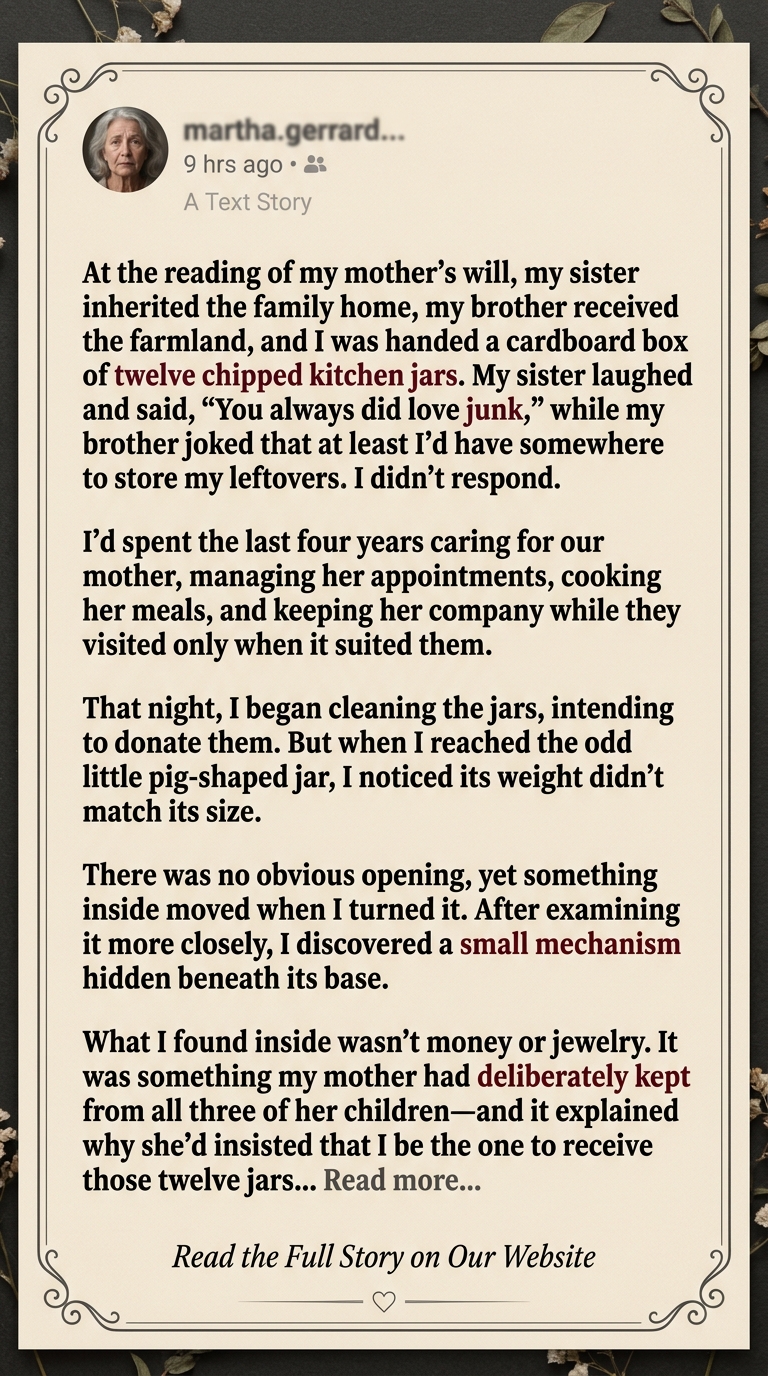
When the solicitor finished reading my mother’s will, my sister laughed so loudly that even the receptionist outside the conference room looked through the glass door.
“Well, this is disappointing,” Vanessa said, examining the list of belongings assigned to me. “After everything, you get a box of old kitchen jars.”
My brother, Peter, leaned back in his chair.
“At least you won’t need to buy containers for leftovers.”
The solicitor cleared his throat and continued reading.
Vanessa inherited our mother’s house, a beautiful old property with a large garden and a conservatory. Peter received the farmland, including the barns and the small farmhouse where our grandparents had once lived.
I received twelve chipped kitchen jars.
They were described in the will as a collection of household objects, specifically identified and assigned to me.
I looked at the solicitor.
“That’s everything?”
“That’s everything listed under your personal bequest,” he replied.
Vanessa smiled sympathetically, although there was nothing sympathetic about her expression.
“You always did love junk, Claire.”
I didn’t answer.
For the last four years, I had been the one caring for our mother, Margaret. I drove her to medical appointments, organized her medication, prepared her meals, and helped her wash when arthritis made ordinary movements difficult.
I had moved into her house temporarily after her first fall. Eventually, temporary became permanent.
Vanessa lived two hours away and visited when her schedule allowed. Peter came mostly during harvest season, when he needed our mother’s signature on farm documents or wanted to discuss something concerning the property.
Neither of them had ever offered to take over my responsibilities.
They had both told me I was better suited to caring for her because I worked from home as a freelance bookkeeper.
I had accepted that arrangement because I loved my mother.
But there had been difficult days.
I remembered sitting beside her hospital bed after a minor stroke, listening to her apologize because she couldn’t remember the name of her favorite tea.
I remembered helping her through long nights when her joints hurt and she couldn’t sleep.
I remembered the afternoon she asked whether I regretted giving up so much of my own life.
I had told her no.
She had looked at me for a long time.
“Don’t let anyone convince you that caring for someone means you have no life of your own,” she said.
At the time, I thought she was simply worried about me.
Now, sitting in the solicitor’s office with a cardboard box of chipped jars as my inheritance, I wondered whether she had understood more than I realized.
I collected the box and took it home.
That evening, I placed the jars on the kitchen counter.
Most were ordinary. There was a blue ceramic jar with a cracked lid, a small yellow container shaped like a chicken, two glass jars with faded floral patterns, and a green one that had lost most of its glaze.
The strangest was a little pig-shaped jar.
It was brown, with a painted pink nose and one chipped ear.
I remembered it from childhood. My mother had kept it on the kitchen shelf for as long as I could remember. She used to store loose buttons inside it, although I had never seen her open it.
I decided to clean the jars and donate them to a charity shop.
I filled the sink with warm water and began washing them one by one.
When I picked up the pig-shaped jar, I noticed something unusual.
It was heavier than it should have been.
I turned it upside down, expecting to find a thick ceramic base, but the bottom sounded hollow when I tapped it.
There was no visible opening.
I examined the edges carefully and noticed a narrow circular line beneath the glaze.
Using a soft cloth, I wiped away years of kitchen dust.
A small metal notch appeared.
I pressed it with my thumbnail.
Nothing happened.
Then I turned the pig’s head slightly to the left.
There was a faint click.
The base loosened.
I stared at it in disbelief.
Inside was a small metal cylinder wrapped in waxed paper.
It wasn’t money or jewelry.
It was a miniature audio recorder and a folded piece of paper bearing my name.
My hands began to tremble.
The note was in my mother’s handwriting.
Claire,
If you are reading this, then I have finally managed to give you something without your brother or sister deciding what it should be worth.
Please listen to the recording before you speak to either of them.
I sat down.
The recorder had a tiny switch on its side. I pressed it, and after a moment of static, my mother’s voice filled the kitchen.
“Claire, my darling. If you’ve found this, then I hope you’re sitting somewhere comfortable.”
I covered my mouth.
Her voice sounded exactly as it had before her final illness: gentle, slightly breathless, and full of the warmth I missed every day.
“I need to tell you something about the farm, the house, and the jars.”
There was a pause.
“Your father and I never owned the farmland in the way your brother believes.”
I frowned.
The recording continued.
“Your grandfather, Samuel, left the farm in a special arrangement when he died. He wanted it kept together because he believed the land would become valuable if it was managed carefully. Your father was appointed to oversee it, but he was never given the right to sell or divide it without the agreement of the other family members named in the original arrangement.”
I sat perfectly still.
Peter had always claimed that the farmland was his because our mother had promised it to him.
But the recording suggested there was more to the story.
“After your father died, Peter began making decisions about the land without understanding the original agreement. I discovered that several years ago. He had signed a long-term option with a development company, promising them access to part of the property if they paid him an advance.”
I remembered Peter mentioning a company that wanted to build storage facilities near the highway.
He had described it as a harmless opportunity.
My mother’s voice became quieter.
“I told him not to sign anything. He said I was confused and didn’t understand modern business. I asked him to bring me the paperwork, but he refused.”
I felt a cold sensation in my stomach.
“Vanessa knew about it too. She encouraged him because she believed the land would eventually be sold and she wanted her share of the proceeds.”
The recording paused again.
“Neither of them knew that your grandfather had placed the original documents somewhere safe. Your father moved them before he died, and I kept them where no one would think to look.”
I glanced at the other eleven jars.
The pig-shaped container was not the only one with an unusual weight.
I picked up the blue ceramic jar and tapped its base.
It sounded solid.
Then I turned the jar over and examined it.
A small indentation was hidden beneath a faded flower.
I pressed it.
Another compartment opened.
Inside was a narrow strip of paper with a number written on it.
I returned to the recorder.
“Each jar contains part of the instructions. Don’t open them all at once. Start with the blue one, then the green one, and finally the little white jar with the cracked lid.”
My mother continued.
“I know Vanessa and Peter will laugh when they hear you received these jars. Let them. I have spent too many years watching them assume that the quietest person in the family has the least understanding.”
The recording ended.
I sat in silence for a long time.
Then I opened the blue jar completely.
The compartment contained a small brass disc with the number 17 engraved on it.
The green jar held a folded map of the farmland.
The white jar contained a second recorder, a key, and a handwritten instruction directing me to contact a retired solicitor named Arthur Bell.
I found his telephone number on the back.
The next morning, I called.
When I explained who I was, he became very quiet.
“Your mother finally gave you the jars,” he said.
“You knew about them?”
“I helped her prepare them.”
I nearly dropped the phone.
Arthur explained that my grandfather had established a family land trust decades earlier. The farm was held for the benefit of the three children and their descendants, but no individual beneficiary could sell or transfer the land without following the trust’s rules.
Our mother had been appointed as the managing trustee after our father’s death.
The house, however, was her personal property. She had been free to leave it to Vanessa.
The farm was different.
Peter had received the right to manage agricultural operations, but he had not inherited unrestricted ownership.
The development company had been given an option by Peter, but he had no authority to promise access to the land without trustee approval.
Arthur asked me to bring the jars and all the documents to his office.
When I arrived, he examined the numbered pieces carefully.
“The jars were your grandfather’s idea,” he explained. “He used to say that valuable things were often safer when people assumed they were worthless.”
He opened a file cabinet and removed a copy of the trust deed.
The document confirmed everything my mother had said.
It also explained why she had chosen me.
Under the trust agreement, the managing trustee could appoint a successor, provided the appointment was properly documented and accepted by the solicitor responsible for the trust.
My mother had appointed me six months before her death.
I stared at the signature.
“Why didn’t she tell me?”
Arthur folded his hands.
“Because she was concerned that your siblings would pressure you. She believed they would try to influence your decision before you understood the responsibilities.”
He showed me another document.
It was a statement from an independent land surveyor confirming that a large section of the farm contained a protected wetland and a natural drainage system feeding several neighboring properties.
The development company had not been told about the restrictions.
If construction began without the necessary approvals, it could damage the water supply and create serious flooding problems for the surrounding community.
My mother had discovered that Peter’s proposed agreement ignored those environmental restrictions.
She had tried to stop him.
He had accused her of interfering in his future.
Arthur placed another document on the desk.
“This is the most important part.”
It was a letter from the development company, asking the trust to confirm whether it would honor Peter’s agreement.
They had already paid him a substantial advance.
If the trust refused to approve the deal, the company would demand repayment from Peter.
I stared at the amount.
It was far more than he could afford.
“Does he know this agreement is invalid?”
Arthur shook his head.
“He was informed that the trust’s approval was required. He chose to proceed anyway.”
I felt sick.
My brother had not simply misunderstood the property arrangement. He had committed himself to a financial obligation based on land he did not have the authority to offer.
I asked Arthur what my mother expected me to do.
He gave me a sealed envelope.
“She wanted you to make the decision she believed was right, not the decision your siblings wanted.”
I opened it.
Inside was a final letter.
Claire,
I know you will probably be angry with me for leaving you this responsibility. I am sorry.
I gave Vanessa the house because she has always wanted a place that feels like hers. I gave Peter the right to manage the farm because working the land has always mattered to him.
But I could not give either of them the power to destroy something that belongs to more than our immediate family.
Your grandfather planted trees on that land that are older than all three of us. The wetland feeds the stream that runs through the neighboring farms. The old workers’ cottages are still occupied by families whose parents worked alongside your father.
I want the land protected, but I also want it to remain useful. It should support the people who depend on it, not become another development project that benefits a few people while leaving everyone else to deal with the consequences.
I chose you because you listen before deciding. You know how to care for something without needing to own it.
Please don’t let your brother’s mistakes destroy him. But don’t sacrifice the land to protect him from the consequences either.
Love, Mum.
I read the letter twice.
Then I began to cry.
Not because I had inherited something valuable, but because my mother had trusted me with a responsibility she believed I could carry.
Arthur explained that the trust required a formal meeting with all three beneficiaries. The development company would also need to be notified that the agreement had not been approved.
I agreed.
The meeting took place ten days later.
Vanessa arrived wearing a tailored coat and carrying a folder. Peter came in looking irritated.
“What is this about?” he asked.
Arthur explained that I had been appointed successor trustee and that the trust would not approve the development agreement.
Peter immediately turned toward me.
“You can’t do that.”
“I didn’t create the agreement.”
“I was promised the land.”
“You were given management rights, Peter. Not the authority to sell it.”
He looked at Arthur.
“That’s not what I was told.”
Arthur placed the trust deed in front of him.
“Your father and mother explained the restrictions when you took over farm operations. You signed the acknowledgment.”
Peter examined the page.
His face went pale.
Vanessa crossed her arms.
“So Claire gets to control everything now?”
“No,” I said. “I have a responsibility to manage the trust according to its terms.”
“Convenient,” she replied. “You spend four years looking after Mum, and now you get to make all the decisions.”
I looked at her.
“You received the house. Peter received the farm’s management rights. I received the responsibility neither of you wanted.”
Peter stood abruptly.
“If the company demands its money back, I’m finished.”
Arthur calmly explained that the trust would not assume Peter’s personal obligations. The development company could pursue him for the advance he had accepted, but the land itself could not be transferred under an unauthorized agreement.
I watched my brother sit down again.
For the first time, he seemed to understand the seriousness of what he had done.
I could have walked away and allowed the consequences to unfold without helping him.
But that would not have honored my mother’s wishes.
I proposed that Peter remain responsible for the advance but be allowed to negotiate a repayment arrangement with the company. I also offered to support a revised agricultural plan that would let him continue working the land under a proper management agreement.
The development proposal would be withdrawn.
Instead, we would seek grants for sustainable farming, restore the wetland, and lease the unused storage buildings to local agricultural businesses.
Peter looked at me suspiciously.
“Why would you help me after all this?”
“Because I don’t want the farm destroyed. And because I don’t want you destroyed either. But you will have to accept responsibility for what you signed.”
He didn’t answer.
Vanessa left the meeting early.
For several weeks, she barely spoke to me.
Peter eventually negotiated a repayment plan and agreed to operate the farm under the trust’s rules. He was furious about losing the chance to make a large profit, but he gradually began to understand that the land was worth more than a quick sale.
The wetland restoration project began the following spring.
The neighboring farmers helped clear blocked drainage channels, and several local businesses rented space in the old storage buildings. Peter remained in charge of daily farm operations, but financial decisions were independently reviewed.
I continued serving as trustee.
As for the jars, I didn’t donate them.
I cleaned each one carefully and placed them on the shelves in my kitchen. They were still chipped, still ordinary-looking, and still worth very little to anyone who didn’t know their history.
One afternoon, Vanessa came to visit.
She stood in the kitchen staring at the collection.
“You’re keeping them?”
“Yes.”
She picked up the little pig-shaped jar.
“I thought they were worthless.”
“They were never meant to be valuable.”
She looked confused.
“Then why did Mum leave them to you?”
I placed a cup of tea in front of her.
“Because she knew I would look inside before deciding what they were worth.”
Vanessa lowered her eyes.
After a long silence, she admitted that she had assumed my years of caring for our mother were simply a choice I had made because I had fewer responsibilities than she did.
“I didn’t understand how much you were doing,” she said.
“No,” I replied. “You didn’t ask.”
She nodded.
It wasn’t a perfect apology, but it was the first honest conversation we had shared in years.
I never received the family home or the farmland as personal property. My inheritance was not a fortune, and it did not make me wealthier than my siblings.
But it gave me something my mother believed was more important.
The opportunity to protect a place that had supported our family for generations and continued to support people who had never been part of our family at all.
Sometimes I still hold the little pig-shaped jar and turn it over in my hands.
I remember my mother’s voice coming through that tiny recorder.
She had known exactly how Vanessa and Peter would react when they saw the twelve chipped jars.
She had known they would laugh.
And she had trusted that I wouldn’t.