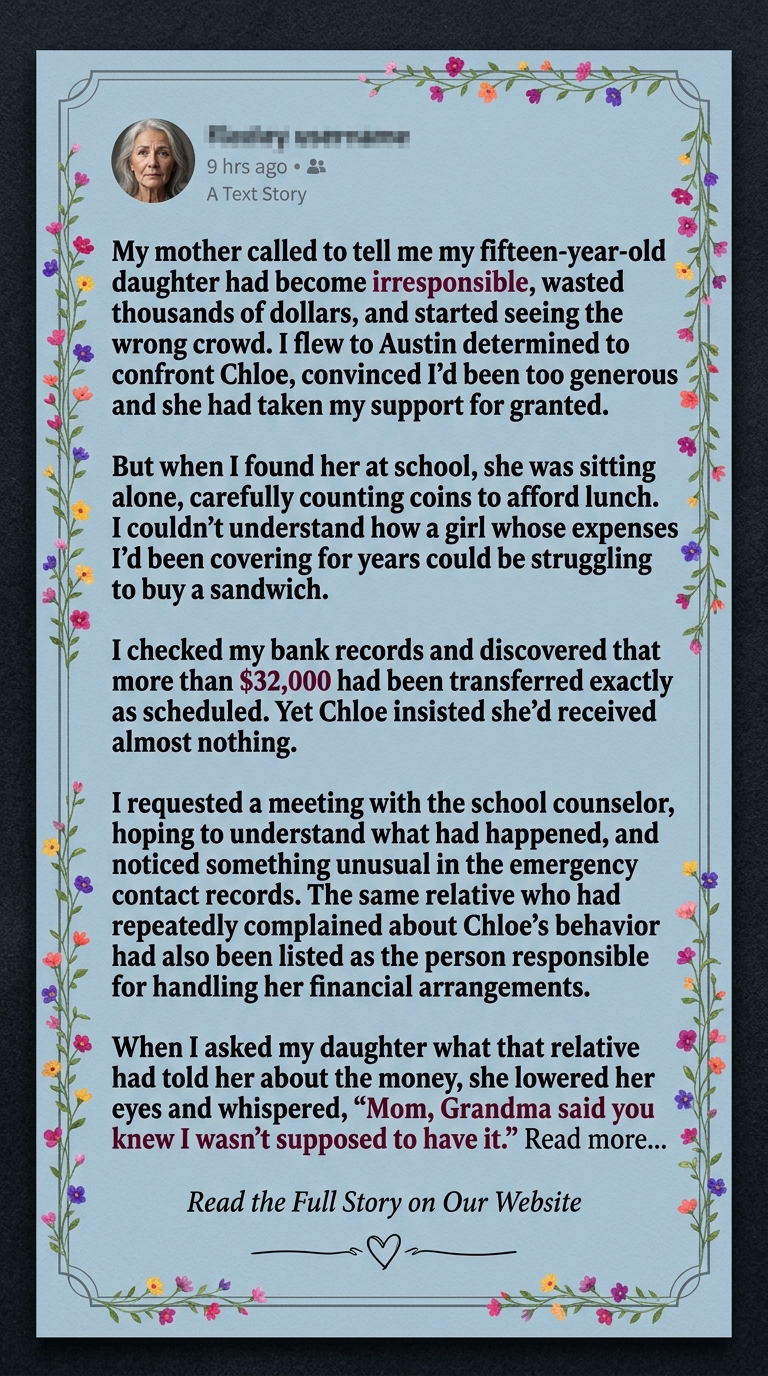
For almost three years, my mother had been telling me that my daughter was becoming impossible to raise.
According to her, Chloe was careless with money, disrespectful, secretive, and increasingly involved with the wrong crowd. Every phone call seemed to bring another complaint.
“She doesn’t appreciate anything,” my mother would say. “You send money, and she wastes it. I’ve tried everything, but she won’t listen.”
I lived several states away, and my job made it difficult to visit Austin regularly. When my husband died, I had moved for work, leaving Chloe in Texas with my mother so she could finish school without changing districts. We agreed it would be temporary, but temporary arrangements have a way of becoming permanent when everyone is busy.
I paid for Chloe’s school expenses, clothing, medical appointments, transportation, and a monthly allowance. I also transferred extra money whenever my mother claimed something unexpected had come up.
I trusted her because she was Chloe’s grandmother.
Then, one Tuesday evening, she called with a particularly angry voice.
“Your daughter has wasted thousands of dollars,” she said. “She’s hanging around with children who skip class, and she has absolutely no sense of responsibility.”
“What did she spend the money on?”
“That’s exactly the problem. She won’t tell me. I’ve had to take control because she clearly can’t manage herself.”
I felt a mixture of embarrassment and anger.
“Put Chloe on the phone.”
“She doesn’t want to talk to you.”
“Then tell her I’ll be there tomorrow.”
My mother sighed dramatically.
“Flying all the way here won’t change anything. She needs discipline, not another rescue.”
But I had already made up my mind.
I booked the earliest flight to Austin.
I expected an argument with my daughter. I expected excuses, perhaps a defensive attitude, and maybe an uncomfortable conversation about spending habits.
I didn’t expect what I found.
The following afternoon, I went directly to Chloe’s school.
The receptionist called her from class, and I waited near the office. When she appeared, she looked smaller than I remembered. Her dark hair was tied back, her backpack was worn at the edges, and her shoes had a strip of peeling material near the toe.
She stopped when she saw me.
“Mom?”
I stood up.
“Hi, sweetheart.”
She gave me a quick hug, but something about her expression bothered me. She looked relieved and frightened at the same time.
I had planned to begin with questions about her behavior. Instead, I noticed a few coins in her hand.
“What are those for?”
“Lunch,” she said.
I frowned.
“Don’t you have your lunch account?”
She shook her head.
“It’s empty.”
I stared at her.
“Why didn’t you tell me?”
She shrugged.
“Grandma said you were already upset about the money.”
“What money?”
Chloe looked at the floor.
I asked whether she had eaten that morning. She said she had, although her hesitation suggested otherwise.
We walked to the cafeteria together. She ordered a sandwich and a carton of milk. When the cashier told her the total, she carefully counted her coins before I stepped forward and paid.
I didn’t say anything until we were seated.
“Chloe, I send money every month. You know that, don’t you?”
She nodded.
“Grandma said you send it to her.”
“And she gives you what you need?”
Chloe looked at me.
“Sometimes.”
“How often?”
She picked at the edge of her sandwich.
“Not much lately.”
I felt a knot forming in my stomach.
I had been sending my mother $1,100 every month, in addition to paying several bills directly. Over the previous thirty months, the transfers alone amounted to more than $32,000.
I had assumed Chloe was receiving the money.
“Sweetheart, I need you to tell me the truth. Have you been spending money on things you shouldn’t?”
Her eyes filled.
“No, Mom.”
“Are you borrowing money from friends?”
She shook her head.
“Then where is the money?”
“I don’t know.”
I believed her.
That evening, after taking Chloe to my hotel, I opened my banking records.
The transfers were there, exactly as scheduled. Each month, $1,100 had gone to my mother’s account. Some months included additional payments for school supplies, medical expenses, and clothing.
I checked the dates against the messages my mother had sent me.
One transfer was supposedly for Chloe’s school trip. Another was for a replacement laptop. There were payments described as tutoring fees, transportation costs, and money for a school activity.
Everything appeared ordinary until I compared the amounts with the school’s actual charges.
The school trip had been canceled before the payment date. Chloe’s laptop had been purchased by me directly from an electronics store. The school had no record of the tutoring program my mother claimed to have arranged.
I called the school the next morning.
The receptionist transferred me to the counselor, Mrs. Bennett, after I explained that I was Chloe’s mother and wanted to discuss her financial and academic situation.
Mrs. Bennett was professional but cautious.
“We can certainly discuss Chloe’s school experience,” she said. “However, I want to make sure we’re communicating with the appropriate parent or guardian.”
“I have parental responsibility. My mother has been caring for Chloe while I work out of state.”
There was a pause.
“Your mother is listed as the primary local contact. She is also listed as the person authorized to coordinate certain school arrangements.”
“Who authorized that?”
“You’ll need to speak with our administration. I can arrange a meeting.”
We scheduled one for that afternoon.
During the meeting, Mrs. Bennett pulled up Chloe’s student information.
Her academic performance was average, with a few missed assignments. She had not been suspended, caught stealing, or involved in any serious disciplinary incidents.
In fact, Mrs. Bennett described her as quiet and responsible.
“She rarely asks for anything,” she said. “We’ve noticed that she sometimes skips lunch, though. When staff members have offered assistance, she has insisted that she’s fine.”
I looked at Chloe.
She was sitting beside me with her hands folded.
“Why didn’t you tell anyone you didn’t have money for lunch?”
“I didn’t want people to know.”
Mrs. Bennett continued.
“There’s another issue I think you should understand. Your mother has contacted us several times about Chloe’s behavior, but the information she provided doesn’t always match what teachers have reported.”
“What do you mean?”
“For example, she told us Chloe was missing school because she was spending time with older teenagers. Our attendance records show that most of those absences were related to medical appointments your mother scheduled.”
I looked at the screen.
Then I noticed something unusual.
Under the emergency contact section, my mother was listed as the person responsible for receiving financial correspondence related to Chloe’s school account. There was also a note stating that she had requested all billing communications be sent to her personal email address.
I leaned closer.
“Why would she receive all the financial notices?”
Mrs. Bennett explained that the school had accepted the arrangement after receiving a signed authorization form.
“Could I see that form?”
She hesitated.
“I can ask the administration to provide a copy. I don’t want to give you documents without confirming the authorization.”
I appreciated her caution, but my concern was growing.
The school administrator joined us shortly afterward. After verifying my identity and reviewing the custody arrangement, she printed the authorization form.
My mother’s signature appeared at the bottom.
The document was not a transfer of parental rights, but it authorized her to handle school billing, receive financial notices, and communicate about certain expenses.
What caught my attention was the date.
It had been signed shortly after Chloe’s father died.
I looked at my daughter.
“Did Grandma ever explain why she was handling your school money?”
Chloe’s shoulders tightened.
“Mom, can I tell you something without you getting mad?”
“Of course.”
She looked at the counselor, then back at me.
“Grandma said you knew I wasn’t supposed to have it.”
I felt my stomach drop.
“Have what, sweetheart?”
“The money you send.”
She began twisting the strap of her backpack.
“She said you wanted her to keep it because I wasn’t responsible enough. She said if I asked you for anything, you would get angry because I had already wasted too much.”
I stared at her.
“Who told you that?”
“Grandma.”
“How long has she been saying it?”
Chloe wiped her cheek.
“Since Dad died.”
The room went quiet.
I had no memory of ever telling my mother to withhold money from Chloe. I had never instructed her to punish my daughter financially, and I had never said Chloe was irresponsible.
“Did she give you an allowance?”
“Sometimes. Usually ten or twenty dollars. If I needed something for school, she said I had to ask her first.”
“What happened when you asked?”
“She said you were already paying enough.”
I took Chloe’s hand.
“Did she ever tell you how much I send every month?”
Chloe shook her head.
“She said you only sent money when you could.”
I felt anger rising, but I forced myself to remain calm.
“Did she ever tell you not to contact me about it?”
Chloe nodded.
“She said you were busy and that I shouldn’t make your life harder. She also said you might send me away if I kept causing problems.”
That was the moment I understood the full damage.
My mother hadn’t simply controlled the money. She had convinced my daughter that asking her own mother for help could cost her the relationship.
I thanked Mrs. Bennett and the administrator. I asked them to preserve all financial correspondence and copies of the authorization documents while the school reviewed the account.
Then I took Chloe back to the hotel.
We sat together for a long time before I spoke.
“I need you to understand something. I never told Grandma to keep your money. I never thought you were a burden. And I would never send you away for asking me for help.”
Chloe began crying.
“I thought you knew.”
I pulled her close.
“I should have checked. I should have asked you more questions instead of assuming everything was fine. I’m sorry I didn’t notice.”
She held on to me as though she had been waiting years to hear those words.
The next morning, I called my mother.
She answered cheerfully.
“Have you finally talked some sense into that girl?”
“I spoke to Chloe. I also spoke to her school.”
Her tone changed.
“Why were you involving the school?”
“Because I wanted to understand why my daughter was counting coins to buy lunch while I was sending you money every month.”
Silence.
Then she said, “She is exaggerating. You know how teenagers are.”
“The school says she has been skipping lunch. They also have no record of several expenses you claimed to have paid.”
“You don’t understand how expensive it is to raise a teenager.”
“I understand that. That’s why I sent you more than thirty-two thousand dollars.”
My mother sighed.
“I’ve been taking care of her. That costs money.”
“I never said it didn’t. But you told me she was wasting money. You told me she was irresponsible. Meanwhile, she believed I had forbidden her from receiving anything.”
“I was trying to teach her discipline.”
“By making her think her mother didn’t want her to have lunch money?”
“She doesn’t need to have everything she asks for.”
“That’s not what this is about.”
I asked her to explain where the transfers had gone.
She became defensive.
“I used some for household expenses. I paid for food, utilities, and transportation. You think looking after her is free?”
“I paid for her school costs, medical appointments, clothing, and transportation separately. You were supposed to use the monthly transfers for her daily needs and anything else she required.”
“Well, the money was never going to be enough.”
“Then you should have told me.”
She accused me of being ungrateful and said I had no idea how much she had sacrificed.
I told her that I would no longer send money to her account. From that day forward, I would pay Chloe’s expenses directly.
My mother became furious.
“You can’t do that after everything I’ve done!”
“I can, and I am.”
She hung up.
I didn’t call back.
Over the following days, I arranged for Chloe to stay with me while I made longer-term plans. I contacted an attorney in Texas to review the existing caregiving arrangement and ensure that all school, medical, and financial decisions were properly documented.
I also asked the school to send every bill and notice directly to me.
Then I began examining the money.
My bank records showed exactly when the transfers had been made, but they couldn’t tell me how my mother had spent them. I requested copies of the relevant statements from her, explaining that I needed an accounting of the funds intended for Chloe.
She refused.
So I contacted the bank to understand what documentation was available and asked my attorney about the appropriate way to proceed. Because the money had been deposited into my mother’s personal account, recovering it would require more than simply pointing to the transfers. I needed evidence of what we had agreed, what had been paid for, and whether any money remained.
The school also reviewed its records.
They confirmed that Chloe’s lunch account had repeatedly run out of funds, even though my mother had received notices about the balance. Several payments she had described to me as school expenses had never been made to the school.
The counselor also arranged for Chloe to speak privately with a student support specialist. I wanted her to have someone neutral to talk to, especially after discovering how long she had believed she couldn’t ask for help.
Meanwhile, my mother began calling relatives.
She told them I had taken Chloe away without warning and was accusing her of stealing. She described herself as a grandmother who had sacrificed everything, only to be betrayed by her ungrateful daughter.
For once, I didn’t rush to defend myself.
I had no intention of turning a family problem into a public argument. The people who needed to know the truth were already receiving the relevant information.
But one person surprised me.
My mother’s younger sister, Aunt Linda, called three days later.
“I heard you and your mother had a disagreement,” she said carefully.
“That’s one way to describe it.”
There was a pause.
Then Linda asked, “Did you know your mother has been telling people that you instructed her to save Chloe’s money until she turns eighteen?”
I closed my eyes.
“No. I never said that.”
Linda was quiet.
“I didn’t think you had. Your mother told me the same thing last year. She said Chloe was too immature to handle money, and you wanted everything kept under her supervision.”
“Did she say where she was keeping it?”
“She mentioned a savings account once. I assumed it was for Chloe.”
That gave me another question to investigate.
I asked my mother directly whether she had placed any of the money in an account for Chloe.
She refused to answer.
My attorney explained that we could request a full accounting through the appropriate legal process if necessary. We also discovered that the original caregiving agreement had included a clear expectation that the monthly payments would be used for Chloe’s support, with unused funds retained for her benefit.
My mother had signed it.
That document did not automatically prove where every dollar had gone, but it established what she had agreed to do.
The situation became more serious when we received copies of the account statements she eventually provided through her attorney.
There was no separate savings account for Chloe.
Some of the money had been used for groceries and household expenses. Other amounts had gone toward my mother’s credit card payments, a new television, furniture, and several cash withdrawals she couldn’t explain.
She had also made recurring transfers to another family member.
I recognized the name immediately.
My cousin, Jason.
He had been struggling financially for years, and my mother had often complained that he was irresponsible. Apparently, some of the money I sent for Chloe had been used to help him.
When I asked my mother about those transfers, she finally admitted that she had given Jason money because he was facing eviction.
“He needed help,” she said. “I couldn’t just let him lose his apartment.”
“And Chloe needed lunch.”
“She had food at home!”
“She was counting coins at school.”
My mother looked away.
For the first time, she had no explanation that could make the two situations sound reasonable.
I didn’t ask for every dollar to be returned immediately. I wanted a proper accounting, a fair agreement, and a clear separation between my mother’s finances and my daughter’s needs.
Through the attorneys, we agreed that my mother would repay the amount that could not be accounted for as Chloe’s legitimate expenses. The repayment would be made in installments, with the agreement documented and enforceable under the terms approved by both sides.
She also signed a statement confirming that she had no authority to control Chloe’s future income, savings, or financial arrangements.
It wasn’t the outcome I would have chosen if I could rewrite the past. But it established a boundary that had been missing for years.
As for Chloe, she slowly began to relax.
I enrolled her in a different after-school activity, arranged regular counseling sessions, and made sure she had a debit card connected to an account I could monitor with her. We agreed on a reasonable allowance and talked openly about budgeting.
I didn’t want her to grow up believing money was something to be ashamed of or something adults could use to control her.
A few weeks later, I asked whether she wanted to visit Grandma.
She thought about it for a long time.
“Will she be angry if I ask for something?”
I took her hand.
“You never have to earn the right to ask for help. But you also don’t have to see someone before you’re ready.”
Chloe nodded.
She wasn’t ready.
I respected that.
Months passed before my mother requested a meeting with us.
I agreed to meet in a public place, with Chloe’s counselor’s advice in mind. My mother arrived carrying a small shopping bag.
She looked tired.
“I bought her something,” she said, placing it on the table.
Inside was a new pair of school shoes.
Chloe looked at them but didn’t reach for the bag.
My mother cleared her throat.
“I know you’re both angry with me.”
I didn’t answer.
She turned toward Chloe.
“I shouldn’t have told you your mother didn’t want you to have the money. That wasn’t true.”
Chloe stared at her.
“Why did you say it?”
My mother struggled to find an answer.
“I thought I knew what was best. I thought if I controlled the money, you would learn to be responsible.”
“But I didn’t have any,” Chloe said.
My mother lowered her eyes.
“I know.”
Chloe’s voice was quiet.
“I thought Mom was mad at me.”
My mother began to cry.
“I never wanted you to think that.”
“But you told me she didn’t want me to have it.”
There was nothing my mother could say to undo that sentence.
I told her that any relationship with Chloe would have to be rebuilt slowly. Gifts would not replace honesty, and apologies would not automatically restore trust.
My mother nodded.
“I understand.”
I wasn’t sure she did, but at least she didn’t argue.
After the meeting, Chloe and I went for lunch. She ordered a sandwich without looking at the price first.
When we sat down, she smiled.
“Mom?”
“Yes?”
“Can I get a cookie too?”
I laughed softly.
“Of course.”
She chose a chocolate chip cookie and ate it while telling me about a science project she was excited to finish.
It was such an ordinary afternoon, but I found myself remembering the girl I had seen at school, carefully counting coins and believing her mother had decided she didn’t deserve more.
I couldn’t give her back the years when she had been afraid to ask.
I couldn’t erase the confusion or the shame my mother had placed on her shoulders.
But I could make sure that from then on, Chloe would never have to wonder whether she was worth providing for.
I had flown to Austin believing I needed to confront an irresponsible teenager.
Instead, I discovered a child who had been doing her best with the little she was given, while the adults around her argued over who had the right to control her life.
And I learned something I should have understood much earlier: sending money is not the same as taking care of someone.
Sometimes the most important responsibility of a parent is not simply providing from a distance. It is paying attention, asking questions, and making sure the person you love is actually receiving the care you believe you’re giving.
Chloe didn’t need another lecture about responsibility.
She needed her mother to come home.