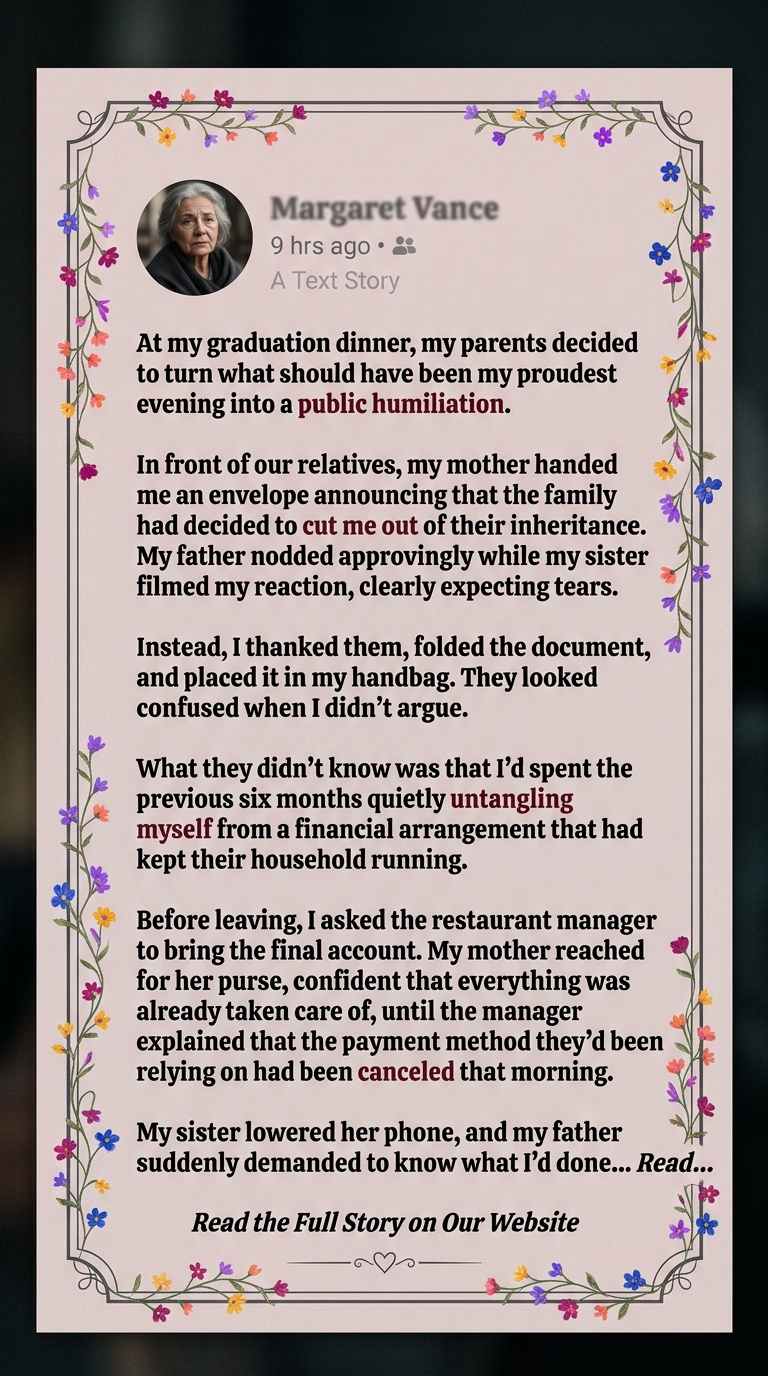
The envelope my mother handed me at my graduation dinner was cream-colored, neatly sealed, and decorated with a small gold sticker.
For a moment, I thought it contained a gift.
Then she stood beside my chair, tapped her glass, and announced that the family had something important to share.
“Before we celebrate tonight, there is one matter we need to settle,” she said.
My father sat beside her, looking unusually pleased with himself. My older sister, Vanessa, had already raised her phone and pointed the camera at me.
I was twenty-four years old. I had just graduated with a degree in civil engineering after working part-time throughout university. I had imagined this evening would be about celebrating the years of effort it had taken to reach that moment.
Instead, my mother handed me the envelope.
“We’ve decided that you will no longer be included in the family inheritance,” she announced. “Your father and I believe this is the fairest arrangement.”
The table went quiet.
One of my aunts lowered her fork. My uncle looked from my mother to me, clearly uncomfortable.
I opened the envelope.
Inside was a short document stating that my parents intended to leave their estate to Vanessa and exclude me from any future inheritance. It wasn’t a legally completed change to their estate plan, but the message was unmistakable.
My father nodded.
“Your sister has always been more involved with the family. She’s been responsible and supportive. You chose your own path, and we think it’s time you understood that choices have consequences.”
Vanessa moved her phone slightly closer.
I looked at her.
“Are you recording?”
She smiled.
“Just preserving a family moment.”
My mother continued.
“We’ve given you plenty over the years. We paid for things, supported you, and made sure you had opportunities. We don’t believe you appreciate what this family has done.”
I folded the document carefully.
“Thank you for letting me know.”
My mother blinked.
“What?”
“I said thank you.”
I placed the document inside my handbag and returned to my seat.
My father looked disappointed.
“That’s all you have to say?”
“You’ve made your decision. I don’t see a reason to argue about it.”
Vanessa lowered her phone slightly, apparently confused that I hadn’t cried.
What none of them knew was that I had spent the previous six months preparing for a very different conversation.
For almost four years, I had been helping my parents financially.
It began when my father’s construction supply business suffered a difficult year. A major customer had delayed payments, and my parents were struggling to cover their mortgage and household expenses.
They asked whether I could help temporarily.
At the time, I was working as a junior engineering assistant and earning enough to contribute without putting myself in immediate difficulty.
I agreed to pay the household’s electricity, water, internet, and insurance bills. I also arranged a monthly transfer to cover part of the mortgage.
My parents promised it would only last a few months.
But the months became years.
When my father’s business failed to recover, my mother began asking for additional help. My sister, Vanessa, was supposedly struggling with her own expenses, so I was told not to expect her to contribute.
I accepted that arrangement because I believed we were working toward the same goal.
I was not wealthy. I had student loan payments, rent, transportation costs, and my own future to consider. Still, I kept helping.
The problem was that my contribution gradually became invisible.
My mother stopped thanking me. My father began describing the household expenses as something he and my mother managed. Vanessa continued enjoying the benefits without acknowledging where the money came from.
Whenever I mentioned that I needed to reduce my contributions, my mother reminded me that I was still living under the family umbrella.
Even though I had moved into my own apartment two years earlier.
I was still paying bills for a household I no longer lived in.
The first warning came when I visited my parents for dinner and overheard Vanessa telling a cousin that she was the one who had been keeping the family financially stable.
I almost laughed.
Then my father asked me to increase the monthly mortgage contribution because the interest rate had changed.
I told him I couldn’t.
My mother accused me of abandoning the family.
That night, I finally reviewed every payment I had made.
The total shocked me.
Over the years, I had paid more than $86,000 toward their household expenses. Some payments were direct transfers, while others went straight to utility companies, the mortgage lender, and insurance providers.
I had never kept a proper record because I trusted them.
That changed immediately.
I downloaded every bank statement, organized the payments by category, and reviewed the automatic transfers connected to my account.
I also discovered that I was still listed as the primary payment contact for several household services.
My name appeared on accounts for a property I didn’t own and no longer occupied.
I contacted each provider, explained that I was no longer responsible for the household, and arranged to have the accounts transferred into my parents’ names.
I didn’t cancel essential services without warning. I gave the companies the required notice and allowed my parents time to arrange their own payment methods.
I also informed the mortgage lender that I was not a borrower or owner of the property and that my voluntary contributions would end.
The lender confirmed that I had no legal responsibility for the mortgage.
I was free to stop paying.
I waited until every account had been properly transferred.
The final arrangement was a recurring payment to my parents’ household account, which they had come to rely on for the mortgage and several other expenses.
I gave them written notice that the contribution would end after six months.
My mother responded with a single message:
You wouldn’t dare leave us to manage everything alone.
I didn’t reply.
I continued paying during the notice period, exactly as promised. I wanted to leave no room for anyone to claim that I had suddenly abandoned them.
During those six months, I also built my own emergency savings, paid down my remaining student loan balance, and signed a lease for a small apartment closer to my new engineering job.
By graduation night, I had completed every transfer and account change.
The final recurring payment had been canceled that morning.
My parents had no idea.
They still believed I was the person quietly keeping their household running.
And they had chosen the evening of my graduation to announce that I was no longer part of their future.
I looked around the table.
My relatives were still waiting for a reaction.
Instead, I turned to the restaurant manager, who had been standing nearby.
“Excuse me. Could you bring us the final account, please?”
My mother smiled.
“There’s no need. Your father has already arranged everything.”
The manager checked his tablet.
“I’ll just confirm the payment details.”
He returned a moment later with the bill.
“I’m sorry, but the payment method on file has been declined. The authorization is no longer active.”
My mother frowned.
“That can’t be right. It’s the same card we’ve used for the previous family dinners.”
The manager looked at me.
“The account was previously registered to this card, but the authorization was removed this morning. We’ll need another payment method.”
My sister lowered her phone.
My father stared at me.
“What did you do?”
I remained seated.
“I removed my payment method.”
My mother looked confused.
“You can’t do that. We’ve always used that card for family expenses.”
“It was my card.”
“But your father told the restaurant you were covering tonight.”
I turned toward him.
“Did he?”
My father looked uncomfortable.
“We discussed this weeks ago.”
“No. You told me the graduation dinner was being arranged by the family. You never asked me to pay for it.”
My mother quickly reached into her handbag.
“Fine. I’ll pay.”
She took out her wallet and handed the manager a credit card.
He returned a few minutes later.
“I’m afraid this card has also been declined.”
My mother’s face changed.
“Try it again.”
He did.
The result was the same.
Vanessa stared at her mother.
“What’s going on?”
My father stood up.
“Give me the bill.”
The manager handed it to him.
He pulled out his wallet and tried his own card.
It was declined too.
For the first time that evening, my father looked genuinely frightened.
He turned toward me.
“You’ve been planning this?”
“I’ve been planning to stop paying your household expenses for six months. The restaurant payment was simply another account I no longer authorize.”
My mother stared at me.
“You let us believe everything was still being taken care of.”
“I gave you six months’ notice.”
“You should have reminded us!”
“I did. Several times.”
My father lowered his voice.
“Do you understand what you’ve done? The mortgage payment is due next week.”
I looked at him.
“That’s not my mortgage.”
He glanced around the table, apparently realizing that our relatives were listening.
“Don’t make this a public argument.”
I almost smiled.
“You made my inheritance a public announcement. I thought we were being honest tonight.”
My aunt finally spoke.
“Wait. Are you saying you’ve been paying their mortgage?”
I nodded.
“And the utilities, insurance, and several other household bills.”
My uncle looked at my father.
“You told us Vanessa was helping with those expenses.”
Vanessa’s expression changed.
“I help Mom and Dad all the time.”
“Then I’m sure they’ll be fine,” I replied.
She glared at me.
“You’re being vindictive.”
“No. I’m being finished.”
My mother began crying.
“You know your father has been under pressure. You could have handled this privately.”
I looked at the document still inside my handbag.
“You could have handled the inheritance privately too. Instead, you chose to announce it in front of everyone while my sister filmed me.”
Vanessa slowly put her phone away.
The restaurant manager waited politely beside the table.
I opened my handbag, removed my wallet, and handed him my own card.
“I’ll pay for my meal and the drinks I ordered. Please separate those from the rest.”
My father stared at me.
“You’re really going to leave us with this bill?”
“I didn’t invite everyone. I didn’t choose the restaurant, and I didn’t agree to pay for the evening.”
My uncle reached for his wallet.
“Let’s not make the staff suffer because of a family disagreement. I’ll cover my portion.”
My aunt did the same.
A few relatives followed.
My parents and Vanessa were left to settle the remaining amount.
I thanked the manager, picked up my handbag, and stood.
My father followed me toward the entrance.
“Where do you think you’re going?”
“Home.”
“We need to talk.”
“You’ve had six months to talk to me about the payments. Tonight, you wanted to talk about inheritance. I think we’ve covered enough.”
He lowered his voice.
“Your mother is upset. You should apologize.”
I looked at him.
“For what?”
“For embarrassing us.”
I shook my head.
“You announced that I was being cut out of the family inheritance because I supposedly failed to appreciate what you’ve done for me. Did you ever consider what I had done for you?”
He didn’t answer.
I left.
The next morning, my mother called repeatedly.
I finally answered after the fourth attempt.
“You’ve put us in an impossible situation,” she said.
“I gave you six months to prepare.”
“We thought you were bluffing.”
“That doesn’t change anything.”
“Your father says the bank may charge us late fees.”
“Then you should contact the bank and discuss your options.”
She began crying.
“I’m your mother. How can you be so cold?”
I took a breath.
“I didn’t stop loving you. I stopped paying your bills.”
She hung up.
For the next several weeks, the family conversations became increasingly uncomfortable.
My father claimed I had deliberately timed the cancellation to humiliate him. Vanessa told relatives that I had used the graduation dinner to punish our parents because they were changing their will.
But the truth gradually emerged.
My aunt asked to see the payment records. I showed her a summary of the money I had contributed over the previous four years.
She was stunned.
“I had no idea you were doing all this.”
I explained that I hadn’t expected praise. I had simply believed I was helping my parents through a difficult period.
My aunt then admitted that my parents had told relatives they were financially comfortable because Vanessa had been helping them.
Vanessa had apparently been taking credit for the support I provided.
I wasn’t surprised.
A few days later, my father sent me a message saying he wanted to meet.
I agreed, but only in a public place.
He arrived at a café near my office and looked exhausted.
“The bank wants us to refinance,” he said.
I stirred my coffee.
“I’m sorry to hear that.”
“We can’t qualify for the amount we need without another source of income.”
“I can’t help with that.”
He rubbed his forehead.
“Your mother and I thought you would always contribute. We didn’t realize how much we depended on it.”
“You depended on it because you never made another plan.”
“We’re your parents.”
“And I was your daughter, not your mortgage lender.”
He looked away.
After a long silence, he said, “We shouldn’t have announced the inheritance decision like that.”
“Was the decision real?”
He hesitated.
“Your mother wanted to make a point.”
“So you didn’t actually change your estate plan?”
“We were considering it.”
I nodded.
“Then you should understand that I never asked for an inheritance. I wanted to be treated fairly while I was alive.”
He looked at me for a long time.
“Do you really think we don’t love you?”
I considered the question.
“I think you got used to what I provided. Somewhere along the way, you stopped seeing it as help and started seeing it as something you were entitled to.”
He didn’t argue.
My parents eventually sold their house and moved into a smaller property they could afford. My father returned to part-time work, and my mother began managing their expenses more carefully.
Vanessa contributed to their new household, although I never learned exactly how much.
I didn’t resume my payments.
The inheritance document from graduation night remained in my handbag for several weeks before I put it away. I never asked my parents to include me in their estate plan again. If they wanted to leave everything to Vanessa, that was their decision.
I had already learned not to build my future around money that wasn’t mine.
Several months later, I received a message from Vanessa.
She wrote that she had watched the graduation video again and realized how uncomfortable the evening had become. She said she hadn’t known I was paying so much toward our parents’ expenses.
I replied that she could have asked.
She admitted that she had assumed our parents were managing everything themselves. She also apologized for filming my reaction.
It wasn’t a complete reconciliation, but it was the first time she had acknowledged her part.
At my next birthday, my parents invited me to dinner.
This time, I asked whether everyone was paying for their own meal.
My mother looked embarrassed.
“Yes,” she said. “Everyone will pay separately.”
I smiled.
“Then I’d be happy to come.”
We had a quiet dinner. Nobody mentioned inheritance, and nobody asked me to cover anything.
My father even asked about my new engineering project.
It was a small conversation, but it felt different.
I still love my family. I hope we can build a healthier relationship over time.
But I no longer confuse love with financial obligation, and I no longer believe that being a good daughter means making my own future smaller so someone else’s life can remain comfortable.
My graduation dinner was supposed to celebrate the beginning of my adult life.
My parents tried to make it a lesson about what I would never receive from them.
Instead, it became the night I finally stopped paying for the approval they had never intended to give me.