The first thing I noticed when I pulled into the driveway was the police car.
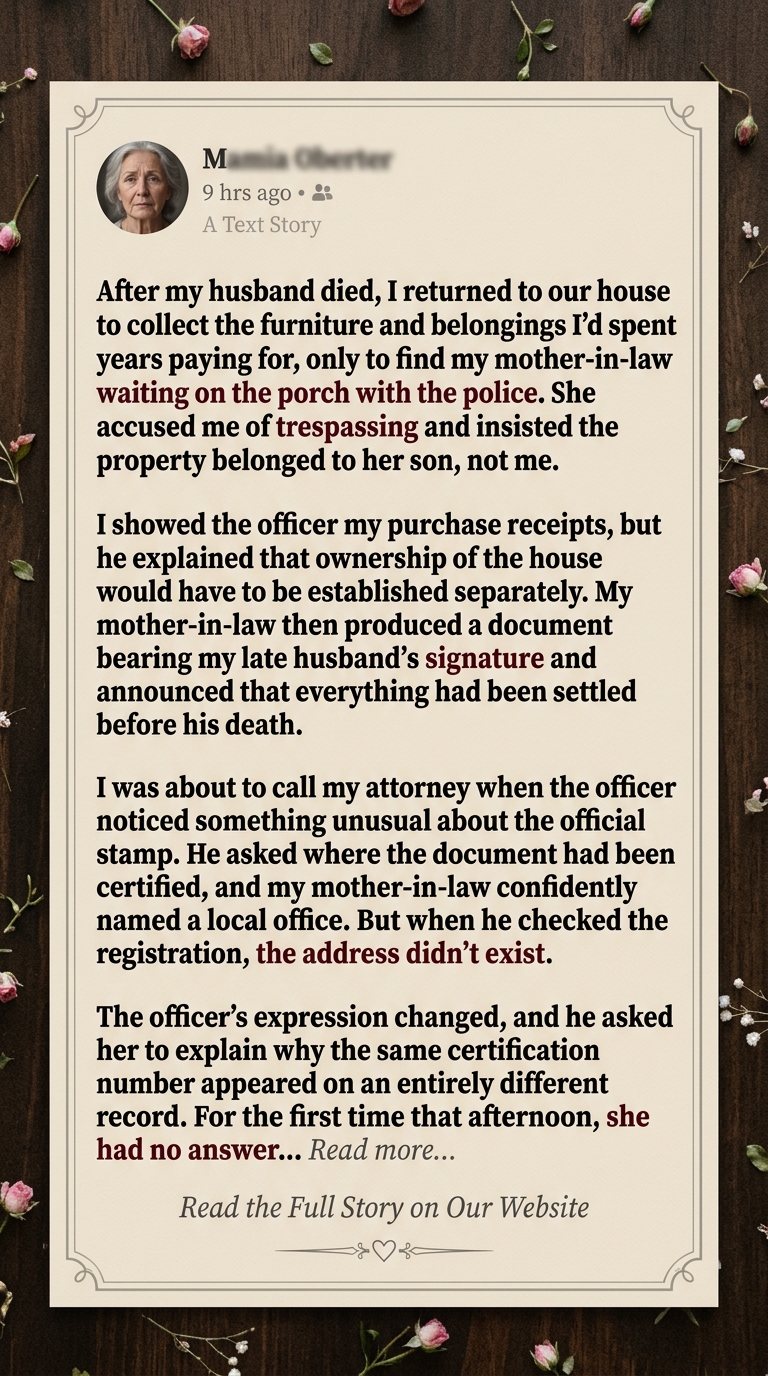
It was parked beside the mailbox, its blue-and-white markings reflecting in the afternoon sunlight. My mother-in-law, Margaret, stood on the front porch with her arms folded. She wore the same expression she had used for years whenever she wanted someone to understand that she considered herself in charge.
I hadn’t spoken to her since my husband, Thomas, died six weeks earlier.
I stepped out of the car, holding the keys to the house.
“What are you doing here?” she demanded.
“Collecting my belongings.”
Margaret gave a short, humorless laugh.
“Your belongings? This house belongs to my son. You have no right to enter it.”
I looked toward the officer standing beside her.
“I’m Thomas’s wife,” I explained. “I’ve lived here for eleven years.”
“Not anymore,” Margaret interrupted. “My son made arrangements before he died. She’s been told to leave.”
I felt the familiar tightness in my chest. Thomas had been gone only a month and a half, and already his mother was behaving as though our marriage had been an inconvenience she was finally free to correct.
The officer introduced himself as Officer Bennett. He asked whether I had any documents establishing my right to enter the property.
I showed him my identification, our marriage certificate, and a folder of receipts for the furniture and household items I had purchased over the years. I had paid for the dining table, the bedroom set, the washing machine, the kitchen appliances, and almost everything else that made the house feel like a home.
Officer Bennett examined the papers carefully.
“These receipts are useful for establishing ownership of the individual items,” he explained, “but they don’t establish who owns the property itself. That would need to be determined through the appropriate legal process.”
Margaret smiled as though she had just won.
“Exactly. Now please ask her to leave.”
Before I could respond, she reached into her handbag and produced a folded document.
“My son signed this before he died,” she announced. “It clearly states that the house and everything inside it belong to me. There’s nothing left for her to argue about.”
She handed it to Officer Bennett.
I watched him read the first page, then turn it over.
The document appeared to be an official declaration. It carried Thomas’s name, a signature, a witness’s name, and a certification stamp. At the bottom was a registration number and the name of a local certification office.
Margaret leaned closer.
“You see? Everything was settled before he passed away.”
Officer Bennett studied the stamp again.
“Where was this certified?”
“At the Westbrook Municipal Records Office,” she answered immediately.
He looked up.
“Which address?”
Margaret gave him an address on the other side of town.
Officer Bennett took out his phone and checked the official directory. His expression gradually changed.
“Ma’am, there is no certification office at that address.”
Margaret’s confidence flickered.
“Perhaps the office moved.”
He checked the registration number.
“That’s not the problem. This number appears on an entirely different record.”
“What does that mean?” she demanded.
“It means I need to establish whether this document is genuine.”
For the first time since I arrived, Margaret had nothing to say.
I could have smiled. I could have reminded her that she had spent years treating me like a temporary guest in my own marriage. Instead, I felt a cold sadness settle over me.
Because I knew Thomas had never wanted this.
To understand why, I need to explain what our marriage had been like before his illness.
Thomas and I met when I was twenty-eight. He was thoughtful, hardworking, and unusually patient. He worked as a civil engineer, while I managed a small interior design business. We rented an apartment for our first two years together, saving every spare dollar until we could afford a modest house.
His mother never approved of me.
She believed her son should have married someone from a wealthier family, someone who would have made his life easier. She rarely said it directly, but her comments always carried the same message.
When Thomas and I bought our house, she called it a poor investment.
When I replaced the old kitchen cabinets with money from my business, she said I was wasting money on appearances.
When I bought our bedroom furniture, she asked why I hadn’t waited for Thomas to choose something.
I learned to ignore most of it because Thomas always defended me.
“It’s our home, Mom,” he would say. “We make decisions together.”
Margaret never accepted that answer.
She had been widowed when Thomas was young, and I understood that she had sacrificed a great deal to raise him. But somewhere along the way, she had confused loving her son with having authority over his life.
Thomas tried to keep the peace. He visited her regularly, helped with repairs, and paid for occasional expenses when she needed assistance. I never objected to that.
What I couldn’t accept was her belief that our marriage made me an outsider.
The situation became more complicated when Thomas was diagnosed with a serious illness.
His treatment lasted almost a year. I reduced my working hours to take him to appointments, manage his medication, and make sure he was comfortable at home. Margaret visited often during the first few months, but her visits gradually became arguments.
She questioned the doctors, criticized the food I prepared, and repeatedly suggested that Thomas should move into her house.
“He needs his mother,” she told me once.
“He needs his wife, too,” I replied.
She looked at me coldly.
“You should remember that he’s my son.”
Thomas heard the exchange.
“Mom, stop,” he said from his chair. “She’s the person taking care of me every day. Don’t make this harder for her.”
Margaret left without saying goodbye.
After that, Thomas became more determined to settle his affairs. He knew his health was uncertain, and he didn’t want me dealing with confusion if something happened.
We met with an estate attorney named Elaine Porter. She explained how to update our wills, review the ownership records, and make sure our wishes were properly documented.
Thomas wanted me to remain secure in the house we had purchased together. He also wanted his mother to have enough money to live comfortably without depending on me.
We discussed everything openly.
Margaret was not included in those meetings.
I knew she would be unhappy, but Thomas said it was important that our decisions remained between us.
A few months later, he died peacefully at home with me beside him.
The days that followed were a blur of condolences, funeral arrangements, and relatives offering help. Margaret barely spoke to me. She spent most of the funeral sitting with Thomas’s cousins, accepting their sympathy and telling them how much she had lost.
At the burial, she turned toward me.
“You may have been his wife,” she said quietly, “but I was his mother.”
I didn’t answer.
I was too exhausted to argue with someone who seemed determined to turn grief into a competition.
Now, standing on the porch with a questionable document in the officer’s hands, I understood that Margaret had been waiting for the funeral to end before making her move.
Officer Bennett stepped away to contact his supervisor.
Margaret immediately turned toward me.
“You’ve caused enough trouble,” she whispered. “Thomas knew what he wanted. You should accept it.”
“Did he tell you he was leaving the house to you?”
“He told me I would be taken care of.”
“That isn’t the same thing.”
Her eyes narrowed.
“You always thought you knew better than me.”
Before I could answer, Officer Bennett returned.
“I’ve spoken with the records department,” he said. “The registration number on this document belongs to a certification issued several years ago for an unrelated property matter. It cannot be used for this declaration.”
Margaret stiffened.
“That must be an administrative mistake.”
“Possibly. But the office you named does not appear in the municipal registry, and the certification number doesn’t match this document.”
He asked her to explain how she had obtained it.
She said Thomas had given it to her shortly before his death.
“Did you witness him sign it?” the officer asked.
“I don’t remember exactly.”
“Who was the witness listed here?”
Margaret glanced down.
“Someone he knew.”
“Do you know their full name?”
She hesitated.
“No.”
Officer Bennett closed the folder.
“I can’t determine ownership of the house, and I’m not going to decide that question today. But I will document the circumstances surrounding this disputed document. If you believe the property belongs to you, you should pursue that through the appropriate civil process.”
Margaret’s face reddened.
“She can’t just walk into the house!”
Officer Bennett turned toward me.
“Do you have a key?”
I held it up.
“Then I recommend you avoid any confrontation and let the ownership question be handled through the proper channels. Neither of you should attempt to force the other out based on an unverified document.”
Margaret snatched the papers from his hand.
“This isn’t finished.”
She walked inside the house and slammed the door.
I stood on the porch, unsure whether I should feel relieved or frightened.
Officer Bennett gave me his card.
“If you receive any threats or discover anything else involving this document, contact the department. And speak with an attorney before removing anything that might be part of a property dispute.”
I thanked him.
Then I called Elaine Porter.
She asked me to come to her office the following morning and bring every document I had.
That night, I stayed with a friend.
I didn’t want another confrontation, and I knew that walking into the house while Margaret was there could make matters worse.
The next morning, Elaine examined the document carefully.
She didn’t look surprised by the irregularities.
“Your mother-in-law has made a serious claim,” she said, “but this paper doesn’t establish what she thinks it does.”
She asked me whether Thomas had ever told me he intended to transfer the house to his mother.
“Never. We discussed our estate plans together. He wanted me to remain in the house.”
“Did you sign anything transferring your interest?”
“No.”
Elaine nodded.
“Good. Let’s establish the actual ownership before responding to her claims.”
She obtained the official property records. The title showed that Thomas and I had purchased the house jointly, with both of our names registered as owners. It also showed that no transfer had been registered before his death.
Elaine explained that Thomas’s share would be dealt with under the applicable inheritance rules and his valid estate documents. Margaret’s paper did not automatically transfer his interest, and it certainly did not give her ownership of my share.
Then Elaine asked for Thomas’s original estate file.
We had completed the paperwork months before his death, but I had not yet received every final document because the estate administration was still underway.
Elaine contacted the firm that had prepared the documents.
Two days later, she called me.
“Your husband made a clear provision for you,” she said. “His will leaves his interest in the house to you, subject to the normal estate administration. He also established a separate financial arrangement for his mother.”
I sat down.
“What kind of arrangement?”
“He left her a specific cash legacy and arranged for her to receive additional support from an investment account. He wanted her to be financially secure, but he did not intend to give her the house.”
I closed my eyes.
That was exactly what Thomas had told me he wanted.
Elaine continued.
“There is another issue. The attorney who prepared the will has confirmed that Thomas never signed the declaration your mother-in-law presented. The signature on it appears to have been copied from an older document.”
“Can we prove that?”
“The attorney has retained the original signed documents. A handwriting examination can be arranged if necessary. We also have the certification office’s written confirmation that the registration number was assigned to a different record.”
I felt sick.
Margaret had not simply misunderstood Thomas’s wishes. She had presented a document that appeared to have been manufactured to support a claim she knew she could not otherwise make.
Elaine advised me not to contact her directly.
Instead, she sent a formal notice explaining the registered ownership, the estate process, and the invalidity of the disputed declaration. She also requested that Margaret preserve the original document and provide information about who had prepared it.
For several days, there was no response.
Then Margaret called me.
I almost didn’t answer.
“What do you want?” I asked.
Her voice sounded different. The certainty was gone.
“You’ve involved lawyers.”
“You brought the police to my house.”
“I was only trying to protect what belonged to Thomas.”
“Thomas’s wishes were clear.”
She sighed.
“He told me he wanted me to be comfortable.”
“He arranged money for you. He didn’t promise you my home.”
There was a long silence.
Finally, she said, “I thought you would leave after he died.”
The honesty of that statement hurt more than her earlier accusations.
“Why would you think that?”
“Because you never really belonged to our family.”
I looked out the window.
“I was his family. We built that home together. I cared for him when he was sick. I stayed beside him until the end. You don’t get to erase eleven years because you never liked me.”
She began crying.
For a moment, I wondered whether I was hearing genuine regret.
Then she said, “I was afraid I would lose everything.”
“You weren’t going to lose everything. Thomas made sure you were provided for.”
“I didn’t know about the money.”
“Then you should have asked Elaine instead of presenting a document you couldn’t verify.”
She didn’t answer.
A week later, the attorney who had prepared Thomas’s will provided a formal statement confirming that the disputed declaration was not among the documents Thomas had signed. The certification office also supplied its records showing that the number on Margaret’s paper belonged to an unrelated document.
When investigators contacted her, Margaret eventually admitted that she had obtained the declaration from a man who had offered to help her establish a claim over the house. She said he had told her the document was legitimate and that she believed it would make me leave.
But the explanation created another problem.
The man had not been an authorized legal professional, and the address he had given her was fictitious. Investigators began examining whether he had produced similar documents for other people.
Margaret was not arrested that afternoon, and the police did not decide the inheritance dispute for us. The matter was referred for further investigation, while Elaine continued the estate process.
Several months later, the estate administration was completed. Thomas’s share of the house passed to me under his valid will, and I became its sole registered owner.
Margaret received the financial provision he had intended for her.
I did not celebrate when the final documents arrived.
I simply sat at the kitchen table, looking at the place where Thomas used to drink his morning coffee.
The house was mine, but it felt different without him.
I considered selling it. Every room held memories, and some days those memories were too painful to bear. But eventually, I decided to stay.
I repainted the bedroom, replaced the curtains, and turned the small room at the back into a studio for my design work. I kept Thomas’s favorite chair by the window because I couldn’t bring myself to move it.
Margaret sent me a letter a few months later.
She apologized for bringing the police, for trying to take the house, and for presenting the document. She admitted that her fear of being left alone had become resentment toward me. She also acknowledged that she had allowed her pride to convince her that Thomas’s decisions were somehow an insult to her.
I read the letter twice.
I didn’t immediately forgive her. An apology could not erase what she had done, and I wasn’t willing to pretend that trust could be restored with a few sentences.
But I wrote back.
I told her I hoped she would use the money Thomas had left her to build a comfortable life. I also told her that if we ever had a relationship again, it would have to begin with honesty and respect.
She never asked for the house again.
A year after Thomas’s death, I invited a few close friends to dinner. We sat around the dining table I had purchased years earlier, the same table Margaret had once dismissed as cheap.
For the first time, the house felt like mine again.
Before everyone arrived, I placed a small photograph of Thomas beside the window. It showed him laughing in the garden, holding a cup of coffee and looking at me as though I were the only person in the world.
I touched the frame.
“You were right,” I whispered. “We did build a home together.”
Then I turned on the lights and opened the door for my guests.
I had spent months fighting to prove that I belonged in the place where I had lived, loved, and cared for my husband. In the end, the truth had not needed a dramatic confrontation. It needed patience, proper records, and the courage to refuse a lie.
Margaret had brought the police to remove me.
Instead, the investigation exposed the document she had hoped would erase me—and the house remained with the person Thomas had chosen to leave it to.