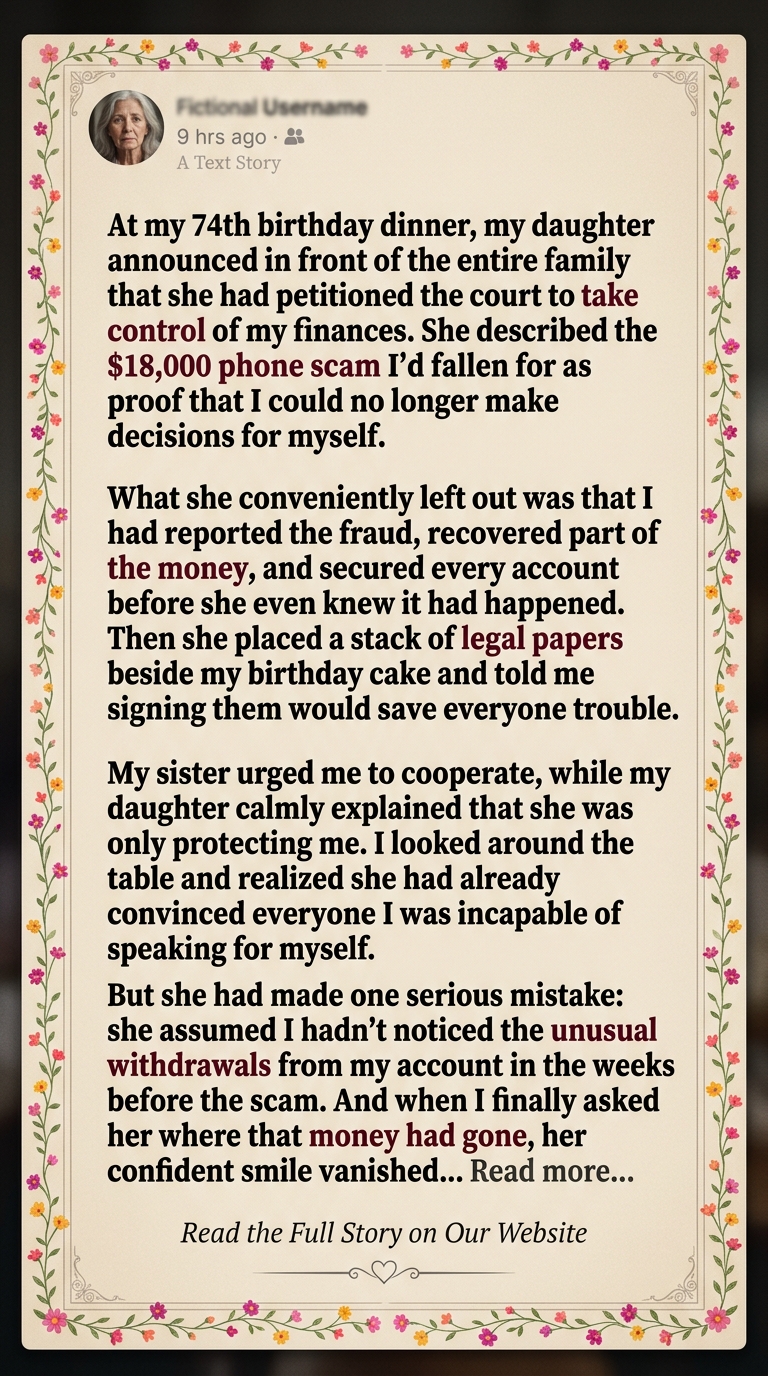
My daughter announced that she wanted control of my finances halfway through my seventy-fourth birthday dinner.
She didn’t wait until the guests had left or ask to speak with me privately. She stood beside the dining table, lifted her glass, and addressed everyone as though she were making a harmless family announcement.
“Before we cut the cake, there’s something everyone needs to understand. Mom has been making some dangerous financial decisions, and I’ve taken steps to protect her.”
I looked up from my plate.
“What steps?”
My daughter, Rebecca, placed a thick folder beside my birthday cake.
“I’ve petitioned the court for authority to manage your finances. After what happened with that phone scam, it’s clear you need help.”
The room went quiet.
My sister, Margaret, stopped cutting her food. My two grandsons exchanged uncomfortable looks. Rebecca’s husband, Paul, stared at his glass.
I knew exactly which incident she meant.
Three months earlier, I had received a call from someone claiming to work for my bank’s fraud department. The caller knew the name of my bank, the last four digits of my account, and several details about a recent transaction. He told me someone had attempted to transfer money from my savings and that I needed to move my funds into a temporary security account.
I believed him.
By the time I realized the call was fraudulent, I had transferred $18,000.
It was a painful mistake, and I was furious with myself. But I hadn’t hidden from it. I reported the fraud immediately, contacted my bank, filed a police report, and worked with the bank’s fraud department to secure my accounts.
The bank recovered $6,500 through a successful recall. The remaining amount was still under investigation, but my accounts were protected, new security measures were in place, and no further transfers had occurred.
Rebecca knew none of those details.
She had only learned about the scam two weeks earlier, when my sister mentioned it during a telephone conversation.
Now she was using it to convince everyone that I could no longer manage my own life.
“You’ve already petitioned the court?” I asked.
Rebecca nodded.
“I’ve spoken to a lawyer. It’s the responsible thing to do.”
“And what exactly are you asking the court to control?”
“My finances, your banking arrangements, your investments, and major financial decisions. It’s only temporary until we can be certain you’re safe.”
I looked at the folder.
“Have you asked me whether I want that?”
“Mom, this isn’t about what you want. It’s about what you need.”
My sister leaned toward me.
“Maybe you should cooperate, Helen. Nobody wants you to lose everything because of another mistake.”
I looked at her.
“Have you even asked me what happened after the scam?”
She hesitated.
“Rebecca said you lost eighteen thousand dollars.”
“I did lose money. But I reported it, recovered part of it, and secured my accounts. Why didn’t anyone ask me about that?”
Rebecca sighed.
“Because you keep insisting everything is fine. You don’t understand how serious this is.”
I looked around the table.
My family had come to celebrate my birthday, but somehow my daughter had turned the evening into a public hearing about my competence.
I picked up my water glass and took a slow drink.
Then I asked the question that changed everything.
“Rebecca, before you explain how you’re going to manage my money, perhaps you can explain where the $4,800 went from my account last month.”
Her expression changed.
Only slightly, but I noticed.
“What are you talking about?”
I folded my hands.
“Three withdrawals. One for $1,600, another for $1,200, and a third for $2,000. They happened over twelve days. I didn’t make them.”
Rebecca glanced at Paul.
My sister put down her fork.
“What withdrawals?”
I kept my eyes on my daughter.
“That’s what I’d like to know.”
Rebecca recovered quickly.
“Mom, you’re confused. Those were probably automatic payments.”
“I checked. They weren’t.”
“Then perhaps you authorized them and forgot.”
“I didn’t.”
She reached for her water.
“Let’s not do this tonight.”
I almost smiled.
“You brought court papers to my birthday dinner. I think we’re already doing it.”
I had noticed the withdrawals several weeks before the scam.
At first, I assumed they were ordinary expenses. I paid several household bills automatically, and I occasionally helped my grandchildren with school costs. But when I reviewed my statements carefully, I found three payments to a company called Westbridge Financial Services.
I had never heard of it.
I contacted my bank and asked for the transaction details. The payments had been made through an online authorization linked to a device I didn’t recognize.
The bank temporarily restricted the account and opened an investigation.
I didn’t tell Rebecca because I wanted to understand what had happened before involving the family.
Then the phone scam occurred.
That incident made me review every transaction from the previous six months.
The $18,000 transfer was a separate fraud. The earlier $4,800 payments were not.
And the bank had traced them to an account controlled by a company connected to my daughter.
I hadn’t confronted Rebecca because the investigation was still ongoing.
Now, with her court petition sitting beside my birthday cake, I decided it was time.
“Westbridge Financial Services,” I said. “Do you recognize the name?”
Rebecca’s face went pale.
Paul finally looked up.
“Rebecca?”
She ignored him.
“It’s a company that handles administrative payments. You wouldn’t understand the details.”
“Then explain them.”
“Mom, you’re making accusations without knowing what you’re talking about.”
“I know the payments were made from my account. I know I didn’t authorize them. And I know the receiving company is registered to a business address used by your consulting firm.”
My sister looked at Rebecca.
“Is that true?”
Rebecca pushed her chair back.
“This is ridiculous.”
I reached into my handbag and removed a sealed envelope.
“I brought something too.”
Inside were printed bank statements, the transaction investigation summary, and a letter from the bank confirming that the payments were being treated as unauthorized transactions.
I placed the papers on the table.
The room fell silent.
Rebecca didn’t touch them.
“Where did you get those?” she asked.
“From my bank.”
“Why didn’t you tell me?”
I looked at her.
“Why would I tell you before I knew whether you were involved?”
She opened her mouth, then closed it.
My sister picked up the first page.
“Rebecca, what is this?”
My daughter finally turned toward Paul.
“Can you please explain?”
He looked uncomfortable.
“Not here.”
I felt something cold settle in my stomach.
“You knew?”
Paul shook his head quickly.
“I knew there was a payment arrangement, but I thought your mother had agreed to it.”
I stared at him.
“What payment arrangement?”
Rebecca spoke before he could answer.
“It was a temporary loan. The company was having cash-flow problems. I intended to pay it back.”
I looked at her.
“You took $4,800 from my account?”
“I borrowed it.”
“Without asking?”
“I was going to tell you.”
“When?”
She looked away.
The answer was obvious.
I sat back.
For months, I had wondered why the money had disappeared. Now I understood why Rebecca had become so interested in my financial decisions immediately after learning about the phone scam.
She wasn’t simply worried that I might lose money.
She was worried that I might discover where some of it had already gone.
“Why did your company need the money?” I asked.
Rebecca’s eyes filled.
“Business expenses.”
“What kind?”
She didn’t answer.
Paul finally spoke.
“Westbridge was supposed to cover a short-term operating deficit. Rebecca said she would repay the money after a client paid an overdue invoice.”
I turned toward him.
“Did you know the account belonged to her mother?”
He lowered his eyes.
“I knew she was using family funds. I didn’t know she hadn’t asked you.”
Rebecca shook her head.
“Paul, stop.”
He continued anyway.
“The company had been struggling for months. We had lost two clients, and the tax payments were overdue. Rebecca was afraid the business would collapse.”
I looked at my daughter.
“Why didn’t you ask me for help?”
“Because you would have said no.”
That answer hurt more than the money.
“You already knew what my answer would be?”
“You’ve always been careful about money. You would have made me explain everything.”
“Yes,” I said. “I would have.”
Rebecca began crying.
“I was going to put it back.”
I looked at the court papers beside the cake.
“And your plan was to convince a judge that I couldn’t manage my own money?”
She wiped her eyes.
“I was trying to protect you after the scam.”
“Were you protecting me, or were you trying to make sure I couldn’t question the transactions?”
She didn’t answer.
My sister put down the bank statement.
“Rebecca, did you really file a petition to control your mother’s finances while using her money without permission?”
Rebecca looked furious.
“I didn’t steal anything. I was going to repay it.”
“That isn’t an answer,” Margaret said.
For the first time that evening, my sister seemed to understand that she had been given only one side of the story.
I turned toward Rebecca.
“I have already spoken to my attorney. The bank has reported the unauthorized transactions, and the investigation is continuing. I will not sign anything tonight.”
“Mom, please.”
“No. You don’t get to decide that I am incapable of managing my life simply because I made one mistake. And you certainly don’t get to use that mistake to hide your own financial decisions.”
I gathered the documents and returned them to my handbag.
Then I looked around the table.
“I know I am seventy-four. I know I can make mistakes. I know the world is changing quickly, and sometimes I need help understanding new technology. But needing help with something does not mean surrendering my independence.”
Nobody spoke.
I looked at my sister.
“And supporting someone you love doesn’t mean agreeing with everything they say.”
Margaret nodded slowly.
“I should have asked you.”
“Yes,” I replied. “You should have.”
The birthday cake remained untouched.
I stood and picked up my handbag.
“I’m going home.”
Rebecca followed me into the hallway.
“Mom, please don’t leave like this. We can work something out.”
I turned toward her.
“You can start by telling the truth.”
She began crying again.
“I didn’t mean for any of this to happen.”
“But it did.”
I left without cutting the cake.
The next morning, I met with my attorney, Daniel Foster.
He reviewed the court petition and the bank investigation. He explained that Rebecca’s application did not automatically give her control of my finances. She would need to demonstrate that I lacked the ability to manage my affairs and that the requested arrangement was necessary.
The scam alone did not establish that.
I had reported the fraud, taken steps to protect my accounts, understood the investigation, and continued managing my daily finances independently.
Daniel arranged for an independent assessment of my decision-making capacity so there would be a clear professional record rather than a family argument about my age.
The assessment confirmed that I understood my financial circumstances, could evaluate risks, and could make my own decisions.
My attorney also submitted the bank’s findings concerning the unauthorized transfers.
Rebecca’s petition became considerably harder to defend.
The court requested further information about the financial transactions and the circumstances surrounding her application.
Meanwhile, the bank traced the $4,800 to Westbridge Financial Services. The company’s records showed that Rebecca had used the money to pay overdue business expenses and a portion of her personal credit card balance.
She had not intended to repay it immediately.
Her company was in deeper financial trouble than she had admitted.
The investigation also revealed that she had used my name as a reference when applying for a short-term business credit facility. She had told the lender that I was aware of the company’s financial arrangements.
I had not been.
My attorney advised me to keep all communications in writing and avoid private financial agreements with Rebecca until the investigation was complete.
I followed his advice.
A month later, Rebecca withdrew her petition.
She did not admit that the application had been intended to protect her from questions about the money, but the timing spoke for itself.
The bank continued its investigation, and Rebecca eventually signed a repayment agreement for the unauthorized transfers. She paid the first installment using money from a personal savings account.
I didn’t demand that she repay everything immediately. I wanted the money returned, but I also wanted the arrangement to be realistic and enforceable.
Her business eventually closed after losing another major client.
Paul moved into a separate apartment for several months while they worked through their financial problems. They remained married, but their relationship was strained.
My sister visited me a few weeks after the birthday dinner.
She brought a small plant and sat across from me in the living room.
“I owe you an apology,” she said.
I waited.
“I believed Rebecca because she sounded so certain. I thought the scam meant you needed help, and I didn’t stop to consider whether she was telling the whole story.”
“Thank you for saying that.”
“I should have asked you.”
“Yes.”
She looked around the room.
“Are you frightened about managing everything alone?”
I considered the question.
“I’m not frightened of managing my life. I am more careful now about who I trust with it.”
She nodded.
“Can I help you with the banking security?”
I smiled faintly.
“Yes. But we’ll do it together, and you won’t have access to my accounts.”
She accepted that.
A few weeks later, Rebecca came to visit.
She looked tired and older than I remembered. She sat at my kitchen table, where we had once spent countless afternoons making school projects and birthday cards.
“I know you don’t trust me,” she said.
“I don’t.”
She swallowed.
“I was desperate. The company was failing, and I didn’t know how to tell Paul. I thought I could borrow the money, repay it, and nobody would ever know.”
“You knew I would have asked questions.”
“Yes.”
“And instead of answering them, you decided I needed someone to control my finances.”
She lowered her eyes.
“I thought if I became responsible for everything, I could prevent you from making another mistake.”
I looked at her.
“Did you believe that, or did you want access to my accounts?”
She was silent for a long time.
“Both,” she finally admitted.
It wasn’t the apology I had hoped to hear, but at least it was honest.
“I love you, Rebecca,” I said. “That hasn’t changed. But I won’t allow you to manage my money, and I won’t pretend what happened was harmless.”
She nodded.
“I understand.”
“Then we can start by having a relationship that doesn’t involve my bank account.”
She gave a small, sad smile.
“I would like that.”
I didn’t promise everything would return to normal. Trust isn’t restored simply because someone admits what they did. It has to be rebuilt through consistent behavior.
But I allowed her to visit again.
On my seventy-fifth birthday, I held a much smaller dinner. Margaret came, as did my grandchildren. Rebecca arrived without a folder, a legal document, or an explanation about my finances.
She brought a cake.
After dinner, my oldest grandson raised his glass.
“To Grandma,” he said. “Who still knows exactly what she’s doing.”
Everyone laughed.
I looked at the people around the table and felt something settle inside me.
The previous year, my daughter had tried to turn my birthday into a public declaration that I was no longer capable of making decisions.
This year, I didn’t need to prove anything.
I had learned that growing older might mean asking for help more often, but it did not mean giving away my voice. A mistake could teach me to be more careful without making me helpless.
And being a mother did not require me to surrender the right to protect myself from my own child.
I blew out the candles myself.