I had imagined the birth of my first child a hundred different ways. In some versions, my husband was beside me, holding my hand. In others, my mother was there, brushing my hair away from my forehead while I laughed nervously through the contractions.
But none of those versions came true.
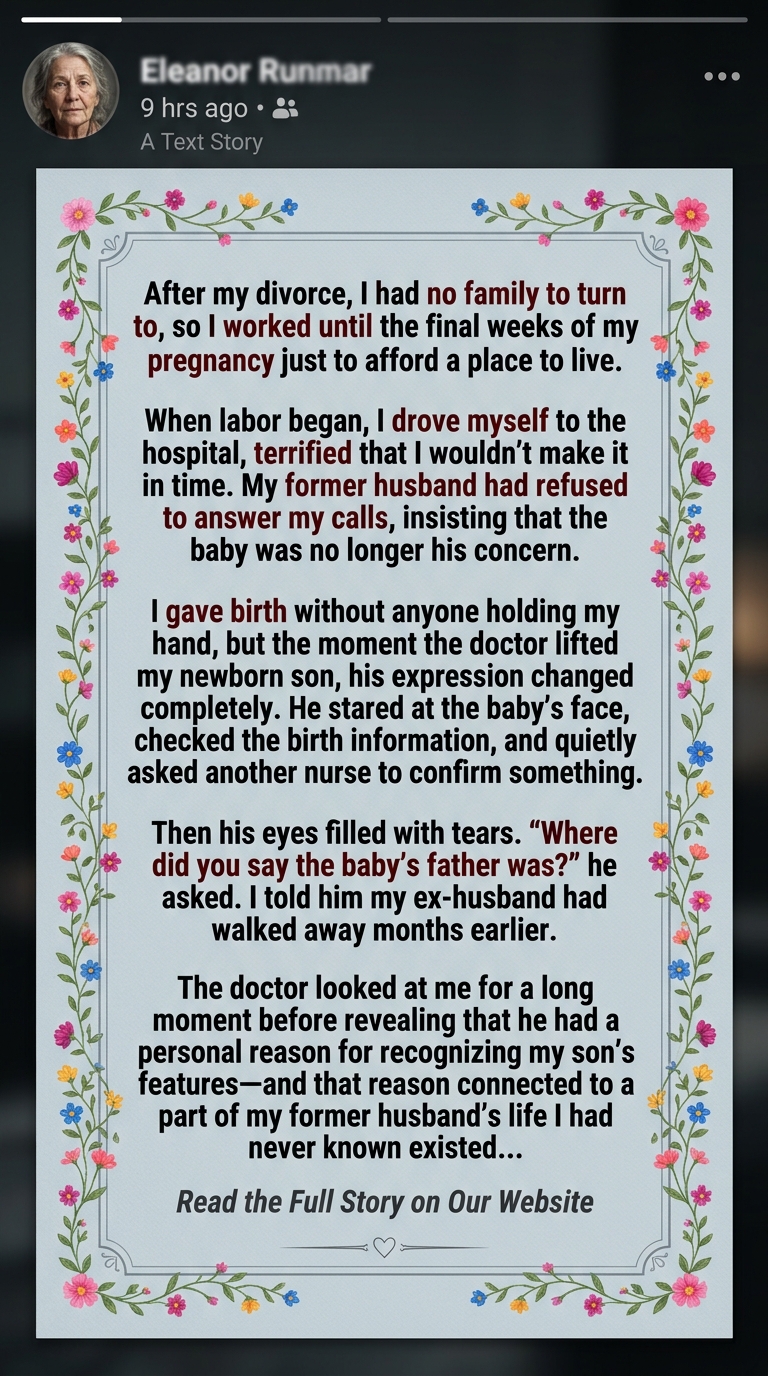
By the time I was thirty-seven weeks pregnant, my marriage had been over for nearly five months. My former husband, Mark, had left after telling me he wasn’t ready to become a father. At first, he promised he only needed time. Then he stopped coming home. Eventually, he stopped answering my calls.
When I told him I was having trouble paying rent, he replied with one sentence.
“You wanted to keep the baby. You figure it out.”
I had no parents to turn to. My mother had died when I was young, and my father had been gone from my life for so long that I couldn’t remember the sound of his voice. I had one cousin in another state, but we hadn’t spoken in years.
So I worked.
I took extra shifts at a small accounting office, answered emails from home, and continued working even when my feet swelled so badly that I could barely fit them into my shoes. My landlord agreed to let me stay as long as I paid something each week. I counted every dollar and avoided buying anything that wasn’t necessary for the baby.
By the final weeks of my pregnancy, I had a secondhand crib, a few packs of diapers, and enough money saved for the hospital bill.
What I didn’t have was anyone to call when the pain began.
It happened shortly after midnight on a rainy Thursday. I was folding tiny clothes when a sharp contraction forced me to grip the edge of the dresser.
I waited, hoping it was another false alarm.
Then another came, stronger than the first.
I looked at the clock, grabbed my hospital bag, and called Mark.
The phone rang until voicemail.
I tried again.
He answered on the fourth attempt, sounding irritated.
“What?”
“Mark, I think the baby is coming. I need you to take me to the hospital.”
There was a pause.
Then he said, “I’m not doing this again, Anna.”
“I’m serious. The contractions are close together.”
“You should have arranged something.”
“I thought you might at least—”
“I’m not your husband anymore. The baby isn’t my concern.”
He hung up.
For a moment, I stood in the middle of my apartment with the phone pressed against my ear. Then another contraction bent me forward, and I understood that I couldn’t waste another minute.
I drove myself to the hospital.
The rain made the road shine beneath the streetlights. Every few minutes, I had to pull over and breathe through the pain. I kept one hand on the steering wheel and the other against my stomach, whispering to my son that we would be all right.
When I finally reached the emergency entrance, a security guard saw me struggling out of the car and hurried over.
“Ma’am, are you in labor?”
“I think so,” I managed.
He called for a wheelchair. Within minutes, I was being rushed toward the maternity ward.
The nurses moved quickly. One checked my blood pressure while another attached monitors to my stomach.
“Where is your husband?” a nurse asked as she prepared the admission paperwork.
“He isn’t coming.”
She looked at me, then gently lowered her voice.
“Is there anyone else we should call?”
I shook my head.
She didn’t ask again.
Labor was harder than I had imagined. I remember the bright lights, the cold water against my lips, and the nurse who kept telling me to breathe. I remember asking whether my baby was okay and hearing the reassuring rhythm of his heartbeat.
But most of all, I remember the moment I reached for someone’s hand and found only the edge of the hospital bed.
I gave birth shortly before dawn.
My son cried immediately.
The sound filled the room, and tears streamed down my face. I had been so frightened for so many months that hearing him cry felt like the first moment I had truly been able to breathe.
The doctor lifted him carefully.
“It’s a boy,” he announced.
I laughed through my tears.
Then I noticed his expression change.
He stopped smiling and looked more closely at the baby’s face. He examined the little boy’s left cheek, then glanced at the identification band attached to his wrist.
“Could you confirm the mother’s information for me?” he asked the nurse.
She checked the chart.
“Anna Bennett. Thirty-two years old. Baby boy delivered at 5:18 a.m.”
The doctor nodded, but he didn’t look satisfied.
He leaned closer to the baby.
“Is there a small mark near his left ear?” he asked.
The nurse gently turned the baby’s head.
There, just below the hairline, was a tiny crescent-shaped birthmark.
The doctor went completely still.
“Please check the father’s information,” he said quietly.
The nurse looked at me.
“Do you know the father’s full name?”
“Mark Bennett,” I replied.
The doctor slowly lowered the baby into my arms.
“Where did you say the baby’s father was?”
“He left months ago. He doesn’t want anything to do with us.”
The doctor stared at my son for another moment. His eyes had begun to fill with tears.
“Anna,” he said, pulling a chair closer to my bed. “I need to tell you something, but I don’t want you to misunderstand why I’m asking.”
I held my son closer.
“What is it?”
“My name is Dr. Samuel Reed. I knew a man named Thomas Bennett. He was my closest friend for almost twenty years.”
I didn’t recognize the name.
The doctor continued.
“Thomas died eleven years ago. He had a son named Mark. I haven’t seen Mark since the funeral, but I remember his family very well.”
My heart began to beat faster.
“What does that have to do with my baby?”
Dr. Reed looked at the crescent-shaped mark again.
“Thomas had the same birthmark. So did his younger sister, Margaret. It was a distinctive family trait.”
I looked down at my son.
“Are you saying you knew Mark’s family?”
“Yes. And there is something else.”
He hesitated before continuing.
“Thomas had an older brother named David. David was also my patient. He died when his son was very young, and his wife passed away a few years later. Their little boy was raised by relatives for a time. Eventually, Thomas took responsibility for him.”
I tried to follow.
“Who was the little boy?”
“Mark.”
I nodded slowly.
“That doesn’t seem unusual. Thomas was his uncle?”
Dr. Reed shook his head.
“Thomas was Mark’s biological father.”
For a moment, I couldn’t understand the words.
“What?”
“Thomas and his older brother David had been involved in a complicated family arrangement. David was unable to have children with his wife, but Thomas had a son before he married. After David and his wife died, Thomas legally adopted Mark and raised him as his own. The family kept the biological history private.”
I stared at him.
“Then why did you say the birthmark was connected to Thomas?”
“Because I recognized it. But the resemblance alone isn’t enough to establish anything about your baby’s family history. I don’t want you making decisions based on my memory.”
He looked down at the baby again.
“I also remember something Thomas told me shortly before he died. He had a daughter, a little girl named Emily, from his marriage. She had the same mark.”
I felt a chill run through me.
“Mark never told me he had a sister.”
Dr. Reed nodded.
“Emily was very young when Thomas died. She was raised by her maternal grandparents. Mark was already a teenager, and after a disagreement over the family business, he lost contact with them.”
“Why would he hide all of that from me?”
“I can’t answer that,” the doctor said. “But I can tell you that I have no right to disclose private information about another patient or family simply because I recognize a resemblance. If you want to understand your son’s biological history, we can discuss appropriate medical and legal options.”
I looked at the tiny mark beneath my son’s ear.
The revelation had opened a door I hadn’t known existed, but it hadn’t explained why Mark had abandoned us.
And I was beginning to suspect that the answer was more complicated than a family secret.
Before leaving the hospital, Dr. Reed gave me the name of a genetic counselor and offered to arrange a consultation. He also asked whether I would be comfortable with him contacting the hospital’s social worker to help me organize practical support after discharge.
For the first time that morning, I felt someone was thinking about what I needed rather than what I had failed to provide.
I named my son Noah.
The first weeks were exhausting. I slept in short stretches, learned how to prepare bottles with one hand, and sometimes cried while folding laundry because I was so tired.
But Noah was healthy, and every day I grew more confident.
The hospital social worker helped me apply for temporary childcare assistance and connected me with a local program for single parents. I returned to my accounting job part-time after my maternity leave, and my supervisor allowed me to work from home several days a week.
I also contacted a family lawyer.
I wasn’t interested in forcing Mark to love his son. But I wanted to understand his legal responsibilities and make sure Noah’s future didn’t depend on whether his father felt like answering a phone call.
The lawyer explained that the hospital could not establish paternity through a doctor’s recognition of a birthmark. If Mark disputed his responsibility, a properly arranged DNA test would be necessary.
I sent Mark a formal notice requesting that he participate.
He ignored it.
Three weeks later, I received a message from an unfamiliar number.
It was Emily.
She introduced herself as Mark’s younger sister and said she had heard that I had given birth to a boy.
I was cautious.
“How did you get my number?”
“Mark gave it to me,” she replied. “He asked me to find out whether the baby was healthy.”
I stared at the message.
After months of silence, he had finally asked about his son—but he had sent his sister instead of contacting me.
I agreed to meet Emily at a quiet café.
She arrived carrying a small paper bag and looked nervous.
She was in her early thirties, with dark hair and the same distinctive crescent-shaped mark beneath her left ear.
When she saw the baby in his stroller, her expression softened.
“He looks so much like our father,” she whispered.
I didn’t know what to say.
Emily explained that she and Mark had grown up in separate households after their father’s death. She had been raised by their maternal grandparents, while Mark had stayed with their father’s family. They had reconnected as adults but never developed a close relationship.
She had tried to contact him after learning about my pregnancy, but he refused to discuss it.
“He told me he wasn’t ready to be a father,” she said. “I thought he was frightened. I didn’t know he had completely abandoned you.”
“Why did he ask you to contact me now?”
Emily looked down at her hands.
“Because he found out about the doctor.”
My stomach tightened.
“What does that mean?”
She explained that Mark had contacted Dr. Reed after hearing that the doctor had been involved in my delivery. Dr. Reed had not disclosed anything about my medical records, but Mark had apparently realized that the family history he had spent years avoiding might become part of his son’s life.
Emily then told me something I hadn’t expected.
Mark had always believed that Thomas, the man who raised him, had chosen him out of obligation. He knew he had been adopted, but he had never understood why his biological parents had died or why the family had kept the circumstances private.
After Thomas died, Mark discovered that his biological father, David, had left behind a small inheritance intended for him. The money had been placed in a trust for his education and future needs.
But Mark’s maternal uncle, who had been managing the family arrangements, had used much of it to cover debts. The dispute had divided the relatives, and Mark eventually walked away from everyone.
“He thinks his family only wants something from him,” Emily said. “He doesn’t trust anyone.”
I looked at her.
“That might explain some of his past. It doesn’t explain why he left me alone while I was pregnant.”
“I know.”
She reached into the paper bag and took out a small knitted blanket.
“Our grandmother made this for the first grandchild she expected to meet after Thomas died. She kept it in a drawer for years. I thought Noah should have it.”
I accepted it, but I didn’t promise her anything.
“I won’t keep you away from him,” I said. “But I won’t let anyone use him to repair a family that couldn’t take care of its own problems.”
Emily nodded.
“I wouldn’t ask you to.”
Over the next month, Emily visited twice. She never pressured me, never asked about Mark’s legal situation, and never pretended that she could speak for him.
She simply wanted to know her nephew.
One afternoon, she brought an old family photograph. It showed Thomas holding a young Mark while Emily stood beside them.
For the first time, I saw the man who had raised my former husband.
He looked kind, with a tired smile and a little boy clinging to his jacket.
I wondered what Mark had lost when that man died. I also wondered why he had allowed his grief to become an excuse for hurting someone else.
Eventually, the DNA test was completed through the proper legal process.
The result confirmed that Mark was Noah’s biological father.
The lawyer sent him the result along with the request to establish a formal parenting and support arrangement.
This time, Mark called me himself.
“I want to see my son,” he said.
I was quiet for several seconds.
“You had months to ask that.”
“I know.”
“You left me to drive myself to the hospital. You told me the baby wasn’t your concern.”
“I was angry and scared.”
“So was I.”
He exhaled.
“I’ve been thinking about what happened. I want to make things right.”
I looked at Noah sleeping in his crib.
“Making things right doesn’t mean showing up once and expecting to be forgiven.”
“I understand.”
“Do you? Because Noah isn’t a way for you to feel better about yourself.”
“I know he’s my responsibility.”
“Then start by acting like it.”
We arranged the first meeting through a family counselor. Mark arrived on time, looking nervous. He stood beside the chair while the counselor explained the boundaries we had agreed upon.
He didn’t try to hold Noah immediately.
Instead, he sat down and watched his son sleep.
After several minutes, he began to cry.
“I should have been there,” he whispered.
I didn’t comfort him.
He had to live with that regret without expecting me to make it easier.
Over the following months, Mark attended the scheduled visits. He learned how to change diapers, prepare bottles, and recognize when Noah was tired. He also began paying support according to the formal agreement.
His relationship with his son grew slowly. I didn’t encourage promises he couldn’t keep, and I didn’t pretend that one good afternoon erased the months he had disappeared.
Dr. Reed eventually met Noah again during a routine follow-up appointment. He smiled when he saw the baby and asked whether we had found the family answers we were looking for.
“We found some,” I said.
He nodded.
“Sometimes knowing where a feature comes from is only the beginning of understanding a family.”
He was right.
The birthmark had led me to Mark’s hidden history, to a family divided by loss, and to a sister who had spent years hoping her brother would stop running from the past.
But it had not changed the most important fact.
Noah deserved a father who showed up because he loved him, not because a doctor recognized his face or a family resemblance made an old secret impossible to ignore.
A year after Noah was born, I watched him take his first uncertain steps across my living room. Emily sat on the floor, laughing as he reached for her hands. Mark was there too, quietly encouraging him.
For the first time, the room held people who had chosen to be present.
I still remembered that rainy night when I drove myself to the hospital, frightened and alone. I remembered the doctor staring at my newborn son, his eyes filling with tears.
I had believed his discovery would explain why my husband had abandoned us.
It didn’t.
Instead, it showed me that my son belonged to a family history larger than the one I had known—and that I could decide which parts of that history deserved a place in his future.
Mark could work to become a father. Emily could become the aunt Noah deserved. And I could build a life that no longer depended on anyone who had once told me I was on my own.
The night Noah was born, I had arrived at the hospital without anyone beside me.
But I left with something I had never expected: not a perfect family, not an instant reconciliation, but the chance to build a better one, carefully and on my own terms.