The first thing I noticed was the smell.
It was faint, almost sweet, but underneath it was the unmistakable odor of bleach.
I had returned to my childhood home just after sunset, expecting to spend the evening preparing for my younger brother’s wedding. My uniform was hanging inside a garment bag, carefully pressed and ready for the ceremony. I had also packed a navy dress, a simple black suit, and two casual outfits for the following day.
I was only supposed to stay one night.
Instead, I found my suitcase open on the bedroom floor.
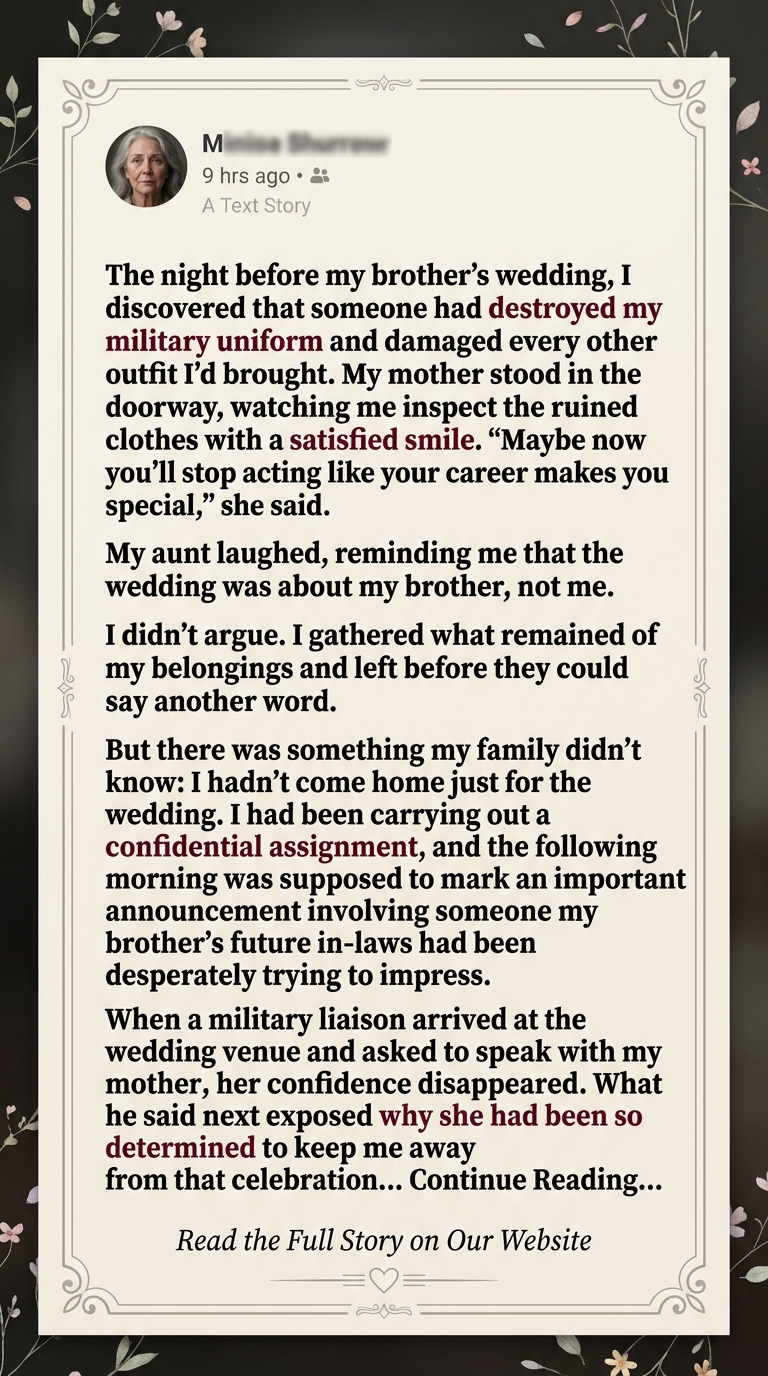
My navy dress had been cut across the front. The black suit was soaked with something that had left pale stains along the sleeves. One of my shirts had been torn at the collar, and the garment bag containing my military uniform was lying beside the wardrobe.
I opened it.
The jacket was ruined. Someone had poured a cleaning solution over the fabric, leaving discolored patches across the chest and shoulders. The trousers had been cut near the knees, and one sleeve had been sliced almost completely through.
For several seconds, I simply stared.
Then I heard a laugh behind me.
My mother, Denise, stood in the doorway with her arms folded. My aunt Linda was beside her, holding a glass of wine.
“Well,” my mother said, “perhaps now you’ll stop acting like your career makes you special.”
I turned slowly.
“Did you do this?”
She raised her eyebrows.
“Don’t be ridiculous. You should have put your things somewhere safe.”
“They were in my bedroom.”
“Which is still my house.”
Aunt Linda laughed.
“Honestly, Rachel, you always bring that uniform everywhere as though everyone needs to be reminded you’re in the military.”
I looked at the damaged jacket again.
It had taken years of training, difficult assignments, and personal sacrifices to earn the right to wear it. It wasn’t just clothing. It represented a career I had built without their approval.
“Why?” I asked.
My mother shrugged.
“Tomorrow is your brother’s wedding. Nobody wants you making everything about yourself.”
“I haven’t said a word about myself.”
“Your uniform says enough.”
I looked from her to my aunt.
Neither seemed particularly ashamed.
My younger brother, Andrew, was getting married to Vanessa Cole, whose family owned several regional engineering and logistics companies. The wedding had been planned for months, and my mother had spent the last few weeks reminding everyone that it was the most important event our family had ever hosted.
She had also repeatedly asked me not to wear my uniform.
I had agreed to attend in civilian clothes.
But the uniform had been included in my luggage because I had another responsibility the following morning.
I wasn’t home merely to attend a wedding.
For the previous six months, I had been serving as the military’s senior liaison for a joint infrastructure protection initiative involving several government agencies and private contractors. The assignment had required me to review security arrangements for strategic transport facilities and coordinate with civilian companies whose operations supported military supply routes.
One of those companies was Cole Strategic Logistics, owned by Vanessa’s father, Richard Cole.
The initiative was reaching an important milestone. The following morning, a military liaison was scheduled to attend the wedding reception briefly, not to celebrate the marriage, but to deliver a formal notice concerning the selection of a contractor for a major national logistics project.
My role was confidential until the announcement.
Only a small group of officials knew that I had been leading the evaluation team.
My family certainly didn’t.
And I had no intention of telling them.
I closed the garment bag.
“Where is Andrew?” I asked.
“He’s busy,” my mother replied.
“I’d like to speak with him.”
“Don’t start anything tonight. He’s getting married tomorrow.”
I looked at the ruined clothes.
“I won’t.”
I took my phone from the dresser and photographed everything. Then I packed the few undamaged items, placed my identification and assignment documents in my handbag, and carried my luggage downstairs.
My mother followed me.
“Where do you think you’re going?”
“Somewhere else.”
“You’re leaving the night before your brother’s wedding?”
“Yes.”
She laughed.
“Fine. Maybe you’ll finally learn that the world doesn’t revolve around you.”
Aunt Linda raised her glass.
“Try not to make a scene tomorrow.”
I opened the front door.
“I won’t.”
Then I left.
I checked into a hotel near the wedding venue and contacted my commanding officer to report the destruction of my uniform. I didn’t accuse anyone or speculate about motives. I simply documented what had happened and requested guidance about the following morning’s official engagement.
My commanding officer, Colonel Hayes, was displeased.
“Do you have another service uniform available?”
“Yes, sir. It’s at the regional office. I can collect it before the ceremony.”
“Good. The announcement proceeds as scheduled. Your civilian family circumstances have no bearing on the assignment.”
“Understood.”
Before ending the call, he added something that made me pause.
“One more thing. The contractor selection committee has approved your recommendation. The formal notice will identify the selected company, but the review report will also explain why two competing bids were rejected. Make sure you’re prepared for questions.”
“I am, sir.”
I spent the rest of the evening reviewing the briefing materials.
The next morning, I collected a replacement uniform and arrived at the wedding venue shortly before the ceremony.
The hotel ballroom had been decorated with white flowers and gold table settings. Guests were gathering near the entrance, while photographers moved between the tables.
I entered through the side corridor.
My mother spotted me almost immediately.
Her expression tightened when she saw the uniform.
“What are you wearing?”
“My uniform.”
“I thought we discussed this.”
“We did.”
She stepped closer.
“You’re not supposed to wear that here.”
“I have an official responsibility this morning.”
She looked at me as though I had deliberately insulted her.
“Today is about Andrew. Can you not leave your work at home for once?”
Before I could answer, Vanessa approached.
She was wearing a beautiful ivory dress, and her father, Richard, stood beside her.
“Is everything all right?” she asked.
My mother smiled instantly.
“Of course, darling. Rachel is just being difficult.”
Vanessa glanced at my uniform.
“Oh. You’re the sister in the military.”
“I am.”
Richard extended his hand.
“Good to meet you. I’ve heard you’re involved in government work.”
“Some government projects,” I replied.
He smiled politely, but I noticed his eyes linger on my rank insignia.
“Interesting. We do quite a bit of government contracting ourselves.”
“I know.”
His smile became more cautious.
Before he could say anything else, my mother interrupted.
“Richard, you mustn’t let her distract you. Andrew has been looking forward to this day for months.”
Richard nodded and walked away with Vanessa.
My mother leaned toward me.
“Go change. You’re embarrassing us.”
“I won’t be changing.”
Her smile vanished.
“You have no idea how much we’ve done to make this wedding perfect.”
I looked at her.
“I didn’t ask you to do anything for me.”
She stepped closer.
“Then don’t ruin it.”
I moved past her and took my assigned seat near the rear of the ballroom.
The ceremony began shortly afterward.
Andrew looked happy. When Vanessa walked toward him, he smiled in a way I hadn’t seen since we were children.
For his sake, I tried to put the previous evening aside.
But during the reception, I noticed something unusual.
Richard Cole was speaking privately with two men near the entrance to the ballroom. One of them was a senior executive from his company. The other was a consultant whose name appeared in the procurement records I had reviewed.
When Richard noticed me watching, he stopped talking.
A few minutes later, my mother approached my table.
“Richard wants to speak with you.”
I looked up.
“Why?”
“He’s interested in your work. I told him you might be able to help with a few introductions.”
“I can’t discuss my assignment.”
Her expression changed.
“Don’t be rude. This is your brother’s new family.”
“That doesn’t change what I’m allowed to discuss.”
She leaned closer.
“Do you understand how important the Coles are? Their company is about to receive a major government contract. Your father and I have worked hard to make this marriage beneficial for Andrew.”
I stared at her.
“What did you just say?”
She seemed to realize she had revealed more than she intended.
“Nothing. Just go and congratulate Richard.”
I stood.
“Is that why you destroyed my uniform?”
Her face hardened.
“Lower your voice.”
“Did you want to make sure I couldn’t attend in it?”
“I told you the wedding wasn’t about you.”
“That isn’t an answer.”
She glanced toward the nearby tables.
“Not everything needs to become a military investigation, Rachel.”
I didn’t respond.
Instead, I walked toward the side corridor and waited for the official liaison team.
At 11:40 a.m., a black government vehicle pulled up outside the hotel.
Colonel Hayes entered with two officials carrying document cases. A military security officer followed them.
The event coordinator approached immediately.
“May I help you?”
“We’re here to meet Captain Rachel Morgan,” Colonel Hayes replied.
The coordinator looked toward the ballroom.
“Of course. I’ll find her.”
My mother, who had been standing near the entrance, heard the exchange.
She turned sharply.
“Captain Morgan?”
Colonel Hayes looked at her.
“Yes. We’re expected.”
My mother glanced at me.
“Why are they asking for you?”
I walked toward the group.
“Good morning, sir.”
Colonel Hayes returned my greeting.
“Captain. Are you ready?”
“Yes, sir.”
He turned toward the event coordinator.
“We need a quiet room for the official briefing. We also need Mr. Richard Cole present.”
Richard had heard his name.
He approached quickly, adjusting his jacket.
“Colonel Hayes. I’m Richard Cole. What can I do for you?”
Colonel Hayes shook his hand.
“We’re here to deliver the formal procurement notice and discuss the outcome of the evaluation.”
Richard’s expression brightened.
“Excellent. I assume this concerns the national transport security contract.”
“It does.”
My mother stepped closer.
“Is Rachel involved in this?”
Colonel Hayes looked at her briefly.
“Captain Morgan chaired the technical evaluation team.”
The room seemed to go quiet around us.
Richard looked at me.
“You chaired the evaluation?”
“I led the assessment under the authority of the joint review board.”
He blinked.
My mother stared at Colonel Hayes.
“But she’s just—”
She stopped.
Colonel Hayes continued.
“Captain Morgan has been responsible for coordinating the security requirements, reviewing operational readiness, and assessing the technical compliance of the competing proposals. Her recommendation was approved yesterday.”
Richard’s face changed.
He knew what that meant.
His company had submitted one of the bids.
“Which company was selected?” he asked.
Colonel Hayes opened the document case.
“Northbridge Infrastructure has been selected as the preferred contractor, subject to the final administrative conditions outlined in this notice.”
Richard’s smile disappeared.
“But we were told our proposal was the strongest.”
“Your proposal did not meet several mandatory security requirements.”
“Which requirements?”
Colonel Hayes handed him the notice.
“The evaluation report identifies them. The main issues concern subcontractor disclosure, access-control procedures, and the handling of restricted operational data.”
Richard began reading.
His executive stepped closer and looked over his shoulder.
“This can’t be right,” he muttered.
Colonel Hayes remained calm.
“The decision was made by the full review board. Captain Morgan’s recommendation was supported by the technical and security assessments.”
Richard looked at me.
“Could we discuss this privately?”
“No,” I said. “Any questions about the procurement decision must go through the official review process.”
He lowered his voice.
“Your family is connected to ours now. Surely there’s room for a conversation.”
I held his gaze.
“That relationship has no bearing on the evaluation.”
My mother stepped between us.
“Richard, perhaps we should take this somewhere else.”
Colonel Hayes closed the document case.
“There’s one more matter.”
He handed Richard a separate notice.
“Because your company submitted incomplete subcontractor disclosures, the review board has referred the relevant documentation for an independent compliance examination. This is a standard process when discrepancies are identified. It does not mean wrongdoing has been established, but the board requires clarification before any future participation in the program.”
Richard’s face tightened.
My mother looked from him to me.
“What does this mean?”
Richard didn’t answer.
Colonel Hayes did.
“It means the company will have an opportunity to respond through the proper channels.”
Then he turned to me.
“Captain, we should proceed to the briefing room.”
I nodded.
As we walked away, I heard my mother call my name.
“Rachel!”
I stopped.
She approached, her face flushed.
“How could you do this to us?”
I looked at her.
“I didn’t do anything to your family.”
“You knew Richard’s company was involved. You could have warned us.”
“I wasn’t permitted to disclose the evaluation or its outcome before the official notice.”
“But you knew this would happen!”
“I knew the company had failed to meet certain requirements. I did not decide the outcome alone, and I had no authority to change the rules for anyone.”
She lowered her voice.
“You could have helped your brother.”
I looked toward Andrew, who had come out of the ballroom after hearing the commotion.
He was standing beside Vanessa, confused.
“Help him how?” I asked. “By hiding a procurement failure? By changing an official recommendation? By risking my career so your new relatives could get a contract?”
My mother looked away.
Andrew approached.
“Mom, what’s going on?”
She immediately began speaking.
“Your sister has embarrassed us. She’s using her position to interfere with Vanessa’s family business.”
I turned toward him.
“That’s not what happened.”
Richard stepped forward.
“Your sister was involved in the evaluation of our proposal. Her team rejected it.”
Andrew looked at me.
“Is that true?”
“Yes. The review board rejected the proposal because it failed mandatory requirements. I had no personal authority to award or withdraw the contract.”
Vanessa looked at her father.
“Why didn’t you tell me the bid was in trouble?”
Richard’s expression hardened.
“Not now.”
But Andrew was looking at my mother.
“Why did you say Rachel was trying to embarrass us?”
My mother hesitated.
“Because she arrived wearing that uniform after I specifically asked her not to.”
Andrew’s eyes moved to me.
“Why did you wear it?”
I took a breath.
“Because I had an official assignment. And because someone destroyed the uniform I had brought from home.”
Andrew frowned.
“What?”
I looked at my mother.
“Last night, my uniform and the rest of my clothes were deliberately damaged. I asked whether she had done it. She didn’t deny it.”
Andrew turned toward her.
“Mom?”
She folded her arms.
“I didn’t want her turning your wedding into a military display.”
“Did you ruin her uniform?”
“She always makes everything about herself!”
Andrew looked stunned.
Vanessa’s father cleared his throat.
“This is a family matter. We should not discuss it here.”
I turned to him.
“It became my matter when your company asked for access to a government contract through a family connection.”
Richard said nothing.
Andrew looked at me again.
“Why didn’t you tell me you were working on the project?”
“Because the assignment was confidential. And because I didn’t come here to discuss work.”
He glanced at my uniform.
“I didn’t know.”
“I know.”
For a moment, he looked like the little boy who used to wait for me at the school gate whenever I returned from training.
Then he looked at our mother.
“Did you really destroy her clothes because you thought she would take attention away from my wedding?”
My mother didn’t answer.
Andrew’s voice grew quieter.
“She came here to attend my wedding. You made her leave.”
I looked at my brother.
“I didn’t leave because I wanted to hurt you. I left because I wasn’t going to stand there while someone treated my work and my belongings like garbage.”
Andrew nodded slowly.
“I’m sorry.”
I wanted to tell him that it wasn’t his fault, but I also wanted him to understand that silence had consequences.
“You don’t have to apologize for what you didn’t do,” I said. “But don’t pretend you didn’t see how she treated me before this.”
He lowered his eyes.
Vanessa moved closer to him.
“Andrew, we should talk privately.”
He shook his head.
“Not now.”
Colonel Hayes was waiting near the corridor. I knew I had already taken more time than the briefing schedule allowed.
I turned to Andrew.
“Congratulations on your wedding. I hope you have a good life together.”
He looked as though he wanted to say more, but I followed the colonel into the meeting room.
The official briefing lasted forty minutes.
The procurement decision was confirmed, the compliance referral was documented, and the next steps were assigned to the appropriate officials. I answered technical questions and signed the required acknowledgment forms.
Nothing about the wedding changed the decision.
When I returned to the ballroom, the reception was continuing, but the atmosphere had shifted.
Richard and his executive had left to contact their legal department. Vanessa was speaking with her mother, and Andrew stood near the windows, watching the guests.
My mother approached me one final time.
“You’re satisfied now?”
I looked at her.
“No.”
She seemed surprised.
“You got what you wanted. Everyone knows you’re important.”
“That’s not what I wanted.”
“Then what did you want?”
I thought about the uniform hanging in a hotel room, the years of work behind it, and the fact that my own mother had tried to destroy something she couldn’t understand.
“I wanted to attend my brother’s wedding without being treated as a threat.”
She looked away.
“You’ve always thought you were better than us.”
I shook my head.
“I’ve never thought that. But I won’t make myself smaller just to make you comfortable.”
She said nothing.
I left before the reception ended.
Several weeks later, the independent compliance examination found that Cole Strategic Logistics had failed to disclose a subcontractor with access to restricted operational information. The company was required to correct its procedures before it could participate in future procurement rounds. The review found no basis to accuse Richard personally of criminal conduct, but the company lost the opportunity to compete for the project until its compliance arrangements were repaired.
My role in the process was reviewed independently because of the family connection. The review confirmed that I had disclosed the potential conflict as soon as I became aware of the marriage, that I had not shared confidential information, and that the evaluation had been conducted according to the established rules.
I remained in my position.
Andrew called me two months after the wedding.
He apologized for not defending me sooner and admitted that he had known our mother disliked my military career but had never understood how far she was willing to go.
We spoke for nearly an hour.
He told me that Vanessa was upset about the contract decision, but their marriage was not ending because of it. They had agreed to keep her family’s business separate from their personal relationship.
I told him I hoped they would succeed.
My mother never apologized for the destroyed uniform. Instead, she told relatives that I had used my military position to humiliate her and embarrass the new family.
I stopped trying to correct every version of the story.
The people who mattered knew what had happened.
A year later, I received a replacement uniform with a small service commendation attached to the paperwork. It recognized my work on the infrastructure protection initiative, not the family drama that had surrounded the announcement.
I hung it carefully in my wardrobe.
For a long time, I had believed that earning my family’s respect would make the sacrifices of my career feel worthwhile.
I finally understood that those were two separate things.
My uniform had not made me special, and I had never needed it to.
It simply represented the person I had become through years of discipline, responsibility, and service.
My mother had tried to destroy the fabric because she couldn’t control what it represented.
She had failed.
And the most important announcement that morning had not been about a government contract at all.
It was the quiet decision I made when I walked out of that wedding venue: I would no longer sacrifice my dignity to earn a place in a family that only welcomed me when I made myself smaller.