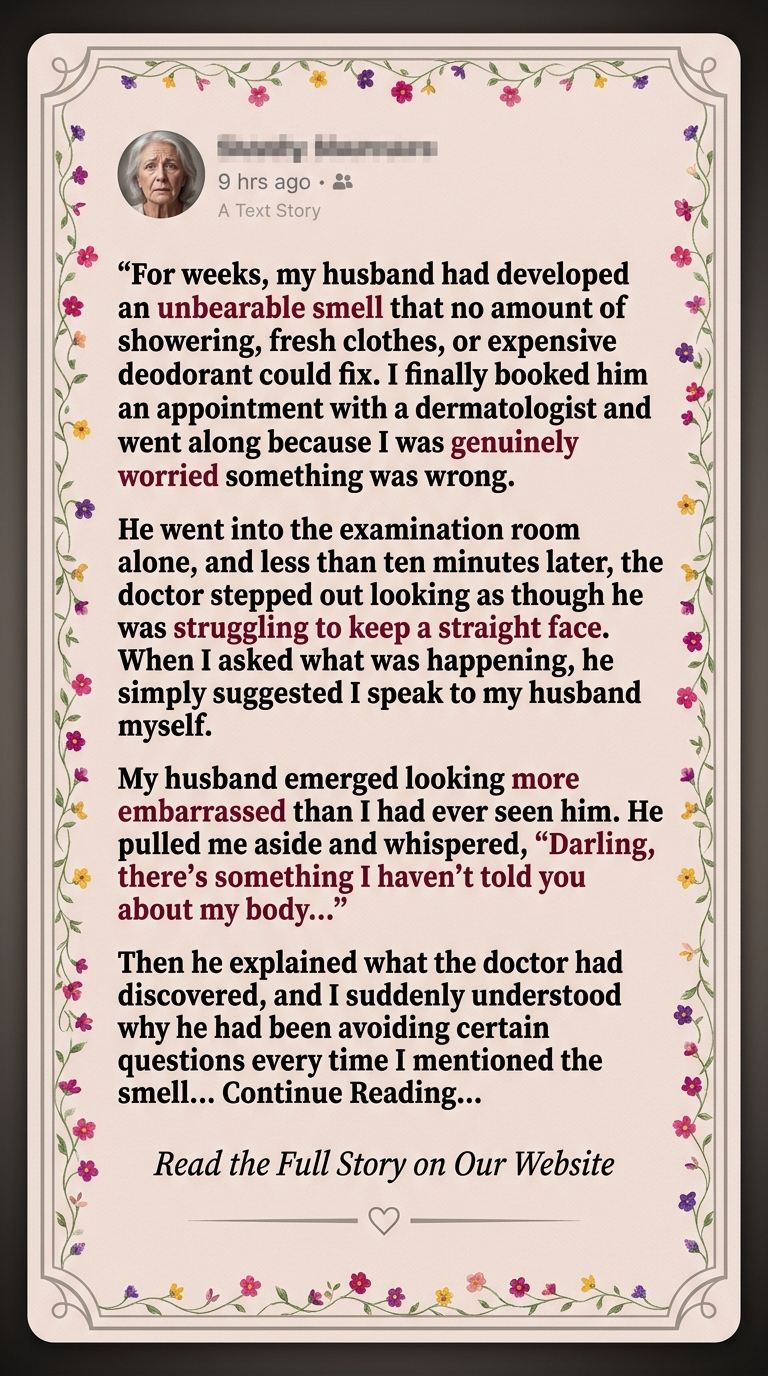
For nearly two months, my husband had smelled like something was rotting beneath his skin.
At first, I thought it was his work clothes. Daniel managed a warehouse, and his days involved loading equipment, checking deliveries, and dealing with machinery that rarely stayed clean. I assumed the smell was coming home with him.
I washed his clothes separately, changed our laundry detergent, and even bought a new washing machine after wondering whether the old one had developed a problem.
Nothing helped.
The smell was strongest around his neck and upper chest. Sometimes it resembled sour milk. Other times, it reminded me of damp fabric left in a sealed bag for days.
Daniel showered twice a day, changed his shirts frequently, and tried every deodorant I bought. He even started using a scented body spray so heavily that our bedroom smelled like a perfume shop.
But underneath the fragrance, the odor remained.
I became worried.
“Daniel, something isn’t right,” I told him one evening.
He was standing in front of the bathroom mirror, examining his neck.
“Maybe it’s stress,” he said.
“Stress doesn’t usually make someone smell like this.”
He turned toward me.
“That’s a lovely way to talk to your husband.”
I immediately regretted the wording.
“I’m not trying to insult you. I’m worried.”
He looked away and rubbed the back of his neck.
“I’ll figure it out.”
But he didn’t.
Over the following weeks, he became increasingly defensive whenever I mentioned the smell. He stopped sitting close to me on the sofa and began sleeping with his back turned. When I tried to hug him, he sometimes stepped away, pretending he needed something from another room.
I wondered whether he was depressed or hiding an illness.
One morning, I found him scrubbing the skin beneath his collarbone with a rough washcloth.
“Please stop,” I said. “You’re going to hurt yourself.”
He dropped the cloth into the sink.
“I’m fine.”
“You’re not fine. You’ve been doing this every morning.”
He stared at the mirror.
“Just leave it alone, Emma.”
That was when I decided I was booking an appointment.
Daniel protested when I told him I had scheduled a visit with a dermatologist.
“It’s probably nothing.”
“Then we’ll find out it’s nothing.”
“I don’t need you coming with me.”
“I’d like to come. I’m worried about you.”
He sighed, but eventually agreed.
The appointment was on a Thursday afternoon with Dr. Helen Morris, a dermatologist at a private clinic near our home.
The waiting room was quiet. Daniel sat beside me, repeatedly checking his phone. When the nurse called his name, he stood and followed her into the examination room.
I expected to be invited inside, but the nurse explained that the doctor wanted to examine him privately first.
I stayed in the waiting area.
Less than ten minutes later, the examination-room door opened.
Dr. Morris stepped into the hallway. She looked toward the reception desk, then noticed me. Her expression was unusual. She seemed to be trying very hard to maintain a professional face.
“Mrs. Carter?” she asked.
“Yes. Is everything all right?”
She hesitated.
“I think your husband would prefer to explain the findings himself. There’s nothing suggesting an immediate emergency, but we should discuss the diagnosis and treatment together.”
Her unusual expression made me even more nervous.
“Is it serious?”
“I don’t believe so,” she said. “But I would rather not discuss his private medical details without his permission.”
She returned to the room.
A few minutes later, Daniel emerged.
His face was bright red.
He didn’t look sick. He looked as though he wished the floor would open beneath him.
“Let’s go outside,” he whispered.
I followed him into the corridor.
“What happened?”
He glanced toward the examination room.
“Darling, there’s something I haven’t told you about my body.”
My stomach tightened.
“What?”
He took a long breath.
“I have a condition called hidradenitis suppurativa.”
I had heard the name before, but I didn’t understand what it meant.
Daniel explained that he had been diagnosed several years earlier, long before we met. It was a chronic inflammatory skin condition that caused painful lumps, abscesses, and sometimes tunnels beneath the skin. It often affected areas where skin rubbed together, including the armpits, groin, and beneath the breasts.
He had developed recurring lesions in his armpits and along the folds beneath his chest.
“They were manageable for years,” he said. “I used medication when they flared up. I thought I had it under control.”
“Why didn’t you tell me?”
He swallowed.
“Because I was ashamed.”
He explained that one of the lesions had recently become infected and started draining. The fluid had collected in the folds of his skin and on his clothing, creating the persistent odor that soap and deodorant couldn’t remove.
The condition itself wasn’t caused by poor hygiene, and the smell wasn’t a sign that he wasn’t washing properly.
The doctor had also found several inflamed areas that needed treatment.
I stared at him.
“Daniel, why would you hide something like that from me?”
He looked down.
“Because I didn’t want you to see me differently.”
I reached for his hand.
“I already knew something was wrong. I just didn’t know what.”
He nodded, but he still looked embarrassed.
Then he admitted something else.
The condition had affected his confidence for years. During our first year together, he had experienced a severe flare-up and had been rejected by a previous girlfriend after she saw the lesions. She had made cruel comments about his body and told him he was disgusting.
He had promised himself he would never let another woman see him that way.
When we married, he planned to tell me eventually. But every time the condition flared, he convinced himself he could manage it privately.
He had become so accustomed to hiding it that even mentioning a dermatologist felt humiliating.
I felt a mixture of sadness and frustration.
“You’ve been sleeping away from me because you were afraid I’d notice?”
“Yes.”
“And all those expensive deodorants?”
He gave a miserable little smile.
“I thought if I found something strong enough, I could make it disappear.”
I squeezed his hand.
“You don’t have to make your body disappear to be loved by me.”
For the first time that afternoon, his expression softened.
We returned to the examination room together.
Dr. Morris explained the condition more thoroughly. She showed us how inflammation could develop beneath the skin, sometimes forming painful abscesses and draining tracts. She emphasized that hidradenitis suppurativa was a chronic inflammatory disease, not an infection caused by being dirty.
Daniel’s current flare-up had become infected, so she prescribed appropriate treatment and arranged follow-up care. She also recommended a longer-term management plan because repeated flare-ups could lead to scarring and further complications.
She advised him to avoid harsh scrubbing, irritating products, and tight clothing over affected areas.
“The goal isn’t to cover up the symptoms with stronger fragrance,” she explained. “It’s to control the inflammation and treat any infection properly.”
Daniel nodded.
Then Dr. Morris looked at me.
“Support from a partner can make a significant difference. This condition can be physically painful and emotionally exhausting. Many patients delay treatment because they’re embarrassed.”
I understood then why she had looked uncomfortable when she came out to speak with me.
She hadn’t been amused by my husband’s condition.
She had recognized the shame on his face.
On the drive home, Daniel was unusually quiet.
I didn’t force him to talk.
When we reached the house, he sat in the car for a moment before opening the door.
“Are you disappointed in me?” he asked.
I turned toward him.
“I’m disappointed that you thought you had to suffer alone.”
He looked at me, and his eyes filled with tears.
“I didn’t know how to tell you.”
“You could have started with, ‘Something is wrong, and I’m embarrassed.’ I would have listened.”
He nodded.
That evening, we cleared out the harsh soaps, scented sprays, and products he had been using to hide the odor. I helped him organize his medication and wrote down the follow-up appointments.
The treatment wasn’t an overnight solution.
His inflammation took time to settle, and he needed additional medical care over the following months. There were days when he experienced pain and exhaustion, and days when he felt discouraged because the condition was chronic.
But he stopped trying to solve it with stronger deodorant.
He also stopped hiding every medical appointment from me.
One evening, several weeks later, I found him sitting on the edge of our bed, reading an information booklet from the dermatologist.
He looked up.
“Do you ever wish I’d told you sooner?”
“Of course,” I said. “We could have dealt with this together instead of spending weeks arguing about laundry.”
He laughed.
Then he became serious.
“I was afraid you’d stop finding me attractive.”
I sat beside him.
“Daniel, I married a person, not a perfectly behaving collection of skin cells.”
He smiled.
It was the first time in months that he had laughed without immediately looking uncomfortable.
A few days later, he told me he had finally contacted a dermatologist support group. He wanted to speak with people who understood the condition and could share practical ways of managing it.
I encouraged him.
He had spent years believing that keeping the diagnosis secret was the same as protecting his dignity. Now he was beginning to understand that asking for help did not make him less of a man.
The smell that had brought us to the clinic eventually disappeared as the flare-up was treated.
His condition did not vanish, and neither of us pretended it would. He still needed ongoing care, and we learned to recognize the early signs of another flare.
But something important had changed.
One morning, Daniel walked into the kitchen wearing a comfortable shirt, sat beside me, and kissed my forehead.
“Coffee?” he asked.
“Only if you make it.”
He smiled and went to the counter.
I watched him for a moment, remembering the frightened man who had stood outside the examination room, convinced that a medical condition could destroy his marriage.
The truth was much simpler.
The smell had never been the greatest problem.
The silence had.
And once my husband finally trusted me enough to tell the truth, we could face the real problem together.