The House We Chose to Leave
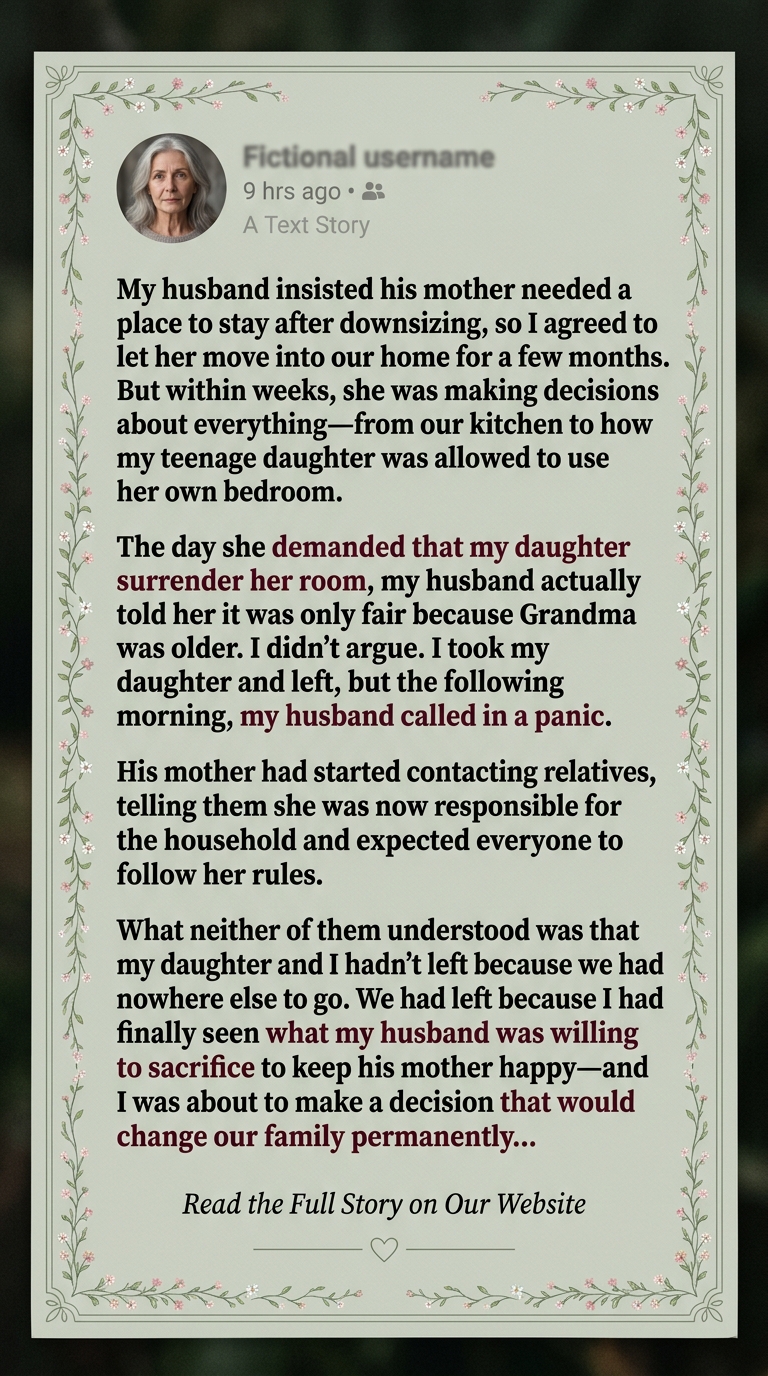
When my husband, Michael, asked whether his mother could stay with us for a few months, I didn’t hesitate to say yes.
Evelyn had recently sold the house she’d lived in for more than thirty years. She was downsizing to a smaller apartment, but the new place wouldn’t be ready until the end of the summer. Michael worried that she would feel lonely staying in a hotel, especially after losing her husband two years earlier.
“Just until September,” he promised. “She’ll have her own space, and we’ll help her settle in.”
I agreed because I loved my husband, and because I believed family should help one another when circumstances became difficult.
My daughter, Sophie, was less enthusiastic. At sixteen, she valued her privacy, her music, and the little routines that made our house feel like hers. Still, she smiled politely when Evelyn arrived with six suitcases, three boxes of kitchenware, and enough decorative cushions to fill a furniture store.
“Thank you for having me,” Evelyn said, kissing Michael’s cheek. “I promise I won’t be any trouble.”
For the first week, she kept that promise.
Then the suggestions began.
The kitchen cabinets were apparently arranged incorrectly. The living room furniture needed to be moved because the television was facing the wrong direction. Our grocery shopping was wasteful, our meals were too casual, and Sophie spent too much time in her bedroom.
I tried to be accommodating.
When Evelyn replaced my favorite blue curtains with beige ones, I said nothing. When she rearranged the pantry, I simply learned where she’d put everything. When she began preparing dinner without asking what I had planned, I reminded myself that she was adjusting to a new environment.
Michael always had the same response.
“She’s just trying to feel useful.”
But Evelyn’s desire to feel useful gradually became a desire to make decisions.
One Saturday, I returned from grocery shopping and found her standing in Sophie’s bedroom doorway. She was examining the furniture with a measuring tape.
“What are you doing?” I asked.
“Looking at the space,” she replied. “This room would be much better for me.”
I stared at her.
“Better for you?”
“Of course. It’s downstairs, close to the bathroom, and it gets lovely morning light. Sophie could move into the smaller room upstairs. She’s young. She can manage stairs.”
Sophie was sitting at her desk, headphones around her neck. Her expression had gone completely still.
“That’s my room,” she said quietly.
Evelyn smiled as if Sophie had made an amusing observation.
“Sweetheart, nobody is taking anything from you. I’m simply suggesting a more sensible arrangement.”
I put the shopping bags down.
“We aren’t changing the bedrooms.”
Evelyn’s smile disappeared.
“I thought we were all trying to make this work.”
“We are. But Sophie isn’t giving up her room.”
She walked away without another word, but I could tell she wasn’t finished.
That evening, Michael found me folding laundry.
“Mom feels unwanted,” he said.
“She wants Sophie’s bedroom.”
“She needs a comfortable place to stay.”
“So does our daughter.”
Michael rubbed his forehead.
“Can we please stop turning every little thing into an argument?”
I looked at him for a moment.
“Michael, your mother has been here for three weeks. She’s changed the kitchen, the living room, our meals, and now she wants to move our daughter out of her bedroom. At what point do you think this stops being a little thing?”
He didn’t answer.
Two days later, Evelyn made her decision for us.
I was preparing breakfast when she entered the kitchen carrying a notebook.
“I’ve worked out a better arrangement,” she announced. “I’ll take Sophie’s room, and Sophie can move upstairs this weekend. I’ve already spoken to a furniture delivery company about bringing in a proper bed for myself.”
I put down my coffee.
“You arranged furniture delivery without discussing it with us?”
“There’s no reason to make everything difficult. Michael agrees that I need a more suitable room.”
I turned toward my husband, who was standing beside the refrigerator.
“Did you agree to this?”
He looked uncomfortable.
“Mom’s getting older. The downstairs room is more practical.”
“Sophie has lived in that room since we moved here.”
“She can use the upstairs room. It’s only fair that Grandma gets the more convenient one.”
Sophie had just entered the kitchen. She stopped when she heard him.
“Only fair?” she repeated.
Michael sighed.
“Sophie, don’t make this harder than it needs to be.”
She looked at him, waiting for him to take the words back.
He didn’t.
I watched my daughter’s expression change. She wasn’t angry anymore. She looked hurt in a way that made her seem much younger than sixteen.
That was the moment I understood something I had been trying not to see.
My husband wasn’t simply struggling to manage his mother’s expectations. He had decided that keeping her happy mattered more than protecting his daughter’s sense of belonging in her own home.
I didn’t shout. I didn’t argue.
I went upstairs, packed two suitcases, and told Sophie to bring whatever she needed for a few days.
“Where are we going?” she whispered.
“Somewhere we can breathe.”
Michael followed us to the front door.
“You’re seriously leaving over a bedroom?”
I met his eyes.
“No. I’m leaving because you just told your daughter that her place in this family is less important than your mother’s comfort.”
“That’s not what I meant.”
“Then you should have said something different.”
I took Sophie to my sister Laura’s apartment. Laura had a spare room, and she welcomed us without asking for an explanation until we’d had dinner.
Later that night, Sophie sat on the edge of the guest bed.
“Did Dad really think I should move?”
I sat beside her.
“I don’t know what he thought. But I know you shouldn’t have to compete with anyone to feel safe in your own home.”
She leaned against my shoulder.
“I don’t want Grandma to hate me.”
“Her feelings aren’t your responsibility. Neither are Dad’s.”
I held her until she fell asleep.
The next morning, Michael called.
He sounded breathless.
“Where are you? You need to come home.”
“Why?”
“Because Mom has gone completely out of control.”
I waited.
“She’s been calling my aunt, my cousins, even people from church. She’s telling everyone she’s now responsible for managing the household because you’re refusing to cooperate. She says she has to establish rules before things get worse.”
I closed my eyes.
“What rules?”
“She told Aunt Linda that everyone needs to check with her before inviting guests. She also said she’ll be deciding the household budget and meal schedule. She even told my cousin that Sophie should be expected to help with the cleaning because she’s old enough.”
I looked toward the living room, where Laura was helping Sophie with her schoolwork.
“Michael, why are you telling me this?”
“Because I can’t handle her. She’s telling everyone I’m the only person who understands how difficult you and Sophie have been.”
I almost laughed, but there was nothing funny about it.
“Yesterday, you told me she needed Sophie’s bedroom because she was older. Today, you’re upset because she’s trying to run the entire house. What exactly did you think would happen?”
He went quiet.
Then he said something I hadn’t expected.
“Can you come home and talk to her? Maybe she’ll listen to you.”
That sentence told me he still didn’t understand.
I wasn’t leaving because Evelyn needed better management. I wasn’t asking for a different arrangement or a more convincing apology.
I had reached the point where I no longer trusted my husband to protect the family we had built together.
“I’ll come home,” I said.
He sounded relieved.
“Good. We can sort this out.”
“But I’m not bringing Sophie back.”
His relief vanished.
“What?”
“I’m coming to collect some things and discuss what happens next. Sophie will stay with Laura.”
He started protesting, but I ended the call.
I spent the rest of the morning making arrangements. I contacted a family lawyer, not because I wanted to punish Michael, but because I needed to understand my options. I also reviewed our finances and the ownership documents for the house.
Michael and I had purchased it together six years earlier. We both contributed to the mortgage, and both our names were on the title. There was no question that Evelyn had a right to stay there temporarily because we had invited her. But she had no authority over the property, the household finances, or our daughter’s living arrangements.
I had never imagined needing to explain that to my own family.
That afternoon, I returned to the house.
Evelyn was sitting at the dining table with her notebook. She had apparently been making a list.
Michael stood near the kitchen, looking exhausted.
“Finally,” Evelyn said when she saw me. “Perhaps now we can have a sensible conversation.”
I placed my handbag on the counter.
“I’d like to make one thing clear. You are a guest in this house. You are not responsible for managing it.”
Her face tightened.
“I’ve been trying to help.”
“Then you should have asked before making decisions that belong to Michael and me.”
She turned toward her son.
“Are you going to let her speak to me like that?”
Michael looked at me, then at his mother.
“Mom, maybe you should stop for a minute.”
Evelyn stared at him.
“Excuse me?”
“You can’t decide where Sophie sleeps. You can’t make rules for the entire household. And you shouldn’t have been calling relatives and telling them you’re in charge.”
For the first time since her arrival, I saw her lose confidence.
But she recovered quickly.
“I’ve sacrificed everything to raise you. Your father and I worked for years so you could have a good life. Is this how you repay me?”
Michael’s shoulders dropped.
There it was again. The familiar guilt that had controlled so many of his decisions.
I understood then that this wasn’t entirely about the bedroom. Evelyn had spent years teaching her son that disagreement was betrayal. Michael had learned to avoid conflict by giving her what she wanted, and he had carried that habit into our marriage.
But understanding the reason didn’t make the behavior acceptable.
“Your son can love you without surrendering his family’s choices,” I said.
Evelyn turned on me.
“You’ve been poisoning him against me.”
“No. I’ve been asking him to act like a husband and father.”
She pushed her chair back.
“Then perhaps I should leave.”
I looked at her calmly.
“That would be best.”
Michael immediately stepped forward.
“Mom, don’t go. We can work this out.”
I looked at him.
“Michael, she has a new apartment available next month. We can help arrange temporary accommodation until then. But she cannot continue living here under these conditions.”
He looked between us.
“You’re making me choose.”
“No,” I said. “Your choices are your own. I’m simply no longer willing to make mine for you.”
Evelyn gathered her notebook and went upstairs.
Michael followed her.
I stayed downstairs, listening to the muffled conversation. His voice rose once, then fell. Eventually, Evelyn came down carrying her handbag.
She stopped in front of me.
“I hope you’re satisfied.”
“I’m not satisfied. I wanted us to be a family that respected one another.”
She shook her head and walked out.
Michael drove her to a nearby serviced apartment. I stayed behind and packed the remaining things Sophie and I needed.
When he returned that evening, the house was quiet.
“She’s furious,” he said.
“I imagine she is.”
“She says you humiliated her.”
“Did you tell her why she had to leave?”
“I tried.”
“Did you tell her that she was wrong to demand our daughter’s room?”
He looked away.
“She thinks you and Sophie don’t respect her.”
“Michael, respect isn’t the same as obedience.”
He sat down at the dining table.
“I know I handled things badly.”
I wanted to believe him, but I had heard similar words before whenever his mother became upset.
“Do you understand what hurt Sophie most?” I asked.
He shook his head.
“She wasn’t upset because Grandma wanted the room. She was upset because her father agreed that she should give it up without even asking how she felt.”
Michael covered his face.
“I didn’t think she’d take it that way.”
“She’s sixteen. She may be young, but she understands exactly what happened.”
He began to cry.
I had seen my husband cry only twice in our marriage. The first time was at his father’s funeral. The second was when we lost our first pregnancy. Seeing him now brought back the man I had fallen in love with, but it didn’t erase what he had done.
“I’ll apologize to her,” he said.
“You should. But don’t expect an apology to fix everything immediately.”
That night, I stayed at Laura’s apartment.
Over the following week, Michael visited Sophie twice. The first time, he brought her favorite chocolate and apologized for making her feel unwanted. She accepted the chocolate but didn’t hug him.
The second time, he didn’t bring anything.
He simply sat with her and listened.
“I was wrong,” he told her. “Grandma’s age doesn’t make your feelings less important. I should have protected your space, and I should never have made you feel like you were being pushed out of your own home.”
Sophie looked down at her hands.
“Why didn’t you say that when she was standing there?”
Michael had no quick answer.
“Because I was afraid of upsetting her.”
“Well, you upset me instead.”
He nodded.
“I know.”
She didn’t forgive him that day, but she agreed to speak with him again.
Meanwhile, Evelyn continued calling relatives. Some believed her version of events, while others asked Michael directly what had happened. He finally stopped trying to make everyone happy.
He told them the truth: his mother had been invited to stay temporarily, had tried to take control of the household, and had demanded his daughter’s bedroom. He had supported her until he realized how much damage he was causing.
Not everyone agreed with him. His aunt accused him of abandoning his mother. He replied that helping her find suitable accommodation was not abandonment.
A few weeks later, Evelyn’s apartment became available earlier than expected. Michael helped her move her belongings and arranged for a furniture company to set up the bedroom she had chosen.
Before leaving, she asked him whether I would come to see the apartment.
He said he would ask me, but he wouldn’t pressure me.
I declined the first invitation.
I wasn’t ready to pretend nothing had happened.
Michael and I began meeting with a marriage counselor. I told him that I couldn’t continue a marriage in which his mother’s disappointment automatically became my problem or our daughter’s burden.
He listened, sometimes defensively, sometimes with genuine understanding. Over time, he began recognizing how often he had confused keeping the peace with doing the right thing.
The counselor asked him one question that stayed with him.
“If your daughter grows up and marries someone who treats her feelings the way you treated hers, what would you tell her?”
Michael had no answer.
He later told me that question had kept him awake for several nights.
After two months, Sophie agreed to return home, but only after Michael promised that her bedroom would remain hers and that no one would make decisions about her personal space without involving her.
He kept that promise.
We didn’t suddenly become a perfect family. There were difficult conversations, awkward visits, and moments when old habits resurfaced. But Michael stopped asking me to absorb his mother’s anger simply because he found it uncomfortable.
Evelyn eventually visited for lunch.
She looked around the kitchen, noticed the curtains were blue again, and said nothing.
When Sophie came downstairs, Evelyn greeted her politely.
“I hope you’re doing well at school.”
“Thank you,” Sophie replied.
It wasn’t warm, but it was civil.
After lunch, Evelyn asked whether she could speak with Sophie privately. I glanced at my daughter, allowing her to decide.
Sophie agreed, provided the door remained open.
Evelyn sat beside her on the sofa.
“I owe you an apology,” she said. “I convinced myself that because I was older, I deserved to have things arranged around me. I didn’t consider how much I was asking you to give up.”
Sophie listened.
“I also shouldn’t have made your father choose between us,” Evelyn continued. “That was unfair.”
Sophie took a moment before answering.
“I don’t mind helping you, Grandma. I just don’t want to feel like I don’t belong in my own house.”
Evelyn nodded.
“I understand.”
I couldn’t tell whether she fully understood, but I appreciated that she had finally acknowledged the harm.
After she left, Michael stood beside me at the front window.
“Do you think things can get better?” he asked.
“Maybe,” I said. “But they’ll get better because we change how we treat each other, not because we pretend nothing happened.”
He took my hand.
“I don’t want to lose you or Sophie.”
“Then don’t make us compete with someone else for our place in your life.”
He nodded.
Several months later, Evelyn settled comfortably into her apartment. She began attending a weekly gardening group and made friends in her building. She still occasionally offered unsolicited advice, but Michael learned to respond with a simple, respectful no.
And Sophie kept her bedroom.
One evening, I found her painting at her desk with music playing softly. She looked up and smiled.
“Mom, are we having Grandma over next Sunday?”
“If you want her to come.”
Sophie considered it.
“Yes. But only for lunch.”
I laughed.
“Only for lunch.”
As I closed her bedroom door, I realized that leaving had not been an attempt to destroy our family. It had been the first time I had refused to let someone else’s expectations decide what our family was allowed to look like.
Michael had finally understood that being a good son did not require him to become an absent husband or father.
And I had learned that a home is not simply a place where everyone has a room. It is a place where everyone has the right to belong.

