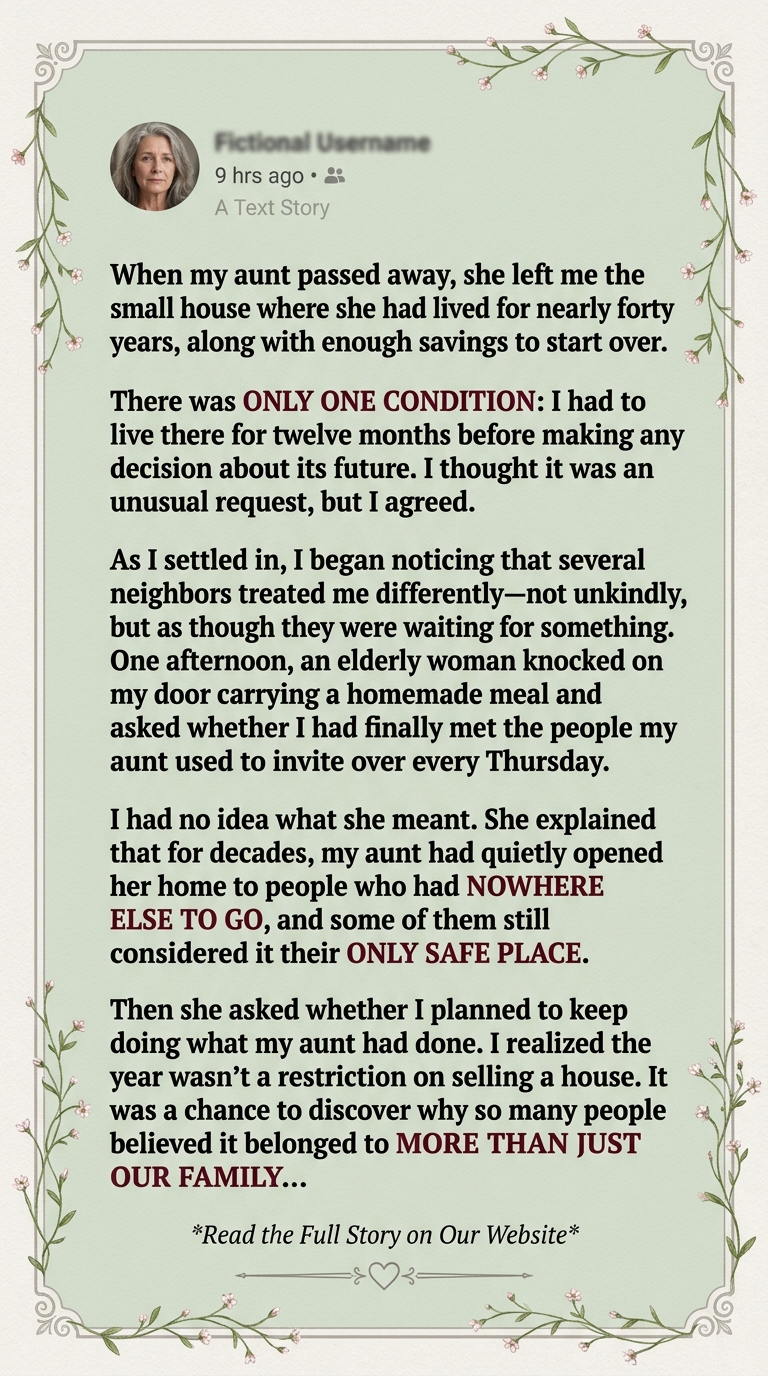
But there was one unusual condition in her will.
Before I could sell the house, rent it out, or make any permanent changes, I had to live there for twelve consecutive months.
My aunt’s solicitor, Mr. Collins, explained that the condition was legally binding under the terms of the inheritance.
“Your aunt was very specific,” he told me. “She wanted you to experience the house as a home before deciding what should happen to it.”
I laughed.
“She could have saved herself the trouble. I already know what I want. I’ll probably sell it.”
He gave me a small smile.
“She expected you might say that.”
I didn’t understand why my aunt had made such a request. Eleanor had always been private, independent, and occasionally stubborn. She had never married or had children, and although we were close, I had no idea that her house meant anything beyond being the place where she had lived for most of her adult life.
Still, I agreed to the condition.
The house was modest, with three bedrooms, a narrow kitchen, and a garden that had become overgrown during my aunt’s final months. The furniture was old but well maintained. Her books filled the shelves, and her collection of mismatched cups occupied almost every kitchen cabinet.
I spent the first week cleaning, sorting, and deciding what I wanted to keep.
Then the neighbors began visiting.
The first was a man named George who lived across the street. He brought a basket of apples from his garden and asked how I was settling in.
“Quite well,” I replied.
He nodded, then looked toward the front door.
“Are you planning to keep the Thursday evenings?”
I frowned.
“What Thursday evenings?”
He seemed surprised.
“Oh. Eleanor’s gatherings.”
I told him I knew nothing about them.
He studied my face for a moment, then nodded slowly.
“Well, perhaps someone will explain.”
A few days later, an elderly woman named Margaret knocked on my door carrying a covered dish.
She introduced herself as Eleanor’s friend and explained that she lived three houses away.
“I thought you might be hungry,” she said, handing me the meal. “Your aunt always said nobody should have to cook alone after a difficult day.”
I thanked her and invited her inside.
As she looked around the kitchen, she smiled.
“Everything still feels the same.”
Then she asked whether I had met the people Eleanor used to invite over every Thursday.
I shook my head.
Margaret sat down at the table.
“Your aunt opened this house to people who had nowhere else to go. Some were elderly. Some had lost their families. Others were simply going through periods when being alone felt unbearable.”
She explained that the gatherings had started nearly thirty years earlier.
At first, Eleanor had invited one neighbor who had recently lost her husband. Then she began inviting another woman who was caring for a sick parent and needed an evening away from the house. Eventually, the group grew.
Some people came for dinner. Others stayed for tea and conversation. A few simply sat in the living room because they wanted to hear familiar voices.
“There was never a membership list,” Margaret said. “No one had to explain why they came. Your aunt just made sure there was enough food.”
I looked at the kitchen.
“How many people?”
“Usually between six and twelve. Sometimes more.”
I was astonished.
“Why didn’t she ever tell me?”
Margaret smiled sadly.
“Because she didn’t want praise for it. She used to say that people who need kindness shouldn’t have to earn it by telling their stories.”
Before leaving, Margaret asked a question that stayed with me.
“Are you going to continue what she started?”
I didn’t know how to answer.
I had inherited a house, not a community project. I had spent years working in an office, managing deadlines and dealing with clients. The idea of feeding a dozen strangers every Thursday sounded exhausting.
“I haven’t decided,” I said.
Margaret nodded.
“That’s fair. Just remember that some of us still think of this place as our safe home.”
After she left, I found myself looking at the dining table.
It was large enough for ten people, although I had assumed my aunt simply liked having extra space.
The next Thursday, I heard a knock at the door.
A woman stood outside holding a small paper bag.
“I’m sorry,” she said. “I know Eleanor isn’t here anymore. I just wanted to see whether anyone was coming tonight.”
Her name was Ruth. She was sixty-three and had been attending the gatherings for eleven years.
She told me she had started coming after her husband died. At first, she had barely spoken. She had spent most evenings alone, eating in front of the television and avoiding invitations because she didn’t want people to pity her.
“Eleanor never asked me to explain anything,” Ruth said. “She just gave me a plate and asked whether I preferred potatoes or rice.”
I smiled.
“That sounds like her.”
Ruth looked toward the dining room.
“May I ask something?”
“Of course.”
“Are we allowed to come next week?”
I hesitated.
“I don’t know yet.”
She nodded without disappointment.
“Then I’ll wait until you decide.”
That night, I sat alone at the dining table and wondered how many people had sat in those same chairs over the years.
The following week, I began finding out.
A retired bus driver named Thomas came by to repair a loose garden gate. He explained that Eleanor had invited him to dinner after he had spent several months caring for his brother, who had dementia.
A young woman named Sophie visited with her six-year-old daughter. She had been a teenager when she first met Eleanor, and the house had become a place where she could do homework after school while her mother worked late.
Another man, Peter, told me that Eleanor had once helped him prepare for a job interview when he was recovering from homelessness.
Their stories were different, but they shared one thing.
My aunt had never treated anyone as a burden.
She remembered birthdays, food allergies, difficult anniversaries, and small details that people often forgot about one another.
She had built a place where people could arrive without pretending their lives were perfect.
I began to understand why the neighbors had looked at me with such expectation.
They weren’t waiting for an inheritance to be distributed.
They were waiting to see whether the door would remain open.
Still, I wasn’t ready to take on the responsibility.
I had my own life to rebuild. I had spent years caring for a marriage that had ended, and I wanted a period in which nobody needed anything from me.
So I told Margaret I needed time.
She accepted my answer.
But one Thursday evening, something happened that changed my mind.
It was raining heavily. I had just finished dinner when someone knocked.
A young man stood outside, soaked through, with a small backpack over one shoulder.
He looked about twenty-five.
“I’m sorry to bother you,” he said. “Is this Eleanor’s house?”
“Yes. I’m her niece.”
His face fell.
“Oh.”
“Did you know her?”
He nodded.
“My name is Daniel. I used to come here on Thursdays.”
I invited him inside.
He sat near the kitchen door, looking uncomfortable.
He explained that he had been living with his older brother after losing his job. Their relationship had become increasingly hostile, and that evening his brother had thrown his belongings outside during an argument.
Daniel had nowhere to go.
He remembered Eleanor’s house because she had once told him that if he ever found himself in trouble, he should come back.
I felt my chest tighten.
“How long ago did you last see her?”
“Almost two years. She told me she was getting weaker, but I didn’t know she had died.”
He looked down.
“I thought maybe I could sit here for a while. I don’t need money. I just didn’t want to spend the night outside.”
I brought him a towel and made him tea.
Then I called Margaret, who arrived twenty minutes later with a list of local emergency accommodation services and the number of a housing adviser she trusted.
Daniel stayed at a temporary hostel that night. Over the next few weeks, Margaret and I helped him connect with a local employment service and arrange a more stable place to live.
I didn’t solve his life.
But I realized that Eleanor’s house had never been intended to solve everyone’s problems.
It had given people a place to pause long enough to work out what came next.
The following Thursday, I put ten plates on the dining table.
Margaret arrived first, followed by George, Ruth, Thomas, and Sophie with her daughter. Daniel came too, carrying a loaf of bread from the bakery where he had recently started working.
I had prepared a large pot of vegetable stew.
The meal was simple, and the conversation was sometimes awkward. I didn’t know everyone well enough to understand all the old jokes, and I certainly couldn’t remember every name.
But nobody seemed to mind.
At one point, Ruth began telling a story about Eleanor’s terrible attempts at gardening. Everyone laughed, and for a moment, I could almost imagine my aunt sitting at the head of the table.
After dinner, nobody rushed to leave.
Some washed dishes. George fixed a loose cupboard handle. Sophie helped her daughter draw pictures at the kitchen table.
When the last guest finally departed, I stood in the doorway looking at the empty chairs.
For the first time since inheriting the house, I didn’t think about its market value.
I thought about how many evenings it had taken for people to feel comfortable enough to laugh again.
Over the following months, the Thursday gatherings became part of my routine.
I established a simple arrangement. Nobody had to contribute money, but those who could help with cooking, cleaning, or shopping were welcome to do so. People could come without explaining why, and nobody was expected to attend every week.
We also agreed that the house would not become an emergency shelter. When someone needed accommodation, professional advice, or financial assistance, we would connect them with organizations equipped to provide it.
I wanted to preserve what Eleanor had built without pretending I could do everything she had done.
Then, in the eighth month, I discovered something that made me reconsider the condition in her will.
I was clearing a cupboard in the upstairs hallway when I found an old calendar from the previous year. Every Thursday was marked with a name or a small note.
Some entries were ordinary:
Ruth — birthday.
Thomas — brother visiting.
George — bring apples.
Others were more concerning:
Daniel — interview next week.
Peter — first week sober.
Sophie — school meeting.
The notes weren’t instructions or records of favors. They were reminders to pay attention.
On the final page, my aunt had written a sentence:
Keep the door open, but never make someone feel they owe you for entering.
I sat on the floor for a long time.
Then I understood the twelve-month requirement.
My aunt hadn’t wanted to force me to keep her house. She wanted me to experience the responsibility before deciding whether I wanted it.
The year was not a test of obedience.
It was an opportunity to see what I might otherwise have sold without ever understanding.
When the twelfth month arrived, I met Mr. Collins again.
He asked whether I had made a decision.
I told him I wanted to keep the house.
He nodded, as though he had expected that answer.
“Your aunt hoped you would find your own reason,” he said.
I looked at him.
“Did she tell you about the Thursday gatherings?”
“She told me she hoped you would meet the people who had become part of her life. She also told me not to pressure you.”
I smiled.
“She knew me rather well.”
The house remained mine, and I used a portion of the savings to repair the roof, improve the heating, and make the downstairs bathroom accessible for older visitors.
I didn’t turn it into a registered charity or give it an impressive name. It remained an ordinary home with an ordinary kitchen and a table that was often too small for everyone who wanted to sit around it.
A few months later, Margaret brought a new visitor.
Her name was Elaine, a woman in her late fifties who had recently moved into the neighborhood after leaving a difficult marriage. She stood near the doorway, holding her handbag with both hands.
“Margaret said I could come,” she said nervously. “I don’t want to intrude.”
I pulled out a chair.
“There’s plenty of room.”
She sat down, and Margaret placed a bowl of stew in front of her.
Nobody asked Elaine to tell her story.
Nobody asked why she was alone.
We talked about the weather, a broken bus route, and the price of vegetables. Gradually, her shoulders relaxed.
Before she left, she thanked me.
I shook my head.
“You don’t need to thank me. Just come again if you’d like.”
After she walked away, I noticed Margaret watching me.
“Your aunt would be pleased,” she said.
I looked around the room.
For years, I had thought of inheritance as something measured in money, property, and possessions. My aunt had left me all three, but the most valuable part of what she owned had never appeared in the will.
It was the trust people placed in a simple open door.
I still had the savings. I still had the freedom to sell the house one day if my circumstances changed. But I no longer saw it as an empty property waiting for a new owner.
It was a place where people could come when life became difficult, where they could be welcomed without explanation, and where an ordinary Thursday evening could make someone feel less alone.
And every Thursday, when I set the table for dinner, I left one extra chair near the kitchen door.
Not because I knew who would need it.
But because my aunt had taught me that the most important guest was often the one nobody expected.

