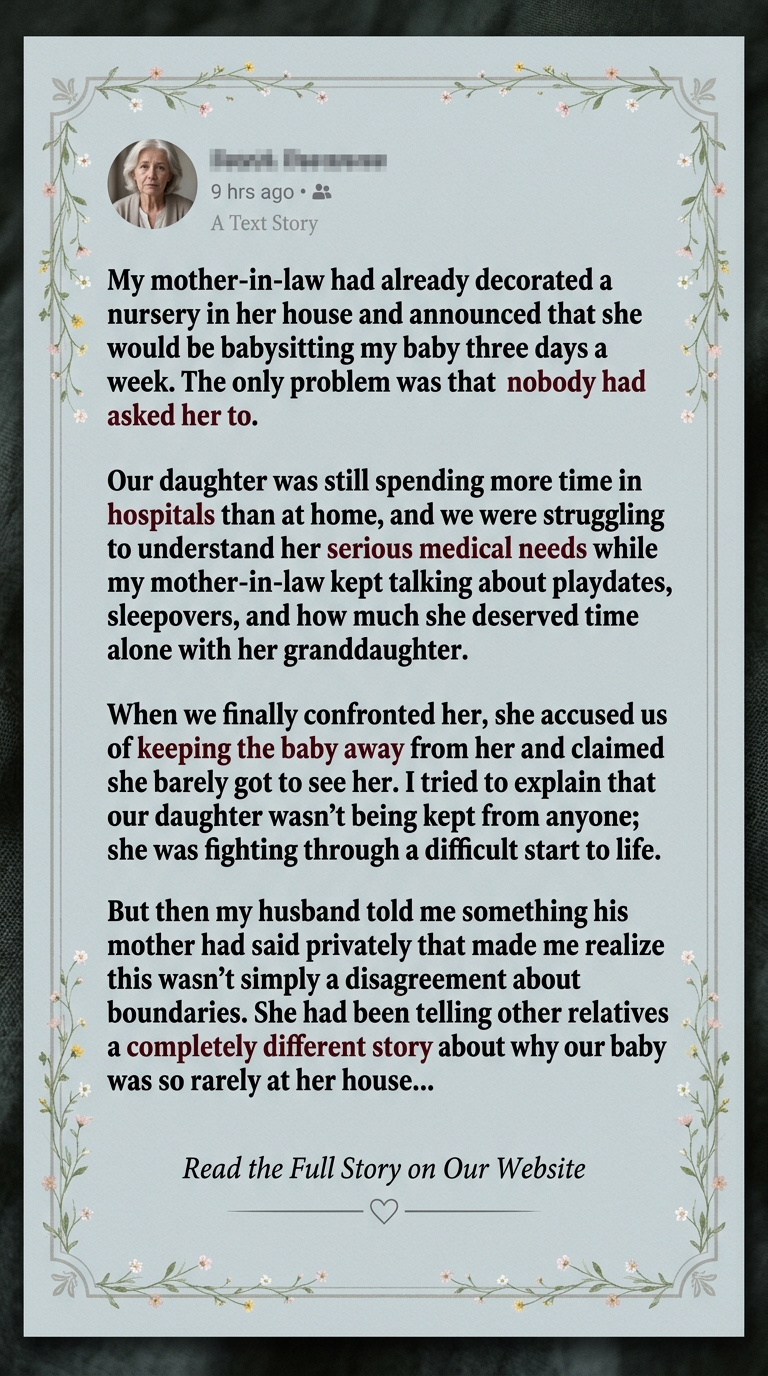
When my mother-in-law announced that she would be looking after our daughter three days a week, our baby was still too fragile to spend an ordinary afternoon away from us.
Her name was Lily, and she had been born several weeks prematurely. From the beginning, her little body had struggled with things most parents never had to think about. She needed regular monitoring, medication, and frequent hospital appointments. Some days, we celebrated something as simple as her finishing a bottle without becoming exhausted.
My husband, Daniel, and I were learning how to be parents under circumstances we had never imagined. We kept medication schedules on the refrigerator, recorded feeding times in a notebook, and slept lightly because even the smallest change in Lily’s breathing could send us rushing to her bedside.
We were exhausted, frightened, and completely in love with our daughter.
Daniel’s mother, Patricia, had a very different picture of what becoming a grandmother would look like.
She had imagined taking Lily shopping, arranging playdates, buying matching outfits, and having her granddaughter sleep over on weekends. She talked about these plans long before Lily was born.
At first, I thought her excitement was sweet.
Then Lily arrived, and Patricia began behaving as though her imagined grandmother experience mattered more than the reality of our daughter’s condition.
When Lily was barely three months old, Patricia invited us to her house for Sunday lunch. I was surprised when she opened the door and proudly led us upstairs.
“I’ve been busy,” she announced.
At the end of the hallway was a newly decorated nursery. The walls were pale yellow, a white crib stood beside the window, and shelves were filled with toys, blankets, and stuffed animals.
There was even a small changing station.
I looked at Daniel.
He seemed as surprised as I was.
“Isn’t it lovely?” Patricia said. “I’ve been planning it for weeks.”
“It looks beautiful,” I replied.
She smiled.
“Good. Because I’ve decided I’ll have Lily every Monday, Wednesday, and Friday. That way, you two can get some rest and get back to your normal lives.”
I thought she was joking.
But she wasn’t.
“Patricia,” Daniel said carefully, “we haven’t discussed babysitting arrangements.”
“There’s nothing to discuss. I’m her grandmother.”
I explained that Lily’s medical team had given us specific instructions about her care. She couldn’t simply be taken to another house for an entire day. Anyone looking after her would need to understand her medication schedule, feeding difficulties, and the signs that required immediate medical attention.
Patricia waved her hand.
“You’re making it sound much more complicated than it is. Babies need love, not a medical degree.”
I felt my stomach tighten.
“She needs both.”
Patricia’s smile disappeared.
“I raised two children without all this fuss. I think I know how to look after a baby.”
Daniel stepped between us.
“Mom, nobody is saying you can’t learn. But we aren’t arranging childcare right now.”
She looked offended.
“Fine. But don’t expect me to keep the nursery ready forever if you never let me use it.”
We left shortly afterward.
For the next several weeks, Patricia continued making plans. She sent photographs of baby clothes she had purchased, asked when Lily would be old enough for sleepovers, and repeatedly mentioned the three days she expected to have her granddaughter.
Whenever we explained that Lily’s health had to come first, she accused us of being overprotective.
Then her comments became more personal.
“You two are going to make her afraid of everything,” she told Daniel during a phone call.
Another time, she told me that I needed to stop treating Lily as though she were made of glass.
I tried not to argue. I knew Patricia loved her granddaughter, but love did not automatically make someone capable of caring for a medically vulnerable infant.
The situation became more difficult after Lily was readmitted to the hospital.
She had developed a respiratory infection, and because of her premature birth, the doctors wanted to monitor her closely. We spent several nights beside her hospital bed, taking turns sleeping in uncomfortable chairs.
Patricia visited once.
She arrived carrying a large pink gift bag and looked disappointed when she saw the monitors.
“Is she still attached to all that equipment?” she asked.
I looked at her.
“Yes. She’s being monitored because her breathing needs support.”
Patricia placed the gift bag on the chair.
“Well, she won’t get used to normal life if you keep her surrounded by machines.”
I was too tired to answer.
Daniel gently asked her to be quiet because Lily had finally fallen asleep.
Patricia stayed for less than twenty minutes.
Afterward, she complained that we had barely spoken to her.
When Lily came home, we followed the doctors’ instructions carefully. We limited visitors, maintained a strict hygiene routine, and avoided unnecessary outings.
Patricia considered those precautions a personal insult.
She called almost every day.
“Can I have her tomorrow?”
“Not yet, Mom.”
“What about Friday?”
“She has an appointment.”
“Then Saturday.”
“We’ll see how she’s doing.”
Eventually, she stopped asking and began announcing.
“I’m coming over at ten.”
“I’ve bought her a new outfit.”
“I’m taking her to the park when the weather improves.”
We tried to explain that visits needed to be arranged around Lily’s condition, but Patricia insisted that we were making excuses.
Then came the family gathering that changed everything.
Daniel’s older sister, Rebecca, invited us to a birthday lunch. Lily was having a relatively good week, and her pediatrician had said she could attend for a short visit if we avoided crowded indoor spaces and kept her away from anyone who was unwell.
We decided to go.
When we arrived, Patricia was already telling everyone about the nursery.
“I’ve got everything ready,” she announced. “Three days a week, just as soon as they stop being so anxious.”
I looked at Daniel.
He put his hand on my shoulder.
Patricia continued.
“I don’t know why they make it so difficult. I’m lucky if I get to see my granddaughter for an hour.”
Rebecca looked uncomfortable.
“Mom, they’ve had a lot going on.”
Patricia sighed dramatically.
“I know. Apparently, I’m not trusted.”
I took a breath.
“That’s not what this is about.”
She turned toward me.
“Then what is it about? Because I’ve offered to help from the beginning, and you’ve refused every time.”
“Our daughter has spent a significant part of her life in hospital,” I replied. “We’re not keeping her away from you. We’re following medical advice.”
Patricia shook her head.
“She isn’t sick every minute of every day.”
“No, but she needs consistent care, and we have to be careful.”
“You’re making her illness the center of everyone’s life.”
The room went quiet.
I felt tears rising, but I refused to let them fall.
“She’s our baby,” I said. “Her health is supposed to be the center of our decisions.”
Patricia rolled her eyes.
“Well, I suppose I’ll never be good enough for either of you.”
Daniel ended the conversation by taking Lily into the garden.
We stayed another half hour, then went home.
I thought the disagreement was over.
I was wrong.
That evening, Daniel received a phone call from his cousin, Melissa.
She asked whether Lily’s doctors had finally approved the weekly childcare arrangement.
Daniel looked confused.
“What arrangement?”
“The one your mother told everyone about. She said you and your wife were refusing to let her babysit because you wanted to keep Lily completely dependent on you.”
I turned toward him.
He put the call on speaker.
Melissa continued.
“She also said you were considering moving farther away and that she was afraid she would lose her relationship with the baby.”
Daniel’s expression hardened.
“Who else has she told?”
“Quite a few people. She said you were using Lily’s medical problems as an excuse to control the family. She even told Aunt Susan that you had promised her regular visits and then changed your minds.”
Daniel thanked Melissa and ended the call.
For several seconds, neither of us spoke.
Then he said, “There’s something else.”
I looked at him.
“What?”
He explained that his mother had called him privately two weeks earlier. During that conversation, she had suggested that he bring Lily to her house without telling me.
“She said you were too anxious to make a reasonable decision,” he told me. “She wanted me to let her have Lily for an afternoon so she could prove that nothing bad would happen.”
My stomach dropped.
“Did you tell her no?”
“Immediately.”
“Why didn’t you tell me?”
He looked ashamed.
“I didn’t want to upset you while Lily was in hospital. I thought Mom would eventually understand.”
I felt a mixture of anger and fear.
Patricia wasn’t simply imagining herself as a grandmother with a nursery.
She had been trying to persuade other relatives that we were unreasonable parents, while privately encouraging Daniel to go behind my back.
And she had been doing it while our daughter was still medically vulnerable.
The following morning, Daniel called his mother and asked her to come over.
Patricia arrived carrying a bag of baby clothes.
“I thought we could have a nice visit,” she said.
Daniel didn’t invite her into the living room.
“We need to talk about something.”
Her expression changed.
“What now?”
He explained that relatives had told us about the things she had been saying.
Patricia immediately became defensive.
“I was only telling people how upset I am.”
“You told them we were deliberately keeping Lily away from you.”
“Well, you are!”
“We’ve told you repeatedly that her care has to follow medical advice.”
She turned toward me.
“You’re the one making all these rules. Daniel knows I raised him perfectly well.”
Daniel shook his head.
“Mom, you asked me to bring Lily to your house without telling her mother. That’s not acceptable.”
Patricia’s face reddened.
“I was trying to help you.”
“No. You were asking me to deceive my wife.”
She looked at him as though he had betrayed her.
“I am your mother.”
“And I’m Lily’s father.”
For the first time, Daniel’s voice was firm enough to stop her.
He continued.
“You don’t get to decide that you’re entitled to three days a week with our daughter. You don’t get to tell people we’re neglecting your feelings because we follow her doctors’ instructions. And you absolutely don’t get to ask me to take her somewhere without her mother’s knowledge.”
Patricia began crying.
“I have done nothing but love that child.”
“I believe you love her,” I said. “But loving her means accepting what she needs, even when it isn’t what you imagined.”
She looked at the nursery bag in her hands.
“So I’m supposed to sit here and wait until you decide I’m allowed to be a grandmother?”
“No,” Daniel replied. “You’re supposed to be her grandmother without making every visit a fight.”
We explained that we would arrange visits when Lily was well enough and that anyone spending time caring for her would need to follow the medical instructions. If Patricia wanted to learn those routines, we would arrange a meeting with Lily’s nurse so she could understand them properly.
But there would be no unsupervised babysitting until we were confident she understood and respected the requirements.
Patricia stood silently.
Then she said something that surprised me.
“Your father would never have treated me this way.”
Daniel looked at her.
“Please don’t bring Dad into this.”
She left without taking the bag of clothes.
For the next month, she barely contacted us.
I worried that the situation would become another family argument, but Daniel refused to let relatives turn it into one. When someone repeated Patricia’s version of events, he calmly explained that Lily’s medical needs were the reason for our decisions.
He didn’t attack his mother or share private details about her behavior. He simply told the truth.
Meanwhile, Lily slowly improved.
Her hospital visits became less frequent, and her feeding became more consistent. She still needed careful monitoring, but we began to enjoy ordinary moments that had once seemed impossible.
One morning, she laughed when Daniel made a ridiculous face during breakfast.
I cried.
Not because anything terrible had happened, but because it was the first time I had heard her laugh without immediately worrying about what might happen next.
Several weeks later, Patricia called.
She asked whether she could visit.
I checked Lily’s schedule and agreed to an afternoon visit.
When she arrived, she didn’t bring a bag of toys or a list of plans. She carried a small knitted blanket she had made herself.
“Is she allowed to use this?” she asked.
I checked the care instructions and told her it was fine as long as we used it while Lily was awake and supervised.
Patricia nodded.
She sat on the sofa while Daniel placed Lily in her arms.
For a few minutes, she simply looked at her granddaughter.
Then she whispered, “Hello, little one. Grandma’s been waiting to hold you.”
Lily moved her fingers against Patricia’s hand.
Patricia began crying quietly.
I watched them from the doorway.
There was still a long way to go before I could trust Patricia with responsibility for Lily’s care. But for the first time, she wasn’t asking for control. She was simply enjoying the moment she had been given.
After the visit, she approached me in the kitchen.
“I owe you an apology,” she said.
I waited.
“I thought being a grandmother meant I should have the same freedom with Lily that I had with Daniel when he was small. I didn’t understand how frightening things have been for you.”
I appreciated the admission.
“But you also told people we were keeping her away from you,” I said.
Patricia lowered her eyes.
“I was angry, and I wanted them to understand how hurt I felt. I didn’t think about how unfair it was to you.”
“That hurt us more than you realize.”
“I know.”
She didn’t ask me to forgive her immediately, and I was grateful for that.
Over the following months, she began attending Lily’s medical education appointments with Daniel. She learned how to prepare her feeds, recognize signs of respiratory distress, and follow the instructions for medication. She asked questions instead of assuming she already knew the answers.
Eventually, we allowed her to care for Lily for short periods while we remained nearby. As her confidence and reliability grew, we gradually increased the time.
The nursery at Patricia’s house remained unused for a while.
Then, on Lily’s first birthday, Patricia showed us something she had changed.
She had removed the crib and replaced it with a comfortable chair, a low bookshelf, and a small play area.
“I realized I had decorated this room for the grandmother I wanted to be,” she said. “I forgot to think about the little girl who would actually be using it.”
Daniel smiled.
“That’s a good start, Mom.”
Patricia knelt beside Lily, who was busy examining a soft toy.
“Would you like to read a book with Grandma?”
Lily reached toward the book.
It was a small moment, but it meant more than the elaborate babysitting schedule Patricia had once announced.
That afternoon, I watched my daughter play on the rug while Daniel and his mother sat together reading a picture book.
Our family was not suddenly perfect. We still had difficult conversations, and Lily’s health continued to require attention. But the relationship had begun to change.
Patricia finally understood that being a grandmother wasn’t measured by how many days a week she had a baby in her house.
It was measured by whether she could make that baby feel safe.
And we understood something too: protecting our daughter didn’t mean keeping everyone at a distance. It meant choosing carefully who could be trusted with her care, and allowing that trust to grow through actions rather than promises.