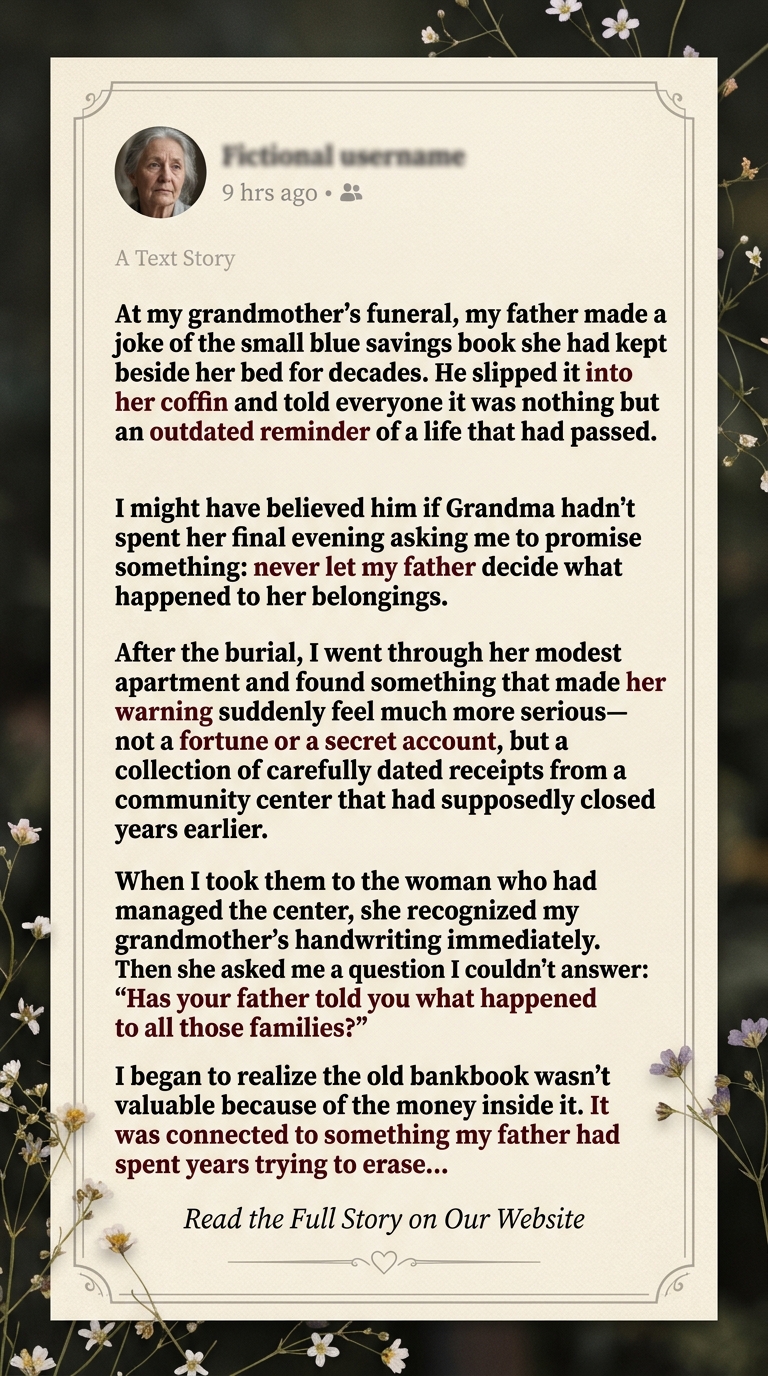
My father laughed when he placed the little blue savings book inside my grandmother’s coffin.
“Look at this,” he said, holding it up for the relatives gathered around the open casket. “She kept this thing for half her life. Probably thought she was saving the world one dollar at a time.”
A few people chuckled politely. Others looked uncomfortable, but nobody challenged him.
I stood beside the flowers, staring at the worn blue cover. The corners were soft from years of handling, and a strip of faded tape held the spine together. My grandmother, Margaret, had carried that book everywhere. Even when she stopped driving, she insisted on keeping it in the small handbag she took to the grocery store.
My father, Richard, slipped it between her folded hands.
“There,” he said. “She can take it with her.”
I wanted to reach into the coffin and take it back, but something stopped me. Not because I believed his joke was funny. Because I remembered the promise Grandma had asked me to make the night before she died.
She had been weak, barely able to lift her head from the pillow. Her fingers had closed around my wrist when I leaned closer.
“Whatever happens after I’m gone,” she whispered, “don’t let your father decide what happens to my belongings.”
I had assumed she was worried about sentimental things. My father had always been impatient with her old furniture, photographs, and boxes of keepsakes. He liked clean spaces and modern things. Grandma liked keeping everything that reminded her of someone.
But she had looked directly into my eyes when she said it.
“Promise me, Daniel.”
I promised.
Now, as I watched my father walk away from the coffin, I understood that I hadn’t taken her request seriously enough.
After the burial, my father announced that he would handle the apartment.
“There’s nothing worth keeping,” he told the family. “I’ll have someone clear it out next week.”
I reminded him that Grandma had asked me to sort through her belongings.
He frowned.
“She was confused near the end. Don’t turn this into a project.”
“I promised her.”
He gave me a tired look, as though I were a child making an unreasonable demand.
“Fine. Take a few days. But don’t expect to find anything valuable.”
Her apartment was exactly as she had left it. A knitted blanket rested over the armchair. Her reading glasses sat beside a half-finished crossword puzzle. A small calendar hung near the kitchen, with certain dates circled in red.
I started with the bedroom.
Inside the wardrobe, I found neatly folded clothes, old birthday cards, and a tin filled with buttons. In the bottom drawer, beneath several tablecloths, I discovered a stack of envelopes tied with green string.
They contained receipts.
Not ordinary grocery receipts or utility bills, but carefully dated payment slips from the Willowbrook Community Center.
I recognized the name. The center had closed when I was a child, supposedly because the building had become unsafe and the organization could no longer afford to operate.
Yet the receipts continued for years after its official closing date.
Some showed payments for heating. Others listed food deliveries, school supplies, transportation, and emergency accommodation. Each receipt carried Grandma’s signature.
There were hundreds of them.
I spread them across the kitchen table and noticed something stranger. The payments weren’t always made to the center itself. Some went to individual families. Others were recorded as reimbursements for rent, medical appointments, and children’s school expenses.
Grandma had been supporting people long after everyone believed the center had disappeared.
At the bottom of the drawer, I found a small notebook containing names and dates. Beside each name were short handwritten notes.
Two children. Father injured. Rent due Friday.
Mrs. Collins needs transport to dialysis.
The Harris family must not be sent back to the old address.
That last sentence made me pause.
Why would someone need to be protected from an address?
I gathered the receipts and notebook and took them to a woman named Evelyn Price, who had managed Willowbrook Community Center before it closed. I remembered her from childhood. She had always worn colorful scarves and spoke to everyone as if they mattered.
She was now retired, living in a small house near the river.
When she opened the door and saw the papers in my hands, her expression changed.
“Where did you get these?”
“My grandmother kept them. Her name was Margaret.”
Evelyn slowly lowered herself into a chair.
“Margaret,” she repeated. “I wondered what had happened to her.”
“You knew she was still helping people?”
Evelyn looked at the receipts for a long time.
“I knew she was helping some of them. I didn’t know she had kept everything.”
Then she asked the question I couldn’t answer.
“Has your father told you what happened to all those families?”
I shook my head.
Evelyn folded her hands.
“Your father was on the center’s board when he was younger. He handled the building contracts and helped manage the accounts. When the center closed, he told everyone the program had run out of money. He said the families had been transferred to other services.”
“Was that true?”
“Some were. Most weren’t.”
She explained that Willowbrook had been more than a building. It had provided temporary housing, meals, childcare, transportation, and assistance for families facing eviction or sudden unemployment.
When the center’s finances began to deteriorate, Margaret had discovered that several of the payments recorded as operating expenses had never reached their intended recipients.
At first, she believed it was poor bookkeeping.
Then she found out that families were being told their assistance had been canceled even though money had been allocated for them.
Evelyn said she had confronted my father, who was then the center’s financial administrator.
“He told us the records were complicated and that we should leave the accounting to him. A few weeks later, the board received a report claiming the center was insolvent. The building was sold, and the organization was dissolved.”
“Was money stolen?”
Evelyn hesitated.
“I can’t tell you that. We suspected funds had been redirected, but we never had enough documentation to prove where they went. Your grandmother wanted to challenge the closure, but your father threatened to take her to court for defamation if she repeated her accusations.”
I looked down at the notebook.
“What happened to the families?”
Evelyn’s expression hardened with sadness.
“Some found help elsewhere. Some didn’t. One family lost their apartment after being told their rent assistance had ended. A mother and her two children spent weeks moving between relatives. An elderly man stopped receiving transportation to his medical appointments. Your grandmother tried to help them herself, but she couldn’t replace an entire organization.”
I felt sick.
“Why didn’t she tell me?”
“She probably didn’t want you caught between her and your father. She also believed that one day the records might matter.”
I thought about the blue savings book in the coffin.
“Do you know why she kept that?”
Evelyn leaned forward.
“Because it wasn’t simply a savings account.”
She explained that Margaret had used the account as a personal bridge between the center’s closure and the families who still needed help. She deposited her pension money into it, then used the account to pay specific expenses for people who had lost support.
But the book also recorded deposits and withdrawals from the period when the center was still operating.
“If the bank statements still exist,” Evelyn said, “they might help establish what happened to the original funds.”
I felt a chill.
“Can we get them?”
“Not without knowing whether the account is still active and who has legal authority over it.”
I told her my father had placed the book in Grandma’s coffin.
For the first time, Evelyn looked genuinely frightened.
“Then you need to find out whether he knew what was in it.”
I returned to the apartment that afternoon and searched every drawer, cabinet, and storage box. I found no second bankbook, but I did discover an old address book with a bank branch written beside Margaret’s name.
I went there the following morning.
The manager listened carefully as I explained that my grandmother had passed away and that I was trying to locate records connected to an old community assistance account.
He couldn’t release private financial information without the proper estate documents, but he confirmed something important.
The account had never been closed.
It had been converted into a restricted estate account several years earlier, and the bank still held archived statements.
“Does anyone else have authority over it?” I asked.
He checked the records.
“Your grandmother was the sole account holder. There is no joint owner or authorized representative listed.”
That meant my father couldn’t simply take control of it.
I began the formal process to obtain the records as the person handling her estate, and I contacted a solicitor to make sure everything was done properly.
Two days later, my father called.
“Why are you asking questions at the bank?”
I froze.
“How did you hear about that?”
“Someone from the branch contacted me. They said you were asking about your grandmother’s account.”
“It’s part of her estate.”
He sighed sharply.
“Daniel, that account is old. Whatever money was in it belonged to your grandmother. There’s no reason to start digging into things that happened twenty years ago.”
“Then why are you worried?”
Silence.
Then his voice became colder.
“Because I know how these things go. Someone tells you a story, you misunderstand it, and suddenly you’re accusing your own family of something terrible.”
“I haven’t accused you of anything.”
“Good. Keep it that way.”
He hung up.
His reaction told me more than any explanation could have.
A week later, the bank released the archived statements through the estate process. I sat in the solicitor’s office with Evelyn beside me as we examined them.
The records showed that the community center had received several substantial grants during its final years. They also showed that money had been withdrawn in installments under descriptions that did not match the center’s approved programs.
Some transfers went to a property management company.
Others went to a consulting business registered under my father’s name.
The most troubling transactions occurred during the final six months before the center closed.
My grandmother had not merely suspected something. She had been recording the discrepancies.
But the receipts revealed another part of the story.
After the center shut down, Margaret began making regular deposits from her pension and withdrawals for individual families. She had spent nearly every spare dollar helping people who had been abandoned by the system.
She had kept the receipts because she wanted each person to know where the money had gone.
The solicitor advised us not to draw conclusions until the records were reviewed by an independent accountant. We also contacted the former grant administrators to determine whether the transfers had been reported properly.
Several weeks later, the accountant confirmed that substantial amounts had been moved out of the center’s accounts without adequate authorization or supporting invoices.
Some of the transfers had been used to pay legitimate outstanding expenses, but others had gone to companies connected to my father.
The findings were referred to the appropriate authorities.
My father came to my apartment that evening without calling first.
He looked older than I had ever seen him.
“You’ve made a serious mistake,” he said.
I invited him inside but left the door open.
He glanced at the papers on my table.
“Your grandmother never understood how difficult it was to keep that center running. We were drowning in expenses. I used money to cover urgent costs, and I intended to put it back.”
“Then why did you report the center as insolvent without telling the families?”
“Because there was no other option.”
“There were children who lost their homes.”
His jaw tightened.
“I didn’t make every decision perfectly.”
“You told everyone the center closed because it had no money. You never told them that some of the money went through companies connected to you.”
He looked away.
For a moment, I saw the man I had grown up with, the father who had taught me to ride a bicycle and helped me with schoolwork. I wanted him to offer an explanation that would make everything easier to understand.
Instead, he said, “Your grandmother was obsessed with keeping those people dependent on her. She never accepted that the center was finished.”
“That isn’t what the records show.”
“She should have let it go.”
I looked at him.
“She spent years helping families you told everyone had been taken care of.”
He rubbed his forehead.
“I made decisions. Some were wrong. But I wasn’t the only person involved.”
“Then tell the investigators who else was involved.”
He stared at me as if I had betrayed him.
“You’re choosing strangers over your own father.”
“No,” I said quietly. “I’m choosing the truth over pretending.”
He left without another word.
The investigation took months. It established that my father had diverted a portion of the center’s funds through companies he controlled. Some money had covered genuine expenses, but other payments had been used for personal purposes. The authorities pursued the financial misconduct, and my father eventually accepted responsibility for the offenses that could be proven.
He was ordered to repay the remaining amount and received a sentence that included community service and financial restrictions.
The money could not restore every lost home or undo the years of hardship those families had endured. But the records allowed the former grant administrators to identify several people who had never received the assistance promised to them. A separate compensation program was established for those who qualified.
Evelyn helped locate former families, while I assisted with organizing the records and contacting people whose names appeared in Grandma’s notebook.
One afternoon, an elderly woman named Mrs. Collins came to meet us.
She was the woman whose dialysis transportation Grandma had paid for.
“I thought your grandmother was simply a kind neighbor,” she said, holding my hands. “I didn’t know she was keeping track of everything.”
“She never wanted people to feel indebted to her,” I replied.
Mrs. Collins smiled sadly.
“She used to say that accepting help should never make someone feel smaller.”
That evening, I returned to Grandma’s apartment one final time.
The rooms were almost empty. The furniture had been donated, the kitchen cupboards cleaned, and the curtains taken down. Only her small calendar remained on the wall.
I removed it carefully.
On the last page, beneath the date of her final hospital visit, she had written a sentence in her familiar handwriting:
People are not forgotten simply because an office closes.
I stood there for a long time.
My father and I did not return to the relationship we had before. He sent an apology through the solicitor, but I didn’t rush to accept it. Eventually, we spoke again, though our conversations were careful and limited. He never asked me to defend what he had done, and I never promised to hide it.
The blue savings book was gone, buried with Grandma.
For months, I regretted not taking it from the coffin.
Then Evelyn told me something I hadn’t considered.
“Your grandmother knew the book might be lost,” she said. “That’s why she kept the receipts.”
I understood then that Grandma hadn’t trusted one object to carry the whole truth. She had preserved the records in several places, written down names, and made sure other people knew what had happened.
The bankbook had mattered, but it had never been the only evidence.
On the anniversary of her death, Evelyn and I gathered several former Willowbrook families in a small library room. We didn’t recreate the old center or pretend we could repair every loss. Instead, we created a modest emergency assistance fund using money recovered through the legal process and voluntary contributions from people who had once received Grandma’s help.
We named it the Margaret Fund.
At the first meeting, Mrs. Collins placed a handwritten card beside the donation box.
It read:
For the people who need help before anyone notices they’re missing.
I looked at those words and finally understood why Grandma had made me promise not to let my father decide what happened to her belongings.
She hadn’t been protecting a savings account.
She had been protecting the truth about people whose suffering had been hidden behind a locked door and an official announcement that everything was finished.
My father had once believed that closing a building meant ending its responsibilities.
My grandmother had spent the rest of her life proving otherwise.
And this time, the people she had tried so hard to protect were no longer forgotten.