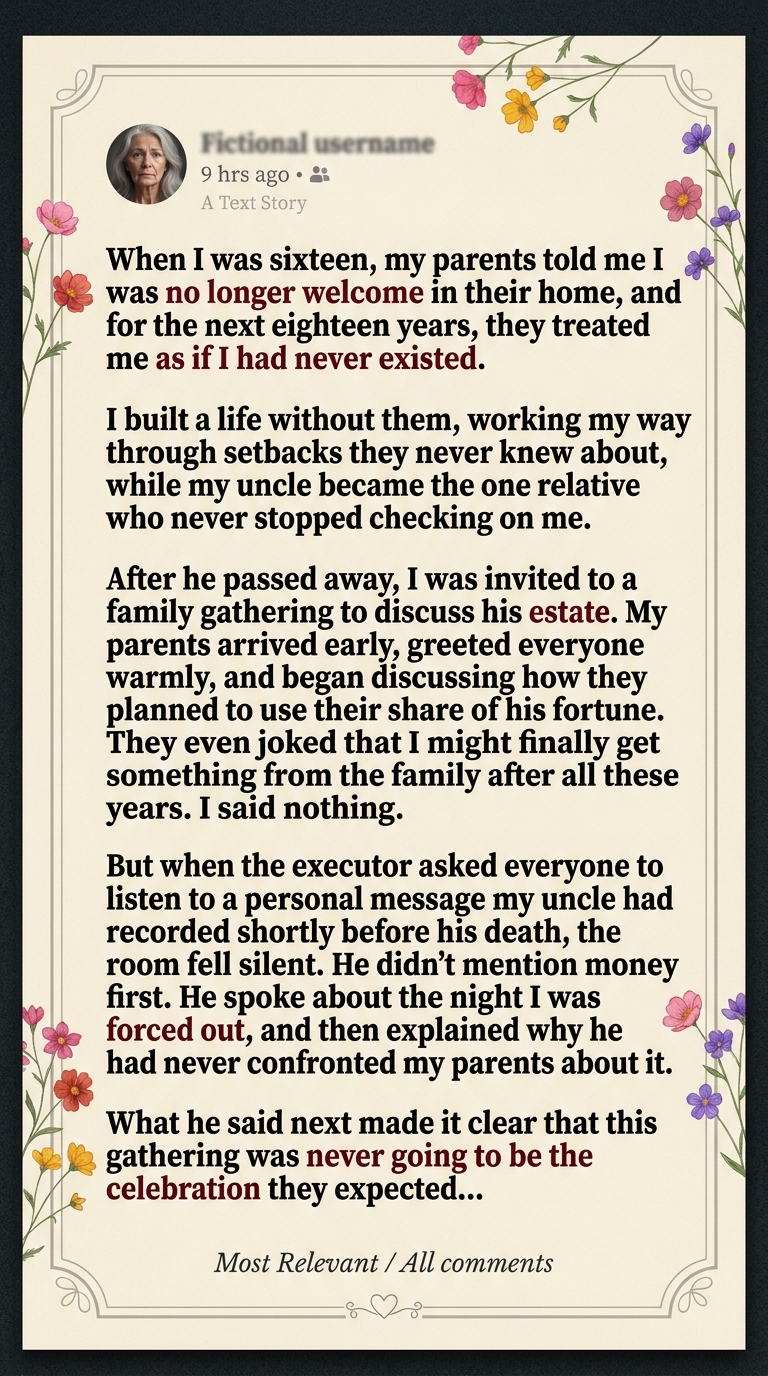
For eighteen years, my parents treated me as though I had never been born.
I was sixteen when they told me to leave. My father stood in the hallway with his arms crossed while my mother watched from the kitchen doorway. I had argued with them about a decision they had made concerning my future, and the disagreement had turned into something much bigger.
“You think you know better than everyone?” my father shouted. “Then go prove it somewhere else.”
I looked at my mother, expecting her to intervene.
Instead, she said, “Perhaps some time away will teach you to appreciate what you have.”
I packed a backpack with a few clothes, my schoolbooks, and the little money I had saved from weekend work. My father put the bag outside before I had finished packing.
I waited on the pavement for almost an hour, hoping my mother would come out and tell me to return.
She never did.
A school friend’s family let me stay with them temporarily. Later, a counselor helped me find a supervised youth residence where I could finish school. I worked evenings, applied for scholarships, and learned to manage responsibilities most teenagers never had to consider.
There were days when I wondered whether my parents would call.
My birthday passed. Then Christmas. Then graduation.
Nothing.
When I started university, I sent my mother one message with my new address. It came back unanswered. Eventually, I stopped trying.
The one person who refused to disappear from my life was my mother’s older brother, Uncle Raymond.
He had been away on business when I was forced out. When he returned and learned what had happened, he called me immediately.
“Where are you staying?” he asked.
I told him.
“Are you safe?”
“Yes.”
“Are you eating properly?”
I laughed despite myself. “I’m managing.”
He was silent for a moment.
“Managing isn’t the same as being all right. Let me help where I can.”
He offered to let me live with him, but I had already started settling into a stable arrangement. Rather than force me to change everything again, he helped with school expenses and visited whenever he could.
He never spoke badly about my parents, even when I wanted him to.
“I’m not going to tell you what to feel,” he once said. “But don’t let their decision become the measure of your worth.”
I carried those words with me.
Over the next eighteen years, I built a life that had very little to do with the family I had lost. I completed university, found work in commercial property management, and eventually became a regional operations director for a property development company.
My career was not effortless. I lost a job during a company restructuring, spent months searching for another position, and once had to move into a smaller apartment after a financial setback. But I learned to recover without waiting for someone to rescue me.
Uncle Raymond remained part of every important milestone.
He attended my graduation, celebrated my first promotion, and once drove several hours through a storm because I had called him after a difficult day.
He never asked me to repay his kindness.
Whenever I thanked him, he gave the same answer.
“You don’t owe me for being family.”
Then, when I was thirty-four, he became seriously ill.
His condition deteriorated over several months. I visited him regularly, helped organize his appointments, and spent many afternoons sitting beside his bed while he talked about his life.
One afternoon, he asked me whether I still spoke to my parents.
“No,” I said.
He looked toward the window.
“I thought perhaps things might have changed.”
“They haven’t.”
He nodded slowly.
“I wish I had handled some things differently.”
I turned toward him.
“What do you mean?”
He shook his head.
“Not today. There’s something I need to arrange first.”
I assumed he was talking about his medical care or his estate. I didn’t press him.
He died several weeks later.
His funeral was attended by relatives, former colleagues, neighbors, and people whose lives he had quietly helped over the years. My parents attended too.
My mother approached me afterward, but she didn’t say she was sorry. She asked whether I had been given the details of the estate meeting.
That was the first conversation we had in eighteen years.
I told her I had received the invitation.
She nodded and walked away.
The meeting was scheduled for six weeks later at the offices of Raymond’s solicitor, a man named Peter Lawson who had handled my uncle’s affairs for more than twenty years.
I arrived early and found several relatives already seated.
My parents were there, looking unusually relaxed.
My father wore a new suit. My mother had brought a handbag that probably cost more than my first month’s rent when I was sixteen.
They were talking with two cousins about the estate.
“I understand Raymond did very well with his investments,” my father said. “There should be a substantial amount to divide.”
My mother smiled.
“We’ve already discussed what we might do with our share. The house needs renovating, and we’d like to travel.”
One cousin glanced at me.
“And what about you? Have you spoken to your parents yet?”
My mother answered before I could.
“Oh, we’ve hardly seen her in years. Perhaps she’ll finally receive something from the family.”
My father chuckled.
“Let’s hope she doesn’t expect too much.”
I took a seat without responding.
I wasn’t there because I expected money. I had my own income, my own home, and a career I had built independently.
I was there because Uncle Raymond had been the closest thing to a parent I had known for most of my adult life.
Peter entered the room carrying several folders.
“Thank you for coming,” he said. “Before we discuss the distribution of the estate, Mr. Raymond specifically requested that I play a personal recording he made shortly before his death.”
My father shifted impatiently.
“Can’t we handle the legal matters first?”
“No,” Peter replied. “Your brother-in-law made this request a formal condition of the meeting.”
He placed a laptop on the table.
The screen showed Uncle Raymond sitting in his study. He looked tired, but his voice was steady.
“If you’re watching this, I am no longer here to explain my decisions in person. I hope you’ll listen carefully, especially those of you who believe you already know what happened in this family.”
My mother’s expression changed.
Raymond began by explaining that he had known about the night I was forced to leave home almost immediately.
He had returned from a business trip, discovered what had happened, and contacted my parents.
He had offered to take me into his home.
My father refused.
“He told me she needed discipline, not rescue,” Raymond said in the recording. “He believed that taking her in would undermine his authority.”
My father looked down at the table.
Raymond continued.
“I was angry. I wanted to go to their house and demand that they bring her back. But I made a different decision. I had spoken to my niece, and she was frightened that any confrontation would make her situation worse. She wanted stability, not another battle between adults.”
He paused.
“So I helped her quietly. I paid for things she needed, stayed involved in her education, and made sure she had someone to call when life became difficult.”
I felt tears gathering in my eyes.
My mother whispered, “He never told us he was doing all that.”
The recording continued.
“There is something else I want everyone to understand. I never confronted her parents publicly because I believed that a public argument would give them another opportunity to blame the child. I did not want her to become the subject of a family dispute in which everyone discussed her as though she were a problem to be solved.”
My father leaned back.
For the first time, he looked uncomfortable.
Raymond then explained that he had spent years watching the family repeat the same version of events.
He had heard my parents describe me as rebellious, ungrateful, and determined to leave.
He had heard relatives say I had chosen independence.
But he knew the difference between a teenager choosing to move out and a child being told there was no place for her at home.
“I have never asked her to forgive them,” he said. “Forgiveness is not an inheritance that relatives can demand on someone else’s behalf.”
He looked directly into the camera.
“I want my niece to know that I believed her. I believed her when she was sixteen, and I believe her now.”
I covered my mouth.
Then came the part nobody in the room expected.
Raymond explained that several years after I left, my father had approached him privately.
He had asked for a substantial loan to rescue a business venture that was struggling. Raymond had refused to provide the money without a proper financial review.
During that review, he discovered that my father had been using funds from a small company Raymond had helped establish years earlier.
The company had been created to manage a commercial property inherited by Raymond and my grandfather. My father had been given responsibility for its day-to-day administration, but he did not own it.
Raymond discovered that my father had transferred money from the company to cover personal expenses and losses from his struggling business.
Rather than immediately accusing him of theft, Raymond brought in an independent accountant.
The review revealed that the transfers had continued for years.
Raymond confronted my father and demanded repayment.
My father promised to correct the accounts, but instead he asked Raymond to keep the matter within the family.
“I did not want to destroy his reputation,” Raymond explained. “But I also refused to pretend that the money belonged to him.”
The recording revealed that my father had eventually repaid the amount through a structured settlement and the sale of assets he personally owned.
The matter had been resolved years earlier, and the company had remained financially sound.
But Raymond had learned something important.
My father believed that being a family member entitled him to control resources that were not his.
That belief had influenced more than his business decisions.
It had also shaped how he treated the people around him.
My father stood abruptly.
“This is ridiculous. He settled that matter with me years ago.”
Peter paused the recording.
“Mr. Raymond anticipated that you might object. The accounting records and settlement documents are available for review. They are not part of a new allegation. They explain why he made certain decisions regarding the estate.”
My father sat down again.
My mother looked between us.
“What decisions?”
Peter opened the first folder.
Raymond’s estate was divided into three principal parts.
His personal savings and investment portfolio were to be divided among several relatives, including my parents and me.
The commercial property company, however, would remain under an independent family trust. My uncle had arranged for me to receive a controlling beneficial interest, subject to professional management and restrictions designed to protect the property and its tenants.
My parents would receive a fixed financial distribution, but they would have no authority over the company or its assets.
My father stared at the documents.
“Why would he give her control?”
Peter answered calmly.
“Because Mr. Raymond believed she had the professional experience and judgment to manage it responsibly. He also wanted the business protected from informal family arrangements.”
My mother looked at me.
“You knew about this?”
“No.”
“Did he tell you?”
“Never.”
Peter continued explaining the trust.
The property included several commercial units and a warehouse leased to small businesses. It generated stable income, but it required careful management. Raymond had instructed the trustees to appoint me as managing director if I accepted the position and passed the required professional review.
The trust would retain independent oversight, and I would be accountable for the company’s performance.
It wasn’t an unrestricted fortune.
It was a responsibility.
My father shook his head.
“She doesn’t even know how the company operates.”
Peter opened another folder.
“Her professional qualifications and employment history were reviewed by an independent panel. The panel recommended her appointment.”
I looked at the documents.
My uncle had not simply given me a share of his wealth. He had created a path for me to use the skills I had spent eighteen years developing.
Then Peter placed a final document on the table.
It was a letter addressed to my parents.
Raymond had instructed Peter to read it aloud.
“To my sister and brother-in-law,
I am not writing this to punish you. I am writing because I do not want my death to become an excuse for rewriting what happened.
You told yourselves that your daughter left because she was difficult. You repeated that story until it became easier than admitting what you had done.
I watched her build a life without the support you should have given her. I watched her work, study, struggle, and recover from setbacks. I watched her become a capable and generous adult.
You were free to contact her at any time. You chose not to.
I hope you understand that the inheritance she receives is not compensation for those eighteen years. No amount of money can replace them.
I am giving her the opportunity to manage the company because she has earned my confidence. I am giving you what I believe is fair under the circumstances, not what you might have expected from a family fortune.
Please do not use my death to demand a relationship she has not offered.
If she chooses to speak with you, let it be her decision.
Raymond.”
Nobody spoke when Peter finished.
My mother was crying quietly.
My father looked at the table, his face flushed.
After several minutes, he finally turned toward me.
“You must understand that things were different back then.”
I met his eyes.
“They were different for you. I was still sixteen.”
He opened his mouth.
“You were difficult to raise.”
“I was a child.”
My mother reached for a tissue.
“We made mistakes.”
I wanted to believe that she meant it, but I had spent too many years waiting for those words.
“What would have happened if Uncle Raymond hadn’t left me anything?” I asked.
She looked at me.
“What do you mean?”
“Would you have contacted me? Would you have invited me to lunch? Would you have asked how my life was going?”
She lowered her eyes.
My father stood again.
“This is becoming unnecessary. We came here to discuss an estate, not relive old arguments.”
Peter closed the folder.
“Then we can proceed with the remaining documents.”
My father walked out of the room.
My mother stayed behind.
She approached me slowly.
“I didn’t know how to fix things,” she said.
I looked at her.
“You could have started with a phone call.”
She nodded, crying harder.
“I know.”
I didn’t hug her, and I didn’t promise that everything would be different.
I simply told her that I needed time.
Over the following months, I completed the professional assessment and accepted the managing director position. I spent the first year reviewing contracts, improving maintenance systems, and building a more reliable management team.
The company remained independent and profitable.
I also discovered that my uncle had arranged for a portion of its annual revenue to support vocational training for young people who had left difficult home situations. It wasn’t a condition of my inheritance, but it reflected something he had believed in for years: people deserved opportunities to build lives beyond the circumstances they were born into.
I kept the program.
My parents eventually received their fixed distributions. My father never apologized for his treatment of me, and our relationship remained distant.
My mother sent occasional messages. Some were awkward attempts at conversation; others were brief updates about family members. I answered when I felt ready, but I refused to pretend we had suddenly become close.
A year after the estate meeting, I visited the commercial property on a quiet Saturday morning.
The warehouse tenants were operating normally, the maintenance team had finished a major renovation, and the small businesses in the units were preparing for the holiday season.
I stood outside the building and thought about the girl who had left home with a backpack and no idea where she would sleep.
She had spent eighteen years believing that being abandoned meant she had somehow failed to be worth keeping.
Uncle Raymond had never allowed that belief to become the truth.
He had not rescued me by confronting my parents or forcing them to change. He had done something quieter and, in the end, more lasting.
He had believed me.
He had stayed.
And when he was gone, he had made sure that the life I built without my parents would remain mine.
I no longer needed my father to admit he had been wrong. I no longer needed my mother to explain why she had stayed silent.
Their choices belonged to them.
My future belonged to me.