The Promise Mrs. Henderson Made to My Mother Before I Was Born
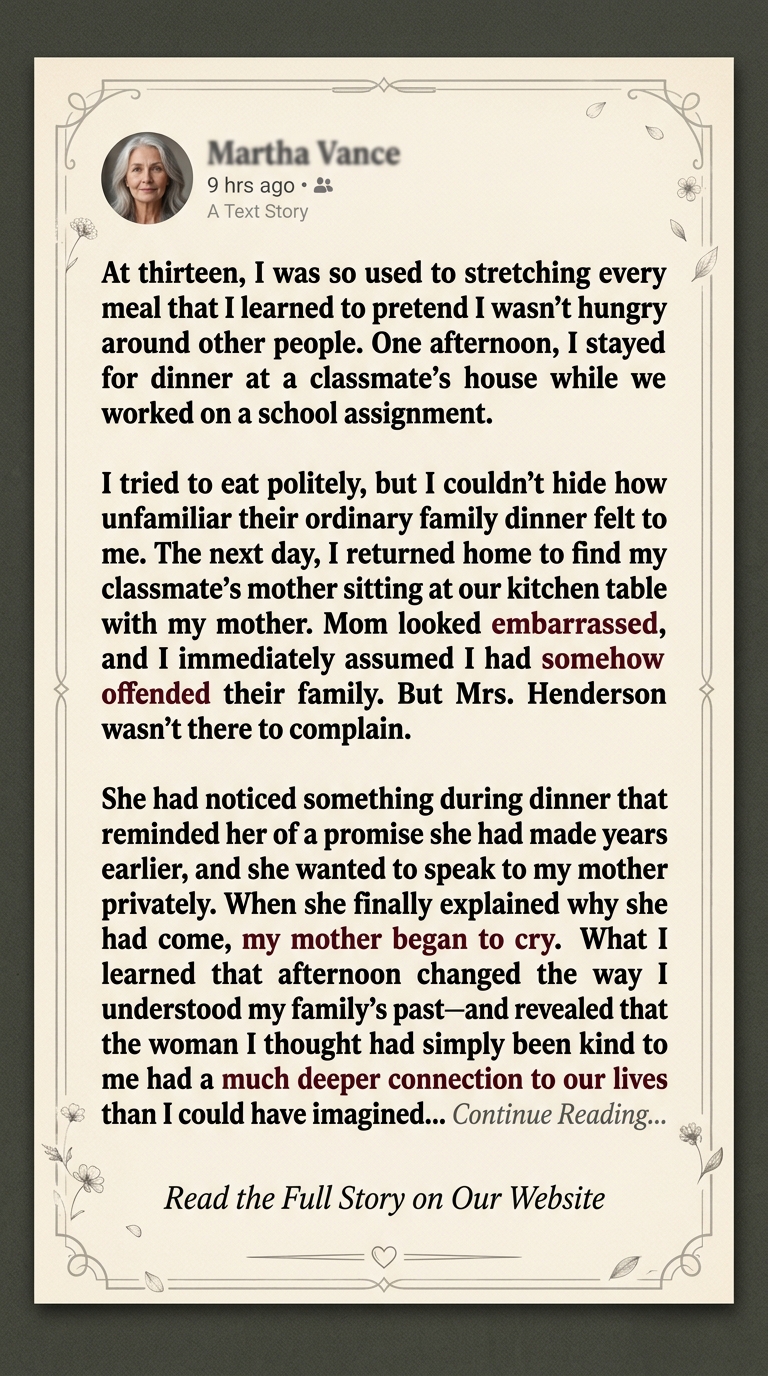
When I was thirteen, I had become very good at pretending I wasn’t hungry.
My mother worked two jobs, but even with all her effort, money rarely lasted until the end of the month. Some evenings, dinner was a bowl of rice with a little butter. Other nights, she told me she had eaten at work and encouraged me to finish whatever was left.
I knew she was lying.
I also knew she hated seeing me worry, so I learned not to ask questions. At school, I avoided talking about food. When classmates invited me to restaurants, I usually found an excuse not to go. I didn’t want anyone to discover how different my life was from theirs.
Then my classmate Ethan invited me to his house to work on a history assignment.
I had known Ethan for almost a year. He was friendly without being overly curious, and he never made fun of my old shoes or the fact that I brought the same sandwich to school several days in a row.
That afternoon, we worked at his dining-room table until his mother called us for dinner.
I immediately said I should go home.
“Don’t be silly,” Ethan said. “Mom made enough for everyone.”
His mother, Mrs. Henderson, appeared in the doorway wearing an apron.
“You’re staying,” she said cheerfully. “I refuse to let a thirteen-year-old boy leave my house hungry.”
I wanted to refuse, but she had already placed another plate on the table.
Dinner was ordinary for them. There was roasted chicken, mashed potatoes, vegetables, warm bread, and a bowl of fruit. Ethan complained about the vegetables, his younger sister argued about who had taken the last roll, and his father asked everyone about their day.
I sat quietly, trying to eat slowly.
Mrs. Henderson noticed that I kept looking at the serving dishes before taking anything.
“Would you like some more chicken?” she asked.
“No, thank you. I’m full.”
She looked at my plate, then at me.
“Well, if you change your mind, there’s plenty.”
I tried to act normal, but I couldn’t hide how unfamiliar the meal felt. I had never seen so much food placed on a family table without someone carefully measuring how much everyone could have.
At one point, Ethan reached across me for another piece of bread.
“Give me that,” he said. “You barely ate anything.”
I laughed awkwardly.
Mrs. Henderson watched me for a moment but didn’t say anything.
After dinner, I helped clear the table. She thanked me and wrapped a piece of cake for me to take home.
I almost refused.
Then I remembered my mother would probably enjoy it, so I accepted.
The next afternoon, I returned home from school and found Mrs. Henderson sitting at our kitchen table.
My mother was opposite her, holding a cup of tea. Her eyes were red, and her hands were clasped tightly together.
I stopped in the doorway.
“Mom?”
She looked up quickly.
“Come here, Daniel.”
My stomach dropped.
I immediately thought I had offended Ethan’s family. Perhaps I had eaten too much, behaved badly, or made some comment that had embarrassed them.
“Did I do something wrong?” I asked.
Mrs. Henderson stood.
“Oh, sweetheart, no. You didn’t do anything wrong.”
She smiled, but her eyes were already wet.
My mother reached for my hand.
“Mrs. Henderson came because she recognized something yesterday. Something she hadn’t seen in a very long time.”
I looked between them.
“What?”
Mrs. Henderson pulled out a chair.
“Before I explain, I want you to know that none of this is your fault. And your mother has done nothing to be ashamed of.”
Then she turned toward my mother.
“Margaret, I think it’s time he knew.”
My mother closed her eyes.
For several seconds, nobody spoke.
Finally, Mrs. Henderson began telling me a story about a woman named Laura.
Laura had been her closest friend when they were young. They had met while working at a small clothing factory and had remained friends for years. Laura was generous, stubborn, and always willing to help someone who needed it.
She had also been the reason Mrs. Henderson was alive.
When Mrs. Henderson was twenty-eight, she had become seriously ill during a difficult pregnancy. She had no family nearby, and her husband was working out of town. Laura took her to the hospital, stayed beside her through the night, and looked after her newborn daughter while she recovered.
But the story didn’t end there.
A few years later, Laura became pregnant herself. She was unmarried, and the father of her child disappeared before the baby was born.
That baby was me.
I stared at Mrs. Henderson.
“You’re saying you knew my mother before I was born?”
She nodded.
“I knew her very well.”
My mother began crying.
Mrs. Henderson continued.
“After you were born, Laura struggled. She loved you more than anything, but she was frightened about raising a child alone. I offered to help, but she refused to let me take over. She wanted to be your mother, not someone else’s responsibility.”
I looked at my mother.
“Why didn’t you tell me?”
She wiped her cheeks.
“Because I didn’t want you growing up thinking you were a burden.”
Mrs. Henderson explained that she and Laura had made a promise shortly after my birth. If Laura ever reached a point where she couldn’t provide for me, she would allow Mrs. Henderson to help without feeling that she had failed as a mother.
They had written down the agreement, but it was never meant to be a legal arrangement. It was simply a promise between two friends.
Years later, when Laura’s health began to decline, Mrs. Henderson had offered to take me into her home temporarily.
My mother refused.
She believed she could manage if she worked harder.
But Mrs. Henderson had not forgotten the promise.
“Your mother disappeared from my life for a while,” she said. “Not because I stopped caring. She was embarrassed that she couldn’t repay the money I had lent her when you were little. She thought avoiding me would make things easier.”
My mother lowered her head.
“I was ashamed.”
Mrs. Henderson reached across the table.
“You never owed me anything. You helped me when I had nobody. I was simply waiting for you to let me help you.”
I was still trying to understand.
Then Mrs. Henderson said something that changed everything.
“Your mother saved my daughter.”
I looked at her.
She explained that during her difficult pregnancy, doctors had discovered a serious complication. Laura had recognized the warning signs and insisted she go to the hospital rather than wait until morning.
That decision had saved both Mrs. Henderson and her baby.
The little girl who had been born that night was Ethan’s older sister, Olivia.
I remembered Olivia. She was seventeen and away at a boarding school most of the year.
Mrs. Henderson had never forgotten that Laura had stood beside her during the worst night of her life.
And she had spent years looking for a way to return that kindness without making my mother feel indebted.
“When I saw you at dinner,” she said, “I recognized the way you tried to make yourself smaller. Laura used to do the same thing when she was worried about money. She would insist she wasn’t hungry, even when I knew she hadn’t eaten all day.”
My mother began sobbing.
I looked at her, suddenly remembering all those evenings when she had pushed food onto my plate and claimed she had already eaten.
“Mom, were you hungry too?”
She tried to smile.
“Sometimes.”
“Why didn’t you tell me?”
“Because you were a child. I wanted you to have one less thing to worry about.”
I moved closer and hugged her.
Mrs. Henderson gave us a few minutes before continuing.
She had come with a proposal.
She and her husband had recently established a small education and family assistance fund through a local community organization. They wanted to help families facing temporary financial difficulties, especially those who had children.
She wanted my mother to accept support for groceries, school expenses, and overdue utility bills.
My mother immediately shook her head.
“I can’t accept that.”
Mrs. Henderson smiled sadly.
“Laura didn’t help me because she expected payment. She helped me because I needed her. Please don’t turn my gratitude into something you have to refuse.”
My mother stared at her.
“I don’t know how to accept help.”
“Then let me show you.”
That afternoon, my life changed in ways I couldn’t have imagined.
Mrs. Henderson didn’t hand my mother a large check or promise to solve every problem. Instead, she helped her contact the community organization, which arranged practical assistance while my mother worked with a counselor to stabilize her finances.
Ethan’s family also began inviting me to dinner regularly.
At first, I felt uncomfortable. I worried that every meal was a reminder of what my mother couldn’t provide.
But Mrs. Henderson made sure I never felt like a charity case.
She asked me to help prepare vegetables, let me choose the dessert on Fridays, and occasionally asked me to teach Ethan how to organize his schoolwork.
She treated me like someone who belonged at the table.
My mother slowly accepted that receiving help did not erase everything she had sacrificed.
She found a better-paying administrative job through a community employment program and eventually moved to a more affordable apartment closer to work.
Within a year, our circumstances improved considerably.
But the most important change wasn’t financial.
My mother and Mrs. Henderson became close again.
They started meeting for coffee on Sunday afternoons, talking about their younger days and the years they had lost touch. Sometimes they laughed so hard that I could hear them from the next room.
One evening, I asked my mother why she had never told me about Laura.
She looked confused.
Then she smiled.
“Laura was the name of Mrs. Henderson’s daughter, wasn’t it?”
I nodded.
“Your mother was Laura,” she said.
I stared at her.
For a moment, I couldn’t speak.
She explained that Laura had been her middle name, given to her by her own mother. She had rarely used it because everyone called her Margaret.
I looked toward the living room, where Mrs. Henderson was helping Ethan with a school project.
“She knew all along?”
My mother nodded.
“She recognized you because you have your grandmother’s eyes. But she wanted to be certain before she said anything.”
I finally understood why Mrs. Henderson had looked at me so carefully during dinner.
She hadn’t simply recognized a hungry boy.
She had recognized the child of the woman who had once saved her life.
Years later, when I was old enough to understand what had happened, I asked Mrs. Henderson why she had waited so long to help us.
She gave me a thoughtful smile.
“Because kindness should never become a way of controlling someone. I wanted your mother to know she could accept my help without surrendering her dignity.”
Then she added something I have never forgotten.
“Your mother gave me the chance to raise my daughter. I wanted to give her the chance to raise you without having to fight every day just to put food on the table.”
I looked at her and realized that the dinner I had thought was an ordinary act of generosity had actually been the return of a promise made years before I was old enough to remember.
Mrs. Henderson never asked us to repay her.
My mother never forgot what she had done.
And I grew up understanding that families are sometimes connected by more than blood. Sometimes they are connected by the people who stand beside us when life becomes difficult and refuse to let us face it alone.
I still remember that first dinner at Ethan’s house.
The chicken, the warm bread, the laughter around the table.
But what I remember most is the feeling of sitting somewhere without having to pretend I wasn’t hungry.
For the first time in years, I understood that accepting a place at someone’s table did not make me less worthy of being there.
It simply meant someone had made room for me.