The first thing I noticed was the pair of unfamiliar shoes outside my apartment door.
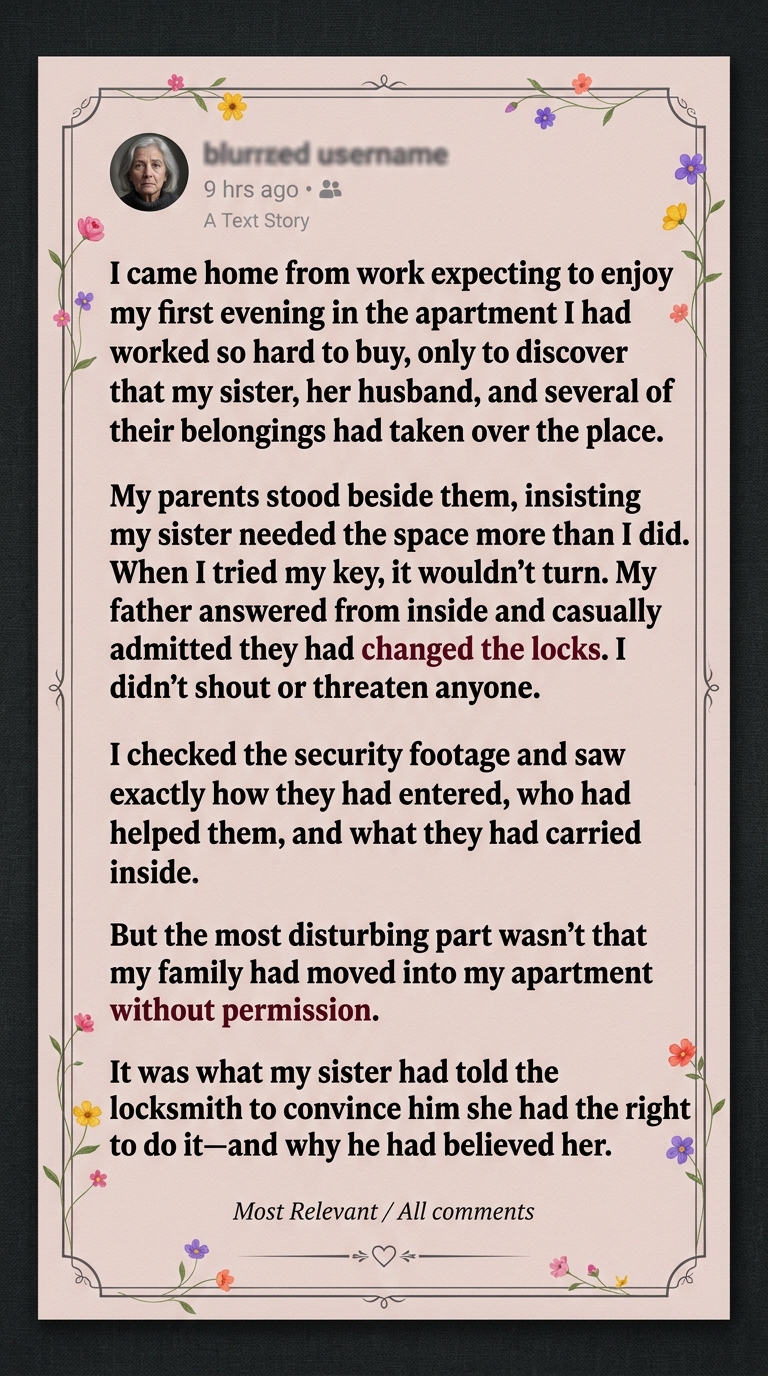
They were men’s leather shoes, neatly placed beside a cardboard box marked KITCHEN. A second box sat against the wall, and a folded stroller leaned near the elevator.
I stood there holding my work bag, wondering whether I had reached the wrong floor.
Then I noticed the new lock.
I slid my key into it and turned.
It wouldn’t move.
I tried again, slowly, then checked the apartment number. It was correct. The hallway was correct. Even the small scratch near the door handle was the one I had made while moving in a bookshelf three days earlier.
But someone had changed my lock.
Before I could call the building manager, the door opened.
My father stood there wearing his usual gray sweater. Behind him, I could see my mother arranging cushions on my living-room sofa. My sister, Melissa, was carrying a lamp toward the bedroom, while her husband, Jason, stood near the kitchen opening a bottle of water.
For several seconds, nobody spoke.
Then my father smiled.
“You’re home early.”
I stared at him.
“What are you doing in my apartment?”
My mother sighed as though I had asked an unreasonable question.
“Don’t start, Emily. Your sister needs somewhere to stay.”
I looked past her at the furniture, the boxes, and the unfamiliar curtains already hanging in my bedroom.
“Where are my things?”
Melissa appeared from the hallway.
“We moved some of them into storage. Don’t worry. We were careful.”
“You moved my belongings?”
She shrugged.
“We needed space.”
I turned to my father.
“You changed my locks.”
“Yes. Jason and I thought it was safer.”
“Safer for whom?”
His expression hardened.
“Your sister has two children. You live alone. She needs this apartment more than you do.”
I couldn’t believe what I was hearing.
I had purchased the apartment with money I had saved over eleven years. I had worked weekends, declined vacations, and lived in a small rented studio while putting aside every possible amount.
My parents knew exactly how much the apartment meant to me.
They had attended the housewarming celebration only three days earlier. My mother had cried when she saw the keys in my hand. My father had raised a glass and told everyone how proud he was.
Now they were standing inside my home, explaining why I no longer needed it.
I looked at Melissa.
“Did you agree to this?”
She crossed her arms.
“Mom and Dad said it was the fairest solution.”
“The fairest solution?”
“You don’t have children, Emily. You don’t need two bedrooms. Jason and I have been struggling for months.”
“Then why didn’t you ask me?”
She rolled her eyes.
“Because you would have said no.”
That was the first honest thing anyone had said.
I took a breath and looked around the apartment.
My dining table was gone. The framed photograph of my late grandmother had disappeared from the mantel. Someone had moved my work desk into the smaller bedroom, and a child’s toy lay on the rug I had bought only the previous week.
I didn’t shout.
I didn’t threaten anyone.
Instead, I asked my father one question.
“Who gave you permission to change the locks?”
He looked at me as though the answer were obvious.
“Your sister handled everything.”
I turned toward Melissa.
She didn’t look particularly worried.
“Jason called a locksmith,” she said. “We explained the situation, and he helped us.”
“What situation?”
“That the apartment was being transferred to us.”
My stomach tightened.
“Transferred?”
My father stepped between us.
“Emily, this is a family matter. We don’t need to turn it into something ugly.”
I looked directly at him.
“You have entered my apartment, removed my belongings, and changed the locks. I think it’s already ugly.”
He told me to calm down.
I nodded, took my phone from my bag, and walked back toward the elevator.
“Where are you going?” my mother called.
“To make a few calls.”
Melissa laughed.
“Don’t be dramatic. We can talk about this tomorrow.”
I didn’t answer.
I went downstairs to the building manager’s office.
Mr. Lewis had managed the property for almost fifteen years. He looked surprised when I told him what had happened.
“Your family is upstairs?”
“Yes. They changed my locks.”
He frowned.
“That’s impossible. I never approved a lock replacement.”
I showed him my purchase documents and identification. He checked the ownership records and confirmed that I was the sole registered owner.
Then he asked whether I had authorized anyone to access the building’s security system.
I shook my head.
“Can we review the entrance footage?”
He hesitated.
“We can review footage relevant to a security incident. I’ll make a copy of the available recordings and document the request.”
Within twenty minutes, we were watching the footage from the previous afternoon.
The first recording showed Melissa arriving with Jason. They carried several empty boxes and spoke to the concierge.
The second showed my parents entering twenty minutes later with bags of clothing and a folded travel crib.
Then came the recording that made my hands go cold.
At 2:17 p.m., a locksmith arrived carrying a tool case.
Melissa greeted him at the entrance and led him upstairs.
Mr. Lewis paused the footage.
“That’s unusual. We normally require authorization from the registered owner before a lock is changed.”
“Can we see the conversation?”
“There is no audio in the hallway, but the concierge may have spoken to them.”
We went downstairs and found Samuel, the afternoon concierge, finishing his shift.
When I showed him the recording, he immediately recognized Melissa.
“She told me you were expecting them,” he said.
I stared at him.
“She told you that?”
“She said there had been a family transfer and that your parents were helping arrange the move. She showed me a document on her phone.”
“What document?”
Samuel thought for a moment.
“It looked like a letter. There was a signature at the bottom. She said you had already signed everything.”
I felt my stomach drop.
I had signed no such document.
Samuel explained that he had questioned the locksmith when he arrived. Melissa had shown him the letter again and said the building office already knew about the change.
He had allowed them upstairs because he believed the paperwork was legitimate.
I asked whether he remembered the locksmith’s name.
He checked the contractor log.
The man’s name was Peter Walsh.
I photographed the entry and contractor records, then called the building manager’s recommended legal adviser. He told me not to confront anyone or attempt to force entry. He also advised me to preserve the security footage and obtain copies of any documents used to authorize the work.
I followed his instructions.
The next morning, I returned with Mr. Lewis and a locksmith who had been contacted through the building’s approved contractor list.
My family was still inside.
My father opened the door with an expression of irritation.
“What is this now?”
I held up my phone.
“I’ve confirmed that the apartment belongs to me. The building has no record of an authorized transfer, and the lock replacement was carried out without my permission.”
Melissa appeared behind him.
“You can’t just throw us out!”
“I haven’t asked anyone to throw you out. I’ve asked you to leave my property voluntarily.”
Jason stepped forward.
“Your sister has nowhere else to go.”
“Then you should have discussed that with me before moving in.”
My father shook his head.
“You’re behaving like a stranger.”
I looked at him.
“You treated me like a stranger when you changed the locks on my home.”
He began to argue, but Mr. Lewis interrupted.
He explained that the building had verified my ownership and that the access records were being preserved. He also confirmed that no one had permission to replace the lock or occupy the apartment on my behalf.
Melissa’s expression changed.
She glanced at Jason, then back at me.
“You’re really going to do this to your own sister?”
I didn’t answer.
The locksmith arrived shortly afterward. He had been told that the matter involved disputed authorization, so he brought his work records and agreed to explain what he had been shown.
When he saw Melissa, he frowned.
“You’re the woman who called me yesterday?”
She nodded.
He looked at me.
“She showed me a signed authorization letter. It said the owner had transferred occupancy rights to her and that she was permitted to arrange access.”
“Did you verify the signature?”
He looked uncomfortable.
“I asked whether the document had been witnessed. She said it had been handled by your family’s solicitor.”
I had never met the solicitor she named.
The locksmith opened his phone and showed us the photograph he had taken of the letter before beginning the work.
I recognized my name immediately.
The signature at the bottom looked similar to mine, but it wasn’t mine.
It was a poor imitation.
Worse, the letter included a sentence stating that I had voluntarily surrendered possession of the apartment and authorized Melissa to take over the premises.
I felt a chill run through me.
This wasn’t a misunderstanding.
Someone had prepared a document to make it look as though I had willingly given away my home.
I asked the locksmith whether he still had the original.
He explained that Melissa had handed him a printed copy, which he had returned to her after completing the job. He had kept the photograph because his company required proof of authorization for unusual requests.
That photograph became important evidence.
The building manager immediately suspended the contractor’s access privileges while the incident was reviewed. The locksmith cooperated fully, providing his work order and a statement explaining what Melissa had told him.
He apologized for not verifying the document independently.
“I should have contacted the building office,” he said. “I was given something that looked official, and I accepted it too quickly.”
I told him that I understood, but the matter had to be properly documented.
My father was growing increasingly agitated.
“Enough,” he said. “We’re family. This has gone too far.”
I turned toward him.
“Did you know the letter was fake?”
He looked at Melissa.
That brief glance told me he knew more than he wanted to admit.
My sister began crying.
She claimed she hadn’t forged anything. She said Jason had prepared the letter after our parents told them that I had agreed to let them use the apartment.
Jason immediately denied it.
“You told me your father had arranged everything.”
Melissa turned on him.
“You said the document was fine!”
Their argument became louder, each accusing the other of knowing more than they had admitted.
I asked them to stop.
“Who prepared the letter?”
Neither answered.
Finally, my father spoke.
“I found a template online.”
Everyone turned toward him.
He explained that he had written the letter himself using information from my purchase documents. He had copied my signature from a scanned form that I had once sent him while asking for help reviewing a utility application.
He claimed he had only intended to make the move easier.
“Melissa needed somewhere to live,” he said. “You had a perfectly good apartment sitting empty most of the day.”
I stared at him.
“You used my signature?”
“I thought you would eventually understand.”
“You forged my permission.”
His face tightened.
“I was trying to help your sister.”
That was when the real reason behind the move became clear.
Melissa and Jason had been facing eviction from their rental property after falling behind on payments. Their landlord had issued formal notices, and they had been given a deadline to leave.
They had nowhere affordable to go.
My parents had offered to help them, but instead of finding temporary accommodation or asking me for assistance, my father decided that my newly purchased apartment was the solution.
He believed I would eventually give in once they were already inside.
Melissa had known the document was not a genuine transfer. She had not written it, but she had used it to convince the locksmith and building staff that she had authority to take possession.
Jason had known the arrangement was unauthorized, although he claimed he believed my father would persuade me to accept it.
The three of them had made a decision about my home without consulting me.
Then they had tried to make that decision look legal.
I felt something inside me settle.
I had spent years being the dependable daughter. Whenever Melissa had financial problems, I was expected to help. Whenever my parents needed something, I was expected to arrange it. I had paid overdue bills, covered emergency expenses, and postponed my own plans because someone else always needed support.
I had convinced myself that helping them was simply part of being a family.
But I had never agreed to give them ownership of my life.
I told my father that the forged authorization would be submitted to the appropriate authorities, along with the security footage, contractor records, and the locksmith’s statement.
He looked horrified.
“You’re going to involve the police?”
“You used my signature to take possession of my apartment. What would you call it?”
He lowered his voice.
“Please don’t destroy your sister’s life over this.”
I answered, “I didn’t put her in this position. And I didn’t forge my own signature.”
My father had no response.
The legal process took several weeks. The building’s records and the locksmith’s documentation established how the unauthorized entry had occurred. The forged letter was examined, and my father’s involvement was confirmed through his own statements and the digital file he had created.
The authorities treated the matter as a serious property and document-fraud complaint. Melissa and my father were both questioned about their roles. Jason admitted that he had helped move the belongings despite knowing I had not given permission.
My family was required to leave the apartment, and I regained possession through the proper legal process. The locks were replaced again, this time with the building’s approval and a complete record of the work.
The forged authorization was not treated as a harmless family misunderstanding. My father accepted responsibility for preparing it, while Melissa faced consequences for knowingly presenting it as genuine. Jason was also required to answer questions about his involvement.
Their actions damaged more than my property.
My parents’ relationship with me changed permanently.
My mother called repeatedly, crying and saying she had never imagined the situation would become so serious. She insisted that she had only wanted to keep the family together.
I asked her why keeping the family together had required removing me from my own home.
She had no answer.
Melissa sent me a long message saying she was sorry, but much of it focused on how frightened she had been about losing her rental accommodation. I understood that she had been desperate, but desperation did not give her the right to take what belonged to me.
I didn’t respond immediately.
Instead, I concentrated on restoring my apartment.
I had the walls repainted, replaced the damaged curtains, and retrieved my belongings from storage. The framed photograph of my grandmother had a cracked corner, but it could be repaired.
When I finally unpacked my books, I placed them on the shelves in the living room and stood there for a long time.
The apartment was quiet.
For the first time since buying it, I could enjoy the space without worrying that someone would decide I didn’t deserve it.
Several months later, Melissa contacted me again.
This time, she didn’t ask for money or a place to stay. She told me she and Jason had moved into a smaller rental apartment and were working through their debts. She said she understood that I might never trust her again.
I appreciated that she didn’t demand forgiveness.
I told her I hoped she would get her life back on track, but I would not be offering financial assistance or housing.
She accepted my answer.
My father eventually sent a short apology. He admitted that he had convinced himself he was entitled to make decisions on behalf of the family because he believed he knew what was best for everyone.
I told him that being a parent did not give him authority over my property or my choices.
We began speaking occasionally again, but our relationship never returned to what it had been.
I still loved my family.
I simply stopped confusing love with unlimited access.
On the anniversary of the day I received my apartment keys, I invited a few close friends over for dinner. We ate at my dining table, laughed in the living room, and celebrated the home I had worked so hard to earn.
Before everyone left, one friend raised her glass.
“To having a place that’s truly yours.”
I looked around the room.
The furniture was mine. The photographs were mine. The keys in my handbag belonged to no one else.
I raised my glass.
“To knowing the difference between people who love you and people who think loving you gives them the right to own your decisions.”
And for the first time, I understood that protecting my home had also meant protecting the life I had spent eleven years building.