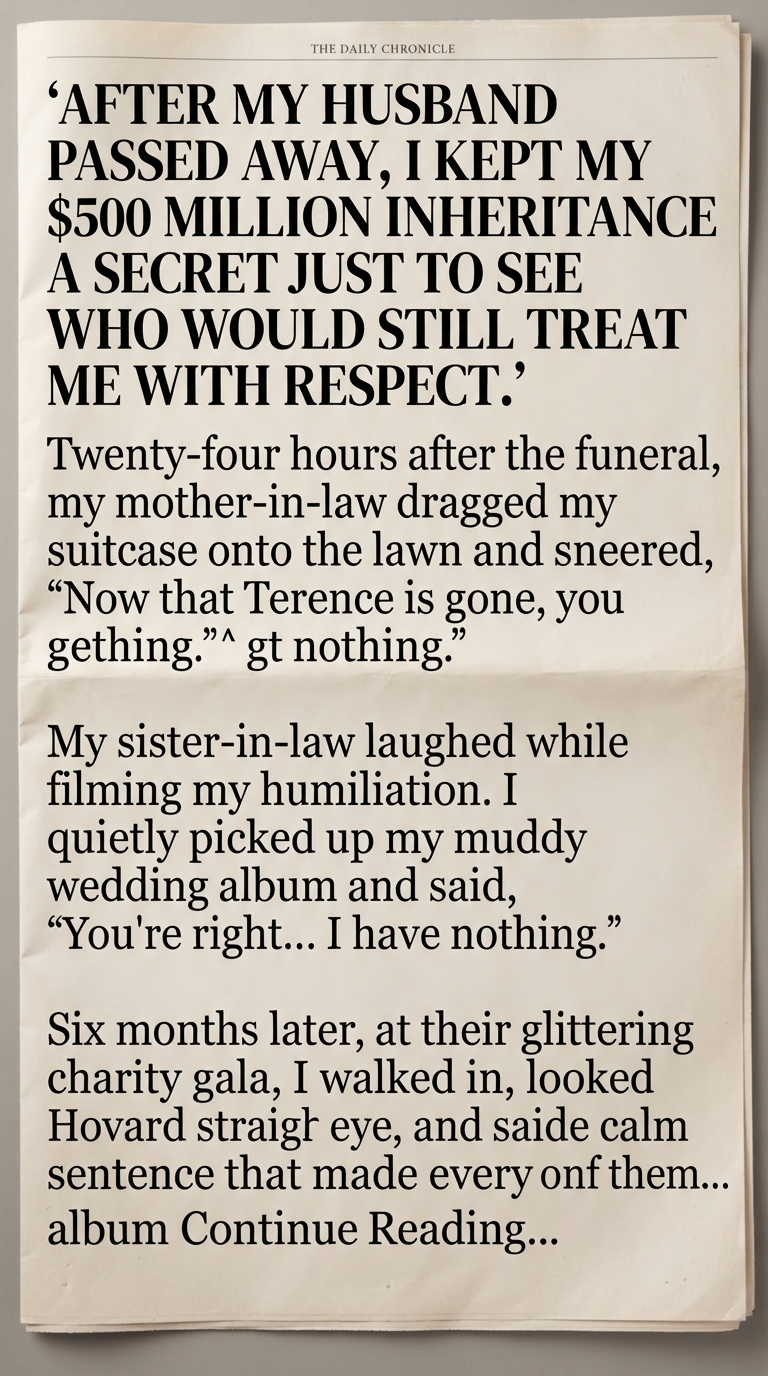
After my husband passed away, I kept my $500 million inheritance a secret just to see who would still treat me with twenty-four hours of respect.
I didn’t need twenty-four hours.
I needed less than one.
The funeral ended at four on a gray Tuesday afternoon.
By five, my mother-in-law had dragged two suitcases onto the lawn.
She didn’t knock.
Didn’t cry.
Didn’t even pretend to offer condolences.
She stood beside the stone walkway with her arms crossed while my sister-in-law, Melissa, filmed everything on her phone.
Howard, my husband’s older brother, stood near the driveway.
Nobody looked at me like I had just buried the man I loved.
They looked at me like I was already an obstacle.
My mother-in-law sneered.
“Now that Terence is gone, you get nothing.”
I stared at her.
I was still wearing the black dress from the funeral.
My hair was still pinned up.
My eyes were swollen from crying.
The wedding album I’d carried outside that morning slipped from my hands when she shoved one suitcase toward me.
It landed in the mud.
Melissa laughed.
“Did you hear her? Nothing.”
Howard stepped forward.
“You should be grateful we are giving you time to move your things.”
I looked at him.
“Move?”
“This is family property.”
“No.”
He smiled.
“It belonged to Terence.”
“Yes.”
“And Terence belonged to this family.”
I almost laughed.
My husband had spent fifteen years telling me that this house was ours.
Not theirs.
But I didn’t argue.
I quietly picked up my muddy wedding album.
The corner was covered in dirt.
I wiped it with my sleeve.
Then I looked at all three of them.
“You’re right.”
My voice was soft.
“I have nothing.”
My mother-in-law smiled.
“Good. Then you understand.”
I nodded.
“Perfectly.”
I carried the album inside.
I didn’t pack.
I didn’t leave.
I simply closed the door.
And for the first time since Terence died, I stopped pretending.
Terence had left behind something nobody in his family knew about.
Not because he had wanted to deceive them.
Because he had learned, years earlier, that money changes the way people look at you.
We had met when we were twenty-seven.
He had been brilliant, stubborn, funny, and completely unimpressed by wealth.
At the time, I knew almost nothing about his business.
He told me he owned “a few investments.”
What he didn’t tell me was that those investments became a global logistics and technology empire.
By the time he died, the family business was worth billions.
But that wasn’t where my inheritance came from.
Two weeks before his death, Terence’s estate attorney had come to our house.
He sat across from me and placed a black folder on the table.
Inside was the final version of Terence’s private estate plan.
I read the number twice.
Then again.
$500,000,000.
Five hundred million dollars.
My husband had left every dollar of his personal inheritance to me.
Not Howard.
Not his mother.
Not Melissa.
Me.
But there was one instruction attached.
Terence had written a private letter.
The lawyer handed it to me.
I opened it.
His handwriting filled the page.
My love,
People will tell you that money makes life easier. It doesn’t. It simply makes people’s intentions harder to hide.
Don’t announce the inheritance immediately.
You don’t need revenge.
Just give everyone a chance to show you who they are.
Then the final line:
Watch what they do when they think you have nothing.
I cried so hard I couldn’t finish reading.
Because even in death, Terence knew me.
He knew I would want to defend myself.
He knew I would want to expose his family.
And he knew the best evidence would come from their own behavior.
So I listened.
I kept the inheritance secret.
I told everyone Terence had left a modest estate that would take months to settle.
I told them I was sorting out the house.
I told them I wasn’t sure what I would do next.
And then I watched.
Within a week, Howard stopped pretending to care about me.
He began asking questions.
“How much is in the estate account?”
“Did Terence leave business interests?”
“Did he have life insurance?”
“Did the house go to you?”
I always gave the same answer.
“I don’t know yet.”
His mother was worse.
She called nearly every morning.
Sometimes she didn’t even say hello.
“Have you found the jewelry?”
“Did Terence have a separate investment account?”
“Where are his watches?”
“His father left those to the family.”
I told her I hadn’t found anything.
She started going through closets.
One afternoon, I caught Melissa photographing documents in Terence’s office.
She smiled when she saw me.
“Just helping.”
“Of course.”
She laughed.
“Don’t worry. Once everything settles, you’ll get something.”
I looked at her.
“Something?”
She nodded.
“Terence always knew his real family mattered.”
I said nothing.
That evening, I called the attorney.
“How long?”
“Until what?”
“Until everything is legally transferred.”
“There are procedures.”
“How long?”
“Approximately six months.”
I smiled.
“Then six months it is.”
The first test came two weeks later.
Howard arrived with a real-estate broker.
“This house is too much for one person,” he said.
I stared at him.
“I like it.”
“You can’t afford the upkeep.”
“I’ll manage.”
He laughed.
“Be realistic.”
I realized then that he had already decided I was poor.
Not temporarily.
Permanently.
The second test came when my mother-in-law asked me to sign a document allowing her to access Terence’s personal belongings.
I gave it to my attorney.
He called me ten minutes later.
“Do not sign this.”
“Why?”
“It grants her authority over several assets.”
I almost laughed.
“She told me it was for his watches.”
“It isn’t.”
I declined.
She became furious.
“You’re being selfish.”
I looked at her.
“My husband died.”
She answered:
“Exactly. And now you have to think about the family.”
I didn’t respond.
The third test came from Melissa.
She posted a photograph of herself on social media wearing one of Terence’s watches.
The caption read:
Some things belong where they always belonged. ❤️
I didn’t confront her.
I saved the photograph.
Then I emailed it to my attorney.
He replied:
Keep everything.
So I did.
By the third month, their behavior had become almost routine.
They treated me like a temporary tenant.
They spoke over me.
Discussed selling the house in front of me.
Started dividing Terence’s belongings.
Howard even told a family friend:
“She’ll probably be moving to a small apartment soon.”
I heard him.
He didn’t know I was standing behind the doorway.
I didn’t correct him.
I just walked upstairs.
And opened Terence’s letter again.
Watch what they do when they think you have nothing.
I finally understood why he had written it.
Money hadn’t changed them.
Money had simply removed their need to pretend.
The fourth month brought something worse.
Howard showed up with a lawyer.
He claimed Terence had promised him part of the family business.
I asked him for proof.
He didn’t have any.
Then he said:
“You don’t belong in the company.”
I looked at him.
“Why?”
“Because you’re his wife.”
I almost laughed.
“What does that mean?”
“It means you’re not blood.”
I stared at him.
For years, Terence had defended me from exactly that attitude.
Now I understood why he had written the letter.
Howard didn’t see a widow.
He saw a competitor.
He thought the business would eventually fall into his hands.
He was wrong.
But he didn’t know how wrong.
At the five-month mark, the attorney called.
“Everything is finalized.”
I sat quietly.
“All of it?”
“Yes.”
“Every account?”
“Yes.”
“Every trust?”
“Yes.”
“The shares?”
“Transferred.”
I closed my eyes.
Five hundred million dollars.
Not a rumor.
Not a possibility.
Mine.
But I didn’t celebrate.
I asked one question.
“What about the foundation?”
He smiled.
“Also finalized.”
That was the part nobody in the family knew.
Terence hadn’t simply left me money.
He had established a charitable foundation.
And I was the sole controlling trustee.
The same foundation was scheduled to host a major charity gala in six months.
The guest list included business leaders, politicians, investors, philanthropists, and every important person connected to Terence’s professional life.
Including Howard.
Including my mother-in-law.
Including Melissa.
They thought they were attending a family charity event.
They had no idea whose event it really was.
On the night of the gala, I stood in front of my closet for twenty minutes.
I finally chose a simple black gown.
No diamonds.
No excessive jewelry.
Just a thin gold bracelet Terence had given me on our tenth anniversary.
I walked into the ballroom alone.
The room was enormous.
Crystal chandeliers.
White flowers.
Live orchestra.
Hundreds of guests.
And near the entrance stood Howard.
He was laughing with several investors.
My mother-in-law stood beside him.
Melissa was filming everything for social media.
Then she saw me.
Her smile disappeared.
Howard looked over.
He froze.
My mother-in-law whispered something.
They all stared at me.
I walked toward them.
Calmly.
No security entourage.
No dramatic entrance.
Just me.
Howard forced a smile.
“You came.”
“Yes.”
“I thought you weren’t attending.”
“I changed my mind.”
My mother-in-law looked at my dress.
“Where did you get that?”
“From home.”
She laughed.
“You’re still staying there?”
“Yes.”
Howard frowned.
“You know the estate is going to be complicated.”
I looked at him.
“Is it?”
“Very.”
“Interesting.”
He leaned closer.
“You should really talk to me before you make any decisions.”
I smiled.
“I already made them.”
He didn’t understand.
Then the lights dimmed.
The host walked onto the stage.
“Ladies and gentlemen, thank you for joining us tonight for the first annual Terence Whitmore Foundation Gala.”
Applause filled the ballroom.
The host continued.
“Tonight’s event is made possible by the generosity of our late founder, Terence Whitmore, and the foundation’s principal trustee.”
He paused.
“His wife.”
Every head turned toward me.
I walked onto the stage.
The applause grew louder.
Howard stared.
My mother-in-law’s face went pale.
Melissa stopped filming.
The host smiled.
“Please welcome the woman who will lead this foundation for years to come—Mrs. Eleanor Whitmore.”
I stood at the microphone.
The room became silent.
I looked directly at Howard.
Then my mother-in-law.
Then Melissa.
And said one sentence.
“You were right six months ago—I had nothing; now you finally know who had it all.”
The ballroom exploded into applause.
Howard couldn’t move.
His mother looked like she’d forgotten how to breathe.
Melissa lowered her phone.
I continued.
“Six months ago, I buried my husband.”
The room grew quiet again.
“I was told that because he was gone, I had no place here.”
I looked toward Howard.
“I was told I would get nothing.”
Then I smiled.
“So I believed you.”
I pressed a button.
The screen behind me came alive.
The first slide showed:
THE WHITMORE FOUNDATION
Then beneath it:
Initial Endowment: $100,000,000
The ballroom gasped.
Howard took a step backward.
I continued.
“My late husband left a personal inheritance of $500 million.”
Someone whispered.
“Five hundred million?”
I nodded.
“And every dollar was transferred to me.”
Silence.
My mother-in-law closed her eyes.
I wasn’t finished.
“But Terence also left instructions.”
The screen changed.
A sentence appeared in his handwriting.
Give them time to show you who they are.
The room went completely silent.
I looked toward my family.
“For six months, I watched.”
The next slide appeared.
Email screenshots.
Messages.
Requests for assets.
Requests for signatures.
Photographs of property documents.
A social-media post featuring Terence’s watch.
A recorded voicemail from Howard asking a broker about selling the house.
The audience murmured.
Howard stepped forward.
“This is private!”
I turned toward him.
“You made it public when you decided to take what wasn’t yours.”
My mother-in-law began crying.
“I was grieving.”
“No.”
I looked at her.
“You were counting.”
She lowered her eyes.
Melissa whispered:
“Please.”
I looked at her.
“You filmed me while your mother threw my husband’s funeral luggage onto the lawn.”
Her face turned red.
“I’m sorry.”
I nodded.
“I believe you.”
She looked relieved.
Then I added:
“But forgiveness doesn’t erase consequences.”
The room went silent.
I announced that the $100 million foundation endowment would fund cancer care, children’s hospitals, grief support, and housing assistance for widows.
Then I made another announcement.
“The family members who attempted to claim assets they weren’t entitled to will have no involvement in the foundation.”
Howard stared at me.
“You can’t do that.”
“I already did.”
He looked around.
Everyone was watching him.
The investors he’d spent years trying to impress.
The board members.
The business leaders.
The people he’d spoken to about taking over Terence’s company.
They now knew the truth.
I looked at him one final time.
“You thought my husband’s death made me powerless.”
I paused.
“You were wrong.”
Howard lowered his head.
The room erupted in applause.
Not because I had embarrassed him.
Because people finally understood what Terence had wanted.
He hadn’t left me $500 million so I could win a family argument.
He had left it to me because he trusted me to protect what he built.
And I did.
After the gala, I returned to the house alone.
The same house where my mother-in-law had dumped suitcases onto the lawn.
I walked into the living room.
The muddy wedding album was still there.
I had cleaned it.
The pages were slightly warped.
But the photographs were intact.
I opened to the first picture.
Terence and me on our wedding day.
He was smiling at me.
I smiled back.
Then I found the note he’d slipped into the album years earlier.
Three words.
Always choose kindness.
I cried.
Not because I missed him less.
Because I understood him better.
He hadn’t wanted me to destroy his family.
He wanted me to see them clearly.
And once I did, I knew exactly what to do.
I didn’t throw anyone into the mud.
I didn’t scream.
I didn’t threaten.
I simply stopped pretending they loved me.
Six months earlier, my mother-in-law had told me:
“Now that Terence is gone, you get nothing.”
She was right about one thing.
I didn’t get what she thought I would.
I got something far more valuable.
The truth.
I learned who stood beside me when they thought I had nothing.
And more importantly…
I learned I never needed their approval to have everything.