Fourteen Days
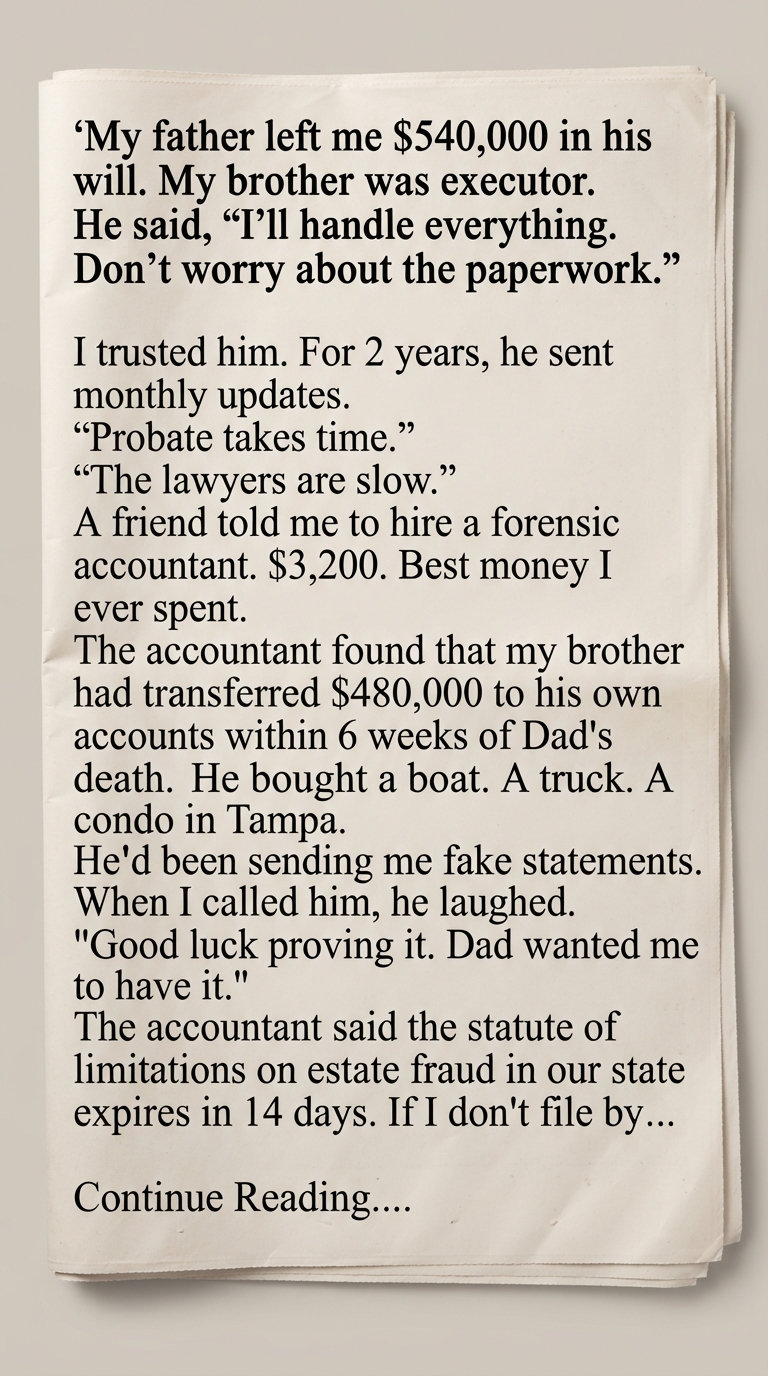
For two years, I believed the word “probate” was just legal jargon for slow. My brother, Derek, had been the one to sit across from Dad’s lawyer while I was still too grief-stricken to look at paperwork, and when he said, “I’ll handle everything, don’t worry about it,” I believed him the way you believe your older brother when you’ve spent your whole life believing him.
He sent monthly updates. Screenshots of what looked like estate account balances. Texts that said things like lawyers are dragging their feet again and probate takes time, sis, I promise I’m on it. I had no reason to doubt him. Dad had left him as executor for a reason—he was the “responsible one,” the one with the finance degree, the one who’d always made me feel like the paperwork was better left in his capable hands.
It was my friend Angela, over coffee one Tuesday, who asked a question that changed everything. “Two years for a $540,000 estate? That’s unusual. Have you had anyone independent look at the actual accounts?”
I hadn’t. I hired a forensic accountant named Priya for $3,200, which felt like an enormous sum at the time, money I almost talked myself out of spending. It was the best $3,200 I have ever spent in my life.
Within three weeks, Priya came back with a report that made my hands shake as I read it. Derek had transferred $480,000 out of Dad’s estate account and into his own personal accounts within six weeks of the funeral—long before probate had even meaningfully begun, long before any of the “delays” he’d described to me had any basis in reality. The monthly statements he’d been sending me were fabricated, edited screenshots designed to look like official estate documents. In the same window of time, he’d bought a boat, a new truck, and put a down payment on a condo in Tampa.
I called him with the report open on my laptop in front of me, hands still shaking, hoping—stupidly—that there was an explanation, that Priya had somehow gotten it wrong, that my brother hadn’t spent two years lying to my face while I trusted him with our father’s memory.
He laughed.
“Good luck proving it,” he said. “Dad wanted me to have it anyway.”
That laugh told me more than any account statement could have. This wasn’t a misunderstanding. This wasn’t a delay. This was theft, dressed up in family loyalty and two years of my own trust.
Priya didn’t waste time being sympathetic, and I was grateful for that, because sympathy wasn’t going to get me anywhere. “The statute of limitations on estate fraud in this state is tight,” she told me. “Based on the date of the transfers, you have fourteen days left to file before you lose the ability to pursue this criminally or civilly.”
Fourteen days to undo two years of carefully constructed lies.
I didn’t sleep much in the days that followed. I met with an estate litigation attorney, Marcus, who took one look at Priya’s forensic report and told me we had more than enough to move forward—the fabricated statements alone would be difficult for Derek to explain away, and the timeline of the purchases matched the transfers almost to the day. We filed a police report for the criminal side, and Marcus filed a civil claim for breach of fiduciary duty on day nine, with five days to spare.
Derek’s laughter did not survive being served papers on his own front porch, in front of his new truck, in front of the Tampa condo he hadn’t even finished moving into.
The case took another year to resolve. It wasn’t clean, and it wasn’t cheap, and it cost me more than money—it cost me any relationship I’d had left with the only sibling I had. But the forensic paper trail Priya built was airtight, and faced with a criminal fraud charge in addition to the civil suit, Derek’s lawyer eventually pushed him toward a settlement rather than risk a jury seeing those fabricated statements. He was ordered to liquidate the boat, the truck, and the condo, and to repay the estate in full, plus interest, plus my legal fees.
It will never undo two years of being lied to by someone I trusted with our father’s final wishes. But it did something almost as important: it made sure he didn’t get away with it, and it made sure Dad’s actual wishes—not Derek’s rewritten version of them—were finally the ones that mattered.