What Mark Forgot About the Woman He Married
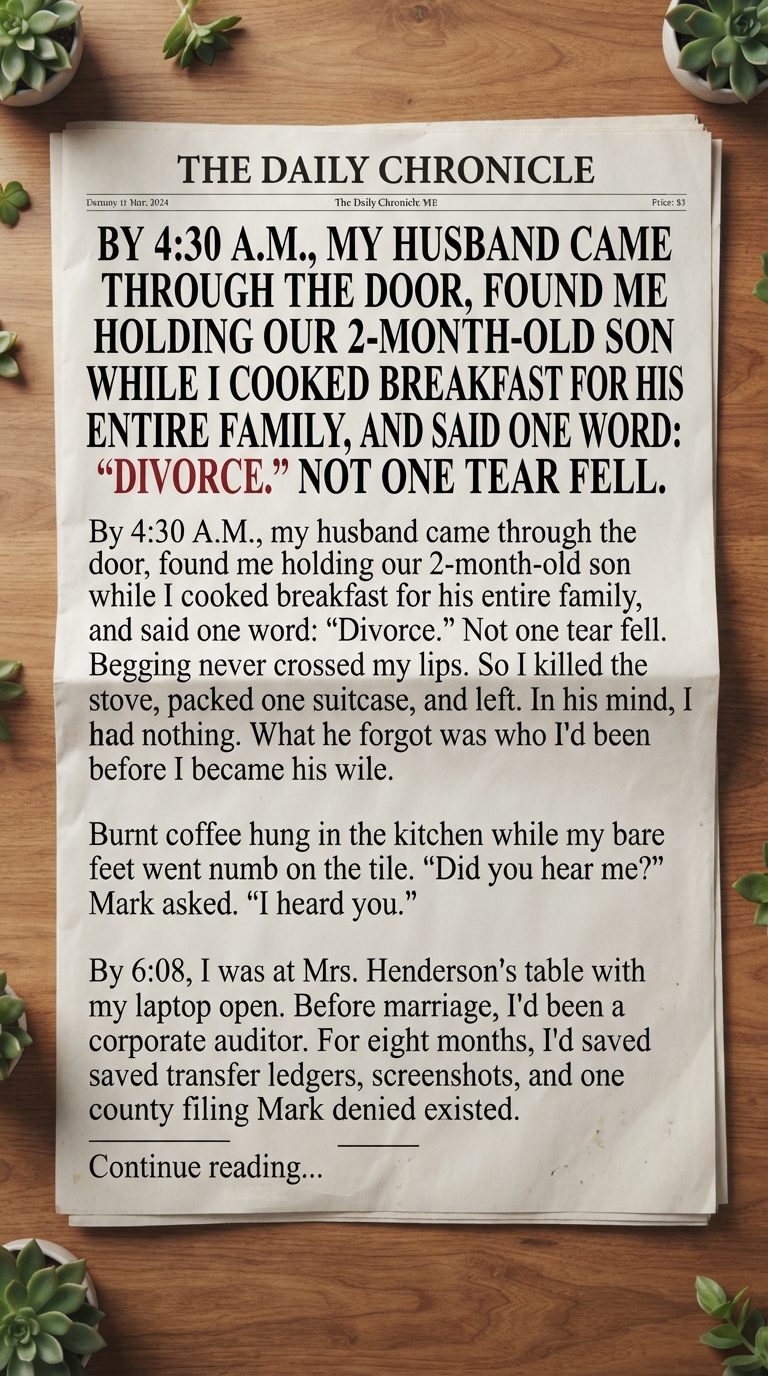
By 4:30 A.M., my husband came through the door, found me holding our two-month-old son while I cooked breakfast for his entire family, and said one word:
“Divorce.”
Not one tear fell.
Begging never crossed my lips.
I killed the stove, packed one suitcase, picked up my son, and left.
In Mark’s mind, I had nothing.
What he forgot was who I’d been before I became his wife.
Burnt coffee hung in the kitchen while my bare feet went numb on the tile.
“Did you hear me?” Mark asked.
“I heard you.”
His mother sat at the kitchen table, silent.
His sister, Vanessa, was scrolling through her phone as if the conversation had nothing to do with her.
My husband dropped his keys beside the sink.
“I can’t do this anymore.”
I looked at him.
“What exactly is ‘this’?”
“This whole situation.”
He gestured toward me.
“The baby. The house. The constant stress.”
I almost laughed.
The baby was two months old.
The house was the one he insisted we buy because his parents lived ten minutes away.
And the “constant stress” was me waking up every night with our son while cooking, cleaning, doing laundry, and making sure his family always had what they needed.
I had stopped asking Mark for help three weeks after our son was born.
Not because I didn’t need it.
Because every time I asked, he told me I was “making motherhood harder than it needed to be.”
Now he wanted a divorce.
Fine.
I turned off the burner.
“Okay.”
He blinked.
“Okay?”
“Yes.”
He looked almost disappointed.
Maybe he expected tears.
Maybe he expected me to fall apart.
Maybe he thought motherhood had erased the woman I used to be.
He was about to learn otherwise.
At 5:02 A.M., I packed one suitcase.
Clothes for me.
Clothes for the baby.
Diapers.
Formula.
Important documents.
Nothing else.
I left the wedding album.
I left the expensive handbag Mark had given me.
I left the jewelry.
I left the furniture.
I even left the coffee machine.
At the front door, I stopped.
Mark was standing in the hallway.
“You’re actually leaving?”
“You asked for a divorce.”
“I thought you’d fight for us.”
I looked at him.
“You didn’t ask me to fight.”
He said nothing.
“You asked me to leave.”
Then I opened the door.
Cold morning air hit my face.
My son stirred against my chest.
I kissed his forehead.
And walked away.
By 6:08, I was sitting at Mrs. Henderson’s kitchen table with my laptop open.
Mrs. Henderson had been my next-door neighbor before I married Mark.
She was seventy-two years old, terrifyingly observant, and had never liked the way Mark spoke to me.
“You can stay as long as you need,” she said.
“I won’t be long.”
“You don’t know that.”
She placed a cup of tea beside my laptop.
“Start with what matters.”
I opened a folder.
Inside were transfer ledgers.
Screenshots.
Bank statements.
Property records.
Emails.
And one county filing Mark had spent eight months insisting did not exist.
I stared at the screen.
Mrs. Henderson leaned over.
“What are you looking for?”
“The truth.”
Before I married Mark, I had been a senior corporate auditor.
I had spent eleven years following money through companies large enough to hide millions in numbers that looked ordinary.
I knew how people concealed transactions.
I knew how shell companies worked.
I knew how to recognize altered records.
And I knew one rule better than any other:
Money leaves a trail.
Mark had forgotten that.
So had his family.
Eight months earlier, I’d noticed something unusual.
A transfer.
$48,500.
From an account associated with the property company Mark claimed was “owned by his father.”
The money went to a consulting company I’d never heard of.
Two weeks later, another transfer.
$31,200.
Then $17,900.
Then $64,000.
Every payment had the same strange description.
“Administrative services.”
There were no services.
The company had no employees.
No website.
No office.
Its registered address was a mailbox.
I started looking deeper.
That’s when I found the county filing.
The property company wasn’t owned by Mark’s father.
It wasn’t even owned by the family.
A trust held controlling interest.
And the trustee name on the filing was mine.
I had no idea why.
Until I found the signature page.
My late uncle, who had worked with my father for years, had established the trust before he died.
Mark had never mentioned it.
Neither had his parents.
And somehow, over the previous year, money from that trust had been moving through accounts connected to Mark’s family.
I knew immediately that something was wrong.
So I did what auditors do when they smell smoke.
I documented everything.
Quietly.
At 7:11 A.M., my phone started buzzing.
Mark.
I ignored it.
Then his mother.
Then Vanessa.
Then Mark again.
Finally, a message arrived.
You can’t take my son and disappear.
I stared at it.
My son.
As if he were a piece of property.
I took a screenshot.
Then another message.
Come home before you make this ugly.
I saved that too.
Mrs. Henderson watched me.
“You’re collecting evidence.”
“Yes.”
“Good.”
She sipped her tea.
“But don’t make the mistake of assuming paperwork is enough.”
“What do you mean?”
She looked toward the baby.
“You’re not fighting for a house.”
She paused.
“You’re fighting for your child’s future.”
At 9:30, my attorney arrived.
Her name was Claire Bennett.
She had handled the estate paperwork after my uncle’s death.
She read through the documents without saying much.
Then she looked up.
“Did Mark ever tell you about this trust?”
“No.”
“Did he ever ask you to sign anything related to the family property?”
“Yes.”
“What?”
“Last year he asked me to sign a ‘management update.’”
Claire’s face changed.
“Did you?”
“No.”
“Why?”
“Because the language was wrong.”
She nodded slowly.
“That may have saved you.”
She pointed at the county filing.
“This is the original registration.”
I nodded.
“I found it eight months ago.”
Claire closed her eyes for a moment.
“Your uncle suspected Mark’s family would eventually try to gain control.”
My stomach tightened.
“Why?”
“Because there was already an investigation before his death.”
“Into what?”
Claire looked at me.
“Asset diversion.”
We spent the next four hours building a timeline.
The suspicious transfers.
The consulting company.
The property filings.
The emails.
The attempted signature changes.
And finally, the one piece of evidence I’d kept off every computer.
A paper copy.
The original.
A handwritten note from my uncle.
Claire read it.
Then she looked at me.
“You need to hear this.”
She handed me the page.
I am placing the controlling interest in the trust under the protection of my niece. She is an auditor. She will recognize the pattern when the time comes.
I read the sentence twice.
Then I looked at Claire.
“What pattern?”
She turned the page.
There was another paragraph.
The family will likely tell her she owns nothing. Let them believe that until she understands the records.
My breath caught.
My uncle had known.
He had been preparing me for exactly this.
At 2:14 that afternoon, Mark showed up at Mrs. Henderson’s house.
He stood on the porch holding an envelope.
“I want my wife back.”
I remained inside.
Claire opened the door.
“No.”
Mark’s face hardened.
“I wasn’t talking to you.”
“No,” Claire said. “You were talking to someone who is currently represented by counsel.”
Mark looked past her.
“Emily.”
I stepped forward.
“What do you want?”
“I want to fix this.”
“You asked for a divorce this morning.”
“I was angry.”
“You said you didn’t want me.”
“I didn’t mean it.”
“You told me you were finished.”
“I was frustrated.”
I looked at him.
“That’s not a legal argument.”
His jaw tightened.
Then he said something that told me everything.
“You don’t understand how complicated the finances are.”
I almost smiled.
“I understand them better than you do.”
Silence.
His eyes narrowed.
“What does that mean?”
“It means I know about the transfers.”
His face changed.
I continued.
“I know about the consulting company.”
He swallowed.
“I know about the county filing.”
He said nothing.
“And I know you were trying to move control of the property trust.”
His expression went completely blank.
That was when I knew.
I had been right.
Three days later, the bank’s fraud department froze several accounts.
The county recorder flagged the attempted ownership changes.
The trust administrator opened a formal review.
And Mark’s family hired lawyers.
Suddenly, they weren’t calling me selfish anymore.
They were calling me “misunderstood.”
They weren’t demanding my return.
They were asking for a meeting.
I agreed.
In a conference room.
With attorneys present.
Mark sat across from me.
His mother sat beside him.
Vanessa was there too.
Claire placed a folder on the table.
“You told Emily she had no assets.”
Mark’s mother looked at me.
“She was never supposed to know about the trust.”
Vanessa immediately looked at her.
“You said she wasn’t the beneficiary.”
Silence.
I stared at Vanessa.
She looked away.
Claire opened another folder.
“The beneficiary is Emily.”
Then another.
“The controlling interest is Emily’s.”
Then another.
“The attempted transfers occurred after Mark learned about the trust.”
Mark finally spoke.
“You don’t know what happened.”
I slid my laptop across the table.
“Then explain these.”
The screen showed the transfers.
Dates.
Amounts.
Recipients.
Descriptions.
I watched Mark’s face.
He had no answer.
Because numbers don’t care about excuses.
The most shocking discovery came from the consulting company.
Its registered owner was Vanessa.
She had created it eight months before the first transfer.
The payments from the family property company went into that account.
From there, money moved into personal accounts.
Luxury purchases.
Credit card payments.
A down payment on a car.
Vacation expenses.
None of it had been authorized.
The total was more than $400,000.
Vanessa burst into tears.
“I was told it was legal.”
I looked at Mark.
“Who told you?”
She pointed at him.
Nobody spoke.
Mark stood abruptly.
“This is ridiculous.”
Claire didn’t flinch.
“Sit down.”
He didn’t.
Then the door opened.
Two investigators entered.
They introduced themselves.
And Mark finally understood what I had known since dawn:
This was no longer a family argument.
The divorce took eight months.
The financial investigation took longer.
Some assets were recovered.
Some weren’t.
Mark was ordered to account for the money he had controlled.
Vanessa faced her own legal problems.
His parents stopped speaking to him.
And the house?
I kept it.
Not because I wanted revenge.
Because my son deserved stability.
I moved to a smaller bedroom and turned the old guest room into a nursery.
I painted the walls a soft blue.
I put a rocking chair beside the window.
And every night, I sat there with my son in my arms.
He had no idea what his father had tried to do.
He didn’t need to.
Children shouldn’t have to inherit the consequences of adults’ greed.
One year after that 4:30 A.M. breakfast, I sat at the same kitchen table.
The stove was clean.
There was no burnt coffee.
No shouting.
No one demanding anything.
My son, now walking, toddled across the kitchen.
He stopped beside me and reached for my hand.
I smiled.
“You know,” I whispered, “your mother used to think leaving meant losing.”
He looked up at me.
“I was wrong.”
I looked at the laptop on the table.
On the screen was the final trust report.
My uncle had been right.
The woman Mark thought he had married was not helpless.
She was not uneducated.
She was not financially dependent.
She was an auditor.
A mother.
A woman who knew how to follow a trail.
And when I finally looked at every document, every transfer, every signature, I discovered something more valuable than the money itself.
I discovered the truth.
Mark had walked through the door at 4:30 A.M. believing he was ending my life as he knew it.
He didn’t realize he was ending the part of my life where I kept making excuses for him.
He thought I left with one suitcase.
He was wrong.
I left with my son.
My evidence.
My career.
My courage.
And everything that had always belonged to me.
The last thing Mark forgot was the simplest.
Before I became his wife…
I knew exactly who I was.
And after I became his ex-wife, I finally remembered.