The One Dollar That Exposed My Family
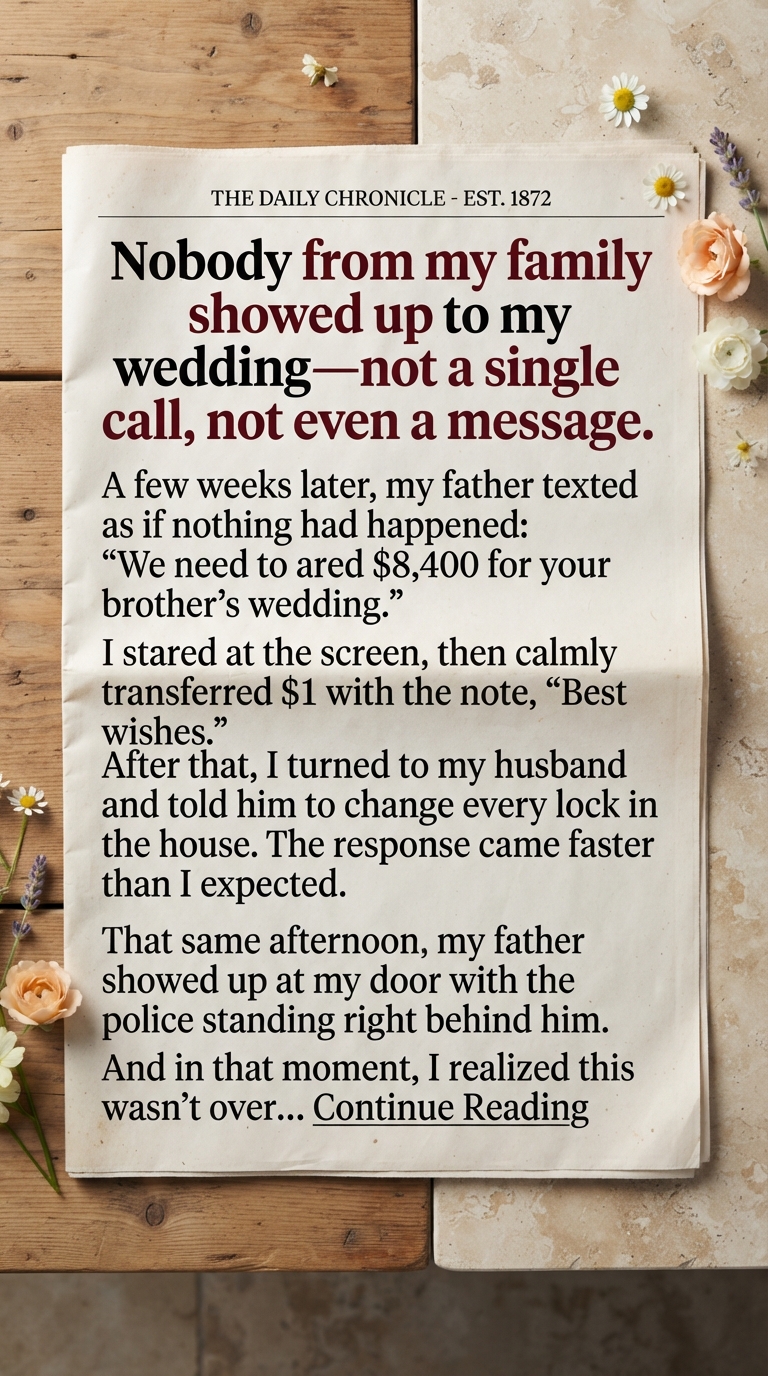
Nobody from my family showed up to my wedding.
Not a single call.
Not one message.
Not even a cheap “Congratulations.”
There were thirty-two chairs at the small outdoor ceremony.
Two of them had our names written on little place cards:
Dad and Mom.
They remained empty.
My brother’s chair stayed empty too.
I had spent the entire morning pretending I didn’t care.
But when I walked down the aisle and saw those empty seats, something inside me broke quietly.
My husband, Ethan, noticed.
He squeezed my hand.
“Don’t look at them,” he whispered.
“I’m not.”
“You are.”
I smiled weakly.
“I’m looking at you.”
And I was.
That was the day I stopped waiting for my family to choose me.
I just didn’t know yet that they would eventually come back—not because they missed me, but because they needed something.
Money.
Three weeks after our wedding, my phone buzzed.
It was Dad.
The message was so casual that for a moment I thought I had misread it.
We need to raise $8,400 for your brother’s wedding. Everyone is expected to contribute. Send your share today.
I stared at the screen.
No apology.
No explanation.
No mention of my wedding.
Nothing about how they had hurt me.
Just a demand.
I showed Ethan.
He read it twice.
“You’ve got to be kidding.”
“I wish I were.”
“Are you going to answer?”
I opened the banking app.
Ethan looked at me.
“What are you doing?”
“Contributing.”
I transferred exactly one dollar.
In the note field, I wrote:
Best wishes.
Then I sent it.
Ethan burst out laughing.
“That’s cold.”
“No.”
I put my phone down.
“It’s polite.”
Then I turned to him.
“Change every lock.”
He stopped laughing.
“You’re serious?”
“Every door.”
We changed the front lock.
Back door.
Garage.
Side entrance.
The keypad.
Even the code to the alarm system.
Then I changed every password that my family had ever known.
It was strangely peaceful.
Like closing doors that should have been closed years earlier.
I thought that was the end.
It wasn’t.
My father called twenty-seven minutes later.
I didn’t answer.
He called again.
Then again.
Finally, I got a text.
How dare you send $1.
I smiled.
A second message came.
We need to discuss this in person.
I replied:
There’s nothing to discuss.
His answer came instantly.
We’ll come over.
I stared at the screen.
Ethan noticed.
“What did he say?”
“They’re coming.”
“Okay.”
He reached for his phone.
“I’m calling security.”
We had barely finished speaking when the doorbell rang.
I checked the camera.
My father stood on the porch.
My mother beside him.
And behind them—
two police officers.
My stomach tightened.
Ethan stepped beside me.
“Why are the police here?”
“I don’t know.”
My father knocked again.
“Open the door!”
One of the officers motioned toward the camera.
“Ma’am, we need to speak with you.”
I didn’t move.
Instead, I called the police department directly.
The dispatcher confirmed the officers had been sent after my father reported a dispute involving property and alleged theft.
I stared at the screen.
“Theft?”
Ethan looked at me.
“What does your father say you stole?”
“I don’t know.”
Then I heard Dad shouting through the door.
“You can’t keep my property from me!”
I froze.
Property?
What was he talking about?
I opened the door but kept my body between the entrance and the hallway.
“What property?”
My father held up a folder.
“My mother’s jewelry.”
I stared at him.
“What?”
“You took it.”
“No, I didn’t.”
He turned toward the officer.
“She took family valuables from the house and refuses to return them.”
I looked at him in disbelief.
“Dad, your mother’s jewelry is in your safe.”
“I sold that house.”
“What?”
He swallowed.
“The house you grew up in.”
I stared at him.
“You sold Grandma’s house?”
“Yes.”
“Then how could I have her jewelry?”
“You removed it before the sale.”
“I haven’t been inside that house in eighteen months.”
My father didn’t answer.
The officer looked at him.
“Sir, do you have documentation showing your daughter currently possesses the items?”
My father pointed at me.
“She does.”
“That is not documentation.”
He became frustrated.
“She knows where they are.”
I finally understood.
This wasn’t about jewelry.
It was pressure.
They wanted me scared enough to open the door.
But why?
Then I noticed something sticking out of my father’s folder.
A blue envelope.
My name was written across it.
My heart stopped.
I knew that envelope.
It belonged to my grandmother.
She had died two years earlier.
Before her death, she had given me one instruction.
“Never let your father know I gave this to you.”
I had obeyed.
Inside the envelope was a handwritten letter and a copy of an old property deed.
I had never understood why she wanted me to keep them.
After her funeral, my father had asked whether Grandma had left me anything.
I said no.
He accepted the answer.
At least, I thought he had.
Now the envelope was in his hand.
“How did you get that?”
His face changed.
“Where is the original?”
I stared at him.
The officer immediately noticed.
“What original?”
My father looked at me.
“You know exactly what I’m talking about.”
Ethan stepped forward.
“Maybe we should have attorneys present.”
My father shouted:
“Stay out of this!”
The second officer moved closer.
“Sir, lower your voice.”
My father ignored him.
“You took what belonged to the family!”
I looked at the envelope.
Then at Dad.
“I didn’t take anything.”
“You have the deed.”
I said nothing.
He had just admitted it.
The deed.
That was what he wanted.
I called my attorney.
She arrived thirty minutes later.
The police remained outside while we talked.
I showed her the letter from Grandma.
She read it once.
Then again.
Her expression changed.
“Emily, where is the original deed?”
“Safe deposit box.”
She looked at me.
“Don’t move it.”
“Why?”
“Because this just got much bigger.”
She explained.
My grandmother had purchased the family property years before.
Not my father.
Not my grandfather.
Her.
And before she died, she had placed the property in a trust.
The beneficiary was me.
My father had never owned the house.
He had only been allowed to live there.
He had sold property he didn’t legally own.
And the sale had already closed.
My attorney looked at me.
“That means someone may have committed fraud.”
I stared at the floor.
The house where I’d grown up.
The home my father had claimed was his.
He had never actually owned it.
My grandmother had left it to me.
And he had sold it anyway.
My father had not come for the $8,400.
He had come because the title company had discovered a problem.
The buyer’s attorney had found the trust.
The sale was now under review.
And my father had panicked.
He knew I had the original documents.
He thought if he accused me of stealing the jewelry, he could frighten me into handing over the deed.
It almost worked.
Almost.
Then Ethan asked the question nobody else had.
“Why did you wait until after the wedding?”
My father looked at him.
“What?”
“You ignored her wedding completely.”
Ethan pointed toward the house.
“Then three weeks later you demand money.”
Silence.
“Why?”
My father didn’t answer.
My attorney looked at me.
“He was waiting for you to marry.”
I frowned.
“Why?”
“Because marriage could change how he believed you would respond financially.”
She paused.
“He assumed your husband would pressure you to settle the dispute quietly.”
I looked at Ethan.
He shook his head.
“He doesn’t know me very well.”
The next morning, the title company contacted us.
The property sale was frozen.
The buyer was furious.
My father faced an investigation.
Then we discovered something worse.
He hadn’t only sold the house.
He had borrowed against it.
Multiple times.
The total debt was nearly $300,000.
He had been using a property he did not own as collateral.
The bank had no idea.
My grandmother had known something like this might happen.
That’s why she had placed the trust in my name.
That’s why she had kept the original deed.
That’s why she had told me never to tell Dad.
And suddenly, one sentence from her letter made sense.
Your father loves what property can do for him. I hope you learn to love what it cannot take from you.
My father begged me to save him.
Not once.
Not twice.
Every day for weeks.
“Please.”
“I can fix this.”
“You’re my daughter.”
“We can keep this private.”
That last one made me angry.
“Private?”
“You embarrassed me by sending one dollar.”
I stared at him.
“You humiliated me by refusing to attend my wedding.”
He looked away.
“We had reasons.”
“What reasons?”
He didn’t answer.
“Say it.”
He remained silent.
So I did it for him.
“You didn’t come because you knew you’d need something from me.”
His face crumpled.
And I realized I was right.
I could have destroyed him.
I could have refused every request.
I could have demanded everything back.
Instead, I made one decision.
I would not rescue him.
But I also wouldn’t become cruel.
I worked with the attorney to ensure the legitimate buyer was protected.
We unwound the fraudulent transactions.
The bank pursued recovery through the proper legal channels.
The title was restored.
And my father was left to deal with the consequences of what he had done.
My mother eventually called me.
She cried.
“I should have stopped him.”
“Yes.”
“I didn’t know.”
“You knew enough.”
She was silent.
Then she whispered:
“I’m sorry.”
I believed she was.
But forgiveness didn’t mean access.
So I kept the locks changed.
Six months later, I stood in the backyard of my own home with Ethan.
The sun was setting.
There were no arguments.
No unexpected relatives.
No demands.
No suitcases arriving without warning.
Ethan handed me a cup of coffee.
“You ever think about how this started?”
I smiled.
“With a $1 transfer?”
He laughed.
“Exactly.”
I looked at my phone.
There was one final message from my father.
I understand now.
I didn’t reply.
Because there was nothing left to say.
He had spent my entire life believing that being my father gave him rights to my loyalty, my money, my time, even my grandmother’s property.
He was wrong.
Love can create a bond.
It cannot create ownership.
And that one dollar?
It wasn’t revenge.
It wasn’t cruelty.
It was the smallest possible way of saying something I had been afraid to say for years:
You don’t get to treat me like family only when you need something.
I slipped my phone into my pocket.
Then I took Ethan’s hand.
My wedding had been empty of the people who were supposed to love me most.
But standing there, in the quiet home we had built together, I finally understood something.
A wedding doesn’t determine who your family is.
The people who stand beside you when you have nothing to offer do.
And this time, I knew exactly who mine was.