The Seven Days I Stopped Being My Daughter’s Servant
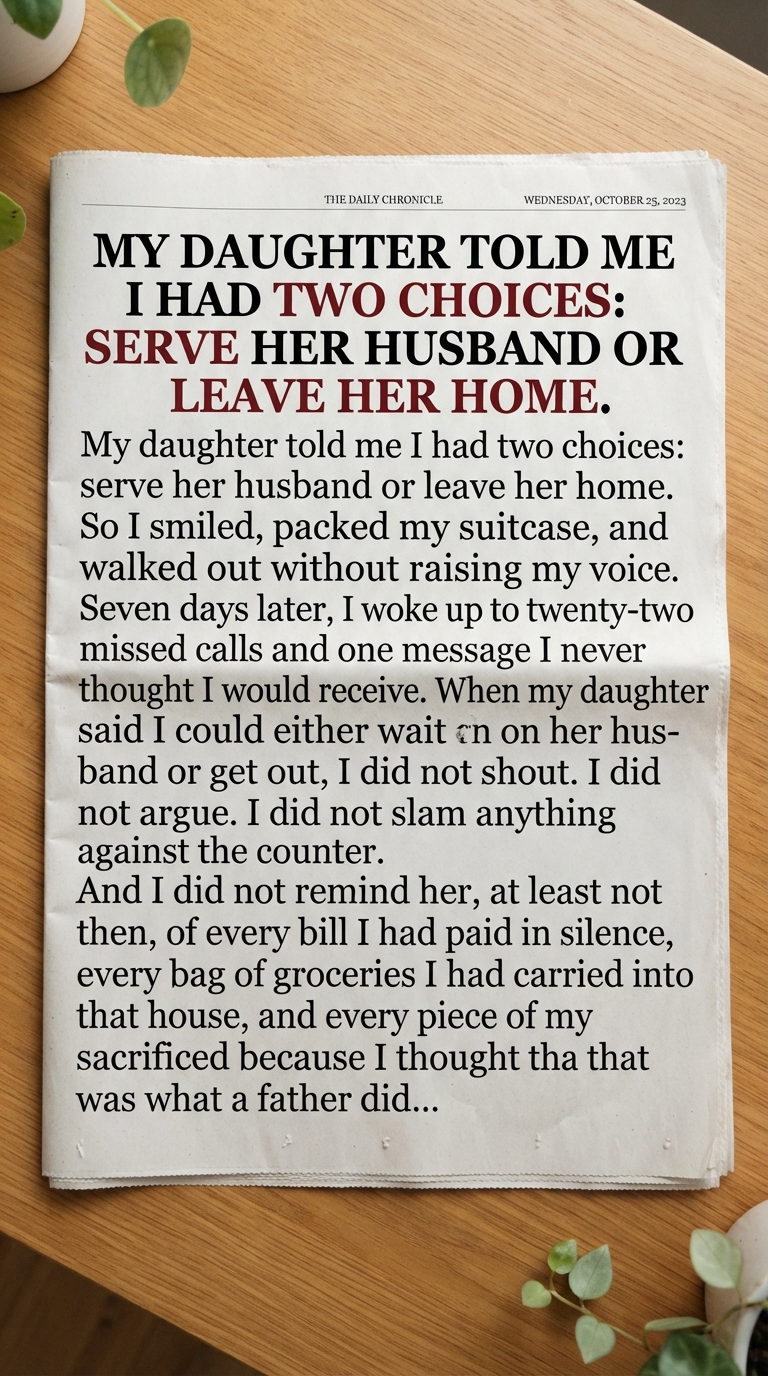
My daughter told me I had two choices:
Serve her husband or leave her home.
So I smiled, packed my suitcase, and walked out without raising my voice.
Seven days later, I woke up to twenty-two missed calls and one message I never thought I would receive.
When my daughter said I could either wait on her husband or get out, I did not shout.
I did not argue.
I did not slam anything against the counter.
And I did not remind her, at least not then, of every bill I had paid in silence, every bag of groceries I had carried into that house, and every piece of my retirement I had sacrificed because I thought that was what a father did.
Instead, I looked at my daughter and asked one question.
“Are you sure?”
She folded her arms.
“Yes.”
Her husband, Brandon, sat on the couch with his feet on my coffee table.
He didn’t look at me.
He simply said, “We need boundaries around here.”
I almost laughed.
“Boundaries?”
My daughter nodded.
“You’ve been living with us for two years, Dad. Brandon works all day. I’m raising the kids. It isn’t fair that he has to come home and still do things around the house.”
I stared at her.
I had cooked most of their dinners.
I had packed the children’s lunches.
I had picked up groceries.
I had paid the electric bill when Brandon’s paycheck was late.
I had even covered the property taxes one year when they were short.
But apparently I had become a burden.
“What exactly do you want me to do?” I asked.
My daughter answered without hesitation.
“Get up early. Make Brandon breakfast. Have dinner ready when he gets home. Do his laundry. Keep his coffee ready. And don’t question him.”
I looked at Brandon.
He finally met my eyes.
“You heard her.”
Something inside me went quiet.
Not angry.
Not broken.
Just finished.
I nodded.
“Okay.”
My daughter frowned.
“That’s it?”
I smiled.
“That’s it.”
I went upstairs.
Packed one suitcase.
Took my medications.
My wallet.
My old photo album.
And the small wooden box that contained my wife’s wedding ring.
Before I left, I placed the house key on the kitchen counter.
My daughter followed me to the door.
“You’re really leaving?”
“You gave me two choices.”
“And you’re choosing to leave?”
“Yes.”
She looked almost annoyed.
“I thought you’d fight.”
I looked at her.
“I already did.”
She didn’t understand.
So I walked away.
My wife had been dead for four years.
After she died, my daughter kept telling me I shouldn’t be alone.
“You can live with us, Dad.”
So I moved in.
At first, it was wonderful.
I helped with the children.
I fixed things around the house.
I cooked.
Brandon called me “Dad.”
My daughter hugged me.
It felt like I had a family again.
Then gradually, something changed.
Brandon stopped asking.
He started ordering.
“Can you make coffee?”
“Can you pick up my dry cleaning?”
“Dinner by seven.”
My daughter stopped defending me.
“Dad, just do it.”
I didn’t complain.
Because I thought peace was worth the price.
And because I had convinced myself that helping my daughter was what a father was supposed to do.
What I hadn’t realized was that helping and being used are not the same thing.
I rented a small apartment across town.
One bedroom.
Old carpet.
Tiny kitchen.
A balcony barely big enough for two chairs.
It was perfect.
No one told me what time to wake up.
No one left laundry on the floor.
No one called me selfish for wanting an afternoon to myself.
The first night, I sat at the tiny kitchen table and ate a frozen dinner.
It was terrible.
I smiled anyway.
For the first time in years, I was eating a bad dinner in my own home.
The next morning, I went to the grocery store.
I bought one steak.
One loaf of bread.
A carton of eggs.
And a small cake from the bakery.
I brought everything home.
I cooked for myself.
And for the first time in a very long time, I didn’t feel like somebody’s father.
I felt like a man with his own life.
On the second day, my daughter called.
I didn’t answer.
On the third, Brandon texted.
This is childish. Come home.
I deleted it.
On the fourth, my daughter sent:
The kids miss you.
That one hurt.
I almost replied.
Then another message appeared.
You can’t just abandon your family because you don’t like being asked to contribute.
I stared at that sentence.
Then I put the phone down.
Because I had not abandoned them.
I had simply stopped carrying them.
On the fifth day, something happened that changed everything.
I received a letter.
It was from my former employer’s retirement administrator.
I had completely forgotten about an old pension account.
I’d left the company twelve years earlier.
Apparently, a portion of the pension had remained untouched because I never completed the rollover paperwork.
The balance was substantial.
Over $180,000.
I called immediately.
The representative confirmed the account was mine.
Then she said:
“There is another interesting detail.”
“What?”
“The account has a beneficiary designation.”
I paused.
“Who?”
“My daughter.”
My chest tightened.
That evening, I sat on my balcony for a long time.
I had been planning to leave my daughter something anyway.
Because that was what parents did.
But suddenly, I wondered whether she’d expected more than love.
Had she thought my retirement was something she could eventually count on?
Had she known about the pension?
I didn’t know.
And I wasn’t going to assume.
On the sixth day, I called an attorney.
I told him everything.
He listened.
Then he asked me a simple question.
“Do you still want to leave your estate the way you originally intended?”
I looked out the window.
“I don’t know.”
“Then don’t decide while you’re hurt.”
That was good advice.
So I didn’t.
Instead, I spent the day doing something I’d forgotten how to do.
Nothing.
No errands.
No favors.
No fixing.
I sat in a park.
Fed ducks.
Read half a newspaper.
And went home before sunset.
It was the most peaceful day I’d had in years.
On the seventh morning, my phone showed twenty-two missed calls.
All from my daughter.
I stared at the screen.
Then I saw one message.
Three words.
Dad, please come.
I nearly called immediately.
But something stopped me.
Then another message came.
I was wrong.
My heart tightened.
A third appeared.
Please forgive me.
I called.
She answered on the first ring.
“Dad?”
Her voice was shaking.
“What happened?”
“Brandon left.”
I sat down.
“When?”
“Last night.”
“What happened?”
She began crying.
“He told me he was tired of taking care of everyone.”
I closed my eyes.
The irony hurt.
“What do you need?”
“I need you.”
I was silent.
Then she said something I will never forget.
“Not because I need you to cook. Not because I need you to pay anything. I just need my dad.”
I couldn’t speak for a few seconds.
Then I asked:
“Are the kids okay?”
“Yes.”
“Are you safe?”
“Yes.”
“Then I’m coming.”
When I arrived, the house looked different.
Not physically.
Emotionally.
Laundry was everywhere.
The kitchen was a mess.
The children were sitting quietly on the couch.
My daughter looked exhausted.
She had lost the confidence she had when she told me to leave.
She walked toward me.
“I am so sorry.”
I didn’t answer immediately.
She started crying.
“I thought you’d always be there.”
“I was.”
“I thought because you’re my dad, you’d always say yes.”
“I did.”
She wiped her face.
“I didn’t realize what I was doing.”
I looked at her.
“You treated my love like an obligation.”
She nodded.
“I know.”
“You didn’t ask me to help. You expected it.”
“I know.”
“And when I stopped being useful, you told me to leave.”
She lowered her head.
“I know.”
I let the silence sit between us.
Then I asked:
“What happened with Brandon?”
She laughed bitterly.
“He said he didn’t marry me to become responsible for my father.”
I looked at her.
“And what did you say?”
“I told him that my father had been more of a husband to this household than he had.”
I almost smiled.
“Then what?”
“He packed a bag.”
I stayed that night.
But I didn’t move back in.
That mattered.
I cooked dinner for the children.
I helped with homework.
I read bedtime stories.
Then I went back to my apartment.
The next morning, my daughter called.
“Dad?”
“Yes?”
“Would you come to dinner tonight?”
“I’d like that.”
“Not to cook.”
I laughed.
“I know.”
“And Dad?”
“Yes?”
“Bring yourself.”
I smiled.
“Deal.”
Things didn’t magically become perfect.
My daughter had to learn how to manage her home without me.
She had to become responsible for her finances.
She had to stop expecting rescue.
I had to learn something too.
I had spent so many years believing that sacrifice was the purest form of love.
It wasn’t.
Love without boundaries can become resentment.
Helping without limits can become enabling.
And being a good father doesn’t mean allowing your children to treat you badly.
A few months later, my daughter found a small house of her own.
She started managing her money better.
She went back to work full-time.
And she and Brandon eventually divorced.
I never told her about the $180,000 pension until everything was settled.
When I finally did, she looked at me.
“Are you leaving that to me?”
I smiled.
“I’m still deciding.”
She nodded.
And to my surprise, she said:
“Whatever you decide, Dad, I understand.”
That was the answer I’d been waiting for.
Not an entitlement.
Not an argument.
Not a demand.
Understanding.
I eventually changed the beneficiary designation.
But I didn’t remove my daughter entirely.
I simply divided things differently.
I created a trust for my grandchildren.
I set aside some money for charity.
And I kept enough for myself to live comfortably for the rest of my life.
Because for the first time, I understood that loving my children did not require me to disappear.
One Sunday morning, my daughter came to my apartment.
She brought breakfast.
She set the food on my little kitchen table.
Then she looked around.
“You really like this place?”
I smiled.
“I love it.”
She sat down.
“It isn’t very big.”
“Neither is your heart when you’re angry.”
She laughed.
“Fair.”
Then she reached across the table and squeezed my hand.
“I am glad you left.”
I looked at her.
“What?”
“I hated that I said those things to you.”
She took a breath.
“But losing you for those seven days forced me to understand what I had.”
I smiled.
“You didn’t lose me.”
“I almost did.”
“Almost.”
We sat quietly.
Then she said:
“Dad?”
“Yes?”
“Thank you for not staying.”
I looked at her.
She smiled through tears.
“Because if you had stayed, I might never have learned how to become an adult.”
I squeezed her hand.
And finally, I understood.
Walking out of my daughter’s house had not been abandoning my family.
It had been the first truly loving thing I had done for all of us.
I had spent years teaching my daughter that a father was someone who sacrificed everything.
That week, I taught her something better.
A father is also someone who knows when to say:
Enough.