The One Dollar That Opened the Door to the Truth
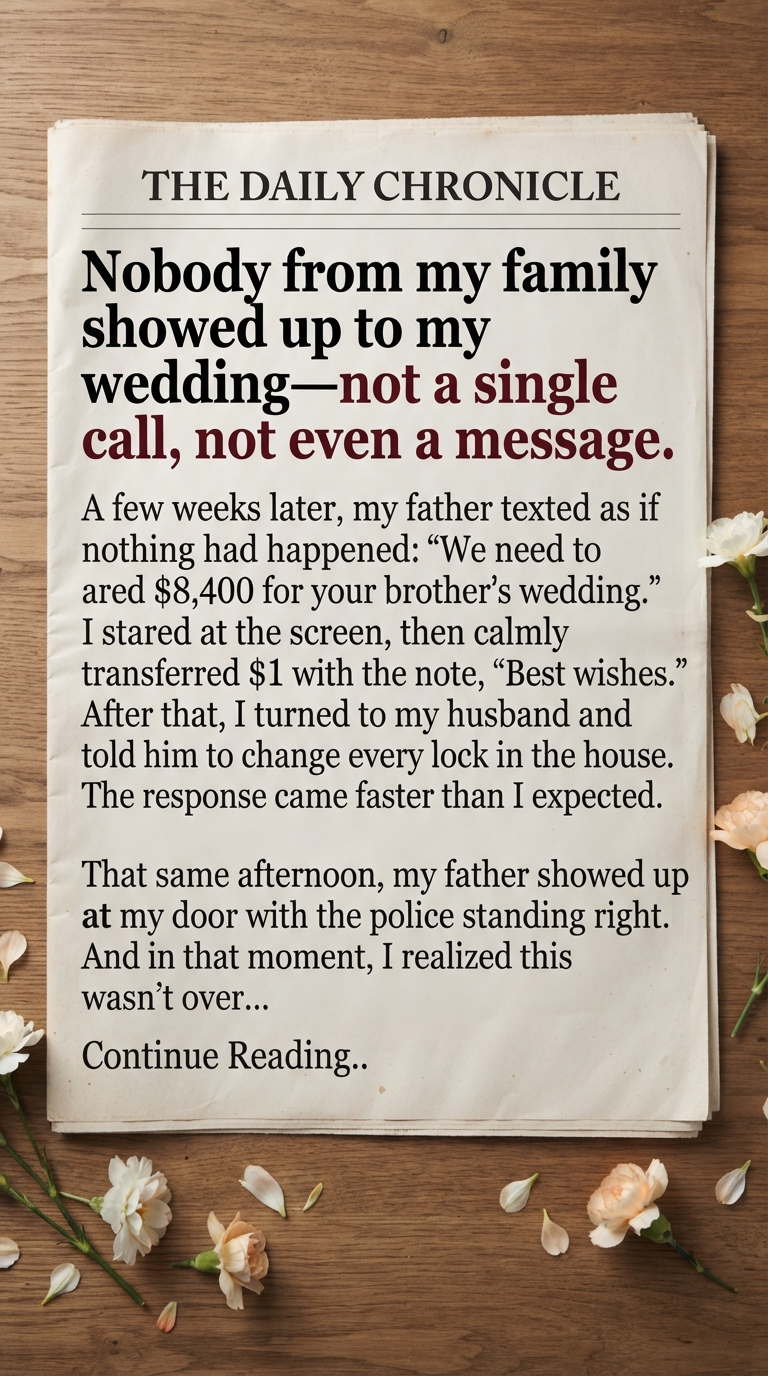
Nobody from my family showed up to my wedding.
Not my father.
Not my mother.
Not my brother.
Not even one of my aunts.
There wasn’t a single call.
Not one text.
Nothing.
Thirty-six chairs had been set up beneath the garden lights that afternoon.
Three rows were reserved for my family.
They remained empty.
My husband, Ethan, noticed me looking at them.
“You don’t have to pretend you’re okay,” he whispered.
I swallowed.
“I know.”
“Do you want to stop?”
I shook my head.
“No.”
Then I took his hand.
“Let’s get married.”
And we did.
It was a beautiful ceremony.
Small.
Quiet.
Full of people who had actually chosen to be there.
Ethan’s parents cried.
My best friend gave a speech.
We danced under the lights.
And for a few hours, I almost forgot the empty chairs.
Almost.
Three weeks later, my phone buzzed at 8:17 a.m.
It was my father.
I hadn’t heard from him since before the wedding.
For one second, I wondered whether he was finally going to apologize.
I opened the message.
We need to raise $8,400 for your brother’s wedding. Everyone needs to contribute. Send your share today.
I stared at the screen.
Then I read it again.
No congratulations.
No explanation.
No “I’m sorry we missed your wedding.”
Just money.
Ethan walked into the kitchen.
“What is it?”
I showed him.
He stared at the message.
“You’ve got to be kidding.”
“I wish I were.”
“What are you going to say?”
I opened my banking app.
He watched me.
“What are you doing?”
“Paying my share.”
“How much?”
I entered the amount.
$1.00.
Ethan laughed.
I smiled.
In the note field, I wrote:
Best wishes.
Then I pressed send.
I put my phone down.
“Now I’m changing the locks.”
Ethan looked at me.
“Every lock?”
“Every single one.”
We changed the front door.
The back door.
The garage.
The side entrance.
The keypad.
The alarm code.
Then I changed every password my family had ever known.
Ethan stared at the new deadbolt.
“You really think they’ll come?”
“I don’t know.”
I paused.
“But I’ve learned not to assume my family will respect a boundary just because I explain it politely.”
He nodded.
“Then we’ll be ready.”
I thought that was the end.
It wasn’t.
At 1:46 p.m., the doorbell rang.
I looked at the camera.
My father was standing on the porch.
My mother was beside him.
And behind them were two police officers.
My heart dropped.
Ethan stepped toward the door.
“What’s happening?”
“I don’t know.”
My father knocked again.
“Open the door!”
I didn’t.
One of the officers looked directly at the camera.
“Ma’am, we’d like to speak with you.”
I immediately called the police department using the official number.
The dispatcher confirmed that the officers had been sent after a complaint involving property and an alleged dispute with a family member.
I stared at the camera.
“What property?”
The dispatcher couldn’t provide details.
Ethan looked at me.
“This is serious.”
I nodded.
Then I opened the door.
But only as far as the security chain allowed.
“What happened?”
One officer spoke calmly.
“Your father claims that you have possession of property that belongs to him.”
“What property?”
My father held up a thick folder.
“My father’s estate documents.”
I frowned.
“What are you talking about?”
“You know exactly what I’m talking about.”
“No, I don’t.”
He looked at the officers.
“She has them.”
“Have what?” one officer asked.
“My mother’s papers. The deed. Financial records.”
I stared at him.
Then I noticed the color in my mother’s face.
She wasn’t angry.
She looked frightened.
That was when I knew something was wrong.
My father had never mentioned his mother.
Not in years.
My grandmother had died when I was nineteen.
She had always been kind to me.
She also distrusted my father.
I’d never understood why.
After her funeral, Dad told me:
“Your grandmother didn’t leave much. I handled everything.”
I believed him.
I was nineteen.
I had no reason to question him.
Until now.
I looked at the folder in his hand.
“Where did you get that?”
He didn’t answer.
My attorney, Claire, arrived twenty minutes later.
She took one look at the folder and asked my father:
“Did you tell the officers what this document is?”
“Yes.”
“Did you tell them there is an active probate dispute over your mother’s estate?”
My father froze.
The officer looked at him.
“Is that true?”
My attorney answered.
“It is.”
My father began talking quickly.
“She was supposed to hand everything over.”
Claire looked at me.
“Did you ever sign an agreement transferring those documents?”
“No.”
“Did you ever receive money from your grandmother’s estate?”
“No.”
Claire turned back to my father.
“Then why are you telling police she stole something?”
He looked away.
No answer.
My attorney asked me to step inside.
Then she whispered:
“There’s something I need to tell you.”
“What?”
“Your grandmother’s estate may be the reason they skipped your wedding.”
I stared at her.
“What?”
She explained that six months earlier, her office had been contacted by another attorney.
That attorney represented my grandmother’s former financial adviser.
The adviser had discovered something strange.
A trust existed.
A trust my father had never disclosed.
And I was one of the beneficiaries.
My grandmother had apparently created it years before her death.
The records had been sealed until a specific condition occurred.
My wedding.
I stared at Claire.
“Why would my wedding matter?”
“Because the trust contained a provision protecting your inheritance once you were legally married.”
My chest tightened.
“So my father knew?”
Claire nodded.
“Apparently.”
The room suddenly became very quiet.
I thought about my wedding.
The empty seats.
My father’s silence.
My mother’s absence.
My brother’s refusal to answer my invitations.
They weren’t simply angry.
They had been waiting.
Waiting to see whether I would get married.
Waiting to see whether the trust would activate.
And three weeks later, Dad had asked for $8,400.
I looked at Claire.
“Why?”
“Because the trust contained something else.”
She opened her briefcase.
A document.
Then another.
Then another.
My grandmother hadn’t left me cash.
She had left me controlling interest in a small group of properties.
Commercial buildings.
A rental complex.
And one piece of land that had increased dramatically in value.
The estimated value was more than $6 million.
I stared at the papers.
“That’s impossible.”
Claire shook her head.
“It’s real.”
My father had known.
Or at least he had suspected.
And suddenly his behavior made sense.
He hadn’t been asking for $8,400 because my brother needed help.
He had been testing whether I had discovered the trust.
The police officers were still outside.
My attorney stepped onto the porch.
“Officer, I believe we have enough information to clarify the complaint.”
She showed them the trust records.
The officers reviewed the documents.
One of them asked my father:
“Did you have authorization to take these documents?”
My father hesitated.
“No.”
“Did you tell your daughter she was legally required to surrender them?”
“Yes.”
“On what basis?”
Again, silence.
The officer looked at my father.
“Sir, you may need to address this matter through civil counsel.”
My father became furious.
“You don’t understand. That’s family property.”
I finally spoke.
“No.”
He turned toward me.
“It belonged to Grandma.”
“Yes.”
“And she left it to the family.”
I shook my head.
“She left it to me.”
My father’s expression collapsed.
My mother finally spoke.
“Please.”
Everyone turned toward her.
She was crying.
“I didn’t know it would go this far.”
I looked at her.
“What did you know?”
She wiped her eyes.
“Your father said he needed to talk to you before the wedding.”
“About the trust?”
She nodded.
“He said your grandmother had made mistakes.”
I stared at her.
“And you believed him?”
She looked ashamed.
“I believed your father.”
I took a breath.
“That was your choice.”
She nodded.
“I know.”
That evening, my father called.
I didn’t answer.
He left a voicemail.
His voice was completely different.
No anger.
No authority.
Just exhaustion.
“Please call me.”
I listened to it twice.
Then deleted it.
The next morning, my brother came to my house.
Alone.
He looked nervous.
“Did Dad tell you?”
“Tell me what?”
He swallowed.
“He borrowed money against the property.”
I stared at him.
“What property?”
“The family property.”
“There was no family property.”
He looked at me.
“That’s not what Dad said.”
My brother sat down.
“He’s been telling everyone that Grandma left him everything to manage.”
I shook my head.
“She didn’t.”
“I know that now.”
Then he handed me a folder.
“What is this?”
“Dad’s financial records.”
I opened it.
Loans.
Transfers.
Personal debts.
Payments to creditors.
And one line that made my stomach drop.
$68,000 — wedding expenses.
My brother looked at me.
“I thought our wedding was being paid for by Dad.”
“It was.”
“With whose money?”
I looked at him.
He didn’t answer.
The answer came three days later.
The money came from a property account connected to my grandmother’s trust.
My father had been using assets he didn’t own.
He had apparently been trying to keep the family financially afloat by borrowing against property he believed would eventually become his.
My grandmother had anticipated exactly this.
She had placed the assets into a trust.
She had prevented my father from controlling them.
And she had chosen me as the person who would eventually inherit them.
The $8,400 request had never really been about my brother’s wedding.
It had been a test.
A desperate test.
My father needed to know whether I had discovered the trust.
My one-dollar response had terrified him.
That’s why he showed up with the police.
He had hoped intimidation would work before I had time to consult an attorney.
It didn’t.
The legal process lasted months.
The trust was formally recognized.
The properties remained protected.
My father had to account for the money he had taken.
Some of it was recovered.
Some wasn’t.
My brother’s wedding was postponed until he could afford it himself.
And strangely, that was the first honest wedding decision my family had made in years.
I didn’t punish my brother.
He hadn’t created the problem.
I helped him financially—but only after he created his own budget and signed a written agreement.
He was embarrassed.
But he accepted.
My mother apologized.
I accepted the apology.
But I didn’t give her a key.
Some lessons require boundaries.
One year after my wedding, Ethan and I hosted Thanksgiving at our house.
My brother arrived with his wife.
My mother brought a pie.
My father didn’t come.
We never asked him to.
My brother looked at me across the table.
“I’ve been thinking about something.”
“What?”
“That $1.”
I laughed.
“What about it?”
“You really sent Dad one dollar?”
“Yes.”
He shook his head.
“Best dollar you’ve ever spent.”
I smiled.
“Actually, it cost me much less than keeping quiet would’ve.”
He nodded.
And I knew what he meant.
The dollar wasn’t revenge.
It was a boundary.
It was the first time I had refused to turn guilt into money.
My father had spent years believing that because we were family, I owed him access.
Access to my time.
My home.
My finances.
My loyalty.
He forgot something.
Being someone’s daughter does not mean becoming their property.
And the family that abandoned my wedding because they thought I wasn’t worth showing up for eventually discovered something they never expected.
The woman they ignored had inherited more than money.
She had inherited the one thing my grandmother had protected all those years:
The right to decide what happened next.
As I stood in my kitchen that Thanksgiving and watched Ethan laugh with my brother, I looked at the new locks on the doors.
They weren’t there to keep everyone out.
They were there to remind me that I finally had the right to decide who came in.
And who didn’t.