The Woman Who Came Back After Thirty Years
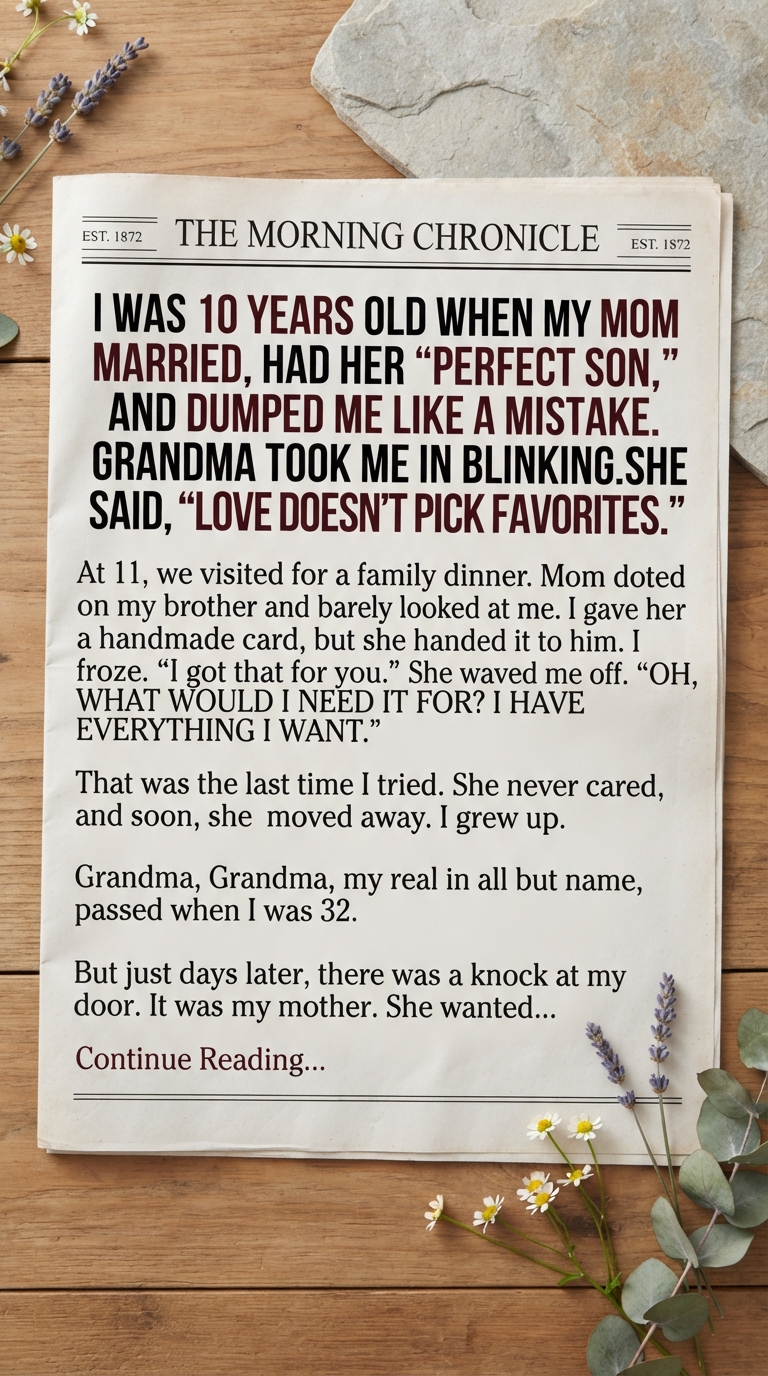
I was ten years old when my mom remarried, had her “perfect son,” and dumped me like a mistake.
Grandma took me in without blinking.
She looked at me while I cried at the kitchen table and said the words that would shape the rest of my life:
“Love doesn’t pick favorites.”
I didn’t understand how important those words were then.
I do now.
Because my mother spent the next twenty-two years proving Grandma right.
At eleven, I went to my mother’s house for a family dinner.
My little brother, Nathan, was three.
He was everything.
My mother held him while she cooked.
Fed him bites from her plate.
Took pictures of him.
Called him “my handsome boy” every five minutes.
I sat across the table, holding a handmade card I’d spent two afternoons making.
I had drawn flowers on the front.
Inside, I’d written:
I love you, Mom. Thank you for being my mom.
When dinner ended, I walked over to her.
“I made this for you.”
She barely looked at it.
Then she handed it to Nathan.
“Here, honey. Look what your sister made.”
I froze.
“I got that for you.”
She waved me off.
“Oh, what would I need it for? I have everything I want.”
Nathan crumpled the corner as he played with it.
I stood there staring.
Then I walked into the bathroom and cried silently.
Grandma found me ten minutes later.
She didn’t ask what happened.
She just held me.
I remember whispering:
“She doesn’t want me.”
Grandma hugged me tighter.
“Then we’ll make sure you know who does.”
That was the last time I tried to earn my mother’s love.
She moved away a year later.
No goodbye.
No birthday calls.
No Christmas cards.
Nothing.
I grew up.
Grandma raised me.
She came to my high school graduation.
She helped me buy my first car.
She was there when I graduated college.
She attended my wedding.
She cried when my daughter was born.
She wasn’t my mother.
But she was my parent in every way that mattered.
When Grandma died, I was thirty-two.
She passed peacefully in her sleep.
I held her hand in the hospital and told her everything I had been too young to say when she first took me in.
“You saved me.”
Her eyes opened slightly.
“No.”
She squeezed my fingers.
“You saved yourself.”
Those were her last words to me.
She died the following morning.
For the first time in twenty-two years, I felt completely alone.
I thought the hardest part was over.
I was wrong.
Three days after the funeral, someone knocked on my door.
I opened it.
And there stood my mother.
I hadn’t seen her in nearly fifteen years.
She looked older.
Tired.
But I recognized her immediately.
She stared at me.
“Hello, Emily.”
I didn’t answer.
Her eyes moved past me.
“Can I come in?”
I stepped aside.
She entered slowly.
She looked around my living room.
Family photographs covered one wall.
Photos of my daughter.
My husband.
Grandma.
There wasn’t a single picture of my mother.
She noticed.
“You have a beautiful home.”
“Why are you here?”
She sat down.
Then she said:
“I need something.”
Of course she did.
My entire body went cold.
“What?”
She looked at me.
“Your grandmother left me something.”
I stared at her.
“No.”
“She was my mother too.”
I almost laughed.
“She was your mother when you remembered she existed.”
My mother’s expression hardened.
“I deserve my share.”
I shook my head.
“Of what?”
“Her estate.”
There it was.
Not grief.
Not regret.
Money.
My mother had come back after fifteen years because my grandmother had died.
And apparently, she expected a daughter she had abandoned to hand over her inheritance.
I opened the door.
“You should leave.”
She stood.
“You can’t keep me from what’s mine.”
“I can ask you to leave my home.”
She looked offended.
“I’m your mother.”
I stared at her.
“Were you?”
The question hit her harder than I expected.
She looked away.
“I made mistakes.”
“You made choices.”
“I was young.”
“You were thirty when you left.”
She said nothing.
“You didn’t even say goodbye.”
“I had a new family.”
I nodded.
“Yes.”
Her eyes filled with tears.
“I thought you would understand someday.”
“I do understand.”
“What?”
“You chose.”
She looked at me.
“And Grandma chose too.”
My mother frowned.
“What does that mean?”
I didn’t answer.
Because I knew something she didn’t.
Grandma had left me a letter.
And she had told me not to open it until after her funeral.
That night, I sat alone at the kitchen table.
The envelope was thick.
My name was written across it.
Emily. After I’m gone.
I opened it.
The first line broke my heart.
My darling girl,
If your mother comes to you after I die, do not let guilt make your decision for you.
I stopped.
My mother knew.
Grandma had expected her.
I kept reading.
Your mother may tell you that she deserves part of what I leave behind because she is my daughter. Remember this: inheritance is not a reward for biology. It is a decision made by the person whose life built the estate.
My eyes filled with tears.
Then I turned the page.
I have left you the house.
I knew that.
But then:
I have also left you my investment accounts, my business interests, and the majority of my estate.
I stopped breathing.
There was more.
Much more.
Grandma had owned several rental properties.
A small commercial building.
Investment accounts.
And a piece of land that had increased dramatically in value over the years.
The total estate was worth more than $3.4 million.
I stared at the figure.
But the next paragraph mattered more.
I am leaving your mother nothing directly.
My hands trembled.
Not because I hate her.
Because I don’t want you to spend the rest of your life paying her for a childhood she chose to abandon.
I covered my face.
And cried.
Then I found another document.
A sealed legal statement.
Grandma had recorded everything.
When my mother left.
When she stopped paying support.
When Grandma became my legal guardian.
When my mother refused to attend my school events.
When she stopped answering calls.
There were copies of letters.
Returned birthday cards.
Unopened Christmas presents.
Even the handwritten card I had given my mother at eleven.
Grandma had kept it.
The card was inside the envelope.
She had written on the back:
She tried. Please never let her believe she wasn’t worthy of love.
I sobbed.
That small card had survived all those years.
My mother had handed it to my brother as if it were worthless.
Grandma had protected it like it was priceless.
The next morning, I called the estate attorney.
“I found the documents.”
“I know.”
“You knew?”
“Your grandmother asked me to be ready.”
“Did she expect my mother to come?”
“Yes.”
“Why?”
The attorney sighed.
“Because your mother contacted her six months before her death.”
I sat down.
“What did she want?”
“Money.”
My stomach tightened.
“How much?”
“She asked for enough to pay off her debts.”
“Did Grandma give it to her?”
“No.”
“Why?”
The attorney paused.
“She asked your mother one question.”
“What?”
“Where had she been for the previous twenty-two years?”
I closed my eyes.
I could almost hear Grandma asking it.
My mother apparently couldn’t answer.
So Grandma said:
“I already gave my daughter what she needed most. A chance to love her child. She chose not to use it.”
My mother returned two days later.
This time, she brought Nathan.
My little brother was thirty.
I hadn’t seen him since I was a teenager.
He looked uncomfortable standing on my porch.
My mother spoke first.
“We need to talk.”
I opened the door.
“Come in.”
Nathan stepped inside.
He looked around.
Then he noticed the photographs.
He picked up one of my daughter.
“She looks happy.”
“She is.”
He smiled faintly.
“I always wondered about you.”
I stared at him.
“You remembered me?”
“You were my sister.”
I nodded.
Before anyone could say more, my mother spoke.
“Your grandmother’s estate needs to be divided.”
I looked at Nathan.
“Did you know she left me most of it?”
He looked surprised.
“No.”
My mother glared at him.
“Don’t get involved.”
Nathan turned to her.
“Mom, I came because you said she was stealing our inheritance.”
I looked at him.
“Our?”
He immediately looked embarrassed.
“I didn’t know the details.”
I nodded.
“Neither did I.”
Then I placed Grandma’s letter on the table.
My mother saw it.
Her face drained of color.
“She wrote to you?”
“Yes.”
“May I read it?”
I handed it to her.
She read silently.
Her hands began shaking.
When she reached the paragraph about the card, she stopped.
She looked at me.
“You kept that?”
“No.”
I swallowed.
“Grandma did.”
My mother’s eyes filled with tears.
“I don’t remember doing this.”
“I do.”
She sat down.
“I was young.”
I shook my head.
“So was I.”
She covered her face.
Nathan stared at the table.
Neither of them spoke.
Finally, my mother whispered:
“I was jealous.”
I looked at her.
“Of what?”
“You.”
I was stunned.
She continued.
“After your father left, I blamed you for everything. Then I remarried. Nathan was born. Everyone loved him. I convinced myself that if I focused on him, I could forget everything that went wrong.”
I said nothing.
“It wasn’t your fault.”
“No.”
“I know that now.”
I looked at her.
“Do you?”
She cried.
“Yes.”
“Then why did you come for the money?”
She looked at the floor.
“Because I was afraid.”
“Of what?”
“That I had wasted my life.”
That answer was honest enough to hurt.
But honesty doesn’t erase damage.
I sat across from her.
“I’m sorry you regret your choices.”
She looked at me.
“But I won’t spend Grandma’s money trying to fix them.”
She nodded slowly.
“I understand.”
It was the first time she had said those words.
And I believed her.
I expected my mother to fight.
She didn’t.
The estate was settled according to Grandma’s wishes.
My mother received only what Grandma had specifically designated through a small personal bequest.
Nothing more.
I kept the house.
I kept the investments.
But I did something Grandma had never asked me to do.
I created a scholarship in her name.
For children who had been raised by grandparents because their parents couldn’t or wouldn’t care for them.
At the opening ceremony, my mother came.
She sat in the back.
She didn’t ask for attention.
Afterward, she approached me.
“I saw what you named it.”
I smiled.
“The Margaret Bell Foundation.”
She nodded.
“She would have been proud.”
“I think so.”
My mother hesitated.
“Could I visit sometimes?”
I thought about it.
“Sometimes.”
She nodded.
“And Nathan?”
“He can come too.”
She smiled through tears.
“Thank you.”
I looked at her.
“Don’t thank me yet.”
She laughed softly.
“I’ll try.”
A year later, my mother came to my house for Thanksgiving.
She brought a pie.
My daughter opened the door.
“Hi.”
My mother smiled nervously.
“Hi.”
My daughter looked at me.
“Mom?”
I nodded.
She stepped aside.
“Come in.”
My mother entered.
She looked around.
On the wall was a photograph of Grandma holding my daughter when she was a baby.
My mother stopped in front of it.
“She was a good woman.”
“Yes.”
“I lost so much.”
I looked at her.
“You did.”
She nodded.
“I can’t get it back.”
“No.”
She wiped a tear.
“But maybe I can stop losing more.”
That was the closest thing to an apology that could have mattered.
Not because it erased the past.
Because it accepted that the past could not be changed.
That night, after everyone left, I opened the old wooden box Grandma had kept.
Inside was the handmade card I’d given my mother when I was eleven.
The flowers were faded.
The paper was yellow.
But my handwriting was still there.
I love you, Mom. Thank you for being my mom.
I touched the card.
Then I smiled.
My mother had once asked what she needed it for.
She said she already had everything she wanted.
She had been wrong.
She had something precious in her hands that day.
A little girl’s love.
And she gave it away.
Grandma had found it.
She had saved it.
She had saved me too.
For thirty years, I thought the greatest tragedy of my childhood was that my mother didn’t love me.
Now I understand something different.
The tragedy was hers.
She had been given the chance to love me.
She chose not to.
And I had been given something better.
A grandmother who did.
So when my daughter asked me years later why Grandma had always said, “Love doesn’t pick favorites,” I told her the truth.
“Because sometimes the person who gives you life isn’t the person who teaches you what love is.”
She looked at me.
“Then who does?”
I smiled.
“The person who stays.”