The Platinum Card He Thought He Owned
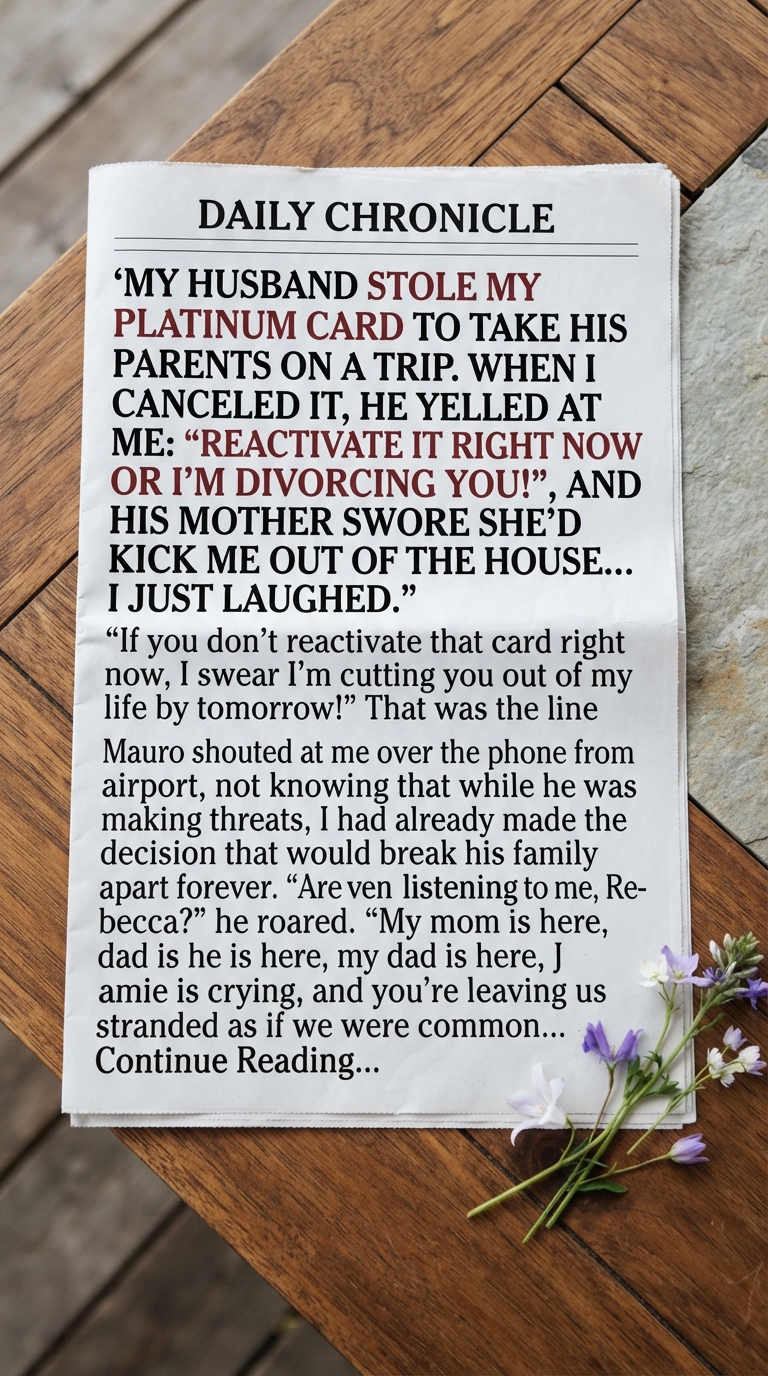
My husband stole my platinum card to take his parents on a trip.
When I canceled it, he yelled at me:
“Reactivate it right now or I’m divorcing you!”
His mother swore she’d kick me out of the house.
I just laughed.
Not because any of it was funny.
Because while Mauro was threatening me from an airport halfway across the country, I had already made the decision that would eventually break his family’s entire financial arrangement apart.
“Are you even listening to me, Rebecca?” he roared through the phone.
“My mom is here. My dad is here. Jamie is crying. And you’re leaving us stranded as if we’re common travelers!”
I looked at the credit-card alert still glowing on my laptop.
$18,742.61 — Luxury Travel Purchase
The airline tickets were first class.
The resort was five-star.
There were charges for private transportation, shopping, and a jewelry store.
And every charge had been made on my card.
A card that was supposed to be in my desk drawer.
A card Mauro had taken without asking.
I leaned back in my chair.
“I heard you.”
“Then reactivate it!”
“No.”
There was a long silence.
Then he shouted:
“You’re my wife!”
“Yes.”
“And you have to support my family!”
“No.”
His voice became colder.
“My mother says if you embarrass us like this, she’ll make sure you don’t stay in the house.”
I looked around the living room.
The house.
The one I had purchased eight years before I met him.
The mortgage paid off with money from my own company.
The house Mauro’s mother had spent years calling “our family property.”
I smiled.
“Tell your mother I said good luck.”
“What does that mean?”
“It means you’re going to have a very difficult time kicking me out of a house you don’t own.”
Then I hung up.
Mauro and I had been married for seven years.
When we first met, he was charming.
Funny.
Attentive.
He brought me coffee every morning.
He remembered little things.
He told me he admired how independent I was.
I believed him.
The problem began slowly.
First it was a request.
“Can you cover dinner?”
Then:
“Can I use your card for a few things?”
Then:
“Don’t be so formal. We’re married.”
I didn’t notice the change because each request seemed small.
A restaurant bill.
A hotel.
A new phone.
A loan to his brother.
His parents’ medical expenses.
A down payment for Jamie’s car.
Then one day, I looked at my credit-card statement and realized Mauro had spent almost $11,000 in three months.
When I questioned him, he became offended.
“Why are you keeping score?”
I should have paid attention to that sentence.
Instead, I paid the bill.
And the pattern continued.
My platinum card wasn’t an ordinary credit card.
It was linked to my business travel account.
It had a high spending limit.
It came with purchase protections.
And, most importantly, the account was solely mine.
Mauro had never been an authorized user.
He wasn’t supposed to have access.
So when my banking app sent the first alert that morning, I knew exactly what had happened.
He had gone into my home office.
Opened the locked drawer.
Taken the card.
And used it.
The first charge was a luxury airline.
The second was a resort.
Then a jewelry store.
Then a private car service.
I immediately called the card issuer.
The card was frozen.
Every pending transaction was flagged.
A fraud investigation was opened.
And the representative asked me one question:
“Do you know who made these purchases?”
I said:
“My husband.”
She paused.
“Did you authorize him?”
“No.”
“Then I recommend documenting everything.”
I did.
Screenshots.
Timestamps.
Messages.
The call.
Everything.
At that moment, I still didn’t know what I was going to do.
Then Mauro called.
And gave me the answer.
He spent the next twenty minutes shouting.
His parents were humiliated.
Jamie was upset.
The airline wouldn’t board them.
The resort required a valid payment method.
His mother was apparently “having a breakdown.”
All because I had canceled my own card.
Eventually, I asked:
“Mauro, did you ask me before taking it?”
“You’re supposed to share with your family!”
“You took it without permission.”
“We’re married!”
“That doesn’t mean you own my accounts.”
He laughed.
“You really want to make this about a credit card?”
“No.”
“Then what?”
“This is about you stealing from me.”
The airport went silent on his end.
“You’re calling me a thief?”
“You used my card without permission.”
“I was going to pay it back.”
“With what?”
Nothing.
He had no answer.
Then his mother came on the phone.
“Rebecca!”
I heard her shouting from somewhere beside him.
“How dare you humiliate my son!”
“I didn’t.”
“You stranded us!”
“No. Your son used a card that wasn’t his.”
“You’re a terrible wife!”
“Okay.”
“You should be ashamed!”
“I’ll survive.”
Then she said the sentence that changed everything.
“This is my son’s house, and I’ll make sure you are out before he comes home.”
I smiled.
“Mauro knows whose house it is.”
There was a pause.
Then:
“What?”
I hung up.
I called my attorney.
Her name was Claire.
She had handled my company’s legal work for years.
“Claire,” I said, “I need you to pull the title on my house.”
She was silent for half a second.
“Why?”
“I need to know exactly who owns it.”
“Rebecca, you bought it.”
“I know.”
“I’ll verify it.”
She called me back twenty minutes later.
“It’s still solely in your name.”
“Any liens?”
“No.”
“Any ownership interest belonging to Mauro?”
“No.”
I exhaled.
“Good.”
“What’s going on?”
I told her about the card.
Then I told her about the threats.
Claire’s voice became serious.
“Don’t confront him in person.”
“I’m not planning to.”
“Secure your accounts.”
“Already done.”
“Change your home security codes.”
“Already done.”
She paused.
“Rebecca, how much has your husband been spending?”
I opened a folder.
“That’s the problem.”
“What?”
“I started checking.”
“And?”
I stared at the numbers.
“I think there is much more.”
For months, Mauro had been transferring money from our joint household account.
Small amounts at first.
$500.
$800.
$1,200.
He labeled them:
“Family.”
“Gas.”
“Repairs.”
“Mom.”
“Dad.”
But when I traced the deposits, the money wasn’t going to his parents’ bills.
It was going to accounts I didn’t recognize.
An LLC.
A personal savings account.
A cryptocurrency exchange.
A credit card in his name.
Then I found one transfer for $32,000.
The recipient was an account belonging to his younger brother.
I called Claire.
She asked me to send everything.
She forwarded it to a forensic accountant.
Two days later, the accountant called.
“Rebecca, I think you should sit down.”
I frowned.
“Why?”
“We found transfers going back six years.”
“How much?”
There was a pause.
“Approximately $286,000.”
My stomach dropped.
“What?”
“That’s what we can identify so far.”
I stared at the wall.
Six years.
Nearly $300,000.
Money I thought we’d been spending on our household.
He had been diverting it.
And apparently, I wasn’t the only person who had been kept in the dark.
The forensic accountant found something else.
The LLC belonged to Mauro.
But the money eventually moved to an account controlled by his mother.
I stared at the records.
“So his mother knew.”
“Looks like it.”
Then Claire said:
“You should see this.”
She sent me a copy of a document.
It was an informal family agreement.
Mauro had apparently promised his parents that once I retired, they would move into my house.
The house I owned.
The house they had threatened to throw me out of.
They had been planning their future around my assets.
And I had never even been consulted.
I felt something inside me go cold.
This wasn’t a misunderstanding.
It was a system.
Mauro returned four days later.
He expected me to be waiting.
Instead, he found a formal notice from my attorney.
He called immediately.
“What is this?”
“Legal paperwork.”
“You hired a lawyer?”
“Yes.”
“Why?”
“Because we’re going to discuss your unauthorized use of my accounts.”
He laughed.
“Are you serious?”
“Yes.”
“You’re blowing up our marriage over a vacation?”
“No.”
I paused.
“I’m ending it because of what I learned about the last six years.”
Silence.
“What did you learn?”
I read out the first transfer.
Then the second.
Then the third.
By the time I finished, he wasn’t saying anything.
Then:
“Rebecca…”
“Don’t.”
“It wasn’t like that.”
“What was it like?”
“I was helping my family.”
“With $286,000?”
“I was going to put it back.”
“You never did.”
“I would have.”
“When?”
Silence.
I knew then.
He had no answer.
His mother arrived the next morning.
She came through the front door without knocking.
“You are destroying my family.”
I looked at her.
“No.”
She pointed at me.
“You have money. You have no idea what it’s like for ordinary people.”
I almost smiled.
“You’ve spent years treating my money like family property.”
“It should be!”
“Why?”
“Because you’re married to my son.”
I shook my head.
“That gives you absolutely no ownership of what I earned before or during our marriage without a lawful basis.”
She stepped closer.
“You can’t keep my son from me.”
“I’m not.”
“You’re leaving him.”
“Yes.”
She looked shocked.
“You really think you’ll be happier alone?”
I smiled.
“I already am.”
The divorce process was ugly.
There were arguments over finances.
Claims that Mauro had contributed “indirectly” to the household.
Arguments about the house.
Arguments about the business.
But the financial records were clear.
The house remained mine.
The business remained mine.
The unauthorized expenditures were documented.
And the money that had been diverted from our accounts became part of the settlement.
Mauro’s family was furious.
Then something unexpected happened.
His mother called me.
Not to threaten me.
To ask a question.
“Did you really freeze everything?”
“Yes.”
“You left us with nothing.”
I corrected her.
“No.”
“I left you with exactly what you had before you decided my money belonged to you.”
She hung up.
A year later, the divorce was finalized.
I sold nothing.
I kept the house.
I kept my company.
I closed every joint account.
I created a new financial structure.
And the platinum card?
I never replaced it with another card that anyone else could access.
I kept it.
Not because I wanted a reminder of Mauro.
Because the little piece of plastic had taught me a valuable lesson.
Trust is not the same thing as access.
Love is not the same thing as ownership.
Marriage does not give someone permission to take what isn’t theirs.
And family doesn’t get to threaten you into surrendering what you built.
One Saturday afternoon, I was sitting on the back porch when my phone buzzed.
A message from an unknown number.
Mauro’s mother wants to talk.
I deleted it.
Then I looked across the backyard.
The house was quiet.
My dog was sleeping in the grass.
The garden needed watering.
My coffee was still warm.
No one was yelling.
No one was demanding money.
No one was threatening divorce because I had the audacity to say no.
I smiled.
Mauro had thought canceling his stolen platinum card would be my breaking point.
He thought the threat of divorce would frighten me.
His mother thought she could kick me out.
They had all made the same mistake.
They thought my wealth was the source of my strength.
It wasn’t.
The strength was mine long before the money.
The card was just the thing that finally showed me who believed they had a right to it.
And when Mauro said:
“Reactivate that card or I’m divorcing you,”
he thought he was giving me an ultimatum.
He was actually giving me permission to stop negotiating with people who had already decided they were entitled to everything I had.
So I chose the option he never expected.
I let him go.
And for the first time in seven years, every dollar in my account—and every decision in my life—was finally mine again.