I Had Nothing—Until I Walked Into Their Gala
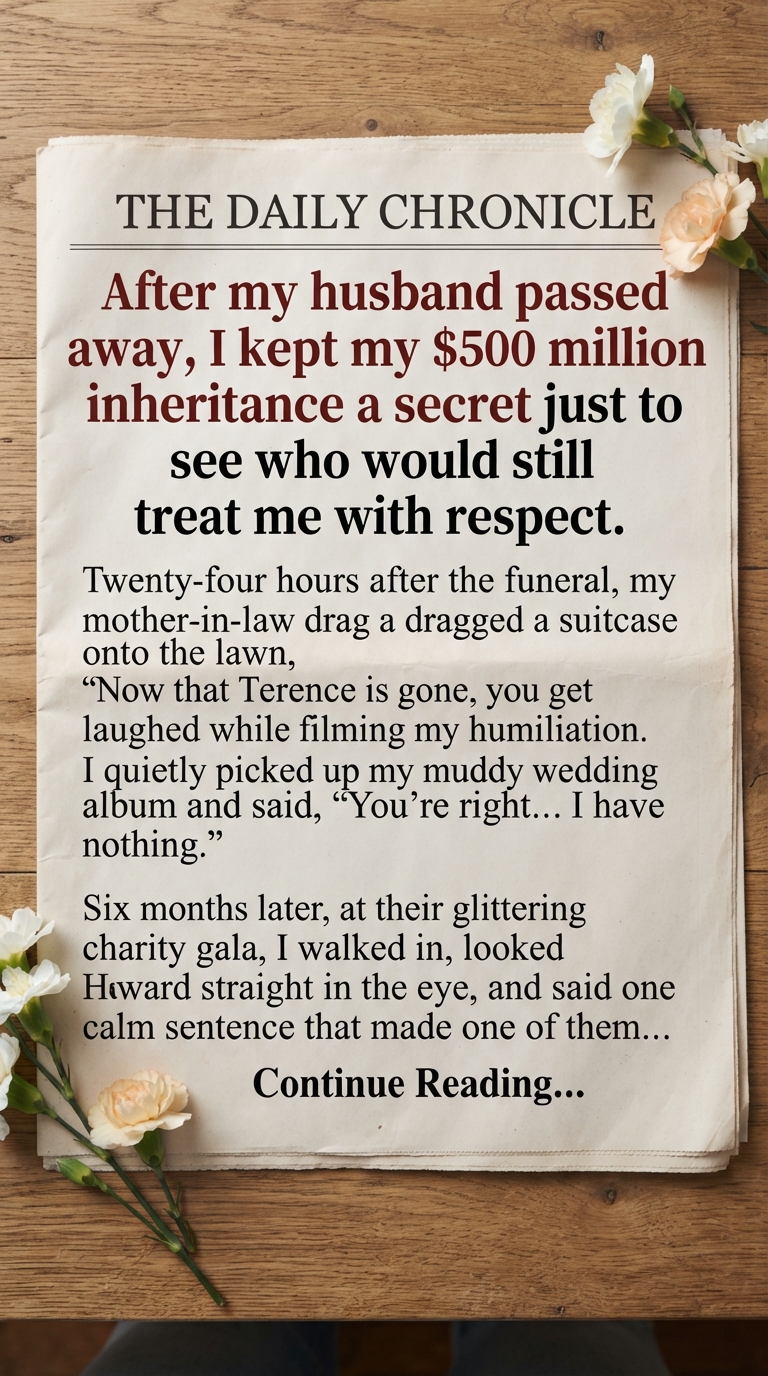
After my husband passed away, I kept my $500 million inheritance a secret just to see who would still treat me with respect.
I didn’t tell my mother-in-law.
I didn’t tell my husband’s siblings.
I didn’t tell the family attorney.
And I certainly didn’t tell the people who had suddenly started referring to me as “the widow.”
Twenty-four hours after Terence’s funeral, my mother-in-law, Marlene, dragged a suitcase onto the front lawn.
She was wearing black sunglasses despite the cloudy afternoon.
Her daughter stood beside her.
Her son, Howard, was filming everything on his phone.
Marlene pointed toward the house.
“Now that Terence is gone, you get nothing.”
I stared at her.
She laughed.
Howard zoomed in with the camera.
“Say something for the video,” he said.
I looked at the suitcase.
Then at the house where I had lived with Terence for twelve years.
Then at the people who had spent the entire funeral pretending to grieve while whispering about money.
I bent down.
A gust of wind had pushed my wedding album into a muddy patch beside the walkway.
I picked it up.
The white cover was stained brown.
My fingers shook.
Then I looked at Marlene.
“You’re right.”
She smiled.
“I have nothing.”
She laughed harder.
Howard kept recording.
“That’s what I thought.”
I carried the muddy album inside.
And I never told them what I actually had.
Terence had been thirty-nine when he died.
A sudden heart condition.
No warning.
One phone call.
One hospital hallway.
One doctor telling me there was nothing more they could do.
I had married him when I was twenty-eight.
We had built a beautiful life.
But there had always been one part of his life he kept carefully separated from the family.
His business.
Terence had inherited part of a technology company from his father, then turned it into something much larger.
I knew he was wealthy.
I didn’t know how wealthy.
When he died, an attorney came to our home with a series of documents.
I expected grief.
Instead, I got a number.
A very large one.
The inheritance wasn’t merely a house or investment portfolio.
It was controlling ownership in several companies, investment funds, property holdings, and trusts.
The estimated value was approximately $500 million.
I stared at the attorney.
“Are you sure?”
“Yes.”
“Does his family know?”
“Not yet.”
“Why?”
“Mr. Vale instructed us to disclose the structure of the estate only to you initially.”
I sat down.
“Why would he do that?”
The attorney opened a sealed letter.
“Because he told us there was something you needed to learn.”
I looked at the envelope.
Terence’s handwriting.
My heart broke all over again.
But I didn’t open it.
Not then.
Because I was still in shock.
And because I suddenly remembered something he’d said six months before his death.
“People treat you differently when they think you can give them something.”
I’d laughed.
He hadn’t.
“You’ll understand someday.”
Now I did.
The family didn’t know about the inheritance.
They assumed Terence had left everything complicated and inaccessible.
They knew there were businesses.
They knew there was money.
But they assumed his parents would control most of it.
And Marlene wanted me gone.
Quickly.
“You can’t stay here,” she told me the day after the funeral.
“This house belongs to the family.”
I looked at her.
“My husband and I lived here.”
“Terence is gone.”
She pointed toward the driveway.
“Pack your things.”
I stared at her.
“You want me out immediately after his funeral?”
“You’re not family anymore.”
That sentence hurt.
Not because I believed it.
Because I realized she did.
Howard filmed the entire thing.
His sister laughed.
Someone recorded me picking up the muddy wedding album.
I didn’t fight.
I didn’t scream.
I packed a small suitcase.
Not because I had to.
Because I wanted to see how far they were willing to go.
The attorney had already transferred the title of the property into a protected trust.
But they didn’t know that.
So I left.
And for six months, I let them believe I was broke.
I rented a quiet apartment under my maiden name.
I drove an ordinary car.
I wore the same clothes I’d always worn.
I answered no questions about money.
When people asked what Terence had left me, I said:
“I’m still sorting things out.”
Marlene told relatives that Terence had “left his widow almost nothing.”
Howard posted a video saying:
“Some people don’t understand that marriage doesn’t make you entitled to a family’s legacy.”
I saw the video.
I saved it.
I never responded.
Instead, I watched.
And what I discovered surprised me.
People I’d known for years stopped calling.
Friends of the family stopped inviting me places.
Several people who had been extremely affectionate during the funeral disappeared.
But a few people stayed.
My neighbor.
Terence’s former assistant.
The nurse who had cared for him.
Two of his oldest friends.
They never asked about money.
They asked whether I was eating.
Whether I was sleeping.
Whether I needed someone to sit with me.
Those were the people I remembered.
Meanwhile, Terence’s family grew more confident.
Marlene started telling people she planned to sell the estate.
Howard began appearing at charity events using Terence’s name.
His sister started shopping for a new house.
They believed I had been erased.
Then they announced a gala.
A huge charity event.
The Vale Foundation’s annual benefit.
Terence had founded it years earlier.
The family had turned it into a glittering social event.
The guest list included business leaders, celebrities, politicians, investors, and old family friends.
Marlene was scheduled to give the keynote speech.
Howard was listed as “acting chairman.”
They thought they owned everything.
They were wrong.
Six months after Terence’s death, I walked into the gala.
The room went silent.
Marlene saw me first.
Her smile disappeared.
Howard turned around.
His champagne glass nearly slipped from his hand.
“You?”
I walked calmly across the room.
I wasn’t wearing anything flashy.
No diamonds.
No dramatic dress.
Just a simple black gown and the wedding ring Terence had given me.
Marlene whispered:
“How did you get in?”
I looked at her.
“My husband founded this foundation.”
Howard stepped toward me.
“You’re not supposed to be here.”
I smiled.
“That’s interesting.”
“Leave.”
“No.”
He looked around.
People were beginning to watch.
A few of Terence’s oldest colleagues recognized me.
One of the foundation trustees hurried toward us.
“Mrs. Vale.”
Marlene interrupted.
“She’s not part of the family anymore.”
The trustee looked confused.
“Actually…”
He turned toward me.
“Mrs. Vale is the chair of the foundation.”
The room went silent.
Marlene stared at him.
“What?”
I looked directly at Howard.
Then I said one calm sentence:
“You should probably stop pretending you own what my husband left me.”
Howard laughed nervously.
“You don’t have authority.”
I nodded toward the podium.
“Go ahead.”
He froze.
“You can prove it.”
He looked at Marlene.
She looked at him.
Then the foundation’s outside counsel stepped onto the stage.
“Ladies and gentlemen, there appears to be a significant misunderstanding regarding ownership and control of the Vale Foundation.”
The lawyer opened a folder.
“Following Mr. Vale’s death, his controlling interest was transferred according to his estate plan.”
He looked at me.
“To his wife.”
Marlene stood.
“No.”
The lawyer continued.
“Mrs. Vale is the sole controlling beneficiary of the relevant trust.”
Howard interrupted.
“This is impossible.”
“It’s documented.”
The lawyer held up the trust certificate.
“And the foundation’s board was never transferred to Mr. Howard Vale.”
Howard’s face turned white.
“You told me I was chairman.”
The trustee looked at him.
“You were acting chairman.”
“Until when?”
The lawyer answered:
“Until Mrs. Vale arrived.”
Marlene stepped toward me.
“You tricked us.”
“No.”
“You knew!”
“Yes.”
“You let us humiliate you.”
I looked at her.
“You did that yourselves.”
She stared at me.
“Why?”
I took a breath.
“Because I wanted to know whether you loved me when you thought I had nothing.”
Marlene’s expression hardened.
“And?”
I looked around the room.
“At least now I know.”
Howard was still staring at the documents.
“How much?”
I didn’t answer.
“How much did Terence leave you?”
The room went silent.
I finally said:
“Enough.”
He laughed bitterly.
“You think you’re better than us?”
“No.”
I looked directly at him.
“I think I know exactly what you’re like.”
Then the estate attorney entered the room.
He carried another folder.
“Mrs. Vale, there is one more thing.”
I nodded.
He turned toward the audience.
“Mr. Vale anticipated that his family might challenge his estate plan.”
Marlene went still.
“He therefore created a series of independent trusts and safeguards.”
The attorney opened the final document.
“He specifically prohibited any beneficiary who attempted to intimidate, dispossess, or publicly humiliate his surviving spouse from receiving discretionary distributions.”
Howard’s face collapsed.
“What?”
The attorney read the provision.
“If any family member attempts to remove Mrs. Vale from the residence, interfere with her property rights, or publicly demean her in connection with inheritance, distributions may be suspended.”
Marlene looked at me.
The lawn.
The suitcase.
The video.
The wedding album.
She remembered.
I knew she did.
Then the attorney said something no one expected.
“There is also a recording.”
The giant screen behind the stage lit up.
Howard’s video appeared.
The clip from six months earlier.
Marlene:
“Now that Terence is gone, you get nothing.”
Howard laughing.
His sister laughing.
And me, kneeling in the mud, picking up my wedding album.
Then my voice:
“You’re right. I have nothing.”
The room watched in silence.
When the video ended, nobody clapped.
Nobody spoke.
Marlene lowered her head.
Howard looked sick.
I walked to the podium.
I could have humiliated them.
I could have announced the full value of the estate.
I could have told everyone exactly how much I was worth.
Instead, I said:
“Terence loved this foundation because he believed wealth should create opportunities for people who had never been given them.”
I looked at Marlene.
“That’s what we’re going to do.”
Then I announced a new initiative.
Scholarships.
Medical grants.
Small-business funding.
Support for families facing financial hardship.
And a new rule:
No family member would receive preferential access to foundation funds.
The room applauded.
Not because I was rich.
Because the foundation would finally represent what Terence had believed.
After the gala, Marlene waited for me outside.
Her face was tired.
“I was wrong.”
I didn’t answer.
She swallowed.
“I thought you had nothing.”
“You did.”
She looked confused.
“I thought you had no money.”
I nodded.
“And that’s why you treated me the way you did.”
She cried.
“I regret it.”
I believed she regretted it.
But regret does not erase memory.
So I said:
“I forgive you.”
Her face softened.
“But we’re not going back to the way things were.”
She nodded.
“I understand.”
Howard never apologized.
His legal disputes with the estate continued.
He eventually left the foundation entirely.
His sister stopped speaking to him.
And the family that had once treated me as disposable suddenly discovered that losing access to me meant losing access to something much larger than money.
A few weeks later, I returned to the old house.
The same house where Marlene had dragged my suitcase onto the lawn.
I walked inside.
Everything was still there.
The living room.
The fireplace.
The photographs.
And in a drawer, I found the wedding album.
I had cleaned the mud from the cover.
The pages were slightly warped.
But the photographs were intact.
I sat on the floor and opened it.
There was Terence.
Twenty years younger.
Smiling.
His hand around mine.
At the end of the album was a small note he’d written on our wedding day.
I had never noticed it.
Whatever happens, don’t let anyone convince you that being loved is something you have to earn.
I cried.
Because six months after his death, I finally understood what he’d been trying to tell me.
My inheritance had not made me powerful.
It had simply removed the fear that made me tolerate people who treated me badly.
I had $500 million.
But the greatest thing Terence left me wasn’t money.
It was the freedom to find out who people really were.
And now I knew.
Some people loved me.
Some people loved what they thought I could give them.
And some people never loved me at all.
That knowledge hurt.
But it also freed me.
I closed the wedding album.
Then I stood.
Outside, the sun was setting over the lawn where my mother-in-law had once told me I had nothing.
I smiled.
Because she had been right about one thing.
That woman standing in the mud six months ago had nothing.
No family standing beside her.
No one defending her.
No one applauding.
Except herself.
And that turned out to be enough.