The Sealed Envelope My Uncle Left Behind
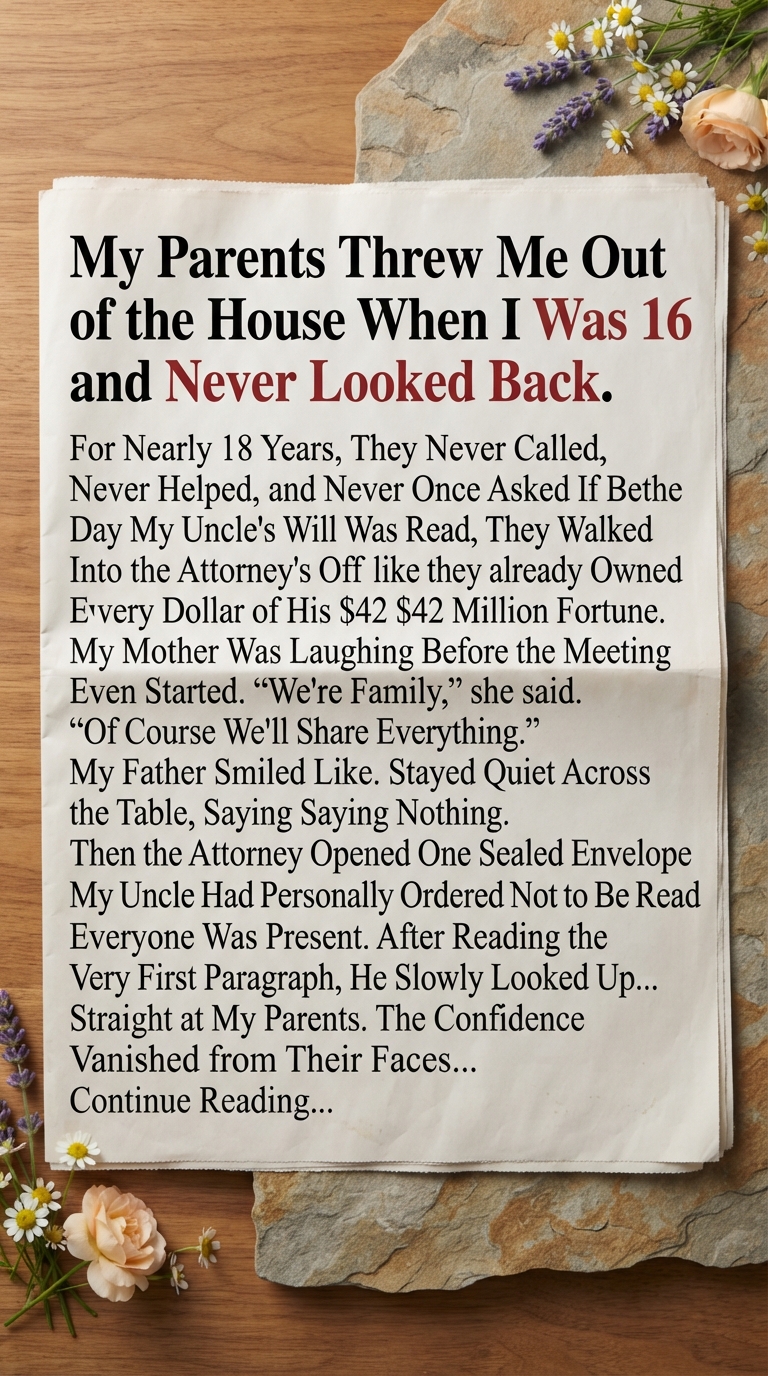
My parents threw me out of the house when I was sixteen and never looked back.
For nearly eighteen years, they never called.
Never helped.
Never asked where I was sleeping.
Never asked whether I was safe.
They simply erased me.
So when my uncle died and left behind a $42 million fortune, I expected my parents to pretend they had never abandoned me.
What I didn’t expect was how confidently they would walk into the attorney’s office acting as if every dollar already belonged to them.
My mother was laughing before the meeting even started.
“We’re family,” she said.
“Of course we’ll share everything.”
My father sat beside her, smiling quietly.
He didn’t have to say anything.
His expression said enough.
Across the table, I sat alone.
I hadn’t spoken to my parents in eighteen years.
Yet somehow, on the day my uncle’s will was supposed to be read, they believed we were all going to divide a fortune together.
Then the attorney opened one sealed envelope my uncle had personally ordered not to be read until after his death.
Everyone was present.
After reading the very first paragraph, he slowly looked up.
Straight at my parents.
The confidence vanished from their faces.
I was sixteen the night my parents threw me out.
I remember the exact time because the digital clock above our kitchen stove read 11:43 p.m.
My mother stood beside the sink.
My father stood near the back door.
I had one backpack.
Two changes of clothes.
My school uniform.
And $23 in my wallet.
“What did I do?” I asked.
My father wouldn’t look at me.
My mother crossed her arms.
“You’re not a child anymore.”
“I am sixteen.”
“You’re old enough to understand consequences.”
“What consequences?”
She looked at my father.
He finally spoke.
“You need to go.”
I thought it was a joke.
“Go where?”
“Anywhere.”
I stared at them.
“You’re kicking me out?”
My mother didn’t answer.
My father opened the door.
“Take your things.”
I looked at the house behind them.
My room.
My books.
My photographs.
The family pictures on the staircase.
Everything I’d ever known.
“Why?”
My mother finally looked at me.
“You’ll understand someday.”
I didn’t.
Not then.
Not for years.
I stepped outside.
The door shut behind me.
And neither of them came after me.
My uncle David found me that night.
He had been my father’s older brother.
He lived forty minutes away.
I don’t know who told him what happened.
I only know that around midnight, an old blue sedan pulled up beside the bus stop where I was sitting.
He rolled down the window.
“Get in.”
I climbed into the passenger seat.
He looked at me.
“Did they hurt you?”
“No.”
“Did they tell you where to go?”
“No.”
His jaw tightened.
“Okay.”
He drove for a while.
Then he said:
“You’re coming home with me.”
I started crying.
Not because I was safe.
Because someone had finally asked.
Uncle David never treated me like charity.
He gave me a room.
A key.
A job in his office when I was old enough.
He taught me how to drive.
How to balance a checkbook.
How to negotiate a contract.
How to spot someone lying.
And perhaps most importantly, he taught me that being abandoned didn’t mean being unworthy.
When I turned eighteen, he helped me enroll in college.
When I graduated, he gave me a place in his company.
Over the years, that company grew.
So did my uncle’s wealth.
But he never flaunted it.
He wore old watches.
Drove the same sedan for fifteen years.
And once told me:
“Money is useful, but it doesn’t make people good. It just gives bad people more expensive ways to prove they’re bad.”
I laughed.
He didn’t.
He was usually right.
I stayed close to Uncle David until the end.
He never married.
He had no children.
I was the closest thing he had to family.
Or at least, that’s what I believed.
Then he died suddenly at sixty-eight.
His estate was estimated at $42 million.
The family came out of nowhere.
Cousins I’d never met.
People who hadn’t spoken to David in years.
And my parents.
For the first time in eighteen years, they contacted me.
Not to ask whether I was okay.
Not to apologize.
Not to say they were sorry.
They wanted to know when the will would be read.
My mother even called me “sweetheart.”
I almost laughed.
“Please don’t call me that.”
She sighed.
“Whatever happened in the past is the past.”
I looked at her.
“You mean when you threw me out?”
“We’re not discussing that.”
“You’re right.”
“We’re family.”
I stared at the phone.
“No.”
She became irritated.
“You’re still carrying that childish anger?”
I hung up.
The attorney’s office was packed on the day of the reading.
My parents sat together.
My father wore an expensive suit.
My mother wore pearls.
They looked like they were attending a celebration.
My mother leaned toward me.
“I’m glad we’re all together again.”
I said nothing.
She smiled.
“This is going to be good for the family.”
I didn’t respond.
The attorney, Mr. Lawson, entered carrying several folders.
Then he placed a sealed envelope on the table.
He looked at everyone.
“Before I begin reading the executed will, there is a separate document.”
My mother smiled.
“Another letter?”
“Yes.”
“From David?”
“Yes.”
She laughed softly.
“How sentimental.”
Mr. Lawson didn’t smile.
“This envelope contains instructions Mr. David personally directed me to follow.”
My father finally spoke.
“Instructions about what?”
“The distribution of his estate.”
My mother’s smile disappeared.
Mr. Lawson broke the seal.
He unfolded several pages.
Then began reading.
“To my attorney,
Under no circumstances should this letter be opened in the presence of my brother and his wife unless my niece is also present.”
My father shifted in his chair.
The attorney continued.
“If they are present, I want the letter read aloud in full before any portion of my estate is discussed.”
Silence.
My mother looked at me.
“What is this?”
The attorney kept reading.
“There is one reason I am giving these instructions. I know what they did to my niece.”
My father’s face changed.
The attorney looked up briefly.
Then continued.
“When she was sixteen, my brother and his wife removed her from their home and abandoned her. They did not contact her afterward. They did not provide financial support. They did not ask where she lived. They did not attend her graduation. They did not attend her wedding. They did not meet the children she never had because they never cared enough to ask.”
My mother’s lips parted.
“You can’t believe that.”
The attorney didn’t respond.
He kept reading.
“I know because I was there for all of it.”
My eyes filled with tears.
My uncle had remembered every detail.
Even the details I had stopped talking about.
The next paragraph was worse.
“For eighteen years, my brother made no effort to repair what he broke. He contacted me only twice. Both times, he asked whether I intended to leave my estate to his children.”
My father suddenly stood.
“This is inappropriate.”
The attorney looked at him.
“Please sit down.”
My father remained standing.
“This is a family matter.”
“No,” Mr. Lawson said calmly.
“This is an estate proceeding.”
My father sat.
The attorney continued.
“I want my niece to understand something before she receives anything from me. She is not receiving my estate because she is my favorite. She is receiving it because she was my family when everyone else decided she wasn’t.”
My mother’s face had gone white.
I covered my mouth.
The attorney turned the page.
“She never asked me to rescue her. She worked. She studied. She built a life. She earned every opportunity I gave her by showing up and doing the work.”
My father looked at the floor.
Then came the line that changed the entire room.
“My brother and his wife are not beneficiaries of my estate.”
My mother’s chair scraped backward.
“No.”
The attorney continued.
“Neither are their children.”
She stood.
“You can’t do that!”
“I can,” the attorney replied.
“But David wouldn’t—”
“He did.”
Mr. Lawson turned another page.
“The primary beneficiary of the David Mercer Family Trust is…”
He looked directly at me.
“…his niece.”
My heart stopped.
The room became completely silent.
My mother stared at me.
My father looked like someone had punched him.
The attorney continued.
“The trust controls the majority of the estate.”
“How much?” my father whispered.
Mr. Lawson checked the document.
“Approximately $39.6 million in assets.”
My mother sat down slowly.
“And the remaining assets?”
“Specific charitable bequests and several smaller gifts to employees and organizations.”
She looked at me.
“You’re getting almost forty million dollars?”
I didn’t answer.
The attorney said:
“Yes.”
My mother began crying.
Not the crying I’d remembered from my childhood.
This was different.
Fearful.
Desperate.
She reached for my hand.
I moved mine away.
“You’re my daughter.”
I looked at her.
“You remembered that today.”
Her face crumpled.
“We made mistakes.”
“You made a choice.”
“We were young.”
“I was sixteen.”
She had no answer.
My father finally spoke.
“David was angry with us.”
“No,” I said quietly.
“He was disappointed in you.”
My father looked at me.
“He was disappointed because you threw away your daughter.”
He swallowed.
“And then he watched me build a life anyway.”
The attorney pulled out one final page.
“There is an additional condition.”
My mother looked up.
“What condition?”
Mr. Lawson read:
“My niece is under no obligation to share this inheritance with anyone. If any beneficiary or potential heir attempts to challenge, pressure, intimidate, or manipulate her regarding the estate, all discretionary distributions associated with that individual shall be suspended.”
My father closed his eyes.
My mother whispered:
“David planned for this.”
“Yes.”
She looked at me.
“He knew we’d ask.”
“He knew you’d feel entitled.”
I paused.
“And he was right.”
After the meeting, my parents followed me into the parking lot.
My mother grabbed my arm.
“Please.”
I pulled free.
“We can fix this.”
“No.”
“You’re my daughter.”
“You stopped being my parent eighteen years ago.”
She started crying.
“We were wrong.”
“Yes.”
“We’re sorry.”
“I believe you.”
Hope flickered across her face.
Then I continued.
“But being sorry doesn’t give you the years back.”
My father stood several feet away.
He looked older.
Smaller.
I expected to feel triumphant.
Instead, I felt tired.
I had spent eighteen years imagining this moment.
I had imagined screaming.
Demanding answers.
Making them feel the pain they caused.
But now that it was here, I realized something.
I didn’t need revenge.
My uncle had already told the truth.
That was enough.
I didn’t give my parents money.
I didn’t buy them a house.
I didn’t pay their debts.
I didn’t become the daughter they suddenly wanted.
But I did something my younger self would never have imagined.
I forgave them.
Not because they deserved it.
Because I was tired of carrying them.
I used part of the inheritance to establish a foundation in my uncle’s name.
The first program provided emergency housing and educational scholarships for teenagers who had been abandoned or displaced by their families.
The first grant recipient was a sixteen-year-old girl.
She had been sleeping in a friend’s garage.
When I met her, I saw myself.
I gave her a scholarship.
A safe place to live.
And something even more important.
A key.
I told her:
“You don’t owe anyone gratitude for being safe.”
She started crying.
So did I.
Years later, I still have the letter from my uncle.
It’s framed in my office.
Not the part about the $42 million.
The first part.
The part that said:
She was family when everyone else decided she wasn’t.
That sentence changed the way I understood my life.
My parents thought abandoning me would make me weaker.
It did the opposite.
It forced me to become independent.
My uncle didn’t make me successful.
He simply gave me the chance to discover that I could be.
And when everyone came into that attorney’s office expecting to divide a fortune, my uncle left them with something far more valuable than money.
The truth.
My parents had believed blood automatically entitled them to everything.
It didn’t.
Family isn’t determined by whose last name you carry.
It isn’t determined by genetics.
And it certainly isn’t something you can abandon for eighteen years and reclaim when money appears.
Family is who stays.
Who shows up.
Who remembers.
Who protects you when you’re sixteen and standing alone with a backpack and nowhere to go.
My uncle did.
My parents didn’t.
And when his $42 million estate finally had a name attached to it, the attorney didn’t say:
“Everything goes to the family.”
He said:
“Everything goes to the person who was there.”
Me.