The Blue Folder on My Dining Table
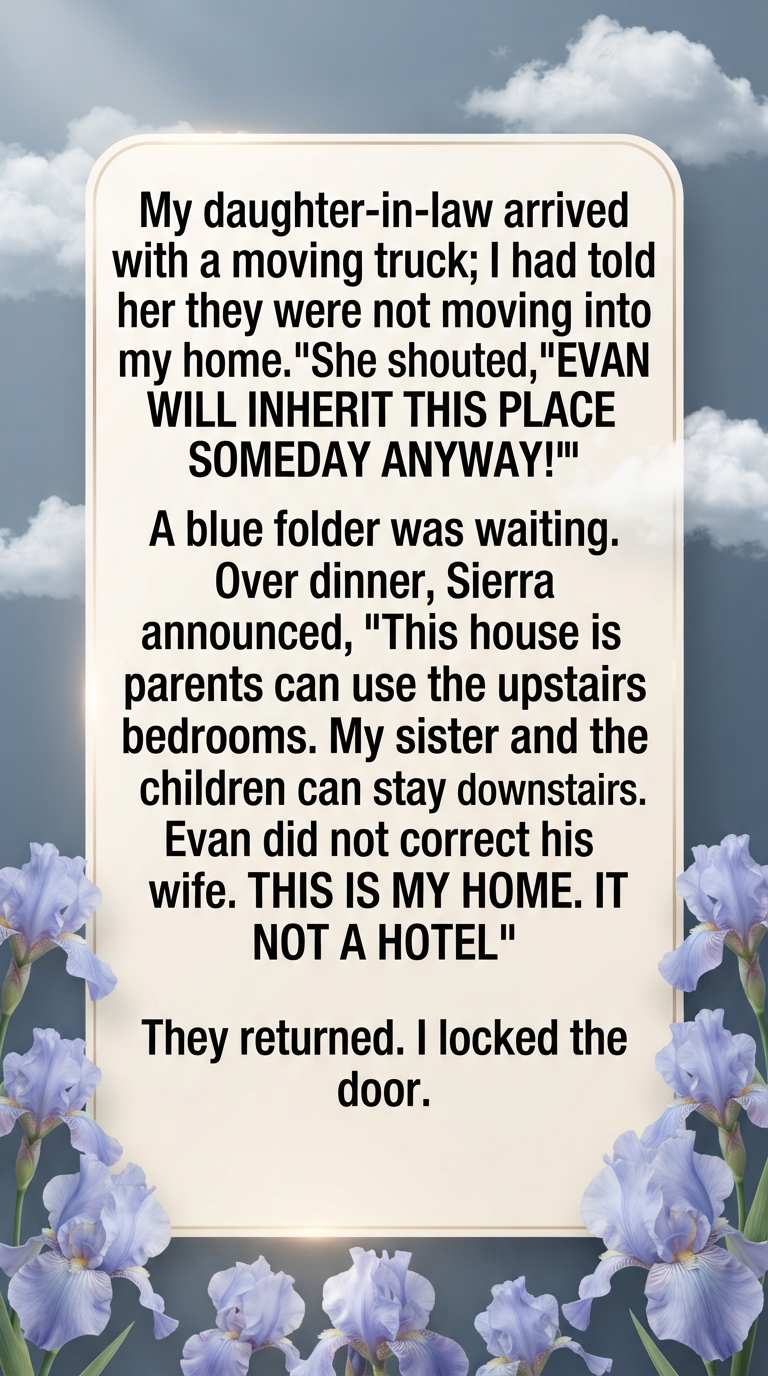
My daughter-in-law arrived with a moving truck.
I had already told her they were not moving into my home.
She ignored me.
When I opened the front door and saw the enormous truck parked across my driveway, Sierra stepped out wearing sunglasses and carrying a coffee.
She smiled.
“Good. You’re home.”
I stared at the truck.
“What is this?”
“Our things.”
I looked behind her.
Boxes.
Furniture.
Suitcases.
A mattress strapped to the back.
Even a television.
“You’re not moving in.”
Her smile disappeared.
“Evan will inherit this place someday anyway!”
I stared at her.
Behind her, my son Evan stepped out of the truck.
He looked uncomfortable.
But he didn’t correct her.
That hurt more than anything.
I had raised him.
Paid for his education.
Helped him buy his first car.
Covered his rent when he was struggling.
And now he was standing in my driveway while his wife tried to move into my home.
I pointed toward the street.
“Take the truck and leave.”
Sierra crossed her arms.
“This is ridiculous.”
“No.”
She laughed.
“You’re going to make your own son beg for a place to live?”
“He has a place to live.”
“Not a real one.”
Evan finally spoke.
“Mom…”
She turned toward him.
“Don’t.”
Then she looked at me.
“This house will belong to Evan someday.”
I nodded.
“Someday isn’t today.”
She rolled her eyes.
“You’re making this more complicated than it needs to be.”
I closed the door.
“Take the truck away.”
I heard Sierra shouting as I walked back inside.
Evan said nothing.
That silence stayed with me.
That evening, I made dinner as if nothing had happened.
Not because I wasn’t angry.
Because I wanted to see what they would do next.
Sierra sat across from me at the dining table.
Evan sat beside her.
She looked around my house.
“This place is perfect.”
I didn’t answer.
She continued.
“My parents can use the upstairs bedrooms.”
I put down my fork.
“What?”
“My mother and father are downsizing.”
I stared at her.
“My sister and the children can stay downstairs.”
She pointed around the room as though she were showing me a floor plan.
“This room can be the children’s playroom.”
Evan didn’t correct her.
I looked at him.
“You’re agreeing to this?”
He rubbed his forehead.
“I’m not saying anything.”
“That is the problem.”
Sierra leaned back.
“Why are you making a big deal out of this?”
I looked around the room.
“This is my home.”
She shrugged.
“It will be Evan’s eventually.”
I nodded.
“Then eventually he can decide what to do with it.”
She looked annoyed.
“But we’re family.”
I smiled.
“Yes.”
“And family helps each other.”
“Yes.”
“But family doesn’t move into someone’s home without permission.”
Her expression hardened.
“This is your problem. You have too much space.”
I stood.
“This conversation is over.”
Sierra rolled her eyes.
“You’ll change your mind.”
I didn’t answer.
Instead, I walked into my office.
And that’s when I noticed the blue folder.
It was sitting exactly in the center of my desk.
I hadn’t put it there.
My name was written across the front.
FOR MARGARET — OPEN BEFORE YOU MAKE ANY DECISION ABOUT THE HOUSE.
My hands went cold.
The handwriting belonged to my late husband.
He had died four years earlier.
I hadn’t seen that handwriting in years.
I opened the folder.
Inside was a copy of our original deed.
Then another document.
A trust agreement.
Then a letter.
I sat down.
The letter began:
Margaret,
If our son ever claims this house is automatically his, please remember that I never intended for our home to become a bargaining chip.
I stopped reading.
Then continued.
Evan is our son, and we love him. But love does not create ownership.
My eyes filled with tears.
I kept reading.
My husband had created a family trust shortly before his death.
The house had been placed into it.
I was the lifetime beneficiary.
Evan was listed as a future beneficiary.
But there was a condition.
He could inherit only after my death if he was not actively using the property to displace me or transfer possession to another party.
And there was another clause.
Any attempt to force me out, pressure me into granting occupancy, or claim immediate ownership would suspend his future interest until the trust was reviewed.
I stared at the page.
Then I looked toward the dining room.
Sierra’s voice floated down the hallway.
She was talking about paint colors.
My blood ran cold.
They had no idea.
I called the attorney listed in the trust.
His name was Charles.
He answered immediately.
“Margaret?”
“Yes.”
“Did you open the folder?”
“I did.”
“I was wondering when that day would come.”
I frowned.
“Did my husband know this would happen?”
“He worried about it.”
“Why?”
Charles sighed.
“Because he believed Evan could be easily influenced.”
I closed my eyes.
“He was right.”
Charles continued.
“The trust was structured specifically so that your son could inherit the property someday without being able to use that future inheritance to remove you from it.”
“What happens now?”
“Nothing happens until you choose.”
“What about Sierra?”
“She has no legal interest in the property.”
“What about Evan?”
“His future interest is conditional.”
I looked toward the dining room.
“What if they move in?”
“Don’t let them.”
“What if they bring a truck?”
“Do not allow possession.”
“And if they return?”
Charles was silent for a moment.
“Then document everything.”
The next morning, I changed the locks.
Again.
I added cameras.
I updated the alarm.
I changed the garage code.
Then I called Evan.
“Mom?”
“You need to tell Sierra the truck is not coming back.”
Silence.
“She already thinks—”
“I don’t care what she thinks.”
“Mom.”
“This is my home.”
He sighed.
“I know.”
“Do you?”
Another silence.
“I’m sorry.”
“Then act like it.”
Two hours later, another truck appeared.
I was standing behind the front door.
Sierra got out first.
She walked toward the house carrying a box.
Evan followed.
I didn’t open the door.
Sierra knocked.
“Margaret!”
I stayed silent.
She knocked harder.
“Open the door!”
I looked at the security camera.
Her parents were sitting in the truck.
Her sister was unloading children’s toys.
They had brought everyone.
They had ignored everything I said.
Then Sierra shouted:
“EVAN WILL INHERIT THIS PLACE SOMEDAY ANYWAY!”
I pressed the intercom.
“Someday isn’t today.”
She froze.
“You can’t keep us out!”
“I can.”
She laughed.
“Evan is your son.”
“Yes.”
“And this will be his house.”
“Under the terms of his father’s trust.”
Her face changed.
“What trust?”
I didn’t answer.
Evan looked at me through the camera.
“Mom?”
I said:
“You need to come inside alone.”
Sierra immediately objected.
“No.”
I looked at Evan.
“You alone.”
He slowly nodded.
He turned toward Sierra.
“I need to talk to my mom.”
She grabbed his arm.
“You’re not going in there without me.”
He gently pulled away.
“I am.”
For the first time, he walked toward my front door without following his wife.
Evan came inside.
I showed him the blue folder.
He read the trust.
His face changed.
“Dad made this?”
“Yes.”
“I never knew.”
“I know.”
He sat down.
Then he whispered:
“Sierra told me you couldn’t legally stop us because I’d inherit the house.”
“I figured.”
He looked at the floor.
“She said your house was basically our future.”
I looked at my son.
“This house isn’t your future until I choose to make it part of your future.”
He nodded.
“I’m sorry.”
“You’re going to have to do more than apologize.”
“I know.”
I closed the folder.
“You need to decide what kind of husband and son you’re going to be.”
He looked up.
“What do you mean?”
“Someone who allows his wife to walk into his mother’s house and claim it?”
“No.”
“Or someone who tells her no?”
He swallowed.
“The second.”
“Then do it.”
Evan walked outside.
I watched through the camera.
He spoke to Sierra.
She yelled.
He didn’t.
She pointed toward the house.
He shook his head.
Then she began crying.
After several minutes, her family started putting boxes back into the truck.
The moving truck pulled away.
Sierra got in the passenger seat.
Evan stood in the driveway.
He looked toward my house.
Then he walked to the front door.
I opened it.
“I’ll sleep somewhere else tonight,” he said.
I frowned.
“Why?”
“Because I need to figure out how I got to the point where my wife thought this was okay.”
I nodded.
“That sounds like your work to do.”
He smiled sadly.
“I deserve that.”
Then he left.
Two weeks passed.
Evan came alone one Sunday morning.
He brought groceries.
Not because I needed them.
Because he wanted to.
He fixed the loose railing on my back steps.
Then sat with me on the porch.
“I left Sierra.”
I didn’t respond immediately.
“Are you okay?”
“I don’t know.”
“Did she understand?”
“No.”
He looked out at the yard.
“She said I chose you.”
I looked at him.
“And what did you say?”
“That I chose to respect you.”
I nodded.
“That matters.”
The divorce process took months.
Sierra accused me of interfering.
She claimed the house was “obviously meant for the family.”
The trust documents ended that argument.
She tried to pressure Evan into challenging the trust.
He refused.
Eventually, the issue disappeared.
Evan and Sierra separated.
Evan moved into a modest apartment.
He rebuilt his finances.
He started taking responsibility for his own future.
And I kept my house.
Exactly as my husband intended.
A year later, Evan came to visit.
He brought a small wooden box.
“What is that?”
“Dad’s.”
He handed it to me.
Inside was another note.
My husband’s handwriting.
I smiled through tears.
Margaret,
If you’re reading this, then perhaps Evan has finally learned what I tried to teach him: inheritance is not permission.
I looked at my son.
He was crying.
I read the final line aloud.
A home is worth more when the people inside it understand that respect is the first key.
I closed the box.
Evan hugged me.
“I’m sorry, Mom.”
I held him.
“I know.”
He looked around the house.
“Can I ask you something?”
“What?”
“Will I ever inherit it?”
I smiled.
“Maybe.”
He laughed.
“You’re not going to tell me?”
“No.”
“Fair enough.”
I squeezed his shoulder.
“That’s the point.”
That evening, after he left, I walked through the house.
The rooms were quiet.
The dining table where Sierra had planned everyone else’s bedrooms was still there.
The blue folder sat safely in my office.
And the doors were locked.
Not because I was afraid.
Because boundaries are not walls against family.
They are doors that tell people how to enter your life.
My daughter-in-law had arrived with a moving truck believing an inheritance gave her the right to move into my home.
She was wrong.
My son had once believed keeping quiet was easier than standing up.
He learned otherwise.
And I learned something too.
Leaving a house to your child someday doesn’t mean handing them the keys today.
Love can be inherited.
Money can be inherited.
Property can be inherited.
But respect cannot.
That has to be chosen.
Every single day.