The One Sentence Hidden in the $800 Million Inheritance
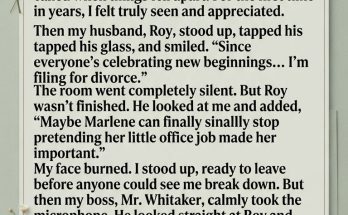
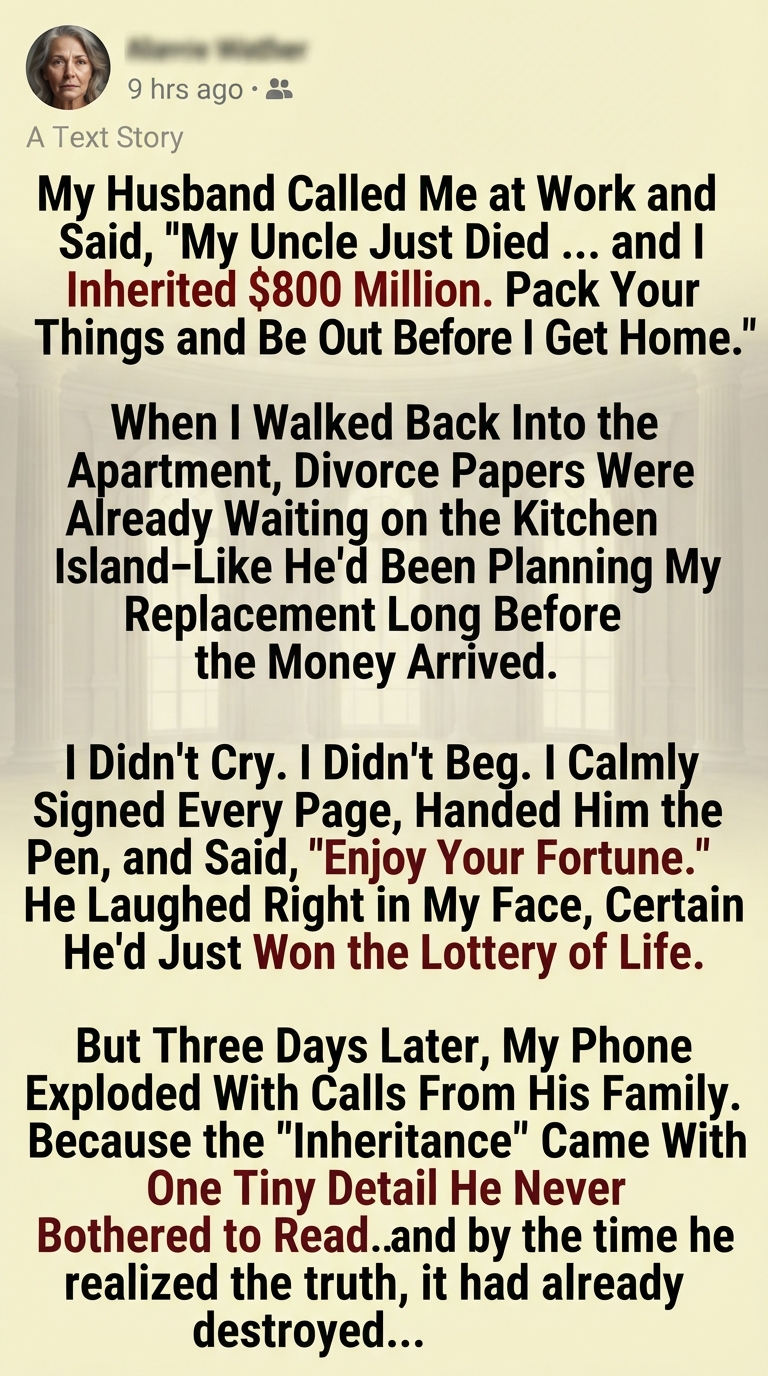
My husband called me at work and said:
“My uncle just died… and I inherited $800 million. Pack your things and be out before I get home.”
For a moment, I thought I’d misheard him.
“What?”
“You heard me.”
His voice was almost cheerful.
“My uncle left me everything.”
I sat frozen at my desk.
“We’re married.”
“Not for much longer.”
He laughed.
“I’ll send someone for your things if you leave anything behind.”
Then he hung up.
I stared at my phone.
Eight hundred million dollars.
My husband had just discovered a fortune.
And within thirty seconds, he had decided I was no longer useful.
I should have been devastated.
Instead, I felt strangely calm.
Because there was one thing he had forgotten.
I knew my husband.
And I knew he had been acting differently for months.
When I arrived home that evening, the apartment was almost empty.
My clothes had been pulled from the closet.
My books were stacked in cardboard boxes.
Photographs had been taken off the walls.
And on the kitchen island sat a neat stack of divorce papers.
Beside them was a pen.
A note was taped to the top.
Sign everything. I don’t want this dragged out.
I looked at the clock.
He had beaten me home.
Or perhaps he’d been preparing for this long before he called.
I picked up the first page.
Property division.
Debt allocation.
Waiver of claims.
Spousal rights.
He had already filled in most of the paperwork.
I almost smiled.
He had really believed twenty years of marriage could be reduced to a stack of forms and a pen.
I sat down.
And signed.
Every page.
No argument.
No tears.
No begging.
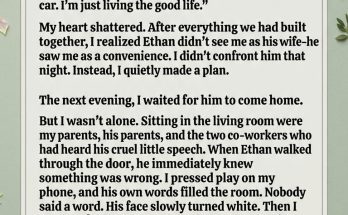
When I reached the final page, I signed my name, placed the pen on top, and waited.
He arrived forty minutes later.
He walked through the door grinning.
“Seriously?”
I looked at him.
“What?”
“You signed.”
“All of it.”
He picked up the papers.
“No fight?”
“No.”
He laughed.
“You’re actually making this easy.”
I nodded.
Then handed him the pen.
“Enjoy your fortune.”
He laughed directly in my face.
“You have no idea what you’re looking at.”
“Maybe.”
He tucked the papers under his arm.
“You’ll regret this.”
I looked at him.
“I don’t think I will.”
He grabbed his jacket.
Then he left.
I sat alone in the apartment.
And for the first time in twenty years, I breathed without feeling like I was waiting for someone else’s permission.
Three days later, my phone exploded.
Calls.
Messages.
Unknown numbers.
Then my husband’s sister.
Call me immediately.
Then his mother.
Please answer.
Then his attorney.
We need to speak with you as soon as possible.
I ignored them.
Finally, his sister called again.
I answered.
Her voice was shaking.
“What did you sign?”
“The divorce papers.”
“No. The other documents.”
“I signed what your brother put in front of me.”
She began crying.
“Did you sign the inheritance acknowledgment?”
I frowned.
“I don’t know.”
“Find the papers.”
I opened the copy I’d kept.
There were several pages I hadn’t really understood.
One was titled:
Acknowledgment of Separate Estate and Waiver of Community or Marital Claim.
I read it again.
Then I noticed the section near the bottom.
The beneficiary acknowledges that acceptance of the inheritance is subject to all conditions contained within the testamentary instrument and any associated trust documents.
I looked at the signature.
My husband’s.
Then mine.
I called his attorney.
“What does this mean?”
He was silent for several seconds.
“Your husband’s uncle did not leave him $800 million outright.”
I sat down.
“What?”
“The estate is structured through a trust.”
“Then why did he tell me he inherited everything?”
“Because that’s what he believed.”
I stared at the papers.
“What did he actually inherit?”
The attorney exhaled.
“A beneficial interest.”
“In what?”
“Several business entities, investment accounts, properties, and intellectual assets.”
“That still sounds like $800 million.”
“On paper, yes.”
I waited.
“What is the condition?”
Another silence.
Then he said:
“He must remain married for five years after receiving the inheritance.”
I almost laughed.
I sat there in silence.
Then I said:
“So my divorce…”
“May have triggered the forfeiture clause.”
I didn’t feel happy.
Not exactly.
I felt stunned.
My husband had spent three days believing he’d won the greatest lottery in history.
He had thrown away his marriage before he had even read the document that controlled his inheritance.
Now the same divorce papers he had shoved in front of me might have cost him the fortune.
I asked the attorney:
“What happens now?”
“The trust reverts to the alternate beneficiaries.”
“Who?”
He hesitated.
“You.”
I closed my eyes.
“No.”
“Yes.”
“How?”
“Your uncle knew your husband might act impulsively. The trust specifies that if he divorces within five years of distribution, his beneficial interest terminates. The surviving spouse receives the designated marital portion.”
I stared at the ceiling.
“He didn’t even tell me.”
“He apparently didn’t know.”
That afternoon, I received a message from my husband.
We need to talk.
I didn’t answer.
Another came.
This isn’t what you think.
Then:
Call me.
I finally replied.
You asked me to leave. I signed. What is there to discuss?
He called immediately.
“Please.”
His voice was completely different.
“What happened?”
“The inheritance.”
“Yes?”
“The trustee says the inheritance is conditional.”
“I know.”
“And?”
He swallowed.
“I made a mistake.”
I closed my eyes.
“You did.”
“I didn’t know.”
“That isn’t my fault.”
“I can fix it.”
“How?”
“I’ll withdraw the divorce.”
“You can’t.”
He went silent.
“You already filed it.”
“I’ll dismiss it.”
“You can’t undo what you signed by pretending it never happened.”
“Please, Rebecca.”
I looked at the stack of papers.
“You told me to pack my things.”
“I was angry.”
“You told me I was leaving before you got home.”
“I didn’t mean it.”
“You laughed in my face.”
“I was wrong.”
I was quiet.
Then I said:
“You weren’t wrong by accident.”
He stopped.
“You showed me exactly what you would do if you thought you no longer needed me.”
Silence.
“And now you need me.”
His family became frantic.
His mother arrived at my workplace.
His sister sent flowers.
His uncle’s former attorney contacted me.
Everyone had the same message.
“Please don’t pursue the inheritance.”
I stared at the attorney.
“I haven’t pursued anything.”
She looked uncomfortable.
“The trust administrator is following the documents.”
“Then the documents will decide.”
She lowered her eyes.
“Your husband is under enormous pressure.”
I almost smiled.
“So was I when he told me to leave.”
A week later, the trustee called a formal meeting.
Everyone attended.
My husband.
His mother.
His sister.
Two attorneys.
The trustee.
And me.
The trustee opened the file.
“Mr. Carter’s inheritance became effective upon his uncle’s death.”
My husband leaned forward.
“Yes.”
“However, acceptance was subject to conditions.”
He nodded.
“I understand.”
The trustee looked at him.
“Do you?”
My husband swallowed.
The trustee continued.
“Clause 14 requires the beneficiary to remain married to the spouse named in the marital acknowledgment for five years following distribution.”
My husband closed his eyes.
The trustee turned to another page.
“Clause 15 states that if the beneficiary initiates, executes, or materially causes dissolution of the marriage during that period, the beneficial interest immediately terminates.”
His mother started crying.
“But they can reconcile.”
The trustee shook his head.
“The condition has already been triggered.”
My husband looked at me.
“Can she withdraw the divorce?”
The trustee answered:
“The legal event has already occurred.”
My husband stared at the table.
Then the trustee read the final clause.
“Upon termination, the designated successor beneficiary receives the estate’s controlling interest.”
My husband’s sister whispered:
“Who?”
The trustee looked at me.
“Mrs. Carter.”
Nobody spoke.
My husband looked like the floor had disappeared underneath him.
I didn’t celebrate.
I didn’t smile.
I simply sat there.
Because a strange thing had happened.
The fortune had changed hands without me lifting a finger.
The person who had tried to throw me away because he thought he had become richer than me had accidentally handed me the legal authority over the very fortune he thought made him untouchable.
But there was still one thing I needed to know.
“Why did his uncle write it that way?”
The trustee looked at me.
“He met you.”
I frowned.
“When?”
“Three years ago.”
I remembered.
My husband’s uncle had come to our anniversary dinner.
He had been quiet.
Observant.
Before leaving, he had taken me aside.
He’d said:
“You’re a patient woman.”
I’d laughed.
“I have to be.”
He had looked toward my husband.
“Don’t let patience become permission.”
I had forgotten the conversation.
Apparently, he hadn’t.
The trustee handed me a letter.
It was from the uncle.
Rebecca,
If you are reading this, then my nephew has probably made a decision I feared he would make.
My hands trembled.
I watched him for years. I saw how he treated people when he thought they were useful, and how quickly his respect disappeared when he believed he had more power.
I swallowed.
I do not care whether he becomes rich. I care whether he becomes worthy of what I built.
Then:
You have been married to him for twenty years. I know you stayed through difficult seasons. I also know you earned far more trust than he ever realized.
My eyes filled with tears.
That is why I created the condition.
Then the final paragraph:
If he values money more than marriage, let him prove it himself. If he chooses you, the fortune remains his. If he discards you for the fortune, the fortune becomes yours.
I stared at the last sentence.
A person who throws away a loyal spouse to gain wealth should never be trusted to control wealth.
I folded the letter.
And suddenly everything made sense.
My husband asked to speak with me privately.
We met outside the trustee’s office.
“I was wrong.”
“I know.”
“I thought the money would solve everything.”
“It didn’t.”
“I thought I’d finally be free.”
“Free from what?”
He looked away.
“From being ordinary.”
I almost felt sorry for him.
Then I remembered the divorce papers waiting on the kitchen island.
“You weren’t trying to become free.”
I paused.
“You were trying to become someone you thought you could only be if I wasn’t beside you.”
He began crying.
“I still love you.”
I shook my head.
“You loved me differently when you thought I had something to offer.”
“That isn’t fair.”
“It is.”
I handed him the copy of the divorce papers.
“You made your choice before you knew what was in the trust.”
I turned away.
“Now you have to live with it.”
The inheritance transferred gradually.
Businesses.
Investment portfolios.
Commercial properties.
Technology holdings.
A charitable foundation.
Not all at once.
Not as cash.
The actual value was enormous, but the assets came with responsibilities.
For months, I worked with trustees and advisers.
I didn’t suddenly become someone who bought yachts and private jets.
Instead, I studied.
I learned.
I listened.
And I discovered something my husband had never understood.
Money isn’t power because of what you can buy.
It’s power because of what you can protect.
I protected employees.
Protected contracts.
Protected charitable commitments.
And I created a foundation for spouses and caregivers who had been financially exploited inside their own marriages.
I knew exactly what that kind of vulnerability felt like.
The divorce became final.
My husband kept his personal assets.
He did not receive the fortune.
His relationship with his family changed.
His mother blamed me.
His sister stopped speaking to him.
And eventually, the family stopped contacting me.
That was fine.
I didn’t need their approval.
Years later, I kept one thing from that old apartment.
The pen he had used to sign the divorce papers.
I had taken it from the kitchen island before I left.
Not because I wanted a souvenir.
Because it reminded me of something important.
The man who had laughed and said:
“Enjoy your fortune.”
hadn’t actually read the fortune.
He had only read the number.
He saw $800 million and thought it meant freedom.
He never bothered to read the tiny sentence underneath.
The one that said he had to remain married to the woman he was throwing away.
And that became his greatest mistake.
Not the divorce.
Not the lost money.
The assumption that I was worth less simply because he thought he was about to become richer.
I didn’t win because I inherited $800 million.
I won the moment I refused to beg someone to keep me.
The money came later.
And by then, I already knew something far more valuable.
My worth was never hidden inside that trust.
It was there long before he opened the document.
He just needed to lose me to finally see it.